Sunday, May 27, 2012

An Aging Generation Memorialized their Own in Woodstock

GAR members, foreground, dignitaries, and the Ladies
Auxiliary gathered to dedicate a new monument.

In 1909 the aging veterans of the Grand Army of the Republic (GAR) and its Ladies’ Auxiliary gathered on the Square in Woodstock, Illinois on what was then known as Decoration Day.  What made this gathering different from others held annually General John A. Logan, the first Commander-in-Chief of the GAR issued General Order No. 11 in 1868 calling for annual observance in honor of the Civil War dead.

It had been the local custom for local residents gathered armloads of flowers from their gardens and marched—often by the hundreds—to the Chicago and Northwestern station to load a special train to the city with blooms.  The flowers were then used to decorate the graves of fallen soldiers and veterans and then to gather on the Square for a simple ceremony.

This year, after a long fundraising campaign the veterans and the community gathered to dedicate a handsome new monument in the center of the Square—a high, polished column surmounted by the statue of a private soldier.  The four sides of the base were decorated with symbols of service—an anchor, crossed rifles, sabers, and cannon representing the Navy, Infantry, cavalry, and artillery branches of the Army.
It was a solemn occasion as well as a joyful one.

From then on, even after the last of the gray beards passed and after new veterans from the Spanish American War and Philippine Insurrection, World War I, World War II, Korea, Vietnam, and all of the endless almost nameless untidy little wars afterwards, Woodstock gathered on and around the Square for what became known as Memorial Day.

More than 15 years ago members of what was then the Congregational Unitarian Church began a tradition of the Sunday before Memorial Day of marching the two blocks to the Square in silence behind a flag donated to the church in memory of Thomas Lounsbury, an 18 year old church member who died on the USS Arizona on December 7, 1949 and was the first Woodstock casualty of World War II.

Gathering around the Monument the Rev. Dan Larsen or one of the interim ministers since his retirement would lead a prayer and a moment of silence.  Then participants lay flowers on the Monument and return in silence to the church for the rest of the worship service. It was simple, even stark and always very moving.

This year members of what now known as the Unitarian Universalist Congregation  will gather to observe Memorial Day in our new McHenry home.  I sure a moving service will be held and once again many of us will weep.

But I will miss the walk to the Square, the bright sunshine, the wind whipping the flag, the simple sacrifice of laying flowers on a wrought iron fence surrounding an old Monument.

Saturday, May 26, 2012

Al Jolson—The Greatest Entertainer of the First Half of the 20th Century

Jolson in and out of blackface

Record keeping was hit and miss and life perilous in Jewish village of Srednik near Kaunas in Lithuania, then part of Tsarist Russia around 1886 so Asa Yoelson was never sure about his birthday.  Years later he would pick May 26 out of a hat to serve and it has been dutifully reported by biographers ever since.
He was the son of a Rabbi and Canter and had three surviving siblings including a brother Hirsh.  His father Moses immigrated to the United States in 1891 and was able to send for his family when he found employment at Washington, D.C.’s Talmud Torah Synagogue in 1894.
Asa and Hirsh became fascinated with American music and show business hanging out on streets outside taverns and music halls.  By 1897 they were performing for spare change on the sidewalks.
In 1902 Asa launched a paying career as a singing usher in a traveling circus.  Soon after he teamed of with Hirsh and working as Al and Harry Jolson were doing specialties on the burlesque stage.
Over the next five decades Al Jolson would perform and triumph in every possible American show business venue—vaudeville, the Broadway stage, concerts, records, movies, and radio.  He would have conquered television as well but he died before his planned debut.  In the process he revolutionized stage and popular music by popularizing blues and jazz forms he learned as a young touring vaudevillian in New Orleans.  His charismatic performance style was the first to “make each song an event.”  And one way or another influenced every singer who came after.
Today he is dimly remembered in popular imagination as the star of the first sound feature film, The Jazz Singer and for his performances in black face.  His style is dismissed as hammy and old fashion.  His black face work makes him suspect as a racist to modern sensibilities.
But one of his closest friends from the streets of Washington as a kid who grew up to be tap dancer Bill “Bojangles” Robinson.  He brought Black performers and featured them for the first time on the Broadway stage.  He brought Cab Calloway to Hollywood and not only insisted on equal billing, but got adjoining suites in Beverly Hills penthouse hotel rooms during the filming of The Singing Kid.  Eubie Blake, with whom he never worked professionally, was one of his closest personal friends and companion at boxing matches and racetracks.  The home he shared with his then wife dancer Ruby Keeler was the only one among all the stars were Blacks were freely welcome and entertained.  His work was widely admired in the Black community, including his black face because he never performed the usual coon stereotypes, but treated black music with heartfelt earnestness and respect.  He saw the affinity of Jew and Blacks as oppressed outcasts and recognized Exodus as a common metaphorical experience.  At his funeral, the entire of Black Hollywood turned out, he was lauded in the black press, and eulogized by the President of the Negro Actors’ Guild.
Jolson first donned blackface in 1904 while working in vaudeville in a trio with brother Harry and veteran performer Joe Palmer.  It not only boosted his career, but it freed Jolson to be more animated and emotional on the stage.
He was on his own as a touring vaudevillian by 1906 and based himself out of San Francisco.  He claimed that he relocated there because the city needed cheering up after the famous earthquake and fire.
In 1909 with his first wife Henrietta he returned to New York City where he joined the cast of the most popular minstrel show of the day, Dockstader's Minstrels.  He was quickly the main attraction.
La Belle Paree at the Wintergarden Theater in 1911 was Jolson’s first Broadway show.  Not the headliner, he did Stephen Foster classics in blackface and stole the show.  From then until 1926 Jolson appeared in an unbroken string of hits with shows like Vera Violetta,  The Whirl of Society, Robinson Caruso, Jr., Bombo, Sinbad, and Big Boy.  As his popularity soared so did his weekly paycheck grew to thousands of dollars a week making him the best paid performer in America.  At the age of 35 he became the youngest actor ever to have a Broadway theater named after him.  Overcoming paralyzing stage fright on opening night for Bombo in 1921, an ecstatic audience called him back for 37 curtain calls.
Also in 1911 Jolson began his recording career featuring songs from his shows and scores of others.  Had there been a Hit Parade, he would have topped it multiple times almost every year.  His signature songs included Rock-a-Bye My Baby with a Dixie Melodie, My Buddy, Swannee, Avalon, April Showers, Toot-Toot-Tootsie Good-by, Juanita, California Here I Come, I Wonder What’s Become of Sally, I’m Sittin’ on Top of the World, When the Red Red Robin Comes Bob-bob-bobbing Along, My Mammy, Back in Your Own Back Yard, There’s a Rainbow Round My Shoulder, Sonny Boy, and Liza (Let the Clouds Roll Away.  That list is far from definitive.  Over 80 of his hundreds of recordings became hits.  No matter how you slice it, a huge chunk of the classic American song bag.
In 1928 Jolson “retired” from the Broadway stage to try his hand in a new medium—movies.
The story of the Cantor’s son who defies his father and tradition to become The Jazz Singer closely paralleled Jolson’s own life.  The Warner Bros. Vitaphone release is was the first feature film to include some sound dialoged and songs, although much of the picture was still silent.  The film also highlighted the parallels between the Jewish and Black experiences as expressed by Jolson’s blackface performance.  Legendarily it was a huge hit and doomed silent movies.
His second film The Singing Fool was his first all talking picture and even a bigger hit because more theaters had been outfitted for Vitaphone sound.  Made and shown in 1928 it held the box office record until Walt Disney’s Snow White and the Seven Dwarves ten years later.  The film also introduced the tear jerker Sonny Boy.
Jolson made four more features for Warner’s, did a short, and made cameo appearances through 1930.  Repetitive and poor quality scripts plus rapidly changing public taste made the last couple of films less successful.  Jolson decided to return to Broadway in a new show, Wonder Bar in 1931.  Although due to the Depression ticket sales to the new show did not match his earlier long string of hits, reviews were positive and helped re-boot his career.
After storied concerts in New Orleans with jazz greats, Jolson returned to Hollywood where Warner’s leant him to United Artists for his most unusual, and many believe finest, films, Hallelujah, I’m a Bum.  This depression era comedy/drama only takes its title from the Haywire Mac McClintock IWW song.  Songs in this one were by Richard Rogers and Lorenz Hart with the script by Ben Hecht.  Jolson played a happy-go-luck bum living with a bunch of others in Central Park who saves the Mayor’s girl friend from suicide.  She loses her memory.  He falls for her, but also befriend the suffering Mayor, Frank Morgan channeling Jimmy Walker.  Much of the dialogue is in couplets.
His wife Ruby Keeler turned down the female lead fearing that if she made her film debut in her husband’s film she would be dismissed.  Instead she made Forty Second Street and became an overnight top star.  Jolson’s picture, although now considered a minor classic, was a box office flop and led to a decline in his film career.
Back at Warner Bros. the next year he made a film version of his stage show Wonder Bar.  It incorporated more of the elaborate production numbers fans were now demanding in their musicals and was a moderate success.
His final film for his original studio was The Singing Kid, the film in which he showcased and co-starred Cab Calloway.  Busby Berkley, unaccredited, choreographed and shot the production numbers.
Although he appeared in several films in cameo, Jolson only stared in one more picture, Rose of Washington Square for Paramount in 1939.  He shared top billing with rising stars Tyrone Power and Alice Faye.  The film reprised some of his most famous numbers.
His film career might be winding down and changing public taste for crooners like Bing Crosby and Big Band singers might have cut deeply into his record sales, but Jolson still was a major star on radio.  He had started making broadcast appearances from the time he began making films.  He made a famous appearance on the Dodge Victory Hour early in 1928 live from New Orleans reaching an audience of 35 million over 47 radio stations, a landmark in early broadcasting.  He fronted his own network shows twice in the ’30’s.  But he was most demand as a guest on shows hosted by all band leaders, singers, and comics.  Singers like Crosby, who had eclipsed his popularity, adored him and were glad to share a microphone.  These programs also showed off his considerable comedic talents and ability to ad lib with the best of them.  For those who know Jolson only from his sometimes stiff acting in his hyper sentimental early Warner Bros. films audio from some of these radio shows is a revelation.
Still, in the early ‘40’s Jolson was restless and depressed.  Occasional radio broadcasts and concerts were not enough to keep him busy.  His fading career and Ruby Keeler’s success had mirrored the fictional story in A Star is Born.  By the late ‘30’s their marriage, once considered the happiest in Hollywood was over.
World War II gave Jolson something to do.  As soon the fires of Pearl Harbor blew away he was pressing the War Department for permission to entertain the troops anywhere in the world.  Before the USO was up and running, he became the first star to perform at a GI base in early 1942.  In fact it was a letter he wrote to President Franklin Roosevelt’s press secretary that is credited with the creation of the USO, in which he was later commissioned.  His first out of country tour that year took him to Central America and Naval bases in the Caribbean.  Not long after he was in Britain playing to packed and cheering GI audiences.  He would go anywhere—remote Alaskan stations, North Africa, the South Pacific.  He was out of the gate long before his friend Bob Hope and did many more shows.  His tireless work damaged his health.  He contracted malaria and lost most of a lung.
Jolson also found personal happiness.  He met Erle Galbraith, a young x-ray technician in an Arkansas Army camp.  Late in the war he tracked her down and got her work as an actress at Columbia.  They were married in March of 1945.
When the war was over, Jolson found his career was resurrected.  He had gained legions of new young fans among returning GIs and publicity surrounding his shows had endeared him to the public.  Columbia Pictures was eager to produce a bio-pic and in 1946 Larry Parks was tapped to play the singer in The Jolson Story.  Parks carefully studied his performances to match his signature moves and style, but Jolson himself did the singing.  He even managed to play himself in one scene—Suwannee filmed entirely in a long shot showing him dancing and doing his famous runs into the audience on a special runway extending into the theater auditorium.  The Technicolor film was one of the biggest hits of the year.  Parks even earned and Academy Award nomination for the role.
Jolson was back in the big time.  He got a new contract with Decca Records where he not only recreated many of his most famous songs, but also recording new ones.  He had hits with both.  Among the hits were Carolina in the Morning, Waiting for the Robert E. Lee, When Your Were Sweet Sixteen, After Your Gone, Is It True What They Say About Dixie, and Are You Lonesome Tonight.
He was back on radio in a big way too.   From 1947 to ’49 he co-hosted the Kraft Music Hall with Oscar Levant. In 1948 he bested Crosby, Frank Sinatra, Perry Como and others in a Most Popular Male Vocalist poll by Variety.
Jolson Sings Again, with Parks reprising his role was released in 1949 and was another huge hit.  Jolson toured in support of the film and sang before thousands in special shows in New York and in Chicago.
He distrusted the emerging new medium of television and resisted going on as a guest star.  He wanted to have his own platform.  A proposal to introduce himself with a live two hour concert broadcast uninterrupted by commercials was naturally greeted coolly by network executives.  But talks were under way for a program of his own.
Those plans were laid aside when President Harry Truman announced he was sending troops to defend South Korea from an attack by the North in the summer of 1950.  Jolson called the White House and simply announced, “I’m going to Korea.”  With the USO officially disbanded Defense Secretary Harold Johnson tried to call him off.  There are no funds for entertainment, he was told. “Funds? Who needs funds? I got funds! I'll pay myself!” Jolson told reporters.
By September he was on the ground with the troops.  He did 42 shows in 15 days.  He was presented by a medal by General Douglas MacArthur as he returned. 
But he paid a heavy price.  Dust had settled into his remaining good lung and he was exhausted.
While playing poker in a San Francisco hotel room just a few weeks later on October 22, 1950 Al Jolson suffered a massive heart attack.  He lived long enough to tell his pals, “Boys, I’m going.”  He was 64.

Friday, May 25, 2012

Philadelphia Court Trampled One of the First Unions in America

A corner in an early 19th Century shoemaker's shop.

On May 25, 1805 the leaders of a local union of shoemakers were arrested in Philadelphia for leading a strike, one of the first such organized work stoppages in American history.  Local employers brought charges against them for criminal conspiracy to violate English Common Law that banned schemes to force wage increases.  The strike was broken.

In the post-Revolutionary period some master artisans and craftsmen, then often referred to as a class as mechanics, were transitioning from small shops employing a handful or less of apprentices and journeymen to larger scale production.  Their shops were becoming factories and they were becoming, at least on a modest scale, capitalists.

This was accelerated in the years after the Constitution was adopted and stable national government and peace helped bring about some boom years before the turn of the 19th Century.  Shoe making crafts, an established trade with ample local raw materials, was one of the first to industrialize.

Philadelphia, still the infant nation’s largest and most important city despite no longer being the Capital, was the center of some of the earliest efforts by workers to come to grips with their new situation.  According to History of Trade Unionism in the United States by Perlman and Selig “The earliest genuine labor strike in America occurred, as far as known, in 1786, when the Philadelphia printers ‘turned out’ for a minimum wage of six dollars a week. The second strike on record was in 1791 by Philadelphia house carpenters for the ten-hour day.

The response was the creation of some of the first recognizable craft unions, as opposed to guilds of master mechanics or beneficial societies. 

In 1796 local shoemakers organized the Federal Society of Journeymen Cordwainers.  Cordwainer is just another name for shoemaker, derived from the Cordovan leather commonly used in quality gentlemen’s footwear. The organization staged a 10 week, successful strike in 1799 for higher wages.  It was the first strike organized and sectioned by a union.  At least one more successful strike followed.

Emboldened, the union struck again in 1805.  This time, however, employers enlisted support from the wider business community which was becoming alarmed with the rise of unionism.  The strike was marked by street battles between workers and would-be replacements.  But because they were skilled craftsmen, replacements were not easy to come by.  The union figured to once again outlast their bosses to force a settlement.

But with the support of the business community, leaders were shocked to be arrested and charged.  The strike collapsed.  But the worst still lay ahead.

Both the union itself and eight officers were charged.  Employers paid for the prosecution in the Mayor’s Court.  The actual trial did not get underway until 1806 months after the strike was over.

The case, known as Commonwealth v. Pullis, was heard over three days.  The union and all of the individual defendants were convicted of “a combination [conspiracy] to raise their wages.”  The Federation of Cordwainers was bankrupted and forced to disband.

The individual officers were each fined $8.  On modern historian has called this a “token fine.”  He is wrong.  That was more than a week’s wages and they also had to bear the cost of the prosecution and trial.  Although no record of those costs remains, it was probably considerable.  In addition all of the men were essentially blackballed from their trade.  They were personally ruined, each and every one of them.

The case became established precedent and was cited several times over the next decades in similar circumstances. 

Under the circumstances, the growth of craft unionism was largely stifled and did not begin to resume on a large scale until the 1830’s.  Strikes were not unheard of, but were often quick, spontaneous actions without organization or support.  Today we would call them wildcats.

It wasn’t until 1842 in decided another case involving shoemakers, that the precedent of Commonwealth v. Pullis would finally be overturned.

An 1839 strike against employers who hired non-union labor by the Boston Journeymen Bootmakers’ Society resulted in the similar arrest and conviction of union leaders on conspiracy charges.  But in the case of Commonwealth v. Hunt heard on appeal by the Massachusetts Supreme Judicial Court in 1842, the convictions were overturned.  The court ruled that “the act of unionization and recognition of that union through strike was legal unless the methods to coerce workers to strike were illegal.”

The case essentially legalized trade unions.  But employer and public opposition remained strong and time and again the rights of working people to organize would be trampled upon or won only at great sacrifice. 

Thursday, May 24, 2012

History Haunted the Greatest Real Estate Deal Ever

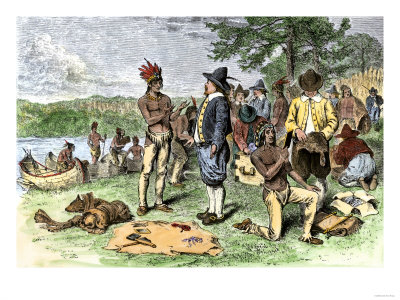
A fanciful 19th Century engraving of the purchase of Manhattan Island.

On this day in 1626 what has been called the greatest real estate deal in history went down.  But the real winner in the deal is not the one you have been told about.

Due to a simplistic account in a 19th Century popular reader, almost any American will tell you that Manhattan Island was bought by the Dutch from local Indians for “$24 in beads and trinkets.”  Those with especially acute memories might recall the alleged sharpie who
hoodwinked the natives with his paltry offering was Peter Minuit, Governor of the North American colony owned by the Dutch West Indies Company. 

There are several things wrong with this version.  First and foremost is that the trade goods Minuit offered were not the trade trifles mentioned, but a selection of metal tools and implements including axe heads, knives, awls, needles, cast iron kettles, as well as cloth.  They were valued by Minuit at 60 silver guilders a significant sum.  Depending on who is doing the reckoning and how inflation over nearly four centuries is figured, that would be worth more than $1000 in today’s cash. 

But as one historian points out, the value of the items to the natives was probably much more than the actual monetary value.  Most of these items had been virtually unobtainable, although a few had found their way ashore from other European ships or have been traded down from New England or far away New France.  A historian described it as a significant “high-end technology transfer, handing over equipment of enormous usefulness.”
But it was the natives who Minuit dealt with that may have been the real sharpies.  He assumed he was doing business with the Lenape; a powerful and extensive tribe that held sway over what is now the Delaware Valley including much of modern New Jersey and over the area around the mouth of the Hudson River including Manhattan and much of Long Island.  They were a sedentary people engaged in extensive agriculture and both coastal and inland fishery, including the harvesting of oysters.  Relatively large villages relocated within the range every year or so, returning to previous sites when the land rejuvenated itself.

Evidently the local Lenape, however, were not using Manhattan at the time the Dutch arrived.  Instead, they made sort of a sub-lease agreement with the much smaller Canarsie tribe who shared some of Long Island with them and a dozen other small bands.  The Canarsie, who were harvesting oysters and gardening on the island could hardly believing their good fortune  They gladly sold the Dutch what didn’t belong to them and retreated to Long Island with what they must have considered a fortune.

A previous governor had established Fort Amsterdam on the southern tip of the island the year before.  Minuit now felt secure enough in his sale to begin settlement of a new colonial capital
Nieuw-Amsterdam.  Eventually the Lanape, who became the chief partners of the new colony in the fur trade, complained about the Dutch squatting on their land and another purchase had to be arranged.  The exact price paid in this second deal is lost to history, but the Lenape likely did pretty well in trade goods themselves.

The fates of all parties to the deal were unhappy.

In 1631 Minuit was fired by the Dutch West India company for failing to meet expectations for the fur trade and was accused of skimming accounts for his own benefit.  Enraged, he returned to Europe and offered himself to the Swedes, an ascending power eager to get into North American colonization.  In 1638 he returned as governor general of New Sweden and established Fort Christiana new modern day Wilmington, Delaware.  He was killed later the same year on a return voyage to recruit more settlers.  He sailed via the Caribean to pick up a load of tobacco to make the journey profitable for the company and perished in a hurricane near the island of St. Christopher.  His colony lasted a dozen more years until a later Dutch governor, Peter
Stuyvesant conquered iit n 1655.

The Canarsie, one of thirteen small tribes on Long Island, allied themselves with the much more powerful Mohawks from the mainland for protection.  They lived in relative harmony with the Dutch until a later governor, William Kieft, launched a war on local tribes.  A massacre of the village of Pavonia united all of the tribes in a general uprising in 1643.  The ensuing war was devastating to both settlers and the tribes.  Peter Stuyvesant eventually negotiated a peace.  Many Canarsie converted to Christianity during the period of peace and continued to farm and fish in the area.

The Dutch persuaded the 13 tribes of Long Island not to pay tribute to their traditional protectors, the Mohawks.  In 1655 a large Mohawk war party invaded Long Island and massacred most of the local tribal residents.

A remnant of the Canarsie later sold most of their remaining land to the British, after they seized New Amsterdam.  Small numbers continued to live and farm in rural Brooklyn into the 19th Century.  A unit of Canarsie volunteers served the Civil War.  Eventually descendents of the tribe became absorbed by the white community and the tribe disappeared into the mist of history.

The much larger Lenape at least persist as a people.  Their culture was much disrupted by the arrival of the Dutch, Swedes, and the English.  In order to obtain much desired trade goods, they abandoned much of their traditional agricultural and fishery based economy to pursue the fur trade.  This took them deep into hostile territory dominated by the Mohawk and other Iroquoian people.  By the late 18th Century pressure from the Iroquois and expanding European settlement forced most major bands to re-settle west of the Allegany Mountains in what is now western Pennsylvania and along the Ohio River.  Remnant bands in the east were mostly absorbed by other tribes or by neighboring white settlements.  

After the signing of the Treaty of Easton in 1758, most the Lenape were forced to move west out of their lands in Delaware, New Jersey, eastern New York, and eastern Pennsylvania into what is today known as Ohio.  A large number of Lenape were converted by the Moravians, a German pietistic sect that practiced pacifism.  These “praying Indians” settled west of Ft. Pitt along the Ohio River with their missionaries. 

In the French and Indian Wars more warlike bands allied themselves with the French and were present at the siege of Ft. Pitt.

During the American Revolution bands of the tribe, by then generally known as the Delaware, split allegiances between the British and the colonists.  Several large bands relocated to the Sandusky to be closer to the British stronghold of Ft. Detroit.  Others scouted for the Americans, or in the case of the Praying Indians tried to remain neutral.  Coshocton was the main town of the Delaware friendly to the colonists.  They hoped to form an all Indian state within the infant republic.  But after their chief, White Eyes was killed, probably by American militiamen, many of the warriors from Coshocton joined their kinsmen with the British.


American Colonel Daniel Brodhead led an expedition out of Fort Pitt and in 1781 destroyed Coshocton. Surviving residents fled to the north to the British.  The next year the peaceful Moravian missionary village of Gnadenhutten was attacked by Pennsylvania militia.  At least 96 men, women and children were massacred.


Various Delaware bands were caught up in the continuing fierce warfare along the Ohio frontier after the Revolution.  Some took up arms again with the British in the War of 1812.  After the capture of Ft. Detroit in that war, northern Delaware bands, including some of the Moravians relocated to what is now western Ontario.

Most of the remaining American Delaware ceded their lands in Ohio in the Treaty of St. Mary’s in 1814.  Bands took up lands in Indiana and Missouri.  In 1829 yet another treaty, the Treaty of James Fork pushed the tribe yet further west.  In exchange for the Indiana and Missouri lands they received grants in Kansas.


The Delaware became active as guides and trappers in the trans-Mississippi west and frequently served as scouts for the Army.  They were prominent in the Seminole Wars and were among those with John Charles Frèmont when he entered California during the Mexican War.  Later they would be guides for emigrant trains to the west.


Despite loyal service the Delaware were again pushed from their lands.  Most relocated to Indian Territory by 1860.  They were forced to buy lands from the Cherokee.  In 1979 The Bureau of Indian Affairs ceased to recognize the Oklahoma Delaware as a separate tribe and began to count them as Cherokee.  That decision was overturned in 1996.  A challenge by the Cherokee to the re-instatement caused a see-sawing legal battle with the tribe stripped of recognition again and then having it restored.  As of 2009 they have had tribal status and the same year reorganized under the Oklahoma Indian Welfare Act with a tribal government of its own.

Other small bands of Lenape or Delaware are scattered from New Jersey to Wisconsin but have no formal recognition.  In Ontario decedents of the Lenape of Ohio still live on four reservations.