Saturday, October 27, 2012

Phillip Berrigan and The Baltimore Four is Not a Band.


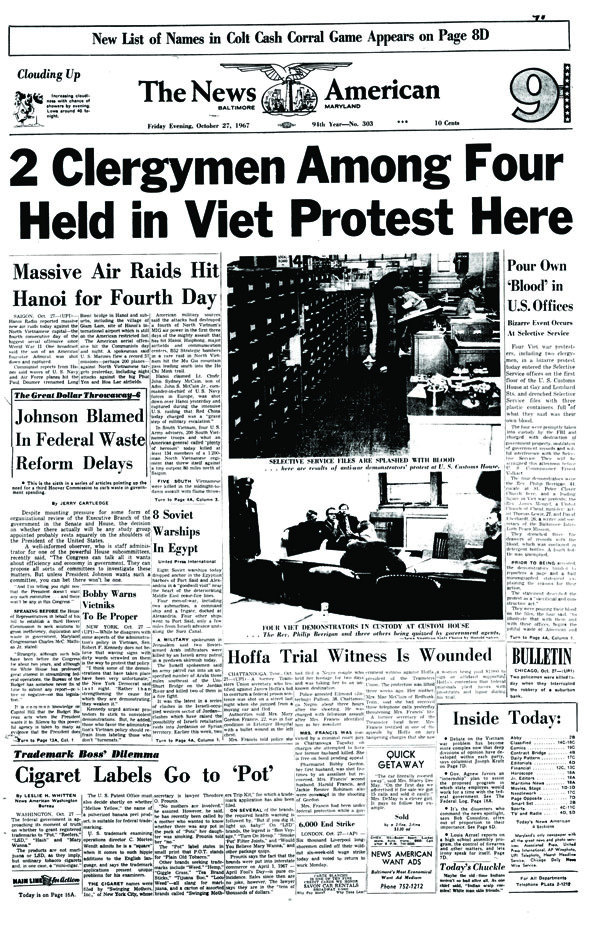
On October 27, 1967 Father Phillip Berrigan and three others calmly walked into a Selective Service office in the Baltimore Customs House.  As the Reverend James L. Mengel, a United Church of Christ minister and activist distributed copies of The Good News For Modern Man to workers, Berrigan, artist Tom Lewis, and writer David Eberhardt poured blood on Draft Board files. 
Each of the four men had contributed some of their own blood then supplemented it with duck blood purchased at a local Polish market.  In a leaflet distributed along with the Bibles, Berrigan wrote, “This is sacrificial and constructive act is meant to protest the pitiful waste of American and Vietnamese blood in Indochina.”
When they were finished all four men calmly awaited the arrival of police and arrest.  The Baltimore Four, as they came to be known, succeeded in grabbing national attention.  Their act of symbolic defiance helped energize the Anti-War Movement as a whole.  Berrigan would be sentenced to four years in prison in this celebrated case.  And it was just Act I. 
Berrigan was born on October 5, 1923 in Two Harbors, Minnesota a tough, Iron Range port on Lake Michigan.  His German mother and Irish father were both devout Catholics and staunch union members. 
Unlike other well known anti-war figures of the era, Berrigan knew war—and injustice—first hand.  At the age of 20 he was drafted in 1943.  Basic training in the South was an eye-opening and painful experience for him.  He had never witnessed firsthand the brutal racism of the Jim Crow South and of the Army that accommodated it in every way possible.
And that was just the start of his education.  He witnessed the stark horror of war first hand as an artilleryman in the Battle of the Bulge and, as the war drew to a close in Europe, a Second Lieutenant in the infantry.
After the war instead or resuming his interrupted studies at the St. Michael's College in Toronto, he entered College of the Holy Cross in Worcester, Massachusetts. After graduation in 1950 Berrigan decided to enter the seminary of the Josephite Fathers, an order founded to minister to recently freed slaves after the Civil War and explicitly dedicated to service to the African dispora in the U.S.  He was ordained in 1955.
As the Civil Rights Movement heated up, so did Berrigan’s involvement.  He marched and participated in sit-ins and other protests immersing himself in the movement’s non-violence and sacrificial militancy, in both of which he found resonance with his developing Catholic theology.
Serving black parishes, Berrigan was beginning to get in trouble with his order superiors by the mid-60’s.  After speaking a public forum in which he blasted the Church for complicity in war crimes above, his superiors removed him from his Up State New York parish and assigned him to Baltimore.  He was assigned to St. Peter Claver Church in 1965 and founded the Baltimore Interfaith Peace Mission.  The group began with public witnesses against the war and actions like the picketing of the homes of Secretary of State Dean Rusk and Secretary of Defense Robert McNamara in the Washington suburbs.  It was out of this group and extensive prayerful consideration that the Baltimore Four decided to act.
While out of jail awaiting sentencing in the first draft board raid, Berrigan committed another.  This time he was joined by his older brother Father Daniel Berrigan, a Jesuit and poet who was already well known as an outspoken early anti-war figure.  In addition to the Berrigan brothers Tom Lewis was once again on hand as were George Mische, De La Salle Christian Brother Br. David Darst, John Hogan, Marjorie Bradford Melville, Thomas Melville, and Mary Moylan.  On May 17, 1968 they went to a Draft Board in Cantonville, Maryland.  Not content with the mere symbolic vandalism of draft records, this time they hauled hundred of file from the office into the parking lot, doused them in homemade napalm concocted of gasoline and soap flakes, and set them on fire.
The trial of the Cantonville Nine—which Berrigan would later turn into a play using mostly trial transcripts—became a media sensation and offered the Berrigans and their collaborators an opportunity to eloquently and defiantly state their positions about war, exploitation, and the complicity of the Church and American society in the carnage.  “Our apologies, good friends, for the fracture of good order, the burning of paper instead of children.”
All of the defendants were convicted.  Phillip Berrigan was sentenced to 3½ years in prison.  Allowed out on bail before reporting to severing their sentences the Berrigan brothers and some of the other defendants decided that since they had a right to protest manifest injustice, they also had a right not be complicity in their own persecution.  They disappeared before reporting and went underground. 
But Philip Berrigan would emerge from hiding, make a public appearance, and once again slip away.  FBI Director J. Edgar Hoover was enraged and put both Berrigans on the Ten Most Wanted List.  A massive nationwide man hunt followed.  On April 11, 1970 Berrigan was arrested when FBI agents broke down the door of Church of St. Gregory the Great in New York City and arrested him in the rectory.
Berrigan was sent to prison with his two sentences to be served concurrently.  While serving these sentences he secretly wed Sr. Elizabeth McAlister and anti-war activist in her own right. He was released in 1972.  When the church learned of the marriage both Berrigan and his wife were excommunicated.
The pair faced a new hurdle when they and five others were indicted for an alleged plot to “kidnap” Secretary of State Henry Kissinger and perhaps “blow up” some steam tunnels.  The Federal case against the so called Harrisburg Seven was built on smuggled letters between the two facilitated by a prisoner/informant and intercepted by authorities.  The government spent over $2 million trying to prove the case in the 1972 trial.   The lead defense attorney, former Attorney General turned anti-war activist Ramsey Clark did not even call a witness.  After lengthy deliberations there was a hung jury.  The greatly embarrassed government declined to re-file the charges.
In 1973 Berrigan and McAalister founded Jonah House in Baltimore to support the community of non-violent resistance to war and injustice.  Styled a Catholic Worker Resistance House, it was their home for the rest of Berrigan’s life.  The couple had three children.  The House served as a center of action and in 1980 was the birthplace of a new activist group, Plowshares which initiated many more actions over the next decades.
The first Plowshares action was a raid on the General Electric Nuclear Missile Re-entry Division in King of Prussia, Pennsylvania where nose cones for the Mark 12A nuclear warheads were made. Phillip and Daniel Berrigan and six other symbolically pounded on the nose cones with hammers and drenched them in blood.  Sentenced to 11 years in prison this time, the trial and appeals dragged on for nearly ten years with much of the time spent behind bars.  In 1990 the Berrigans were re-sentenced to 23½ months and immediately paroled for time served.
Plowshares would continue to conduct similar such raids often planned by the Berrigan brothers.
In December of 1999 Berrigan participated in his last Plowshares protest—at the Warfield Air National Guard Base in Maryland where members pounded on A-10 Warthog warplanes like those which had been used in the Persian Gulf War.  He was sentenced to 30 months in prison for malicious damage to Federal Property.  He was released from prison for the last time in 2001.
Altogether Phillip Berrigan served more than 11 years in jail or prison for his defiant acts of civil disobedience.  That is likely a record for any non-violent activist in American History.
Soon after release, Berrigan died at Jonah House surrounded by his family and supporters of cancer on December 6, 2002 at the age of 72.  He was buried on the grounds of Jonah House, where his wife continues his work.

Friday, October 26, 2012

Dylan Thomas, Sylvia Plath, and Patrick Murfin on One Page!


 Regular readers who are not frightened away by the threat of poetry have probably noticed my habit of being “inspired”  by coincidences of the calendar. 
About a year ago I noticed  that it was the mutual birthday of Dylan Thomas and Sylvia Plath, who had not much in common except that they wrote poetry and died young each in a kind of pitiful squalor.  It was also happened to be the night of a New Moon and where I was, at least, a howling storm of darkness. 
Writing poetry about poets, both infinitely more gifted than I, is an act of terminal hubris for which I shall be justly punished.  But here it is anyway.


How Black the Night

October 26, 2011—New Moon, Dylan Thomas and Sylvia Plath

Even the New Moon hides behind the howling clouds.

Happy Birthday Dylan—
Why did you not
            rage, rage against the dying of the light
            in that pool of your own black vomit
            at the Chelsea?

Happy Birthday Sylvia—
That same year, you dewy goddess,
            you first emptied the medicine vials
            and crawled under your mother’s porch.

Not ships passing in the night,
            but traversing the same black ocean
            away from home
            to something else.

Did you find what you were looking for
            in worship and whiskey,
            in broken love and madness?

As Dylan moldered under Laugharne,
            Lady Lazarus, you wrote.
                   Dying
   Is an art, like everything else.
   I do it exceptionally well.

But laying your head in a oven
             is no art
             and posthumous poems
             no resurrection.

How black the night, dead poets,
            how black the night?

—Patrick Murfin


Thursday, October 25, 2012

It Happened on St. Crispin’s Day

English Yeoman archers and mud spelled disaster for the Cream of French Chivalry.


The Battle of Agincourt, which was fought on October 25, 1415 is usually found on one of those lists of the most important battles in world history, that intrigue the kind of military history geeks who haunted the History Channel before it turned into a freak show of toothless hillbillies.  This is due almost entirely to the Anglo-centrism of the historians and publicity by one William Shakespeare who made a hero out of English King Henry V and put in his mouth a glorious speech which took on a special significance as a rallying cry for the British in the darkest days of another war more than 500 years later.
The battle was a decisive English victory over a much larger French army and is interesting on a number of points, but in the long run did little to change the course of history.  It was a part of the series of wars known at the Hundred Years War fought from 1337 and 1453 between the Valois and Anjou (the English House of Plantagenet) claimants to the French throne. Here is the Cliff Notes version of what happened.
Henry V was the second of the Lancastrian kings of the Plantagenet dynasty, a branch of the French House of Anjou which had ruled England since 1154.  His father, Henry IV had successfully usurped the throne from Richard II and established a new line of succession.  Young Henry V acceded to the throne in 1413 at the age of 27.  As Prince of Wales he was already a seasoned military commander when he led armies against a Welch rebellion in his principality. 
He was an ambitious and aggressive monarch.  He began his reign with many reforms, including restoring the lands and titles of most the heirs and loyalists of Richard II to gain their support.  He also decreed for the first time the English, rather than French, was the official language of the kingdom.  His court was the first to use English and he wrote predominately in it.  But that did not mean he was not interested in France.
The young monarch, seeing France was in dynastic turmoil, decided to reinstate his claim to the title of King of France, which was based on connections through Richard II.  He also wanted to reclaim and expand large claims of land on the continent, most of which had been lost over the preceding two hundred years.  He demanded of the French to be accepted as the legitimate Heir to the throne and in addition to ancestral Anjou and Normandy demanded Aquitaine, Touraine, Brittany and Flanders and marriage to the daughter of the Valois claimant to the French crown to cement his claim.  After two years of negotiations Henry received the permission of Parliament to declare war and a doubling of the tax rate to finance a campaign.
With the revenues, Henry raised an army composed not only of the noble knights and men at arms, but primarily of hired yeomen most of whom were armed with the longbows.  His army of about 12, 000 arrived in France in August of 1415 and immediately lay siege to the port of Harfleur.  Due to a lack of proper siege equipment, the capture of the city took until well into September, which gave the divided French to unite and gather a large army at Roen under Charles d’Albret, the Constable of France.
Because the campaign season was drawing to a close, Henry decided to try and avoid a battle with the main French army, and to march north to the English port of Calais to resupply over the winter.  His force was already reduced to about 9,000 by disease and was soon in hunger as they could not forage enough provisions as they marched.  The French army began to shadow them, but waited to gain strength as more troops joined. 
At the River Somme the French got ahead of Henry and blocked the most direct route to Calais, forcing him to move south, away from the city to find a ford.  He finally crossed south of Péronne.  Resuming his march north again, Henry found the whole French army blocking his path near Agincourt on October 24.  The 250 mile march over two and a half weeks had left his army in wretched condition, but Henry knew that the French were still receiving reinforcements and had to come to battle before they arrived.
As was the custom the two sided met and agreed on the battle field.  It could not have been a more disastrous choice for the French who out-numbered the English by as many as 6 to 1.  The battle was to be fought on a recently harvested open field only 750 yard wide closed in between to heavy stands of woods.  The night before the battle heavy rains had turned the field into a sea of mud, which would only become more encumbering as it was roiled by men and horses. 
Henry deployed his forces across the narrowest point on the southern end of the field, divided into three sections with himself personally on the field in command of the center.  These forces totaled about 1,500 heavily armed knights and men-at-arms mostly dismounted.  Along both flanks, backed against the woods, he deployed his 7,000 longbow men protected from cavalry attack by hastily erected pointed stakes dug into the ground at a sharp angle.
The French had to advance several hundred yards across the muddy ground to reach the English line.  The French deployed 10,000 heavily armored knights and men at arms in two or three divisions, with about 1,200 knights mounted as cavalry.  To the rear were thousands more men including archers, crossbowmen and levies of ill trained, lightly armed infantry which the French evidently did not even plan to deploy, so sure were they about the power of the “cream of French nobility” to carry the day against the vastly outnumbered English.
The action began with a successful raid against Henry’s baggage train to the rear, which made him nervous all day of being surrounded.  Then, as the heavy infantry began their slog across the field, the cavalry charged the two flanks of archers.  The archers let fly with volley after volley of high arching shots that fell on the knights wounding and maddening their horses, many of which broke away and began wildly running across the field.  The surviving horsemen came up against the sharpened stakes and could not break through suffering heavy casualties and being repelled.  They and the maddened horses churned the muddy ground badly then crashed into their own lines of advancing men on foot.
The archers turned their attention to the men at arms who were advancing slowly and with great difficulty over the muddy ground.  Their many flights of arrows did not injure many due to heavy armor, but the incessant rain of missiles made them march with their helmet visors down to prevent injury to the face, which restricted their vision and their breathing.  Soon the French were bogged down in knee deep muck and the rear ranks were pushing forward.  By the time that they finally reached the English line they were exhausted and only the very front ranks could even swing their broadswords because they were pressed so tightly together.  The French did push the English line back, but were soon engaged in furious hand to hand combat.  Many of the French fell unwounded but were unable to get up in the deep mud with the heavy weight of their armor.  Many drowned in the mud, others were trampled by their own men.  With only the front ranks effectively able to engage, they suffered heavy losses and soon the ground was covered by the French.
Then, the English long bowmen, having exhausted their arrows, surged from behind their stakes swinging axes, short swords, and weapon picked up on the field and attacked the dense mass of French on the flanks.  Unarmored except for helmets and light mail, they were speedy and agile and slaughtered the exhausted French.
The English knights began taking prisoners among the survivors in hopes of exchanging them for ransom, as was the custom.  But Henry, fighting at the front of his troops thought he saw movement in the French rear and feared a second attack.  He also began to worry that the many prisoners might take advantage of the chaos of the battlefield to seize weapons and turn on their captors.  Henry ordered his knights to execute their hostages.  Most refused because they wanted the ransom money and because they feared that if they did so, they would receive the same treatment if later captured themselves.  Frustrated, the King sent his most trusted aide at the head of a force of 150 non-noble yeoman infantry to hack the prisoners to death with axes and broadswords.
Whatever the intention of the French secondary had been, the sight of the Nobles of France being hacked to death sent the remaining forces into a panicked retreat.  They ran into, and became ensnared with, the great number of unused archers, crossbow men, and light infantry, who might have saved the day, had not the knights been too proud to deploy them.
The battle was a disaster for France.  French losses were estimated to be between 7,000 and 10,000, almost all of them killed.  About 1,500 nobles survived the slaughter as prisoners.  The English lost a documented 112 men on the day of the battle and probably hundreds more of wounds, disease, or exhaustion within days.  The best guess for total English casualties is about 450 dead and wounded.
Henry did not follow up, as he could have, with an attack on Paris to take the crown.  Instead he returned to England to receive a hero’s welcome and re-arm for another season of campaigning.  He returned to France in 1417.  After years of fighting the 1420 Treaty of Troyes gave him nearly everything he wanted.  He was recognized as heir and Regent of France until the death of King Charles VI.  He married Charles’s daughter Catherine of Valois to secure his dynastic claim.
In 1422 Henry was campaigning in France against hold-outs not recognizing his claim when he died of dysentery.  Charles VI died within a month, making Henry’s infant son Henry VI King of France. 
The younger Henry grew into his crowns, but battled depression and some say bouts of madness.  He was deposed as English King once, returned to the throne, and lost it again to the House of York in the War of the Roses.  But he retained the disputed throne of France until his death 1453.  The same year the Hundred Year War finally ended with England expelled from France except for Calais and accession of Charles VII to the throne, resuming the Valois dynasty.
The lasting impact of the battle of Agincourt was to begin a revolution in military theory and practice.  It was the swansong of chivalry and semi-feudal armies built around the war lord castes of nobility.  Heavy knights were shown to be vulnerable to both the long bow and to lighter forces fighting behind and from field fortifications.  As the Hundred Year War dragged on the addition of fire arms and artillery only accelerated the development.  The fall of reliance on knighthood, also reduced the influence of the nobility and raised the power of monarch who could hire armies.  By 16th Century large professional armies helped lead to the creation of the nation state as we know it.
The French and English went on being the best of enemies through future conflicts that would including 18 wars before the virtual world wars—The Seven Years War (in America the French and Indian Wars), the Anglo-French War of 1779-1783 (including France’s participation in the American Revolution), and the Napoleonic Wars.
Only later in the 19th Century did changing European political realities—certain common colonial interests and the unification and militarization of Germany—finally brought the two old rivals together as sometimes wary and suspicious allies.