|
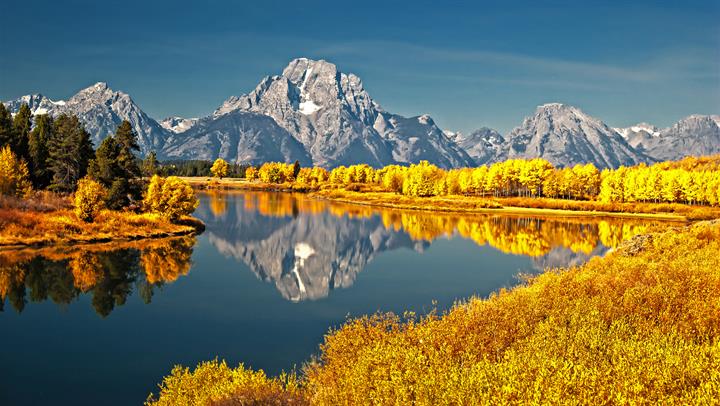
| The Cathedral Group of the Teton Range, Mount Moran center in the fall when the aspens turn. |
Calvin Coolidge was something
between an empty suit and a place holder at President of the United
States. Even his succession to office was accidental—roused
from his bed in a New Hampshire cabin by the news that the rascal Warren G. Harding had croaked
in far away California and sworn into office by kerosene lamp light by his Justice of the Peace Father. He was also probably the most deeply in a profound old fashion way the most conservative Republican ever to hold the office. His main claim
to fame which had landed him on the 1920 GOP ticket was breaking the Boston
Police Strike the year before. Cal
got his well deserved nick name for not saying much because he didn’t have much to say. He carried
that same philosophy into governance where he did as little as possible because he
didn’t think that the government should
do much. Instead be became best
remembered for being willing to pose
for pictures and newsreels in Indian bonnets, cowboy hats,
and silly outfits in honor of
various White House visitors. Yet the country rolled on in a period of unprecedented prosperity and the wild excitement of Prohibition,
speakeasies, and the jazz age and Coolidge was elected in his own right in 1924 could
probably been reelected by a landslide four years later. But
Cal would have none of it and famously said
“I do not choose to run for President in 1928 opening the door for Herbert Hoover.
But
on February 26, 1929 just days before Hoover took over, Coolidge did something
totally uncharacteristic—he signed into law the creation of Grand Teton National Park over the vehement objection of Wyoming’s solidly Republican Congressional
delegation and state government as
well as Western cattle, timber, and mining interests who hated any real or imagined interest in restricting
exploitation of natural
resources. Despite enjoying spending
his lengthy vacations at a Summer White House in the Black Hills of South Dakota and enjoying fishing
at his New Hampshire get-a-way,
Coolidge was never an ardent
conservationist in the style of his Republican predecessor Theodore Roosevelt.
 |
| President Calvin Coolidge and one of his funny hats. |
In
approving the bill Coolidge preserved one of the most stunningly beautiful gems in the growing National Park System. And as
a boy growing up in Wyoming, one of
my favorite places.
The
awesomely majestic Teton Mountain Range is
the youngest in the vast Rocky Mountains. It was up thrust a mere 7 to 9 million years ago. It runs for about 40 miles south of the Yellowstone high plateau and includes ten peeks.
The Grand Teton towering
15,775 feet is the tallest looming above Jackson
Lake and with its near neighbors Nez Perce Peak, Middle Teton, Mount Owen,
and Teewinot
Mountain together forming the Cathedral
Group which has long inspired artists
and photographers.
The
Tetons are unusual in that no foothills obscure
their rise. From the east they can clearly be seen in
their blue snow-capped majesty from
their bases. That is because deep and
wide Jackson Hole, the bed of an ancient sea lies at their
feet. Run-off from the annual winter mantle of snow and glaciers on the mountain sides feeds
numerous streams which have carved a
series of u-shaped valleys and canyons which cut deep into the range
between the peeks. The streams feed
several lakes at the base, the
largest being Jackson Lake. Others include
Leigh, Jenny, Bradley, Taggart, and Phelps Lakes which are all part of the
flowage of the Snake River as it
descends into Jackson Hole. In addition
at higher elevations there are nearly 100 small alpine lakes the highest being Lake
Solitude more than 9,000 feet up.
Paleo-Indians were visiting
the Tetons and Jackson Hole at least 11,000 years ago following migratory herds of elk and bison. They made summer camp in Jackson Hole but
established no year-round villages. They were known to have made spear points and arrowheads from locally found obsidian,
some of which they may have traded to
the Clovis people who in return
traded some of their tools.
At
the time of first contact with Whites, eastern Shoshoni peoples were
following the same pattern.
That
first contact came in the person of
the legendary John Coulter, often
called the first mountain man. Coulter was a member of Lewis and Clark’s
Corps of Discovery who left the expedition
during the return from the
Pacific with the approval of the two captains to explore on his own the territory
south of the rout. His main
interest was the discovery of
areas rich in furs. Most
famously Coulter entered what is now Yellowstone
Park and observed the geysers and
hot springs there. His description of what he saw was ridiculed as a hoax or elaborate tall tale by
many when he got back to St. Louis. The
Yellowstone country was called derisively Coulter’s
Hell.
Despite
the derision, some were intrigued by
his accounts. The St. Louis based Spanish fur trader Manuel Lisa who had opened a trading
post called Fort Raymond at the
mouth of the Big Horn River in what is
now Montana hired Coulter lead a
small party of trappers in a second trip
west. On this trip during the
winter of 1807-08 Coulter passed through Jackson Hole and was the first White
man to see the Teton Range. He groped
his way along the base of the range until he discovered the relatively easy-to-navigate Teton Pass near the
southern end of the chain which allowed him passage into what is now Idaho.
In the Tetons’ cold streams and crystal clear lakes he did find
probably the richest beaver territory in
North America completely unexploited
by European trappers or natives trapping for trade.
Coulter
met Clark in St. Louis in 1810 and provided the Captain a detailed account of
both of these trips, possibly drawing crude maps for him. Based on this information, Clark included a
map of the Yellowstone and Tetons for inclusion
in his long awaited official
report. Although some still doubted
Coulter’s accounts the discovery of a stone
crudely carved into the shape of a
skull and inscribed “John
Coulter” on one side and 1808 on the other which was found just beyond Teton
Pass in Idaho in the early 1930’s.
Although it cannot be conclusively proved that it was left by Coulter, weathering of the stone and
inscriptions are in line with the time frame.
Soon
competing fur trading companies were
sending expeditions into the area. Early
American trapping parties called the mountains the Pilot Knobs because they could be seen clearly at such a great
distance and were like a beacon
calling the Mountain Men to the richness of their waters.
 |
| Mountain men entering Jackson Hole with the Tetons in the background and Snake River below them. |
But
the British also had claims on the region considering it part of Oregon.
Donald Mackenzie led a North West Company expedition made
up largely of veteran French and Métis voyagers and trappers into
the region in from the west in 1818-19.
It was the French trappers who gave the range their name from the three
main peeks in the Cathedral Group—les trois tétons (the three
tits.)
The
British challenge was answered in from the mid-1820’s by the Rocky Mountain Fur Company organized by
Jedediah Smith, William Sublette,
and
David Edward Jackson, names fans of
this year’s Oscar favorite movie The Revenant might recognize in the
story of Hugh Glass. Davy Jackson oversaw operations around
the Tetons and Jackson Hole giving his name to the broad valley and the largest
of the Lakes.
Intensive
trapping depleted even the rich
streams of the Tetons by the late 1830s and beaver hats, the main driver of the trade, were going out of fashion. By 1840 the glory days of the fur trade
were over. The trading companies stopped
sending companies into the mountains. A
few stubborn and grizzled individual trappers continued
to visit the area, but except for transient
Native American hunting parties region was nearly devoid of human activity
for nearly 20 years.
In
1859-60 the U.S. Army sponsored an
exploratory expedition led by Topographical
Engineer Captain Capitan William F. Reynolds and guided by Jim Bridger,
the boyish trapper in Tbe Revenant, entered
Jackson Hole. The expedition failed to
make headway exploring the Yellowstone territory to the north and the Civil War interrupted follow-ups. But naturalist F. V. Hayden who was with
Reynolds would return to lead his own expeditions beginning with the Hayden Geological Survey of 1871. While Hayden mapped Yellowstone his subordinate James Stevenson led the Snake River Division into and around
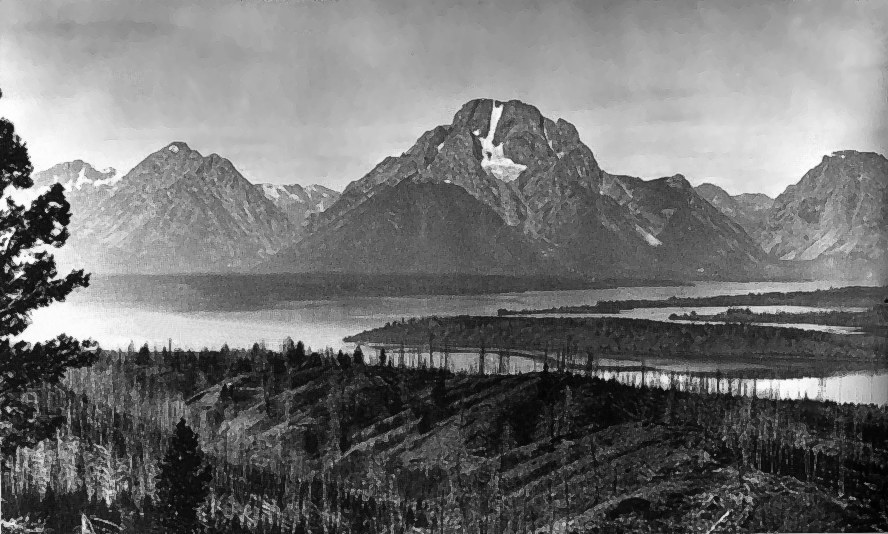
the Tetons. Accompanying Stevenson as photographer was William Henry Jackson who took the first dramatic pictures of the mountains.
 |
| 1871 photo by William Henry Jackson. |
Among
the charges to the Hayden and Stevenson expeditions was searching for possible mineral wealth—gold, silver, or
copper which could be exploited.
Fortunately for future preservationists
they found none allowing the Yellowstone and Tetons to remain relatively undefiled.
By
the late 1870’s Hayden’s reports and Jackson’s photographs began to lure wealthy tourists to the region and rustic lodges were established for them and crude roads laid out to accommodate talley-ho coaches for visitors.
Tourism became the first economic activity in the region since the
collapse of the fur trade.
In
the 1884 a handful of homesteaders began
to settle in Jackson Hole. By 1890 about
50 of them and two years later the construction of Menor’s Ferry which allowed access to the west side of the Snake
River by wagons. Around the turn of the 20th Century and the approach of rail service led to large scale cattle ranching displacing hardscrabble homestead farming in
Jackson Hole.
The
construction of automobile roads along
the old military trails and roads in
the region began a new surge of tourism in the ‘20’s and ‘30’s.
Yellowstone
had become the first National Park way back on March 1, 1872 when Ulysses S Grant signed the legislation
creating it after at campaign led by F. V. Hayden. As early as 1900 conservationists began
attempts to add the Tetons and Jackson Hole to the park. They were met with fierce local opposition,
some of which still hoped to have Yellowstone Park dissolved and made available for commercial development. The waters
of the Snake River Water shed were also coveted. In 1907 the U.S. Bureau of Reclamation dammed
the outlet of Jackson Lake eventually raising its level 39 feet to provide agricultural irrigation water to Idaho. When
the Bureau began to advance a plan to
do the same to same to other lakes and alarmed Yellowstone Park Superintendent Horace Albright renewed the campaign to extend the park south.
Local
opposition remained fierce, but a proposal to create a separate park pretty much confined to the peeks themselves and most
of the lakes at the base, was put forward as a compromise that would leave most
of Jackson Hole in private hands. It was
the bill accomplishing just that that Coolidge signed in 1929.
Albright
was not done with his hopes of preserving more land. He made contact with America’s richest man, John
D. Rockefeller of Standard Oil who built a summer lodge for himself in Jackson
Hole in the mid-‘20’s. Albright
convinced the millionaire to quietly start buying up land in Jackson Hole with the aim of transferring it to
the National Park Service. To this end he created the Snake River Land Company. He acquired significant holdings but in
1930 locals got word of what was going on and raised a stink. For more
than a decade expansion of the Park was in
limbo with fierce opposition in Congress.
In
1942 a frustrated Rockefeller threatened
to sell his holdings to developers unless
Park expansion was approved. Interior
Secretary Harold Ickes recommended that President Franklyn D. Roosevelt use the Antiquities Act to create the Jackson
Hole National Monument adjacent to the National Park using Rockefeller’s donation and transferring land from the
Teton National Forest. The Monument also came under the management of the Park Service but lacked a funding
allotment requiring the Park Service to re-direct funds from elsewhere to operate it.
Despite
continued local opposition, there was growing public support nationally for
bringing the Monument into the Park.
That was finally accomplished in 1950.
In 1972 24,000 acres north of the Grand Teton Park was added making it
contiguous at last to Yellowstone. In
2007 the Rockefeller family donated their private retreat, the JY Ranch to the Park expanding it to
the southwest and establishing the current boundaries. The park today includes 480 square miles and
310,000 acres.
In
2014 Grand Teton National Park had 2,791,392 visitors. But heavy usage and years of Park Service cut or frozen
budgets have left the park with rundown
physical facilities. Environmental
threats to the pristine waters and traditionally clean, clear air are
mounting. Many sunny days now find the mountains shrouded with haze.
Even
more dangerously the old cry for elimination, sale, and private exploitation
of the National Parks has been raised to new level by Tea Party Republicans in Congress and by the armed and dangerous so-called patriot
militias in the West.
Calvin Coolidge’s
good deed
could be undone by a Republican President and Congress.