Showing posts with label John Coulter. Show all posts

Wednesday, February 26, 2025

Stroke of Silent Cal’s Pen Brought Grand Teton National Park into Existence

The Cathedral Group of the Teton Range, Mount Moran center in the fall when the aspens turn.

Calvin Coolidge was something between an empty suit and a place holder as President of the United States.  Even his succession to office was accidental—roused from his bed in a New Hampshire cabin by the news that the rascal Warren G. Harding had croaked in far away California and sworn into office by kerosene lamp light by his Justice of the Peace Father.  He was also probably the most deeply profound old fashion way the most conservative Republican ever to hold the office.  His main claim to fame which had landed him on the 1920 GOP ticket was breaking the Boston Police Strike the year before.  

Cal got his well-deserved nick name for not saying much because he didn’t have much to say. He carried that same philosophy into governance where he did as little as possible because he didn’t think that the government should do much.  Instead be became best remembered for being willing to pose for pictures and newsreels in Indian bonnets, cowboy hats, and silly outfits in honor of various White House visitors. 

One of the many times Coolidge was photographed in a ten gallon hat, this time at the dedication of Mount Rushmore in 1927.
 
Yet the country rolled on in a period of unprecedented prosperity and the wild excitement of Prohibition, speakeasies, and the jazz age.  Coolidge was elected in his own right in 1924 and could probably been reelected by a landslide four years later.  But Cal would have none of it and famously said “I do not choose to run for President" in 1928 opening the door for Herbert Hoover.

But on February 26, 1929 just days before Hoover took over, Coolidge did something totally uncharacteristic—he signed into law the creation of Grand Teton National Park over the vehement objection of Wyomings solidly Republican Congressional delegation and state government as well as Western cattle, timber, and mining interests who hated any real or imagined interest in restricting exploitation of natural resources.  Despite enjoying spending his lengthy vacations at a Summer White House in the Black Hills of South Dakota and enjoying fishing at his New Hampshire get-a-way, Coolidge was never an ardent conservationist in the style of his Republican predecessor Theodore Roosevelt.

In approving the bill Coolidge preserved one of the most stunningly beautiful gems in the National Park System.  And as a boy growing up in Wyoming, one of my favorite places.

The awesomely majestic Teton Mountain Range is the youngest in the vast Rocky Mountains.  It was up thrust a mere 7 to 9 million years ago.  It runs for about 40 miles south of the Yellowstone High Plateau and includes ten peeks.  Mount Moran towering 15,775 feet is the tallest looming above Jackson Lake and with its near neighbors  Nez Perce Peak, Middle Teton, Mount Owen,  and Teewinot Mountain together forming the Cathedral Group which has long inspired artists and photographers.

The Tetons are unusual in that no foothills obscure their rise.  From the east they can clearly be seen in their blue snow-capped majesty from their bases.  That is because deep and wide Jackson Hole, the bed of an ancient sea lies at their feet.  Run-off from the annual winter mantle of snow and glaciers on the mountain sides feeds numerous streams which have carved a series of u-shaped valleys and canyons which cut deep into the range between the peeks.  The streams feed several lakes at the base, the largest being Jackson Lake.  Others include Leigh, Jenny, Bradley, Taggart, and Phelps Lakes which are all part of the flowage of the Snake River as it descends into Jackson Hole.  In addition at higher elevations there are nearly 100 small alpine lakes the highest being Lake Solitude more than 9,000 feet up.

Paleo-Indians were visiting the Tetons and Jackson Hole at least 11,000 years ago following migratory herds of elk and bison.  They made summer camp in Jackson Hole but established no year-round villages.  They were known to have made spear points and arrowheads from locally found obsidian, some of which they may have traded to the Clovis people who in return traded some of their tools.

At the time of first contact with Whites, eastern Shoshoni peoples were following the same pattern.

That first contact came in the person of the legendary John Coulter, often called the first mountain man.  Coulter was a member of Lewis and Clarks Corps of Discovery who left the expedition during the return from the Pacific with the approval of the two captains to explore on his own the territory south of the route.  His main interest was the discovery of areas rich in furs.   Most famously Coulter entered what is now Yellowstone Park and observed the geysers and hot springs there.  His description of what he saw was ridiculed as a hoax or an elaborate tall tale by many when he got back to St. Louis.  The Yellowstone country was called derisively Coulters Hell.

John Colter, based on life time drawings.

Despite the derision, some were intrigued by his accounts.  The St. Louis based Spanish fur trader Manuel Lisa who had opened a trading post called Fort Raymond at the mouth of the Big Horn River in what is now Montana hired Coulter lead a small party of trappers in a  second trip west.  On this trip during the winter of 1807-08 Coulter passed through Jackson Hole and was the first White man to see the Teton Range.  He groped his way along the base of the range until he discovered the relatively easy-to-navigate Teton Pass near the southern end of the chain which allowed him passage into what is now Idaho.  In the Tetons cold streams and crystal clear lakes he did find probably the richest beaver territory in North America completely unexploited by European trappers or natives trapping for trade.

Coulter met Clark in St. Louis in 1810 and provided the Captain a detailed account of both of these trips, possibly drawing crude maps for him.  Based on this information, Clark included a map of the Yellowstone and Tetons in his long awaited official report.  Although some still doubted Coulter’s accounts the discovery of a stone crudely carved into the shape of a skull and inscribed “John Coulter” on one side and 1808 on the other which was found just beyond Teton Pass in Idaho in the early 1930’s.  Although it cannot be conclusively proved that it was left by Coulter, weathering of the stone and inscriptions are in line with the timeframe.

Soon competing fur trading companies were sending expeditions into the area.  Early American trapping parties called the mountains the Pilot Knobs because they could be seen clearly at such a great distance and were like a beacon calling the Mountain Men to the richness of their waters.

But the British also had claims on the region considering it part of OregonDonald Mackenzie led a North West Company expedition made up largely of veteran French and Métis voyagers and trappers into the region in from the west in 1818-19.  It was the French trappers who gave the range their name from the three main peeks in the Cathedral Grouples trois tétons (the three tits.)


The British challenge was answered in from the mid-1820’s by the Rocky Mountain Fur Company organized by Jedediah Smith, William Sublette, and David Edward Jackson, names fans of 2016  Oscar winning movie The Revenant might recognize in the story of Hugh Glass.  Davy Jackson oversaw operations around the Tetons and Jackson Hole giving his name to the broad valley and the largest of the Lakes.

Mountain men entering Jackson Hole with the Tetons in the background and Snake River below them.

Intensive trapping depleted even the rich streams of the Tetons by the late 1830s and beaver hats, the main driver of the trade, were going out of fashion.  By 1840 the glory days of the fur trade were over.  The trading companies stopped sending companies into the mountains.  A few stubborn and grizzled individual trappers continued to visit the area, but except for transient Native American hunting parties region was nearly devoid of human activity for nearly 20 years.

In 1859-60 the U.S. Army sponsored an exploratory expedition led by Topographical Engineer Captain Capitan William F. Reynolds and guided by Jim Bridger, the boyish trapper in The Revenant, entered Jackson Hole.  The expedition failed to make headway exploring the Yellowstone territory to the north and the Civil War interrupted follow-ups.  But naturalist F. V. Hayden, who was with Reynolds, would return to lead his own expeditions beginning with the Hayden Geological Survey of 1871.  While Hayden mapped Yellowstone his subordinate James Stevenson led the Snake River Division into and around the Tetons.  Accompanying Stevenson as photographer was William Henry Jackson who took the first dramatic pictures of the mountains.

1871 photo by William Henry Jackson.  

Among the charges to the Hayden and Stevenson expeditions was searching for possible mineral wealth—gold, silver, or copper which could be exploited.  Fortunately for future preservationists they found none allowing the Yellowstone and Tetons to remain relatively undefiled.  

By the late 1870’s Hayden’s reports and Jackson’s photographs began to lure wealthy tourists to the region and rustic lodges were established for them and crude roads laid out to accommodate talley-ho coaches for visitors.  Tourism became the first economic activity in the region since the collapse of the fur trade.

In the 1884 a handful of homesteaders began to settle in Jackson Hole.  By 1890 there were about 50 of them and two years later the construction of Menors Ferry allowed access to the west side of the Snake River by wagons.  Around the turn of the 20th Century and the approach of rail service led to large scale cattle ranching displacing hardscrabble homestead farming in Jackson Hole. 

 The construction of automobile roads along the old military trails and roads in the region began a new surge of tourism in the ‘20s and ‘30s. 

Explorer F.V. Hayden not only participated in or led several expeditions to Yellowstone and Jackson Hole but was a relentless campaigner to establish Yellowstone National Park and then to add the Tetons and Jackson Hole.

Yellowstone had become the first National Park way back on March 1, 1872 when Ulysses S Grant signed the legislation creating it after a campaign led by F. V. Hayden.  As early as 1900 conservationists began attempts to add the Tetons and Jackson Hole to the park.  They were met with fierce local opposition, some of which still hoped to have Yellowstone Park dissolved and made available for commercial development.  The waters of the Snake River water shed were also coveted. 

In 1907 the Bureau of Reclamation dammed the outlet of Jackson Lake eventually raising its level 39 feet to provide agricultural irrigation water to Idaho.  When the Bureau began to advance a plan to do the same to same to other lakes and alarmed Yellowstone Park Superintendent Horace Albright renewed the campaign to extend the park south. 

Local opposition remained fierce, but a proposal to create a separate park pretty much confined to the peeks themselves and most of the lakes at the base, was put forward as a compromise that would leave most of Jackson Hole in private hands.  It was the bill accomplishing just that that Coolidge signed in 1929.

Albright was not done with his hopes of preserving more land.  He made contact with America’s richest man, John D. Rockefeller  of Standard Oil who built a summer lodge for himself in Jackson Hole in the mid-‘20s.  Albright convinced the millionaire to quietly start buying up land in Jackson Hole with the aim of transferring it to the National Park Service.  To this end he created the Snake River Land Company.  He acquired significant holdings but in 1930 locals got word of what was going on and raised a stink.  For more than a decade expansion of the Park was in limbo with fierce opposition in Congress.

In 1942 a frustrated Rockefeller threatened to sell his holdings to developers unless Park expansion was approved.  Interior Secretary Harold Ickes recommended that President Franklyn D. Roosevelt use the Antiquities Act to create the Jackson Hole National Monument adjacent to the National Park using Rockefeller’s donation and transferring land from the Teton National Forest.  The Monument also came under the management of the Park Service but lacked a funding allotment requiring the Park Service to re-direct funds from elsewhere to operate it.

Despite continued local opposition, there was growing public support nationally for bringing the Monument into the Park.  That was finally accomplished in 1950.  In 1972 24,000 acres north of the Grand Teton Park was added making it contiguous at last to Yellowstone.  In 2007 the Rockefeller family donated their private retreat, the JY Ranch, to the Park expanding it to the southwest and establishing the current boundaries.   The park today includes 480 square miles and 310,000 acres.


Grand Teton National Park had 3,417,106 recreational visits in 2023, a 22% increase from 2022.  But heavy usage and years of Park Service cut or frozen budgets have left the park with rundown physical facilities.  Environmental threats to the pristine waters and traditionally clean, clear air are mounting.  Many sunny days now find the mountains shrouded with haze.  Renewed calls to further privatize lodges and guest facilities and allow the construction of vacation condos  remain a threat.  Active so-called Patriot Militias in the region have threatened to seize the park.

Most devastating of all the Elon Musk war on Federal Workers has already slashed thousands of Park Service employees and threatens more.  Facing the ax are firefighting forces, timber management, fish and game management, educational services—also muzzled on climate change and basic history—and visitor support.  Among other cuts, 16 of 17 supervisory positions at  Grand Teton National Park were eliminated leaving just one person to hire, train and supervise dozens of seasonal employees expected this summer.  Grand Teton and the whole National Park System are on the teetering edge of destruction.

Calvin Coolidge’s good deed is be undone by a Republican President and Congress.


Sunday, July 10, 2022

A Birthday Shout Out to My Old Home State—Wyoming

A Wyoming landscape--a "hole", a fertile, watered widened valley in a mountain range.  A hunting ground for Native Americans, fur trapper's paradise and Rendezvous point, and a rancher's best grazing land.

On July 10, 1890 Wyoming, the place where I grew up, was admitted to the Union as the 44th state.  It is a big, square, empty place—at least if you are looking for people.  It is the tenth largest state by area, but fiftieth in population, the Bureau of Census estimated 581,813 folks lived there this year, hardly changed over the last five years and most of them clustered in small cities along the route of the Union Pacific Railroad/U.S. Highway 30/Interstate 80 in the south, the oil city of Casper in the middle and the boom/bust energy towns (coal, oil, uranium) in the Powder River area.  The vast interior of the state is mostly unpopulated wilderness to this day, range after range of rugged mountains. 

The Federal government still owns 48% of all land, much of it still in open range in addition to an Indian Reservations (Shoshone and Arapaho), an extensive system of National Parks, Monuments, Forests, and designated Wilderness Areas.  There is also sprawling Francis E. Warren Air Force Base headquartered in Cheyenne which controls Intercontinental Ballistic Missile (ICBM) launch silos scattered over hundreds of square miles. 

Wyoming residents are noted for being tough and independent with a tendency to simultaneously hate the Federal government while being dependent in one way or another on its largess.  They regularly return the most reactionary Republicans outside the deep South to Congress.  It’s the state that in recent decades his given the nation such luminaries as former Interior Secretary James Watts, Senators Allan Simpson and Mike Enzi, and, of course, former Vice President Dick Cheney and his daughter Representative Liz Cheney.  She remains far right conservative but has become a darling of Democrats and liberals for recognizing the former Resident of the United States as a traitor and insurrectionist and being an aggressive minority member of the House January 6 Investigation Committee.  Of course, she will be crushed in her re-election bid this November.

Despite this, it’s hard not to love a place of such stunning natural beauty.

The land that became Wyoming was sparsely populated by native peoples for at least 10,000 years. In historic time it was the home or hunting ground of Crow, Arapaho, Lakota, and Shoshone.  East of the Continental Divide it was a cradle of the Plains Indian buffalo hunting horse culture that developed in the late 1700s as wild mustangs, the descendants of Spanish stock in Texas, were introduced to the region.  


Trapper John Coulter was the first White man to see the geysers, hot springs, and mud pots of what is now Yellowstone Park when he left the Louis and Clark Expedition to go off on his own.  When he returned to St. Louis after a hair raising escaped from the Blackfoot, not one believed his account and derided his tales of what they called Coulter' s Hell.

The first white man known to visit was John Coulter, who left the Lewis and Clark Expedition in 1807 to trap beaver.  He wandered into what became Yellowstone Park.  Back in St. Louis his accounts of boiling water shooting into the sky and bubbling mud pots were dismissed as tall tales and the place was dubbed Coulters Hell. 

What couldnt be ignored was the incredible richness in beaver in the hundreds of streams feeding out of dozens of mountain ranges.  By the 1820’s it was the center of the fur trade and Mountain Man culture which featured such legendary figures as Jim Bridger, Hugh Glass, Jeremiah Johnson, and a teenager from New Mexico named Kit Carson.  Most of the Mountain Man Rendezvous, huge fur trading fairs and social gatherings, between 1824 and 1840 when the beaver largely gave out, were held along the Green River or elsewhere in the region.  


Mountain men were the first Whites to penetrate the vast interior of Wyoming's many mountain ranges in their search for beaver.

Trappers were also explorers.  As early as 1812 Robert Stuart of John Jacob Astors Pacific Fur Company discovered South Pass, an easy route across the Continental Divide, on a trip from Astoria to St. Louis.  This would be the route of the future Oregon Trail.  Washington Irving used Stuart’s journal of this trip as the basis of his novel Astoria. 

In 1834 William Sublet built a wooden palisade trading post east of South Pass named Ft. William.  In 1841 with the traditional fur trade in decline and the Rendezvous over, Astor’s American Fur Company bought the post, erected an adobe fort and re-named it Ft. Laramie in honor of one the French Canadian partners in the firm.  By 1849 the fur trade was over and the company sold the post to the U.S. Army. 

In 1842 Jim Bridger established his own trading post, Ft. Bridger, on the Green River near the former Rendezvous site.  Both posts played key roles as immigrant wagon trains began moving west.  The western route was explored and mapped by Army Captain Benjamin Bonneville in 1832-34.  Lt. John C. Frémont and his guide Kit Carson conducted three expeditions to the area between 1842 and 1846.  His journals and “the first decent map” of what would become the Oregon Trail were published in 1848, just in time to become the Bible of a wave of immigrants. 

In 1836 missionaries Henry H. Spalding and Marcus Whitman and their wives Narcissa Whitman and Eliza Hart Spalding became the first immigrants to use the trail—or most of it—to get to Walla Walla in the Oregon Territory.   They had to abandon their wagons in present day Idaho and finish the trip by pack mule and canoe.   Small parties followed over the next few years.  In 1840 Robert Newell, Joseph L. Meek, and their families reached Fort Walla Walla with three wagons, completing the Oregon Trail route.  


The western immigrant trail system including the Oregon Trail pioneered by Missionaries Marcus and Narcissa Whitman.  Jim Bridger's fort and trading post was near where the Mormon Trail split off for the Valley of the Great Salt Lake.

The first small, organized immigrant wagon train parties set out in 1841 and ’42.  The next year the trickle became a torrent when a company of 700-1000 immigrants set out under the leadership of former Army Captain John Gatt.  Marcus Whitman, who accompanied the Great Migration of 1843, dissuaded the company from abandoning their wagons and led them as far the Dalles where they were blocked by Mt. Hood.  A few years later a rude road would be constructed to complete the wagon route to the Willamette Valley.  In subsequent years more and more immigrant trains took the route wearing deep ruts in the prairies that can be found to this day and stopping at Forts Laramie and Bridger for rest and supplies. 

In 1848 Brigham Young led thousands of Mormons broken up into several parties over the Oregon Trail to Ft. Bridger, where the old mountain man advised them of a route into what became Utah.  The Mormon Trail accommodated thousands more over the next few years. 

The discovery of gold in California in 1849, unleashed a new torrent of feverish wealth seekers who followed the route of the Oregon Trail as far as Ft. Hall in present day Idaho before branching southwest along the Humboldt River.  


A wagon train broken up into sections and circled up for protection from Indian raids at Independence Rock, a noted landmark on the Oregon Trail west of Ft. Laramie and east of South Pass.

An estimated 400,000 pioneers used the western trail system before the Civil War.  Despite all of the traffic, almost none settled in Wyoming.  Immigration along the trails was helped by a period of relative peace with the Plains tribes established by the Ft. Laramie Treaty 1851. 

But increased traffic alarmed the tribes, particularly after the Bozeman Trail was blazed branching off from the Oregon Trail to reach the newly discovered gold fields at Virginia City, Montana in 1863.  The route went through the Powder River country reserved to the tribes by treaty.  Warriors began attacking parties on the Bozeman trail, and even fairly large companies on the main Oregon Trail. 

In 1865 Major General Grenville Dodge, already personally interested in a potential transcontinental railroad route roughly following the Oregon/Mormon trail, ordered a punitive expedition to the Powder River country leading to the Battle of the Tongue River in which the main body of Arapaho was defeated, and their horses killed or confiscated.  The next year the conflict blew up into general war with all the Plains tribes named after the Lakota chief Red Cloud, but actually led by the Southern Cheyenne and their Lakota and Arapaho allies. 

The Army established a string of forts deep in the Powder River country—Ft. Reno, Ft. Phil Kearney, and Ft. C.F. Smith all under the inexperienced command of Col. Henry B. Carrington.  The tribes attacked the new forts and regularly harassed their supply lines and small parties that set out to collect firewood or hunt. Vastly outnumbered Carrington could not protect immigrant parties on the Bozeman trail which continued to be attacked.  In December attacks on wood parties from Ft. Kearney resulted in the death of several men, including the only experience cavalry officer in a post made up mostly of infantry.  Another party was besieged on December 21 and a mixed party of 81 cavalry and infantry and two civilian scouts under Capt. William J. Fetterman was lured into a trap by Crazy Horse, then a young Lakota warrior and were massacred.  


Fetterman's Massacre was the worst of several defeats for the Army in the Powder River country during Red Cloud's War.  The string of under-manned and isolated posts established to defend the Bozeman Trail to the Montana gold fields were indefensible. 

Besieged in the fort and expecting an attack, Carrington dispatched civilian scout Portuguese Phillips to ride to Ft. Laramie for relief.  After a storied ride through territory teaming with hostiles and through a raging blizzard, an exhausted Phillips arrived at Ft. Laramie on Christmas Eve to announce the news to the astonished attendees of a formal military ball.  After a delay due to weather, troops were dispatched from Ft. Laramie on January 2, 1867. 

Despite being relieved, the Powder River Forts and any immigrants foolhardy enough to hazard the Bozeman were in danger.  In the summer of 1867 large parties of several hundred Lakota and Cheyenne under Red Cloud planned attacks on Forts Smith and Kearney.  On August 1 a party of 18 troopers and six civilians were attacked while cutting hay by more than 600 warriors.  Making a rude fort of river willow, they held off repeated charges thanks to new breach loading Springfield Rifles by the troopers and the expert marksmanship of civilian Al Colvin wielding a new 16 shot lever action Henry.  The next day a similar party cutting wood was attacked outside of Ft. Kearny.  31 infantry troops under Capt. James Powell managed to form a fort from their wagons and using their new Springfields held off more than 1000 Lakota under Crazy Horse and a smaller number of Cheyenne under Little Wolf.  The battle lasted five hours until the party was relieved by a column from the Ft.  Powell reported killing 60 and wounding 120 attackers while suffering 5 dead and two wounded. 

Despite the back-to-back victories at the Hayfield and Wagon Box fights, the Powder River forts were too exposed to defend.  Besides, the approaching transcontinental railroad made it essential that a general peace be established on the Plains.  The government sent peace commissioners to Ft. Laramie, but Red Cloud and other leaders refused to meet them until the Powder River forts were abandoned, which they were finally in August.  Still Red Cloud refused to come in until November.  He then negotiated the most generous treaty in the long history of tribal warfare in this country.  The Ft. Laramie Treaty of 1868 which created the Great Sioux Reservation, including the Black Hills and recognized that the Powder River country had never been ceded by the Cheyenne and could be used as a haven for them and Lakota who did not want to live on the reservation and as a hunting preserve for all Cheyenne and Lakota.  The Bozeman trail was effectively closed.  Red Cloud became the only native leader ever to win a major Indian war.  


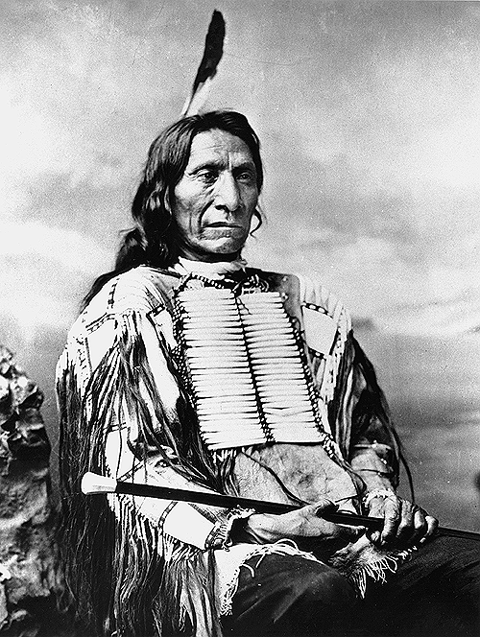
Lakota chief Red Cloud was the nominal leader of a tribal coalition that also included the Northern Cheyenne and Arapaho.  The terms of the Ft. Laramie Treaty of 1868 were generous including the creation a an enormous Great Sioux Reservation including the Black Hills and Powder River country.  In a few short years the treaty was broken and new warfare broke out.

Yet he knew that the white men would eventually break the treaty, which they did after gold was discovered in the Black Hills setting off a new war with the Lakota and Cheyenne that would be fought largely in the Montana/Wyoming border region.  But for a time at least there was peace. 

While war was raging on the northern plains, the Union Pacific Railroad was approaching rapidly from Omaha through the flat, easy country in Nebraska along the Platte River.  On July 4, 1867 railroad construction boss General Granville Dodge (remember him?) platted a town site on in a hollow of the high plateau where the road would cross Crow Creek just before ascending the steep grade of Sherman Hill, the high point of the route.  It was approximately half-way between Omaha and the Valley of the Great Salt Lake and was thus a likely division point for the road.  Tracks arrived at the site on November 13. At first just a rough-and-tumble end-of-tracks Hell-on-Wheels camp, it became the town of Cheyenne, named for the tribe making war just a few hundred miles north


The tent city of Cheyenne in its Hell on Wheels Days as end-of-track for Union Pacific Railroad construction.  It was still relatively rare to display the U.S. flag at civilian buildings.  The flag here probably marked the Federal Land Office.

Within a few months over 4,000 people migrated to the new settlement, dubbed The Magic City of the Plaines in the press for its phenomenal growth.  Even as the railroad moved west taking with it the large construction crews gamblers, prostitutes, and fortune hunters of all sorts flocked to the city as did stockmen hoping to take advantage of the new rail head to open up a whole new range for their herds. 

A temporary Army camp became Fort D.A. Russell, which soon supplanted Ft. Laramie as the main Army post on the Planes.  Its supply depot, Camp Carlin employed teamsters and freight handlers feeding 15 posts scattered to the north.  Within a couple of years stockyards were built, giant ranches established to provide beef for the nation and the famous Cheyenne Club catered to instant millionaires and housed the new and powerful Wyoming Stock Growers Association. 

While other towns sprang up as the U.P moved west—Laramie, Medicine Bow, Rawlins, Rock Springs, Green River, and Evanston—Cheyenne remained the principal city.  Wyoming Territory was carved out of Dakota Territory and organized on July 25, 1868 with Cheyenne as its capital.  The name was picked by Representative J. M. Ashley of Ohio based on a Delaware Indian word that he mistakenly believed meant “end of the plains.”  It actually means some like the “flat by the river,” hardly descriptive of the new Territory. The name was already applied to the Wyoming Valley in Pennsylvania. 

A few towns like South Pass began to spring up in the interior, away from the railroads.  


Esther Hobart Morris in her later years.  In 1870 she became the first woman elected to public office in the the United States as Justice of the Peace at South Park.  She was just one of many women who assumed civic leadership positions and led to the Territory granting women the franchise  leading to Wyoming's claim to be the Equality State.

With men busy building things, the few white women in the Territory began to step forward and at first unofficially took on the duties of local administration.  In recognition women were awarded the franchise in the state in 1869—the first in the country.  In 1870 women served on a Laramie jury while a female bailiff, Mary Atkinson served the court.  The same year at South Pass City Esther Hobart Morris became Justice of the Peace, the first woman officially elected to public office in the United States.  The Territory stuck by its commitment even when women’s suffrage was discouraging support for statehood in Congress.  The state would maintain the women’s vote and go on to be the first state to elect a woman Governor, Nellie Taylo Ross, in 1924. 

Between 1869 and ’71 three government expeditions finally explored and mapped Coulter’s Hell.  The final survey, by Ferdinand Vandeveer Hayden convinced Congress to act to preserve the area from encroachment by miners to the north and stockmen from the south and west.  Yellowstone, occupying the northwest corner of Wyoming and strips of adjacent Montana and Idaho, became the first National Park in the world.  Within a few years it would become an attraction for a tourism industry that would eventually grow to be one of the state’s major sources of income. 

Wyoming also became the home of the first National Forest, Shoshone National Forest in 1891; first National Monument, Devil’s Tower in 1906; and then Grand Teton National Park 1924. 

Still, the Territory of the late 1800’s was a wild and wooly place.  Well organized bands of outlaws and rustlers operated out of the Hole-in-the-Wall a secluded mountain hideout in remote Johnson County from the late 1860’s all the way into the 1920’s.  The best known were Butch Cassidy and Harry Longabaugh, A/K/A the Sundance Kid.  


Rock Springs anti-Chinese riots were bloody and set off similar actions across the the West.

There were also racial tensions in the Territory, particularly at the coal mines operated by the Union Pacific for its engines.   The company began replacing white miners with Chinese laborers at a lower pay in the 1880s.  White miners organized in the Knights of Labor bitterly contested the policy.  In 1883 rioting broke out at Rock Springs resulting in the death of at least 23 Chinese and the burning of the 60 houses in the Chinese district.  Federal troops had to be called in to protect the Asians, although public sentiment across the West was with the white miners.  Violence against Chinese spread over the West in the aftermath. 

In some ways the Territorial Capital of Cheyenne, stoked by the enormous wealth of the cadre of cattle barons who made their homes and headquarters there, became a remarkably modern and progressive city.  In 1884 it became the first city in the nation to illuminate its streets with electric arc lights strung on wires suspended over the streets.  The Capitol Building, Union Pacific Depot, fashionable downtown hotels, the Cheyenne Club, swanky whore houses, and the elaborate mansions of a burgeoning millionaires row were all lit with Edison bulbs. 

The city was also one of the first in the West to install a telephone exchange and some of the earliest horseless carriages could be found on its dusty streets by the turn of the century.


Local cowboys came to Cheyenne in 1896 for the first Frontier Day Rodeo.

In 1897 its one-day cowboy round up and contest became the first municipal rodeo.  It proved so popular that it was soon expanded into annual Cheyenne Frontier Days, a/k/a the Daddy of ‘em All.  It cemented Cheyenne’s reputation as the quintessential cowboy town and a national tourist attraction as well as being a big part in creating the cowboy mythos in popular culture.   Today Frontier Days stretches over ten days in late July and is still the largest and most important outdoor rodeo in the U.S. and Canada.  It is an elaborate festival that includes multiple parades, street dancing, concerts by topflight country music and rock acts, night arena shows, a carnival and other hoopla.   But evenings in downtown Cheyenne are now considerably tamed down from the wild bacchanals that spilled out onto the streets from the many saloons in the 1950s when I was a boy.

The Homestead Act of 1862 began to attract large numbers of immigrants to the fertile, but narrow valleys draining the high country.  Homesteaders fenced their property interfering with free movement of stock over the Open Range where powerful cattle barons ran their herds.  In places they also cut off access to water.  In addition, cattlemen believed that some of the settlers were rustling their beef—something mostly done by the non-sod busters of the Hole-in-the-Wall. 

By far the most violent episode in Territorial and a state history was the infamous Johnson County War, declared by the powerful cabal of the Wyoming Stock Growers Association after the brutal winter of 1888 decimated their herds.  They accused small ranchers and homesteaders of rustling their thin crop of spring calves.  Bands of cowboys began burning out sodbusters and harassing small ranchers, banning them from the traditional joint spring round-ups.  A number of small ranchers were shot, lynched, or disappeared at the hands of Stock Association “Detectives” and Johnson County Sheriff Frank M. Canton who was suspected of organizing most of the terror.   


28 year old Ella Watson and a companion Jim Averell were small homesteaders who were lynched in 1889 by Wyoming Stock Growers Association range enforcers.  Several witness including a 14 year old boy were murdered or kidnapped.  As public outrage grew the Association convinced the eastern press that she was "Cattle Kate" a fictitious "queen of the rustlers."

In a sensational 1889 case two homesteaders, Ella Watson and Jim Averell were lynched and several witnesses, including a 14 year old boy were murdered after the crime was reported to authorities.  The Stock Growers Association circulated a lurid and entirely false story to the national press that Watson was a non-existent Cattle Kate, supposed queen of a ruthless gang of rustlers. 

As lynchings and murders continued, remaining small operators formed their own association, the Northern Wyoming Farmers and Stock Grower’s Association, and announced plans for their own 1892 spring round-up.  In response the cattle barons imported 23 Texas gunslingers, hired four more detectives, and formed an unofficial posse under Canton that also included some of the most important men in the state as well as a sympathetic eastern newspaper reporter.  The Texans were paid a handsome $5 a day plus a $50 a head bounty on any person on a 70 person hit list carried by Frank Canton.  Riding to Johnson County from Casper the Regulators, as they styled themselves, cut telegraph wires to prevent word of their activities from getting out. 

The first target was one of the organizers of the Northern Wyoming group, Nate Champion.  He was besieged in his log cabin after his three companions were captured and shot.  He held off his attackers for most of a day killing 4 and injuring several more until his cabin was set on fire.  He came out shooting and was riddled with 28 bullets.  The Regulators left him where he lay with a note pined on his chest “Cattle Thieves Beware.”  Neighbors heard the lengthy gun battle, depriving the Regulators of surprise. 

They got word to a new, sympathetic Sheriff in the county seat at Buffalo, who rounded up a posse of 200 men and cornered the Regulators in a log barn at the TA Ranch by Crazy Woman Creek.  A prolonged gun battle erupted, and three more Texans were killed.  Someone managed to escape and get word to a sympathetic Acting Governor who wired President Benjamin Harrison for military help to save the Regulators.  Troops from Sixth Cavalry at Ft. McKinley near Buffalo arrived in time to save the men.  


The Texas gunslingers, range detectives, and cattlemen captured by the Army and taken to Ft. Russel in Cheyenne  after the siege of Crazy Woman Creek in the Johnson County War.  Those released on bail melted away.  Charges against the rest were never prosecuted despite overwhelming evidence.

The army took the Regulators into custody and brought them to Ft. Russell in Cheyenne, where Canton’s hit list and other damming evidence, including the instructions of the powerful leaders of the Stock Grower’s Association who hired the thugs and their identities were revealed.  The Johnson County Attorney began to collect evidence against them all, including United States Senator Francis E. Warren, the biggest fish of all. 

In Cheyenne, however the surviving Texans and detectives were released on bail and “disappeared.”  The big wigs escaped prosecution because the County simply could not afford to prosecute the case.  Public outrage in the state resulted in the Republicans, identified with the Stock Growers Association, being ousted from both houses of the legislature and the election of a Democratic Governor. 

It didn’t last long.  Republicans and the Stock Growers were soon riding high again.  Warren was elected to a new term in the Senate in 1894 and served until 1924 becoming one of the most powerful men in that body.  When Ft. Russell was converted from a cavalry post to an Air Force Base after World War II it was renamed in Warren’s honor. 

The events of the Johnson County war marked the early statehood of Wyoming, which remained deeply divided between the two sides for decades with occasional outbreaks of violence.  It became the archetypical western story retold over and over from many points of view.  Owen Wister’s 1902 novel The Virginian glorified the big ranchers and their “loyal cowboys.”  The 1952 film classic Shane told part of the tale from the other side.  The legendary film flop, Michael Cimino’s Heaven’s Gate turned the Johnson County War into an almost Homeric Epic.


Wyoming sent more troops per capita to the Spanish American War than any other state.  In addition to cowboys who volunteered for the Rough Riders and state National Guard troops there was this unit, the Wyoming Volunteer Light Battery.

The new state closed out the 19th Century by enthusiastically embracing the Spanish American War.  It sent more men per capita to the conflict than any other state, including many cowboys, some of them veterans of the Johnson County War, who joined the Rough Riders. 

Today, folks in Wyoming still pick sides in the Johnson County War dispute.  The Wyoming Stock Growers Association remains a powerful force in the state, although it now must share its clout with the big energy companies.

Wyoming is known as both The Cowboy State and the Equality State celebrating different aspects of its past.