 |
| Andrew Jackson, self-proclaimed champion of the common man, had no qualms about ordering Federal Troops to squash a strike for the first time in U.S. history at the request of the politically powerful Chsapeake & Ohio Canal Company. |
It
had been George Washington’s dream first. And a big one. Decades later it seemed that despite enormous obstacles, it was finally coming to pass. But on January 29, 1834 the hundreds immigrant Irish, Dutch, German laborers downed
their picks and shovels in protest to the brutal conditions of hewing
the ditch by hand from the stony
soil of Virginia (now West Virginia) from first light to the descending gloaming seven days a week. Blacks
were also on the job—mostly slaves
contracted from local plantations—but
whether they joined the impromptu strike
is unclear. Slave or free all were ill clothed and given little more than
a single thin blanket in the brutal winter weather. Wages—for
those who got paid at all—were less than
a dollar a day and the use of tools
and such were charged to the workers.
Supervisors and foremen on the job were roughed
up and some Chesapeake & Ohio
Canal Company property was damaged.
The
company claimed insurrection and riot and appealed for aid. In Washington, DC the crusty and volatile President
Andrew Jackson wasted no time in ordering Federal Troops to suppress
the “rebellion.” It was the first
time the Army was ever called upon to suppress a strike. It would not
be the last.
 |
| U.S. Army Regulars turned out against the starving, ragged, and unorganized canal diggers were handsomely turned out in parade ground uniforms. |
When
they arrived on the scene the smartly dressed Army Regulars had no trouble putting down the strike by men armed only with stones and brickbats. It is unclear if shots were fired or the flash of bayonets was sufficient to
disperse the strikers, who had no
organization or union. A few identified
“leaders” were arrested, others fled.
Most of the men sullenly went
back to work under armed guard. It
is presumed that any slaves who participated where much more brutally handled by their owners or overseers with the lash.
It
all began before the Revolution. Virginia planter, surveyor, and militia
officer Col. George Washington had vast land claims in the Ohio wilderness which he dreamed of filling with settlers on 99 year leases to the land that he
owned. But besides persistent hostility by Native
American nations, and the British policy
confining legal settlement to the east
of the Allegheny Mountains, the biggest obstacle to making those dreams
come true was the near geographic
impossibility of easy access to
and from the land. Those mountains divided the watersheds of the Ohio and Potomac
rivers and provided a rugged barrier
to even land access.
Washington
wanted to build canals, complete
with locks to raise boats to higher and higher elevations to circumvent and push past the
rapids which were the navigable
limits of the Potomac. In 1772 he
received a Charter from the Colony of Virginia to survey possible routes. But before work could progress beyond the planning stage, the Revolution intervened and Washington was occupied elsewhere.
But
he never forgot the pet project. Back home at Mount Vernon in 1785 Washington formed the Patowmack Company in. The Company built short connecting canals
along the Maryland and Virginia
shorelines of Chesapeake Bay. The lock systems at Little Falls, Maryland, and Great
Falls, Virginia, were innovative in concept and construction. Washington himself
sometimes visited construction sites
and supervised the dangerous work of
removing earth and boulders by manual labor himself.
Now
confident that his scheme would work, Washington began to plan more inland sections. A
call to another job—as President of the United States—interrupted his plans, but he looked forward to resuming work in retirement.
Unfortunately
that retirement did not last long
and when the great man died in 1799,
the Patowmack Company folded.
Almost
25 years later, in 1823 Virginia and Maryland planters began to fret that the Erie Canal, which was nearing
completion in upstate New York would leave their region far behind in economic growth as all or most of the production from the rapidly growing states north of the Ohio would
be funneled to the Great Lakes, and via the Canal and Hudson River to New York City. They organized
and got chartered the new Chesapeake and Ohio Canal Company.
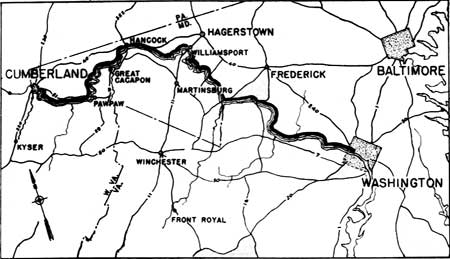 |
| The route of the Chesapeake & Ohio. The ditch was nearing Williamsport when the spontaneous strike broke out during harsh winter weather. |
Five
years later in1828 Yankee born President John Quincy Adams, probably with some qualms about the possible effect
on the westward spread of slavery, ceremonially turned the first spade of earth.
Progress was slow and arduous as the canal
ran parallel to the Potomac. There had
been other sporadic work stoppages.
Difficulties in the era of repeated
financial panics also interrupted
work. Then there was bad weather, the increasingly difficult terrain, and even a cholera epidemic. In late 1822 the ditch finally reached the critical river port of Harpers Ferry. Workers were pushing on to Williamsport when
the trouble broke out.
Work
continued with more interruptions and a lawsuit between the Canal Company and
the Baltimore and Ohio Railroad about
a right of way to cross from the
Virginia to the Maryland side of the river also complicated matters.
In
1850 the canal finally reached Columbia,
Maryland far short of the goal of connecting with the Ohio. But by that time the rapid spread of railroads, particularly the B&O, had rendered completing the project obsolete. Washington’s grand canal never got any
further.
 |
| The Chesapeake & Ohio at Georgetown just outside of Washington in the post-Civil War era. Trains using the iron bridge in the background were rapidly making the canal obsolete. |
But
the existing ditch was still useful.
Boats, originally romantically
named gondolas later barges,
used the waterway until it finally went out of business in 1924.
Today
you can visit the Chesapeake and Ohio Canal
National Historical Park and hike along the tow path.
The bloody tradition of using
Federal troops as strike breakers out lived the canal.


