Tuesday, November 23, 2021

Robert Bly—The Iron Man Succumbs to Rust

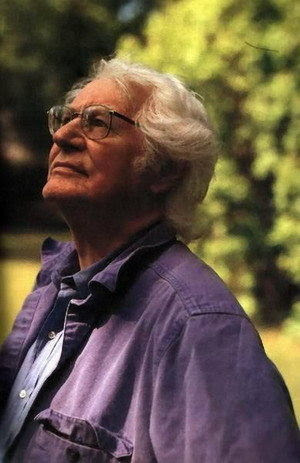
                                Poet, mystic, activist Robert Bly.

Robert Bly, the iconic and wayward Minnesota poet best known as the founder of the sometimes controversial spiritual mythopoetic men’s movement which tried to re-connect masculinity with nature and re-balance the male role the sacred feminine, died Sunday in Minneapolis, Minnesota at the age of 94.  He had been suffering from Alzheimer’s disease since at least 2012.

Bly, through his publications, seminars, and tribal gatherings nurtured new generations of ecopoets.  The men’s movement he spurred with the publication of his book Iron John: A Book About Men in 1990 exploded in popularity and participation around the turn of the 21st Century.  Considered by some as an answer to second wave feminism and women’s’ liberation, he intended it as a complimentary movement, a point lost on many of its most enthusiastic participants.  It was also widely mocked for promoting arcane drum circles of naked men in the woods. 

In the interest of full disclosure, I was one of the mockers when a Bly inspired men’s group briefly flourished at the old Congregational Unitarian Church in Woodstock about 2000.

Garrison Keillor eulogized his fellow Minnesotan yesterday on his Writer’s Almanac podcast:

He was born in Madison, Minnesota on December 23, 1926. A high school teacher taught him to appreciate poetry, but he didn’t start writing seriously until he joined the Navy after high school. There he befriended a man named Eisy Eisenstein — the first person he had ever met who wrote poems. After the Navy, he spent a year at St. Olaf College on the GI Bill. He said: “A woman my age wrote poetry; I fell in love with her, and I wrote a poem to her. I had the strangest sensation. I felt something in the poem I hadn’t intended to put there. It was as if ‘someone else was with me.’” He transferred to Harvard and applied to work as an editor for the literary magazine, the Harvard Advocate. When the staff interviewed him for a position, he responded with a long, detailed critique of American poetry since 1910. The staff seemed unimpressed, but they accepted him anyway. One day a new student board member turned up, a poet a year younger than Bly named Donald Hall. They became best friends.

After Bly left Harvard, he decided that he didn’t want to teach at a university — he was inspired by his idol, William Carlos Williams, and also by Wallace Stevens, neither of whom was a career professor. So, he returned home to his family’s farm in western Minnesota and began to write. Since he was so far away from a literary community, he wrote frequent long letters to his friends and peers: Donald Hall, Tomas Tranströmer, Galway Kinnell, Louis Simpson, and others. Bly and Hall exchanged letters twice a week for decades, with a rule that they had to respond to each other within 48 hours.
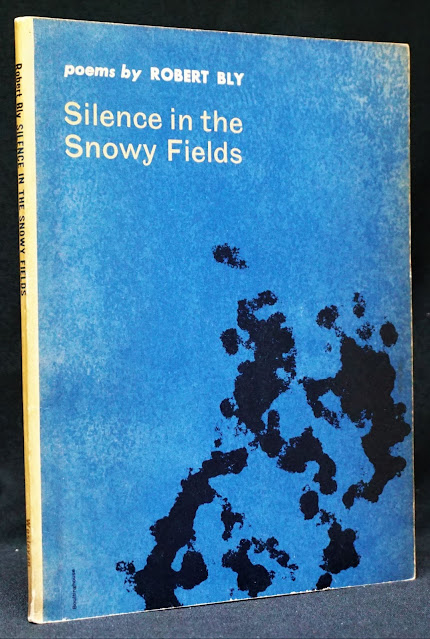
                Bly's first poetry collection in 1962.

Bly’s early collection of poems, Silence in the Snowy Fields, was published in 1962. Its plain, imagistic style had considerable influence on American verse of the next two decades.  The following year, he published A Wrong Turning in American Poetry, an essay in which he argued that the vast majority of American poetry from 1917 to 1963 was lacking in soul and “inwardness” because of a focus on impersonality and an objectifying intellectual view of the world. Bly believed this approach was instigated by the Modernists and formed the aesthetic of most post-World War II American poetry. He criticized the influence of Modernists such as T. S. Eliot, Ezra Pound, Marianne Moore, and former idol William Carlos Williams—a virtual who’s who of the most revered American poets.  He argued that American poetry needed to model itself on the more inward-looking work of European and South American poets like Pablo Neruda, César Vallejo, Antonio Machado, and Rainer Maria Rilke. A Selected Poems translation of Rilke from the German, with Commentary by Bly, was published in 1981. Times Alone, Selected Poems of Machado, with facing pages of Spanish/English translation, was published in 1983.

In 1966, Bly co-founded American Writers Against the Vietnam War and was among the leaders of the opposition to that war among writers. In 1968, he signed the Writers and Editors War Tax Protest pledge, vowing to refuse tax payments in protest against the war.  In his speech accepting the 1968 National Book Award for The Light Around the Body, he announced that he would be contributing the $1000 prize to draft resistance organizations.
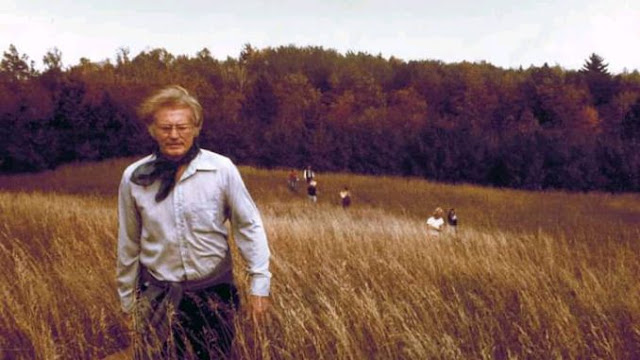
Robert Bly on the farm in midlife.

Bly’s development of his men’s movement had its roots in his close association with the Great Mother Conference in 1975.  The nine-day event featured poetry, music, and dance to examine human consciousness.  The event became annual, and Bly attended every year through 2007.  In the early years, its major theme was the Goddess or Great Mother, as she has been known throughout human history. Much of his collection Sleepers Joining Hands from 1973 was concerned with this theme. In the context of the Vietnam War, he saw a focus on the divine feminine was seen as urgent and necessary. Since that time, the Conference has expanded its topics to consider a wide variety of poetic, mythological, and fairy tale traditions. In the 1980s and ‘90s Bly led the discussion in the conference community about the changes which contemporary men were going through resulting in The New Father, over the objection of some feminists, was added to the Conference title.

Bly published more than 40 collections of poetry, edited many others, and published translations of poetry and prose from such languages as Swedish, Norwegian, German, Spanish, Persian, and Urdu. His book The Night Abraham Called to the Stars was nominated for a Minnesota Book Award. He also edited the prestigious Best American Poetry in 1999 for Scribner’s.
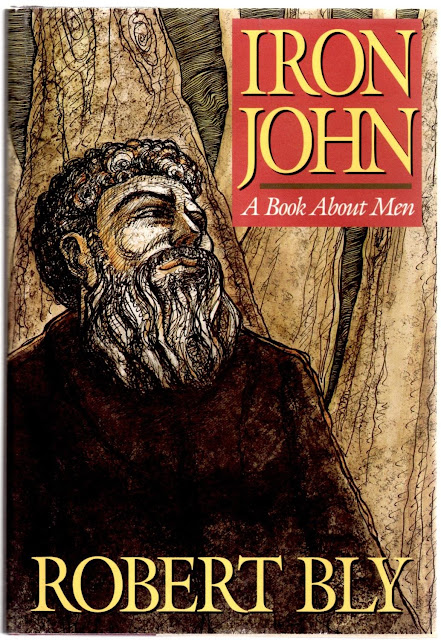
                                            Bly's most famous book was not poetry, but his lyrical manifesto for the mythopoetic Men's Movement.

In 2006 the University of Minnesota purchased Bly’s archive, which contained more than 80,000 pages of handwritten manuscripts; a journal spanning nearly 50 years; notebooks of his morning poems; drafts of translations; hundreds of audio and videotapes, and correspondence with many writers such as James Wright, Donald Hall, and James Dickey. The archive is housed at Elmer L. Andersen Library on campus.

In February 2008, Bly was named Minnesota’s first poet laureate.  In that year he also contributed a poem and an Afterword to From the Other World: Poems in Memory of James Wright. In February 2013, he was awarded the Robert Frost Medal, a lifetime achievement recognition of the Poetry Society of America.
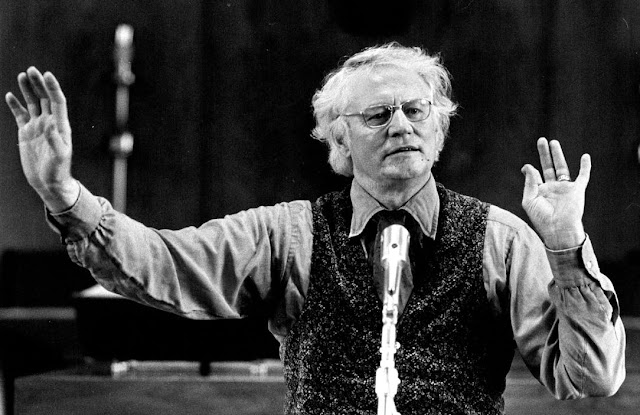
Robert Bly reading.

In a separate post Keillor shared one of the Morning Poems Bly faithfully recorded in his notebooks each morning, one of his regular spiritual practices.

     Every day around dawn Robert Bly

     Writes a poem, that is no lie,

     And the poem he composes

     At the end of his nose is

     Looking him straight in the eye.

     And with great clarity

     Addresses posterity

     Though he is not intending to die.


     Robert Bly


Despite, or perhaps because of his mysticism, Bly remained engaged as a social critic and particularly as a pacifist.


Call and Answer


Tell me why it is we don’t lift our voices these days

And cry over what is happening. Have you noticed

The plans are made for Iraq and the ice cap is melting?


I say to myself: “Go on, cry. What’s the sense

Of being an adult and having no voice? Cry out!

See who will answer! This is Call and Answer!”


We will have to call especially loud to reach

Our angels, who are hard of hearing; they are hiding

In the jugs of silence filled during our wars.


Have we agreed to so many wars that we can’t

Escape from silence? If we don’t lift our voices, we allow

Others (who are ourselves) to rob the house.


How come we’ve listened to the great criers—Neruda,

​Akhmatova, Thoreau, Frederick Douglass—and now

We’re silent as sparrows in the little bushes?

Some masters say our life lasts only seven days.

Where are we in the week? Is it Thursday yet?

Hurry, cry now! Soon Sunday night will come,


—Robert Bly


Other times that famous mysticism shone clearly.


Living at the End of Time


There is so much sweetness in children’s voices,

And so much discontent at the end of day,

And so much satisfaction when a train goes by.


I don’t know why the rooster keeps crying,

Nor why elephants keep raising their trunks,

Nor why Hawthorne kept hearing trains at night.


A handsome child is a gift from God,

And a friend is a vein in the back of the hand,

And a wound is an inheritance from the wind.


Some say we are living at the end of time,

But I believe a thousand pagan ministers

Will arrive tomorrow to baptize the wind.


There’s nothing we need to do about John. The Baptist

Has been laying his hands on earth for so long

That the well water is sweet for a hundred miles.


It’s all right if we don’t know what the rooster

Is saying in the middle of the night, nor why we feel

So much satisfaction when a train goes by.


—Robert Bly

Monday, November 22, 2021

It’s THAT Day Again

New Yorkers gobbled up hastily printed extra editions as they gathered in shock on the city streets.

November 22.  For the members of a couple of generations, at least, I don’t have to say or write anything else.  You know.  The date and the event are etched in your mind.  If you were sentient in 1963 the moment when you heard the news is so solidly etched in your memory that you can recall every detail—the cast of the light through the window, the muffled sobs or wails, even the smell of that autumn day 58 years ago.

November 22, 1963 was, of course, the day President John F. Kennedy was shot while passing the Texas School Book Depository Building in Dallas, Texas in an open car with his young wife, resplendent in pink, sitting beside him. 

Moments before the shooting in Dallas President Kennedy and his fashionable wife Jaqueline ride in an open limousine behind Texas Governor John Connolly and his wife.

I am not going to relate the details.  You know them.  Nor am I going to sort out the 1,354 various conspiracy theories which have been put forward.  Most of them are ridiculous.  Some are compelling.  The official Warren Commission Report was as full of holes as Swiss cheese and the Congressional investigations since then have at best given us a glimpse “trough a glass darkly.”  The absolute truth, if any such thing is possible to know, will probably always elude us. 

In one of the most memorable moments in television history Walter Cronkite removed his glasses and delivered the somber news that the President had died.   Many who had rushed home from work or school saw it live.

It is enough to know that a young President, in whom many of us had invested great hope, was killed because some vague they wanted him dead and that hope, merited or not by the flawed individual, crushed.

It is the stuff of legend.  Two hundred years from now operas, epic poems, or whatever form that heroic art takes shape in then, will imbue the events with magic and dignity.

Yet right now, this is still peculiarly our day, it owns us inescapably. 

Many families rushed to buy the special hard bound Kennedy Memorial Life Magazine edition that included photos of the funeral and kept it for years as a special remembrance.

But for my grown children it is only a historical event.  Their stomachs do not flip with the remembrance.  They acknowledge it without understanding it the way we acknowledged December 7, 1941—the central stark moment in our parents’ lives.  For them September 11, 2001 was the pivot of history.

And for my grandchildren…well it is just another day on the walk-up to Thanksgiving. They hardly know who John Kennedy was.  They never heard of Lee Harvey Oswald.  If reminded, they may grunt a foggy awareness.  But it is no more real to them than the Peloponnesian Wars


Sunday, November 21, 2021

Who Was Tom Horn?—Cowboy Assassin or Tragic Hero

Gun for hire Tom Horn passed the time awaiting trial in the office of the Laramie County Sheriff calmly plaiting a horse hair Mexican style riata. 

Tom Horn is a kind of litmus test of conflicting, class driven, views of Western history.  Depending on who you ask the soft spoken man who was hung for shooting a 14 year old boy in the back and killing him was a misunderstood hero, the beau ideal of a cowboy, lawman, and range detective or a ruthless, pitiless gun for hire.

These two visions are represented in American culture by two iconic but contrasting western stories.  Owen Wister’s The Virginian had as its hero the noble foreman of a great ranch who led a fight against rustlers and thieves.  Years later in the classic film Shane, Alan Ladd would play a drifter with a past who would stand up to a cattle baron on behalf of sod buster farmers.

In 1901 the days of the wild and woolly frontier were fading fast, even in Wyoming.  After gaining statehood in 1890, the bloody Johnson County War between the ranching barons of the Wyoming Stock Growers Association and their small, hired army of gunslingers and plug-uglies and the small ranchers and homesteaders suspected of throwing the occasional long lasso over the necks of cattle had officially ended in 1892.  That’s when a local sheriff with the assistance of the Cavalry rounded up the gang of the gunmen besieging an isolated ranch.  They were hauled to Cheyenne for trial.  But oddly, while out on bail, all slipped away.

Mostly cowboys and gunmen from Texas these men hired by the powerful Wyoming Stock Growers Association were rounded up to stand trial for crimes during the notorious Johnson County Range War.  They all slipped away before they could be brought to trial.

The plutocrats of the Stock Growers Association and the state government in the hands of their handpicked officers laid low for a while in their mansions and in the impressive headquarters that dominated the city’s downtown.  They helped establish Cheyenne Frontier Days, the oldest municipal rodeo, to celebrate the fading glory of the unchallenged Open Range and import tourists.  By the turn of the century some of them were toddling around town in newfangled and expensive automobiles.  But despite the appearance of modernity, they had re-launched their old campaign against small holders, on a scaled back level amounting to a low grade guerilla war.

Enter Tom Horn.

Horn was born on a 600 acre farm on the South Wyaconda River in northeast Missouri’s Scotland County on November 21, 1860.  He was about in the middle of a pack of twelve children.  Not much is known about his childhood other than it was probably pretty typical as any in its time and place.

By age 16, like many younger sons with a taste for adventure and no hope of inheriting the family farm, Tom headed west.  He knocked around the Southwest picking up the skills of a cowboy.  In 1883 he was enlisted as a civilian Cavalry scout under Albert Sieber for General George Cook’s campaign against Chiricahua Apaches under Geronimo.  The German born Sieber took the young man under his wing and mentored him, even taught him to speak German, as well a much tracking and trailing lore.

Tom Horn in his glory days as an Army Scout hunting for Geronimo.

The Scouts accompanied Cook when he illegally crossed into Mexico seeking the elusive Geronimo in the Santa Madre Mountains.  In 1886, after Geronimo and a handful of followers escaped Cook’s custody, Horn was assigned to a small contingent commanded by Captain Henry Lawton of B Troop, 4th Cavalry and First Lieutenant Charles B. Gatewood to once again go into Mexico.  The Mexican’s hated Geronimo but were also sensitive about their sovereignty.  Horn was wounded when local militia attacked his camp.  Later he killed his first known man, and the only one in a stand-up idealized western gun duel—a dust up with a Mexican officer at a cantina

When Lt. Gatewood finally found Geronimo’s camp with Horn’s help, Seiber was elsewhere.  It was Horn who translated at the delicate negotiations that resulted in the old chief’s final surrender.

At loose ends after the essential end of the Indians wars in the Southwest, Horn drifted back into cowboying then staked a mining claim.  It did not take long however, for him to enter the Arizona Pleasant Valley War as a hired gun.  But it is not clear to which side he sold his services.  Also known as the Tonto Basin Feud it was a long running conflict between two large ranching families, the half-Indian Tewksburys and the Grahams over land and water rights as well as mutual rustling.  It had been a deadly affair since 1882 and intensified in ’86 when the Tewksbury’s introduced sheep to the range

In his autobiography Horn said he joined in the pursuit of rustlers, which could refer to either party.  But given his later proclivity for cattle ranchers and enmity toward Indians it is likely that he accepted the pay of the Grahams.  Both families and their employees were victims of several unsolved slayings, some of them perhaps by Horn acting as a “regulator”.  Taken together, both families were nearly wiped out and the conflict has been called the deadliest feud in American history, far outstripping the body count of the Hatfields and McCoys or the earlier Arizona Lincoln County War made famous by Billy the Kid.  Killing continued into the early 1892 when the last Tewksbury killed the last Graham.

Sporadically during and after the Pleasant Valley war, Horn also served as a deputy sheriff prized for his unmatched skill as a tracker.  He served under three of the most famous Southwest lawmen, William “Buckey” O’Neill, later a Captain in the Rough Riders killed in Cuba; long haired Commodore Perry Owens of Apache County; and former Confederate Glenn Reynolds.  Each of them, at one time or another, intervened in the Feud and Horn’s status as deputy may likely have been paid for by one or the other side when posse went after the other.

Horn’s exploits as a gun for hire and erstwhile lawmen became celebrated enough to come to the attention of the Pinkerton Detective Agency which hired him in 1890 as one of its operatives out of the Denver office.  He specialized in tracking down those that stole effectively from the rich—rustlers, train, and bank robbers.  In his most famous case, he tracked Thomas Eskridge “Peg-Leg” Watson and Burt “Red” Curtis who were suspected of a robbery of the Denver & Rio Grande Railroad in August of 1890 all the way from Colorado to a hideout in Oklahoma Territory.  His orders were to bring the men in.  He and his partner took the men “with no trouble and without firing a shot.”

Horn by this time considered himself a professional.  He held no personal animus to any of the men he relentlessly tracked down.  As a professional he did what he was ordered.  If the Agency wanted the publicity of nabbing two semi-famous outlaws and bringing them to justice, he was the man for the job.  It the Agency or its wealthy clients preferred that their problems be eliminated, Horn had no trouble with that either.  Some of the men he hunted ended up dead, generally shot from ambush in ways in which the killing could not be linked to the shooter, the company, or the client.

Horn considered himself honorable and consoled any qualms of conscience by telling himself he was working for if not law, then at least some sort of avenging justice.

Charlie Siringo was a famous Range Detective who turned against his former Pinkerton employer in his memoir Two Evils: Anarchism and Pinkertonism.  He claimed William Pinkerton told him that that Tom Horn was guilt of the murder with which he was charged.

By 1894, however, too many people were ending up dead in Horn’s vicinity.  He resigned from the Pinkertons under pressure.  It was not that the agency was displeased with the results of his work.  When one of the best known of Pinkerton’s western operatives, Charlie Siringo who had worked closely with Horn published a memoir Two Evils: Anarchism and Pinkertonism he claimed that, referring to one case that “William Pinkerton told me that Tom Horn was guilty of the crime, but that his people could not allow him to go to prison while in their employ.”

Although no longer an employee, Horn would continue to sometimes work with the agency and was sometimes contracted by them to work on specific cases in his new role as an independent Range Detective for hire.  One of his most reliable clients was the Wyoming Stock Growers Association, the biggest employer of hired gunmen in the West.  They put him to work on cases in the Johnson County War.

Horn may not have been carrying a badge as an Official Stock Growers Association Range Detective, but was working under special assignment.

He was thought by many to be among the gunmen who killed Nate Champion the leading spokesman of the small ranchers that the Association accused of rustling.  Champion was the first victim of the all-out war.  He was besieged in his cabin at the KC Ranch where he held off a posse of 200 sheriff’s deputies and Association gunmen for hours, keeping while keeping a journal of the battle.  He was cut down by fire from five men, allegedly including Horn, when he ran from the cabin on April 9, 1892.

It was sheer luck that Horn was not among the Association gunmen arrested later that year—he was off working, as he generally preferred, alone and independently at the time.

In 1895, now an independent agent for the Association, he was accused of killing William Lewis near Iron Mountain, Wyoming and six week later another alleged rustler, Fred Powell.  He avoided being charged in both cases due to the powerful political influence of the Association.  The following year a small rancher named Cambell, who had just sold some cattle and was caring a large amount of cash, vanished after last being seen in the company of Horn.  There were other murders or disappearances on the range in those years.  Horn may or may not have been involved—he was not the only gunman on the loose, just the most notorious.

Still, occasionally Pinkerton would call on Horn to investigate real criminals.  He was contracted to investigate the Wilcox train robbery, committed by members of Butch Cassidy’s Hole in the Wall Gang.  He identified two members of the gang, George Curry and Kid Curry as the likely killers of Sheriff Josiah Hazen who had been shot in pursuit of the gang.  He passed the information on to Pinkerton Siringo. 

Patriotically, Horn, like many westerners, volunteered in the Army for the Spanish American War.  Before he could ship out to Cuba, however, he was struck down by malaria, which was rampant among the troops, in Tampa.  He never got to see action and it took some time for him to recover his health.

Back in Wyoming by 1899, Horn was working for the Swan Land and Cattle Company and was known to have killed two rustlers, Matt Rash and Isom Dart.  A year later, working in Colorado, he was suspected in the ambush killing of two other suspected cattle thieves.

In 1901 he was employed by cattle baron John C. Coble.  He was working around an old stomping ground, Iron Mountain, when his attention was drawn to small rancher named Kels Nickell who was running sheep on the range.

14 year old Willie Nickell was photographed on his father's ranch not long before he was shot and killed.

On July 18, 1901 Nickell’s 14 year old son Willie was shot from ambush twice while opening a gate at his father’s ranch.  Two bullets tore completely through his body, one piercing his back and another entering his shoulder and traversing his body sideways and down, indicating that he was either twisting from the impact of the first round, or as some later investigators of the shooting believe, hit by a round from a second shooter.

A few days later Willie’s father was also shot and wounded.

Horn was known to be in the area and interested in the Nickells.  He left immediately after the shooting.  A year later, drunk and supposedly remorseful for killing the boy instead of his father, Horn allegedly confessed to an old acquaintance Joe Lefors, a deputy U.S. Marshall.  Although many would later question the confession, he was charged with the murder.

An artist's conception of the killing.  The shooter may or may not have been Tom Horn and he may or may not have worked alone.

When arrested he had in his possession a Winchester Model 73 lever action rifle, too small a caliber to have been used in the Nickell murder.  But he had in his pocket two rounds for larger caliber rifles, either of which might have been capable of producing Willie’s wounds.  With no eye witnesses, this circumstantial evidence, the questionable and recanted confession, and the knowledge that his employer had targeted the Nickell ranch, was all prosecutor Walter Stoll had to go on.

The Winchester rifle in Horn's possession when he was arrested was too small a caliber to have been used in the Nickell murder, but two larger caliber rounds were found in his pocket.

It turned out to be enough. The public was getting sick of continued violence on the range, and all of the Stock Growers Association political clout could not, for once, get around it.

At the trial the defense tried to show that neighboring rancher Jim Miller with whom the elder Nickell had clashed over his sheep had a motive to kill.  The testimony came from an attractive school teacher, Glendolene M. Kimmell who boarded at the Miller ranch and who was romantically linked to Horn.  But that was not necessarily exculpatory for Horn, who would have used Miller as an asset in his investigation of Nickell, and who might have even been encouraged by him to do the shooting.

Horn visited school teacher Glenolene M. Kimmell on the Miller Ranch before the ambush and she visited him in jail awaiting trial.  Her interviews of him were the basis of Horn's Autobiography published in Denver.  He involvement with Horn has been romanticized in novels and movies.

Whatever the case, the jury returned a verdict of guilty.  Horn’s appeal to the Wyoming Supreme Court failed.  Tom Horn was going to hang.

All the time Horn was sitting in his jail cell he serenely passed his time braiding a two-color horse hair riata in the old Southwest style.  He was visited frequently by Miss Kimmell who gathered from their conversations and Horn’s notes the material for the publication of Horn’s Autobiography in Denver in 1904.  Horn also visited and modestly conversed with reporters and even visiting celebrities including Heavyweight Boxing Champion Gentleman Jim Corbet.  His quiet, pleasant demeanor impressed many visitors.  He just didn’t seem like a hardened killer.

None-the-less, Horn was hung in Cheyenne on November 20, 1903.  He was just past his 43rd birthday.

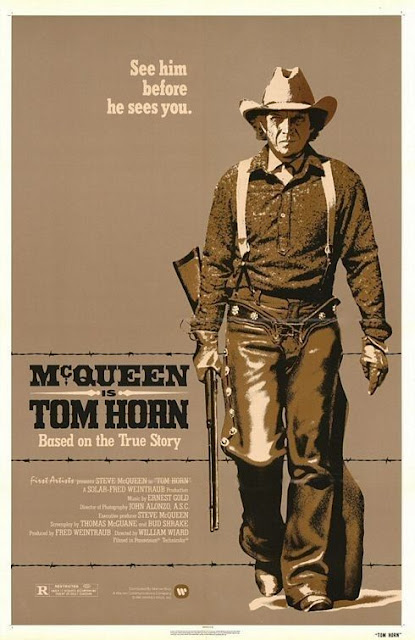
Since then, Horn has lapsed into folk hero/villain status.  He was the subject of several western novels and stories either under his own name or inspiring thinly veiled characters.  At least one totally fiction western movie, Fort Utah staring John Ireland in 1967 cast him as a hero.  Best known film version was Tom Horn released in 1980 with Steve McQueen sympathetically portraying him as a man lost out of his time and confused by the emerging modern worldDavid Carradine played him in a made for TV movie, Mr. Horn a year earlier.  And the History Channel produced a documentary claiming to clear Horn of this particular murder or cast doubt on his guilt.

                                        Steve McQueen's Tom Horn was a man whose time had passed.

Western historians are divided on the case.  A good many believe that despite the scant evidence, Horn was probably guilty.  Others believe that he accidently killed the boy intending to kill the father and many of these would have excused the execution of the older man as rough range justice.  Others believe he may have only been peripherally involved by perhaps fingering the Nickells for another shooter or abetting the Miller family.  Some think he may have been one of two shooters. Others buy the two shooter theory but believe it was the work of the Millers.  And decedents of the old cattle barons and their defenders still maintain that Horn was entirely innocent and the victim of persecution by small rancher/rustlers and a lynch mob of public opinion.

Take your pick.

As for me, however sympathetic and compelling he or Steve McQueen might have been, Tom Horn was a killer who was bound someday for the noose—even if he didn’t shoot Willie Nickell.


Saturday, November 20, 2021

A Light for the Ostracized and Despised —Transgender Day of Remembrance


Note—After public observations of Transgender Day of Remembrance were canceled due to the Coronavirus pandemic, they are returning to communities across the U.S. and the globe as violence continues to escalate against people identifying or displaying non-traditional gender identity, especially transwomen of color.  Remembrance must me matched with action.

Maybe because their names and faces get lost in the grim glut of crime reporting. Maybe because no one knew their story—or their secret.  Maybe it’s because the Guardians at the gate want to protect our tender sensibilities.  Maybe it’s because outside of “those people” no one cares.  Or maybe it’s because some see a kind of rough justice acted out on the streets and prefer to let it go on as they used to whistle-by-the-graveyard the dark at lynchings that kept Black folk in their place.

But someone must remember these Transgender people murdered every year simply because of who they are.  According to transrespect.org :

… a total of 369 cases of reported killings of Trans and gender-diverse people between 1st of October 2017 and 30th of September 2018, constituting an increase of 44 cases compared to last year’s update and 74 cases compared to 2016. The majority of the murders occurred in Brazil (167), Mexico (71), the United States (28), and Colombia (21), adding up to a total of 2982 reported cases in 72 countries worldwide between 1st of January 2008 and 30th of September 2018.


The actual numbers are likely higher.  There is no uniform reporting of crimes against trans and gender-diverse people ranging from those who have completed surgical reassignment, those who identify with a gender other than the one assigned at birth, those who embrace gender ambiguity, cross dressers, and drag performers who may be perceived as trans regardless of their orientation.  Many police reports identify victims only by their genitals and, especially in urban, crime plagued areas, most murders not involving children, multiple victims, white, or prominent victims are poorly covered by the press.

Levels of violence have risen in the United States but there is antidotal evidence that the general rise of intolerance and hate crimes fostered by Donald Trump, his Republican Party, and semi-hysterical right wing Evangelicals has disproportionally affected those who are identified as Transgender, especially Blacks, Latinos, and other minorities due to the double-whammy of the rise of White Nationalism.

Haters respond to none-to-subtle cues from Republican state legislators and rightwing media.  The former Presidential mal-administration tried to define transgender identity “out of existence” and erase civil rights protections for LGBTQ people.

Some state laws now narrowly defining gender as a biological, immutable condition determined by genitalia at birth, the most drastic move yet in the effort to roll back recognition and protections of transgender people under Federal civil rights law.

Street demonstrations demanding safety and justice respond to the right-wing backlash against Trans rights and escalating violence.

The Trumpist Justice Department rescinded Obama era protections for Transgender individuals in prison despite irrefutable evidence that placing prisoners in general populations based solely on birth genitalia is an open invitation to assault, rape, and even murder—precisely the outcome former Attorney General Jeff Sessions had in mind.

Meanwhile those red state legislatures worked over-time on their own attacks including ludicrous Bathroom Bills, removing protections of trans students in schools, and blocking or stripping out existing inclusion in hate crime laws.

Black Trans women are over-represented by percentage of the population among American crime victims.  Often tenuous and sometimes strained relations between activists in the Trans, Black, Gay, and feminist communities have sometimes stood in the way of common action and protest.

Gwendoyn Ann Smith founded the International Transgender Day of Remembrance in 1999.

Perhaps ironically the International Transgender Day of Remembrance had its origin with the murder of Rita Hester, transgender African-American woman murdered in Allston, Massachusetts on November 28, 1998

Like so many memorial days do, an outpouring of community grief and anger led to a candlelight vigil held the following Friday, December 4 with 250 people in attendance. 

That vigil inspired the Remembering Our Dead web project and the International Transgender Day of Remembrance.  Gwendolyn Ann Smith, a transgender graphic designer, columnist, and activist helped organize the first public vigil in honor of all victims the next year in San Francisco in November of 1999.

Since then, the observation has spread across the world.

Black and other Transwomen of Color are disproportionately targeted for violence and abuse.  In McKeesport, Pennsylvania this protest vigil was  held for  Aaliyah Denise Johnson, a 32-year-old Black trans woman and activist.

Many local, national, and international organizations now participate in and promote the Day of Remembrance.  I am proud to say that the Unitarian Universalist Association and the Side of Love Campaign have played a leading role.  Many UUA congregations include some part of their services this time of the year to the memorial.

The Unitarian Universalist Association vigorously supports Transgender rights.  Many congregations will participate in vigils, marches, and demonstrations today and/or have special worship services this Sunday.