Showing posts with label ecopoetry. Show all posts

Tuesday, November 23, 2021

Robert Bly—The Iron Man Succumbs to Rust

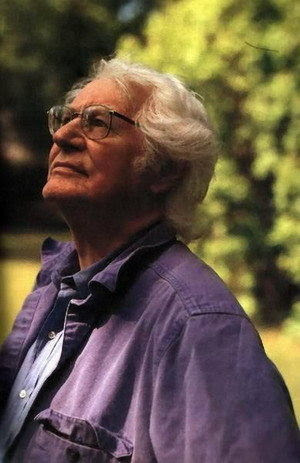
                                Poet, mystic, activist Robert Bly.

Robert Bly, the iconic and wayward Minnesota poet best known as the founder of the sometimes controversial spiritual mythopoetic men’s movement which tried to re-connect masculinity with nature and re-balance the male role the sacred feminine, died Sunday in Minneapolis, Minnesota at the age of 94.  He had been suffering from Alzheimer’s disease since at least 2012.

Bly, through his publications, seminars, and tribal gatherings nurtured new generations of ecopoets.  The men’s movement he spurred with the publication of his book Iron John: A Book About Men in 1990 exploded in popularity and participation around the turn of the 21st Century.  Considered by some as an answer to second wave feminism and women’s’ liberation, he intended it as a complimentary movement, a point lost on many of its most enthusiastic participants.  It was also widely mocked for promoting arcane drum circles of naked men in the woods. 

In the interest of full disclosure, I was one of the mockers when a Bly inspired men’s group briefly flourished at the old Congregational Unitarian Church in Woodstock about 2000.

Garrison Keillor eulogized his fellow Minnesotan yesterday on his Writer’s Almanac podcast:

He was born in Madison, Minnesota on December 23, 1926. A high school teacher taught him to appreciate poetry, but he didn’t start writing seriously until he joined the Navy after high school. There he befriended a man named Eisy Eisenstein — the first person he had ever met who wrote poems. After the Navy, he spent a year at St. Olaf College on the GI Bill. He said: “A woman my age wrote poetry; I fell in love with her, and I wrote a poem to her. I had the strangest sensation. I felt something in the poem I hadn’t intended to put there. It was as if ‘someone else was with me.’” He transferred to Harvard and applied to work as an editor for the literary magazine, the Harvard Advocate. When the staff interviewed him for a position, he responded with a long, detailed critique of American poetry since 1910. The staff seemed unimpressed, but they accepted him anyway. One day a new student board member turned up, a poet a year younger than Bly named Donald Hall. They became best friends.

After Bly left Harvard, he decided that he didn’t want to teach at a university — he was inspired by his idol, William Carlos Williams, and also by Wallace Stevens, neither of whom was a career professor. So, he returned home to his family’s farm in western Minnesota and began to write. Since he was so far away from a literary community, he wrote frequent long letters to his friends and peers: Donald Hall, Tomas Tranströmer, Galway Kinnell, Louis Simpson, and others. Bly and Hall exchanged letters twice a week for decades, with a rule that they had to respond to each other within 48 hours.
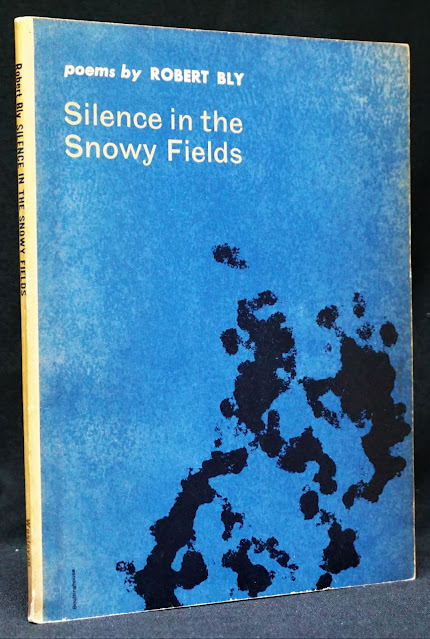
                Bly's first poetry collection in 1962.

Bly’s early collection of poems, Silence in the Snowy Fields, was published in 1962. Its plain, imagistic style had considerable influence on American verse of the next two decades.  The following year, he published A Wrong Turning in American Poetry, an essay in which he argued that the vast majority of American poetry from 1917 to 1963 was lacking in soul and “inwardness” because of a focus on impersonality and an objectifying intellectual view of the world. Bly believed this approach was instigated by the Modernists and formed the aesthetic of most post-World War II American poetry. He criticized the influence of Modernists such as T. S. Eliot, Ezra Pound, Marianne Moore, and former idol William Carlos Williams—a virtual who’s who of the most revered American poets.  He argued that American poetry needed to model itself on the more inward-looking work of European and South American poets like Pablo Neruda, César Vallejo, Antonio Machado, and Rainer Maria Rilke. A Selected Poems translation of Rilke from the German, with Commentary by Bly, was published in 1981. Times Alone, Selected Poems of Machado, with facing pages of Spanish/English translation, was published in 1983.

In 1966, Bly co-founded American Writers Against the Vietnam War and was among the leaders of the opposition to that war among writers. In 1968, he signed the Writers and Editors War Tax Protest pledge, vowing to refuse tax payments in protest against the war.  In his speech accepting the 1968 National Book Award for The Light Around the Body, he announced that he would be contributing the $1000 prize to draft resistance organizations.
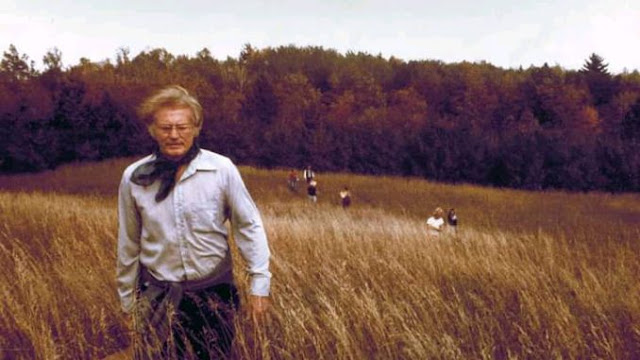
Robert Bly on the farm in midlife.

Bly’s development of his men’s movement had its roots in his close association with the Great Mother Conference in 1975.  The nine-day event featured poetry, music, and dance to examine human consciousness.  The event became annual, and Bly attended every year through 2007.  In the early years, its major theme was the Goddess or Great Mother, as she has been known throughout human history. Much of his collection Sleepers Joining Hands from 1973 was concerned with this theme. In the context of the Vietnam War, he saw a focus on the divine feminine was seen as urgent and necessary. Since that time, the Conference has expanded its topics to consider a wide variety of poetic, mythological, and fairy tale traditions. In the 1980s and ‘90s Bly led the discussion in the conference community about the changes which contemporary men were going through resulting in The New Father, over the objection of some feminists, was added to the Conference title.

Bly published more than 40 collections of poetry, edited many others, and published translations of poetry and prose from such languages as Swedish, Norwegian, German, Spanish, Persian, and Urdu. His book The Night Abraham Called to the Stars was nominated for a Minnesota Book Award. He also edited the prestigious Best American Poetry in 1999 for Scribner’s.
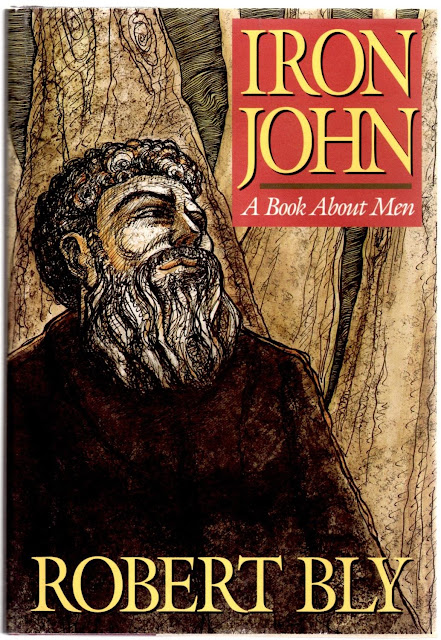
                                            Bly's most famous book was not poetry, but his lyrical manifesto for the mythopoetic Men's Movement.

In 2006 the University of Minnesota purchased Bly’s archive, which contained more than 80,000 pages of handwritten manuscripts; a journal spanning nearly 50 years; notebooks of his morning poems; drafts of translations; hundreds of audio and videotapes, and correspondence with many writers such as James Wright, Donald Hall, and James Dickey. The archive is housed at Elmer L. Andersen Library on campus.

In February 2008, Bly was named Minnesota’s first poet laureate.  In that year he also contributed a poem and an Afterword to From the Other World: Poems in Memory of James Wright. In February 2013, he was awarded the Robert Frost Medal, a lifetime achievement recognition of the Poetry Society of America.
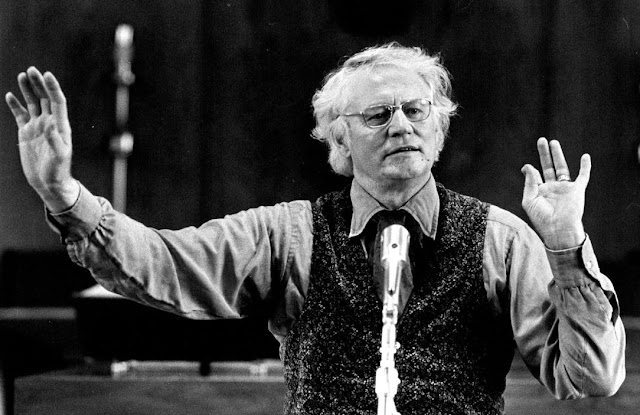
Robert Bly reading.

In a separate post Keillor shared one of the Morning Poems Bly faithfully recorded in his notebooks each morning, one of his regular spiritual practices.

     Every day around dawn Robert Bly

     Writes a poem, that is no lie,

     And the poem he composes

     At the end of his nose is

     Looking him straight in the eye.

     And with great clarity

     Addresses posterity

     Though he is not intending to die.


     —Robert Bly


Despite, or perhaps because of his mysticism, Bly remained engaged as a social critic and particularly as a pacifist.


Call and Answer


Tell me why it is we don’t lift our voices these days

And cry over what is happening. Have you noticed

The plans are made for Iraq and the ice cap is melting?


I say to myself: “Go on, cry. What’s the sense

Of being an adult and having no voice? Cry out!

See who will answer! This is Call and Answer!”


We will have to call especially loud to reach

Our angels, who are hard of hearing; they are hiding

In the jugs of silence filled during our wars.


Have we agreed to so many wars that we can’t

Escape from silence? If we don’t lift our voices, we allow

Others (who are ourselves) to rob the house.


How come we’ve listened to the great criers—Neruda,

​Akhmatova, Thoreau, Frederick Douglass—and now

We’re silent as sparrows in the little bushes?

​

Some masters say our life lasts only seven days.

Where are we in the week? Is it Thursday yet?

Hurry, cry now! Soon Sunday night will come,


—Robert Bly


Other times that famous mysticism shone clearly.


Living at the End of Time


There is so much sweetness in children’s voices,

And so much discontent at the end of day,

And so much satisfaction when a train goes by.


I don’t know why the rooster keeps crying,

Nor why elephants keep raising their trunks,

Nor why Hawthorne kept hearing trains at night.


A handsome child is a gift from God,

And a friend is a vein in the back of the hand,

And a wound is an inheritance from the wind.


Some say we are living at the end of time,

But I believe a thousand pagan ministers

Will arrive tomorrow to baptize the wind.


There’s nothing we need to do about John. The Baptist

Has been laying his hands on earth for so long

That the well water is sweet for a hundred miles.


It’s all right if we don’t know what the rooster

Is saying in the middle of the night, nor why we feel

So much satisfaction when a train goes by.


—Robert Bly

Wednesday, April 24, 2019

Forrest Gander—Pulitzer Prize Poet of 2019

Forrest Gander photo by Gage Skidmore.

Every year the cultural mavens who hand out Pulitzer Prizes reveal their list of honorees in April.  That gives me guaranteed fodder for a post on the winner of the Poetry Prize.  But I have an embarrassing admission to make—most years the winners, no matter how celebrated in poetry circles, not only take me by surprise but I have never even heard of them.  Despite enjoying reading and writing verse, I am not in the loop—outside of both academia and hipper poetry slam culture.  I don’t subscribe to or read the little literary magazines or even venerated Poetry which would surely enlighten me.  
I stumble on most of the contemporary poets I post about in this  National Poetry Month series on the internet or am tipped off by folks much more knowledgeable than me.  You can plainly see that I am something of a fraud and blowhard. 
This year’s Pulitzer poet, Forrest Gander was typically unknown to me.  Ever useful Wikipedia informs me that... 
He was born in the Mojave Desert in 1956 as James Forrest Cockerille III, Forrest Gander grew up in Virginia where he and his two sisters were raised by their single mother, an elementary school teacher. The four shared a two-room apartment in Annandale.  His estranged father ran The Mod Scene, a bar on Bleecker Street in Greenwich Village. With his mother and sisters, Gander began to travel extensively on summer road trips around the United States. The traveling, which never stopped, came to inform his interest in landscapes, languages, and cultures.  Forrest and his two sisters, Karin and Lisa, were adopted by Walter J. Gander soon after his  marriage to their mother, the former Ruth Clare Cockerille.
Gander earned college degrees in geology, a subject referenced frequently in both his poems and essays, and in English literature. His work has been linked to Ecopoetics and ecology.  A writer in multiple genres, Gander is noted for his many collaborations with other artists. 
He is a United States Artists Rockefeller Fellow and the recipient of fellowships from the Library of Congress, the National Endowment for the Arts, the John Simon Guggenheim Foundation, The Whiting Foundation, and the Howard Foundation. In 2017, he was elected as a Chancellor to the Academy of American Poets.
He taught at Providence College and at Harvard University before becoming the Adele Kellenberg Seaver Professor of Literary Arts and Comparative Literatures at Brown University in Rhode Island.
Gander's late wife, the poet C.D. Wright/
Gander was married to the late poet C.D. Wright. Together they raised a son, the artist-craftsman Brecht Wright Gander. He lives now in Petaluma, California with ceramic artist Ashwini Bhat.
He has written books of highly praised poetry including Be With, for which he was honored with the Pulitzer.  He has also written two novels, numerous essays, been a translator if works in Spanish, French, and Japanese, edited anthologies, and collaborated on special projects with fine artists and crafts persons.  
So I’m impressed—he seems to be mix of a latter day roving Beat like Jack Kerouac, and a modern Eco poet with a dose of multi-cultural influences thrown in.
Gander is so hip that he co-authored a poem with Beyoncé about her daughter Blue Ivy and God called Bey the Light.


The Moment When Your Name is Pronounced
This high up, the face
eroding; the red cedar slopes
over. An accident chooses a stranger.
Each rain unplugs roots
which thin out like a hand.
Above the river, heat
lightning flicks silently
and the sound holds, coiled in air.
Some nights you are here
dangling a Valpolicella bottle,
staring down at the flat water
that slides by with its mouth full of starlight.
It is always quiet
when we finish the wine.
While you were a living man
how many pictures were done
of you. Serious as an angel,
lacing up your boots. Ice
blows into my fields.
—Forrest Gander

From Rush to the Lake, 1988

The Iteration

From the grooved highway at sixty-five,
a hum rises. Except intimacy

there is nada. That
was a scissortail the woman says.

The boy in the back seat stops
blowing his Coke bottle

as they pass
the mowing machines. Spiked

lobelia, crown vetch, trumpet vine
under the blades of the Ditch-witch tremble.

What is the true jelly of an animal?
asks the boy, tonguing his tooth

on its last string. The woman
turns her face smiling.

The skyline jumps over the moon.
The man drives with his finger

inside her. Years
of together. The theories

were unfit to live on.
Only dust was given duration.

They know that
they are naked. 

—Forrest Gander

Gander's Pulitzer Prize winning collection Be With, W.W. Norton & Co., 2018

The Sounding

What closes and then
luminous? What opens
and then dark? And into
what do you stumble
but this violet
extinction? With
froth on your lips.
8:16 a.m. The morning’s
sleepy face

rolls its million
eyes. Migrating flocks
of your likesame species
incandesce
into transparency.
A birdwatcher lifts

her binoculars. The con-
tinuous with or without
your words
situates you here
(here (here)) even while
you knuckle your eyes
in disbelief. Those

voices you love (human
and not), can you
hear their echoes
hissing away like
fiery scale
from an ingot hammered
on some
blacksmith’s anvil?
And behind those
voices, what is that
blowing
the valves of your ears open
as black rain,
not in torrents, but
ceaselessly comes
unchecked out of everywhere
with nothing
to slacken it.

—Forrest Gander
From Be With, 2018

Wednesday, April 22, 2015

National Poetry Month—Ecopoetry for Earth Day


Today is Earth Day.  It seemed like a very big deal when it was introduced in 1970 when the Environmental Movement as we know it was still in its relative infancy having grown out the earlier Conservation Movement that emphasized the husbanding of natural resources for human use.  It seems in those early years when hundreds of thousands responded to calls to march or participate in some way that real change was possible.
And, of course, much was accomplished—the EPA and increased regulation of pollution, the hands-on movement to re-cycle and re-use, the on-going involvement of children which critics charge has become a virtual secular religion.  But despite it all, the Planet is in more desperate shape today than it was then.  The Cassandra warnings about climate change have come true in spades, faster than anyone really expected.  Yet resistance to real change to address the root causes has never been fiercer—or more successful—as it is fueled by billionaire exploiters and exploited by rabid right wing movements.  If liberals love the Planet, conservatives MUST attack it wrapping themselves in an ideology of unfettered capitalism on one hand and apocalyptic Evangelical claims that the End of Days is a hand so humans can and should squeeze every ounce of value from the Earth that will be thrown away anyway on the other.
Meanwhile the Earth Day celebration has been tamed, made nice, worth all of five minutes mention on the Nightly News and some grade school art projects.  We are told that “we must not make it political, because everyone loves the Earth”—a lie on the face of it.
Ecopoetry is a broad movement in response to that too easy complacency and the cooption of environmentalism into a marketing tool even by the most evil planet raping corporations.  It grew from an instinctive reaction of poets around the world, whose sensitivity to the world in which they live make them the perfect canaries in the coal mine and is now a more or less concerted literary and political—in its broadest and most significant meaning—undertaking.  It even has its organizations, publications, and web sites.
One of the most important of these is eco-poetry.org which defines its mission “to inspire action to save the habitable Earth for the future of life and art including poetry. There is no planet B.”  Here are some of the poets found on their site.  Plus a final interloper.

Young Ginsberg Howled.

The ecopoets acknowledge forerunner of world class significance including Americans Emily Dickinson, Walt Whitman, Langston Hughes, and Wendell Berry plus world wordsmiths Rumi, Pablo Neruda, and Ernesto Cardinal.  It should come as no surprise that the great Beat rebel Allen Ginsberg is among them.  In fact almost no poet since has summed up with greater passion the outrage of what is being done to our Planet and only home.  Take this stunning excerpt from one of his most famous poems:
from Howl
….Moloch whose love is endless oil and stone! Moloch whose soul is electricity and
        banks! Moloch whose poverty is the specter of genius! Moloch whose fate is a
        cloud of sexless hydrogen! ….

Moloch who frightened me out of my natural ecstasy! Moloch whom I abandon!
       Wake up in Moloch! Light streaming out of the sky!....

Moloch! Moloch! Robot apartments! invisible suburbs! skeleton treasuries! blind
       capitals! demonic industries! spectral nations! invincible madhouses! Granite
       cocks! monstrous bombs!

They broke their backs lifting Moloch to Heaven! Pavements, trees, radios, tons!
       lifting the city to Heaven which exists and is everywhere about us!

Visions! omens! hallucinations! miracles! ecstasies! gone down the American river!

Dreams! adorations! illuminations! religions! the whole boatload of sensitive bullshit!

Breakthroughs! over the river! flips and crucifixions! gone down the flood!...

—Allen Ginsberg

Robert Bly, more than Iron Man.

An elder and godfather to the movement is Robert Bly born in 1928 and still active.  He is best known as the founder of the sometimes controversial spiritual mythopoetic men’s movement which tried to re-connect masculinity with nature and re-balance the male role in balance with the sacred feminine.  Bly, through his publications, seminars, and tribal gatherings has nurtured new generations of ecopoets.
Call and Answer
Tell me why it is we don’t lift our voices these days
And cry over what is happening. Have you noticed
The plans are made for Iraq and the ice cap is melting?

I say to myself: “Go on, cry. What’s the sense
Of being an adult and having no voice? Cry out!
See who will answer! This is Call and Answer!”

We will have to call especially loud to reach
Our angels, who are hard of hearing; they are hiding
In the jugs of silence filled during our wars.

Have we agreed to so many wars that we can’t
Escape from silence? If we don’t lift our voices, we allow
Others (who are ourselves) to rob the house.

How come we’ve listened to the great criers—Neruda,
​Akhmatova, Thoreau, Frederick Douglass—and now
We’re silent as sparrows in the little bushes?
​
Some masters say our life lasts only seven days.
Where are we in the week? Is it Thursday yet?
Hurry, cry now! Soon Sunday night will come,

—Robert Bly

Juanita Torrence-Thompson.
 

Juanita Torrence-Thompson is a Massachusetts born poet and editor who has flown just under wide public readership despite seven collections of poetry, including her latest  Talking With Stanley Kunitz and numerous awards and  honors in the poetry community.  She is the influential editor and publisher  of Möbius, The Poetry Magazine  which has published many of the leading poets of this generation.  Her poetry and prose has appeared in 12 anthologies and dozens of magazines around and has been featured at hundreds of readings in the U.S., South Africa, Singapore, Switzerland, and Canada. She is a former adjunct Professor at the College of New Rochelle.   In this poem she looks at one beloved place, its transformation by unthinking privileged sprawl through the eyes of a long time resident.

Transition in New Hampshire
Inspired by a long-time New Hampshire Resident

They snapped up 10 acres here
5 acres there
built their 2nd or 3rd home
bought out the lake front
fished until the fish nearly
disappeared

No one fishes now
Few swim or go boating
Hunting is dead
Snowboarders wait for snow
But there is only
rain,
rain,
rain

At a nearby restaurant,
A local drinks her coffee with city water
which tastes like chlorinated coffee

She runs home to her pristine well
And makes decent coffee

Then sits on her front porch
Admiring her tall oak tree
Purple pansies, pink hibiscus
And a scampering raccoon
Camped on her conservation land

—Juanita Torrence-Thompson


Now for the interloper, one of the most justifiably obscure poets in North America and proprietor of a penny ante blog.
Raining Earthworms
Bergen, Norway, April 18, 2015 (UPI)

A skier in the snow fields above Bergen
            found earthworms lying atop
            meter and a half snow pack.
When he scooped them into his curious hands
            they began wriggling on the warmth
            of his flesh.

Curious.

Ah, but the sages of science wave their hands
            and declare no mystery here!
The worms were flushed to the surface somewhere
            by heavy rains—
            you know the kinds,
            like those that leave them writhing
            on your sidewalk after that
            June gullywasher—
and swept high
up, up, up,
to where the jet streams wail
by some odd updraft or
tornadic winds.
            Who knows how far they were pushed
                        in that icy gale
                        sleeping as they would in the
                        frozen earth of a long winter.
            We’ve seen this kind of thing before
                        raining fish in Singapore and India,
                        frogs in Hungary,
                        and crawdads in Arkansas, wasn’t it.
            Don’t be alarmed,
                        nothing to see here.
                        move along.

            And yet…

            I say they were the delayed and misdirected
                        eleventh plague of Egypt.

            Or maybe not misdirected at all…

—Patrick Murfin