Monday, November 18, 2024

A Carolina Tribe Whooped the Klan—An Apt Lesson for Native American History Month


Lumbee tribe members surround a  Ku Klux Klan rally meant to intimidate them in rural North Carolina.

The area around Maxton, North Carolina was not typical of the Deep South in the 1950's when Jim Crow law were beginning to be challenged by the emerging Civil Rights Movement.  The population split between Whites, African-Americans, and a distinct Native American tribe included members also descended from the other two races.  They had lived side by side if not together, and not without difficulties, but on the whole amicably for more than 200 years.

The region, tucked away by the South Carolina border, was divided by Robeson and Scotland Counties where the Coastal Plane begins to fade into the Piedmont.  Settlements there by mostly Scottish colonists as early as 1775 identified four villages  or clans of Siouian-speaking communities.  The people began to call themselves Lumbee for the Lumber River that flowed through their hunting grounds. During the American Revolution both Anglos and natives enlisted, mostly in the State Militia.  So did sizable numbers of Free Blacks.  Pension records show that several members of known Lumbee families were listed as Free Blacks, evidence of intermarriage.

Robeson and Scotland Counties by the South Carolina border right where it takes it turn due west.

In the late 18th Century Lumbee families began buying land, obtaining it as a veteran grant, and gaining, for the first time, legal ownership of traditional land.  Several families amassed substantial holdings and some owned slaves.  But the isolated area away from major river routes did not lend itself to large scale plantation system farming.  Most families in all groups were small, subsistence farmers, seasonal hunters, and hired laborers.

Isolation was good for the tribe.  They were not swept up by Andrew Jackson's Indian Removal policy.  In fact they were the largest remaining group north of Florida.  In the late 1830s and '40s they welcomed and absorbed Iroquoian speaking Tuscarora groups likewise stranded when the rest of their people were exiled west of the Mississippi.   

None-the-less when the State of North Carolina began adopting and enforcing Free Black Codes, the Lumbee were stripped of the citizenship rights they had long enjoyed including the rights to vote, purchase property, serve on a Jury, muster with the militia, or posses fire arms.  The enforcement of the fire arms ban was particularly galling because hunting was an important part of feeding their families.  Several prominent men were arrested, tried, and punished.

Like many small, non-slaveholders some local Whites and Natives resented the haughty Tidewater aristocracy that drove secession and Civil War.  Some were avowed Unionists or sympathizers and avoided Confederate Service and war taxes.  When the South enacted a draft, some fled into the woods and back country including those sheltered by the Lumbee.

Other members of the tribe, however, remained loyal to their state and the Confederacy and served in the war.  Northern forces never came near the remote area.  But after the war most Lumbee supported Democrats because they resented the Reconstruction 40 Acres and a Mule for Freemen but did not include those living as members of the tribe.  In fact, the Federal government refused to recognize them as a tribe.  

Under Republican control the State set up separate school for Whites and Blacks.   As non-whites were excluded from white schools and compelled to attend Freedman schools.  They began to campaign for their own schools.

They renamed the central market town originally named Shoe Hill to Tilden in honor of the Democratic Presidential Candidate who promised to end Federal occupation in the South.  Tilden won the popular vote but the election was among the most contentious in American history, and was only resolved by the Compromise of 1877 in which Republican Rutherford B. Hayes agreed to end Reconstruction  in exchange for recognition of his presidency.  Without Federal troops, Democrats quickly regained control of Southern governments and began enacting the Jim Crow laws that returned Blacks semi-servitude with no Civil Rights.

Men of the extended Lumbee Chavis family in traditional dress in the Post Civil War Era.  In their daily lives tribal members wore the same ordinary work clothing as their White neighbors, lived on their own farms, used Anglo style names, and commonly spoke.

As part of a reward for Lumbee support,  Democrats began to look for ways to created Native schools.  To do that they needed to officially recognize the tribe.  In the 1880s, as the Democratic Party was struggling against a biracial Populist movement which combined  poor Whites both Populist  and Democrats and Blacks Republicans the state recognized the Indian people of Robeson County as the Croatan Indians and to create a separate system of Croatan Indian schools.  Croatan referred to the once powerful native confederation around Roanoke in the earliest days of colonization.  There was no known connection between the Lumbee and that nation. By the end of the 19th century, they were legally known as Indians of Robeson County and had established schools in eleven of their principal settlements.  The town of Tilden was finally renamed Maxton.

The Lumbee and their Democratic Party allies in Congress campaigned unsuccessfully for decades in the 20th Century for Federal recognition as a tribe primarily to get support for their schools.  Repeatedly rebuffed they resorted to petitioning under the names Croaton Cherokee and later Croaton as Siouans to take advantage of those Western tribes' existing recognition.  They had no real connection to the Eastern Band of Cherokee in South Carolina who vigorously protested their claim and dim 200 year old connections to the Sioux.  Both claims were ignored.

The Croatan Normal School at Pembroke, North Carolina, 1916, the first Croatan (Lumbee) Indian school established and supported by the state.

In 1919 an agent of the Indian Office reported: 

While these Indians are essentially an agricultural people, I believe them to be as capable of learning the mechanical trades as the average white youth. The foregoing facts suggest the character of the educational institution that should be established for them, in case Congress sees fit to make the necessary appropriation, namely the establishment of an agricultural and mechanical school, in which domestic science shall also be taught.

Then in 1934 another agent reported:

I find that the sense of racial solidarity is growing stronger and that the members of this tribe are cooperating more and more with each other with the object in view of promoting the mutual benefit of all the members. It is clear to my mind that sooner of later government action will have to be taken in the name of justice and humanity to aid them.

 World War II put efforts for Federal recognition on hold while tribal members, like their White and Black neighbors, went into the service.  Near full domestic employment brought unheard of prosperity as other members left to work in defense industries in regional cities.  And when it was over returning GIs used their benefits to buy new homes, start small businesses, and attend college.  Although still poorer than the rest of the country, by 1950 most members were living in homes with electricity, running water, and telephones as well as owning a family car or truck.  Everyone had modern shot guns and varmint rifles for hunting--and self-defense.  That was resented by some whites who thought the native veterans were "uppity" and disrespectful.

In the immediate post-war years the bid for Federal recognition was put on hold during an internal dispute over what tribal name to request with factions favoring Croaton,  Cherokee-Coaton, or Cheraw [Souian].  What they agreed on was that they no longer wanted to be designated the Indians of Robeson County anymore, especially since their populations was spread far beyond that limited jurisdiction. 


In the early 1950s, Reverend D. F. Lowry organized the Lumbee Brotherhood. Lowry and his supporters contended that since their people were most likely the descendants of a mixture of colonial-era indigenous tribes—a theory many scholars supported—they should adopt the name Lumbee after the river that had become the cultural heart of the community. In 1952 members overwhelmingly voted to adopt the new name, and the North Carolina General Assembly changed their official designation in 1953 to the Lumbees.  That paved the way for Congressional action at last.

The Lumbee Act  passed by Congress in late May 1956 as a concession to political lobbying and signed by President Dwight D. Eisenhower designated the Lumbee as an Indian people. It withheld full recognition as a "Tribe", as had been agreed to by the Lumbee leaders. The Lumbee Act designated the Indians of Robeson, Hoke, Scotland, and Cumberland Counties as the Lumbee Indians of North Carolina.  But there was a catch.  The Act stipulated, "Nothing in this Act shall make such Indians eligible for any services performed by the United States for Indians because of their status as Indians." It also forbad a Government relationship with the Lumbee and banned  them from applying through  the Bureau of Indian Affairs (BIA) administrative process to gain recognition.  

The rational was The Lumbee had essentially assimilated into early colonial life prior to the formation of the United States. They lived as individuals, as did any other colonial and U.S. citizens. Lumbee spokesmen repeatedly testified at these hearings that they were not seeking federal financial benefits; they said they only wanted a name designation as Lumbee people.

The Blood Drop Cross logo used by the Ku Klux Klan represented the the "one drop rule" what classified any one with "even a single drop" of Black or Native blood could taint someone "passing" for White.  The multi-racial Lumbee were a prime example of that threat.

The fight for tribal identity put them in the spotlight, especially because tribal members were descended from Native, White, and Black individuals and there was still inter-racial marriage.  Playing on racial anxiety and resentment of Lumbee competition for jobs and property Grand Dragon of the Kights of the Ku Klux   began a campaign of harassment against the Lumbee, as mongrels and half-breeds  whose race mixing threatened to upset the established order of the Jim Crow South.  After giving a series of speeches denouncing the loose morals of Lumbee women, Cole burned a cross in the front yard of a Lumbee woman in St. Pauls as a warning. 

The Civil Rights Movement was gaining strength across the former Confederate states--the Brown v Board of Education Supreme Court decision had just made segregated public schools illegal and Whites were turning to the once-again revived KKK.  Cole thought that an attack on the Lumbee would be easy pickings and a recruitment tool in North Carolina where Klan growth lagged behind neighboring states. He called for a Klan rally on January 18, 1958, near the Maxton. 

The Lumbee, led by veterans of World War II and Korea, decided to disrupt the rally.

 Cole had predicted more than 5,000 Klansmen would show up for the rally, but that night  fewer than 100 and possibly as few as three dozen attended.  Klansmen had prepared for the rally in a large field, with loudspeakers, a cross to be burned, and a large banner. Cole, who was from South Carolina, misunderstood the racial dynamics in Lumbee territory including relatively good relations with local Whites and the extent to which the tribe was prepared to defend itself and other indigenous people.

More than 500 Lumbee, armed with guns, sticks, and ax handles gathered in a nearby swamp.  When they realized they possessed an overwhelming numerical advantage, they attacked the Klansmen encircling the Klansmen, opening fire and wounding four  in the first volley, none seriously. 

Local newspaper headlines expressed astonishment at the rout of the Klan.

Local law enforcement showed up after the altercation had taken place, but by then, the field was clear.  It turned out that the long tribal support of Democrats and friendly ties with local authorities paid off.  The remaining Klansmen panicked and fled. Cole was found in the swamps, arrested and tried for inciting a riot.

The Lumbees gathered up discarded robes and the rally banner and marched back into Maxton to celebrate, which included burning Catfish Cole in effigy. Press coverage showcased two Lumbee men, one a celebrated World War II bomber engineer, wrapped in the KKK banner they had torn off a Klansmen’s car at the rally.

Simon Oxedine and Charlie Warriax, decorated WWII veterans, displaying their captured KKK flag at a Veterans of Foreign Wars convention.

The Lumbee celebrated the victory by burning Klan regalia and dancing around the open flames.

The Battle of Hayes Pond, or the Klan Run, as it came to be called, marked the end of Klan activity in Robeson County, is still celebrated as a Lumbee holiday.  
 
The ignominious route of the Klan was widely celebrated.  Later, in the 1960s it was held up as an example of armed self-defense as opposed to Martin Luther King's non-violence  by Black Power activists, the Black Panthers, and Nation of Islam as well as to the American Indian Movement.

In the 21at Century  many observers were shocked by shifting Lumbee political action.  Robeson County, the heart of Lumbee territory, was carried by Barack Obama by an 18 point margin in 2012 in 2016.  Four years later both Joe Biden and Donald Trump promised long-sought tribal recognition, but Trump  but the failure of Democratic administrations to actually accomplish it flipped the tribal vote and by an even wider margin in 2020 after a campaign rally circus at the Robson County Fair Grounds in Lumberton where the grandstand behind Trump's podium was salted by campaign with members waving bright red Lumbrees for Trump placards.
 
Lumbee showed support for Donald Trump at a 2020 campaign rally in Robeson County.

This year  Trump brought his act to the Aero Center near Wilmington International Airport.   Despite a record as President hostile to Native American tribal interests, he reiterated his support for recognition with tribal members John Cummings, a Robeson County Board Commissioner and other leaders.  Kamala Harris' attempts to reconnect to Native voters was not enough.  Trump carried Robeson County and other areas with strong Lumbee populations and helped tip the critical battleground state.  

There remains Democratic support among tribe members, the political shift is a reflection of the long-time Lumbree stratagy of forging unlikely partnerships with politicians who could best serve the tribes interests. 
 
Lumbee women and girls in procession at a tribal Pow Wow.
 
Today, the Lumbree are the second largest tribe in the United States behind the Navajo with more than 60,000 enrolled members in the original rural core as well as in urban centers including Baltimore, Maryland;  New Port News, Virginia; and Wilmington, North Carolina.  They retain cultural adhesion.


Swiss Hero William Tell—Myth or Historic Figure

                                    This illustration gives William Tell the full 19th Century Romantic treatment.

On November 18, 1307 Wilhelm Tell, who may or may not have existed, allegedly shot an apple off of the head off his trembling son with his trusty crossbow on the orders of a tyrannical local Austrian official or Bailiff who may, or may not, have existed.  Subsequently Tell may, or may not, have assassinated the villain and led a rebellion that led to the creation of the Old Swiss Confederacy.  Or so the story goes.
Known to the English speaking world as William Tell and to Napoleonic Era European romantics as Guillaume Tell, he became a heroic symbol of Swiss independence, revolutionary resistance to oppression and tyranny, and a blank page various political ideologies claimed for their own. 
Americans know him mostly as a motif in countless comedy sketches going back to vaudeville and animated cartoons, built around gags of the boy and the apple stripped of any context.  They also may remember the Overture of an opera by Gioachino Rossini became the theme song for another mythical hero—The Lone Ranger.
In the early 1950's Errol Flynn bankrupted himself trying to revive his sagging career by producing an William Tell film which was aborted and never released. 
Most modern scholars believe Tell is a mythical figure, analogous to the English Robin Hood.  They can find no evidence that or his son ever existed or that Albrecht (sometimes Herman) Gessler ever oppressed the people of Altdorf in the Canton of Uri.  The Swiss tend not to take kindly to these scholars and have been known to burn them in effigy in the streets.  Some Swiss scholars still make a living producing tomes that make historical claims for the truth of at least a nugget of the folk tale.  And like Englishmen love and believe in a rebellious Saxon noble, the Swiss, no matter which of four languages they speak, swear by the reality of William Tell.
Here is the story in its most familiar form.  
Gessler arrived in Altdorf to assume his duties as Landvogt, a local tax collector/enforcer for an Austrian feudal prince—very analogous to the authority of the Sheriff of Nottingham in the Robin Hood tales—already drunk with his new power.  He erected a pole in the market place and demanded that the locals bow down to his hat which he perched on it.  He stationed troops to enforce the order and often sat watching the locals grovel in fear.  Enter Tell and his ten year old son Walter.  Tell was by all accounts a large and powerful man—a hunter, mountain climber, and boatman in early accounts was a local gentleman of wide repute and respect and in later accounts a rustic peasant leader.  He happened to be carrying his crossbow.
One of the earliest graphic depictions--a woodcut illustration from Ein Schönes Spiel…von Wilhelm Tell.
 
Tell proudly refused to bow down to a hat and was seized by Gessler’s troops.  The cruel tyrant had already filled the jails and local dungeons and had recently blinded an elderly man for some trivial or imagined offense.  Gessler, aware of Tell’s reputation with his weapon, offered his prisoner a choice—immediate death or a reprieve if he can shoot an apple off of the head of his son’s head at several paces with a single shot.
Tell comforted his son and then with unerring calm split the apple with a bolt from his crossbow.  Gessler noticed that Tell had a second bolt.  He demanded to know what he intended to do with it.  Tell demurred until he was assured that no matter his answer his pardon would be honored.  Then he told Gessler that the second bolt was meant to kill him should the first have gone astray and wounded the boy.  Infuriated Gessler had Tell and his son seized.
The Tells were put on a boat to transport them across Lake Lucerne to Küssnacht to a dungeon in Gessler’s new castle.  But a terrible storm erupted and the boat was nearly lost.  The oarsmen, in fear for their lives, unbound the powerful Tell who took the rudder and brought the boat to shore—where he leapt to safety on a rocky point now known as Tellsplatte.  He also somehow still had his famous crossbow and that second bolt.
 
An American take on the embellished legend--William Tell Escapes the Tyrant by Nathaniel Currier.
He ran cross country to Küssnacht where he laid in wait at a narrow point in the route he knew Gessler must take from Altdorf.  There from hiding he ambushed the official, assassinating Gessler with a single shot.
Escaping into the mountains Tell joined existing bands of rebels and/or raises a guerilla army  against the Austrians.  The successful revolt that followed united most of the Swiss Cantons into the Old Confederacy and thus began the history of the Swiss as a nation.  
Tell was said to have died heroically 40 years later as an old man when he tried to rescue a child from a raging river.
None of this was corroborated in contemporary annals.
The first mention of Tell in relationship to the rebellion seems to be in the White Book of Sarnen by a country scribe named Hans Schreiber in 1475.  Shortly thereafter a song called the Tellenlied first appearance in a manuscript was in 1501 although it was clearly already widely sung.  In neither of these accounts was Gessler named or is there mention of his assassination.  The Tellenlied called Tell the “First Confederate.”
The first printed version of the story appeared in 1507 in Chronicle of the Swiss Confederation by Petermann Etterlin, a soldier/scholar who wrote in German but supported the French factions ruling Lucerne.  Around 1570 Aegidius Tschudi from Glarus compiled his monumental Chronicon Helveticum which in turn was the main source for Johannes von Müller’s History of the Swiss Confederation in 1780—written under the ideological influence of rising French radicalism—and for Friedrich Schiller’s play William Tell in1804.
In each of these versions the story of Tell became more elaborate with details filled in, names and dates supplied and a mantel of historical verisimilitude draped around it.  The story also adapted to more modern political developments—there really was a Gessler family, for instance, that administered a fiefdom of a Hapsburg prince around Zurich in the late 14th Century.  He became a stand-in for imperial Austrian designs on Switzerland three hundred years later.
Tell inspired The Three Tells—heroes of the 1653 Swiss Peasants’ War who dressed as Tell attempted to assassinate Ulrich Dullike, Schultheiss (Mayor) of Lucerne for the Hapsburgs in 1653.  In the writings of early 19th Century Romantics they became similar to certain Nordic myths and King Arthur in English folklore, sleeping under the mountains and waiting to be resurrected and come to the salvation of the nation in a time of peril. 
Napoleon's puppet Helvetic Republic sought legitimacy by draping itself in the mantle of William Tell as an anti-Austrian patriot.  The  short lived Republic incorporated Tell into its official seal. 

During the French Revolution Tell was adopted as a model for rebellion against authority.  He was re-cast as a peasant leader and his role as a revolutionary elevated over earlier versions which emphasized his individual defiance.  In the Napoleonic Era Gessler became a tool of an unseen—and not even historically accurate—Austrian Emperor.  In the post-Napoleonic era Tell became the symbol to resistance against all oppression—including that inflicted in the false hope that Bonaparte would be a liberating force in Europe.  
When Napoleon invaded western Switzerland and imposed the Helvetic Republic in 1798, the new central government sought legitimacy by making Tell and his son the central device in their official seal.  When the Republic was overthrown in 1803 and the Confederacy of Cantons restore Tell became a symbol for resistance to all foreign meddling in Swiss affairs.  This is the Tell of Schiller’s play and Rossini’s opera.
                            Mattua Battistini as the Swiss hero in an early 20th Century production of Rossini's opera Guillaume  Tell.
 
 Since then he has been schizophrenic—simultaneously hailed as a hero of left populism and of right-wing Swiss nationalism.  He has been cited as the inspiration for Guy Fawkes and the Gunpowder Plotters in England in 1604, along with Brutus by John Wilkes Booth for his assassination of Abraham Lincoln, and by late 19th Century anarchist assassins and attempted assassins of European rulers. Adolph Hitler in Mein Kampf praised Tell as the prototype of a Germanic hero and man of action.  He sang a different song after young Swiss Francophone patriot Maurice Bavaud—dubbed the “New William Tell” by his admirers—attempted to assassinate him in 1938.  He subsequently banned all performances of both Schiller’s play and the Rossini opera.  At a banquet in 1942 he complained, “Why did Schiller have to immortalize that Swiss sniper!”

Sunday, November 17, 2024

Americans Miss International Students Day Yet Again


 International Students Day is such a hot potato that even the United Nations will not support it.  Wonder why?

Note to all my younger readers—if I have any. Today is International Students Day but you would not notice it at any American school, college, or university.  Why? Because the day honors students not just for academics, but for their traditional role as a kind of collective public conscience, the bearers of high ideals, and a thorn in the side of arbitrary authority everywhere.   In other words pretty much exactly what our oligarchs and authorities do not want.  They would prefer you train quietly and diligently to seamlessly become cogs in the machinery of their prosperity.  Or if you must blow off steam, do it at football games, keggers, or meaningless hook-up sex.  Anything but protest.

I come from a quaint generation that took student activism as a given inspired by the Civil Rights Movement and protests against the War in Vietnam.  We paid our dues in innumerable marches, sit-ins, Freedom Rides, the streets of Chicago, university occupations, and at Orangeburg, Kent State, and Jackson State.  But after the war wound down and the Draft became an empty threat, campuses quieted.  Not that student activism ever entirely disappeared—there was always a level of activity and issues that raised the passions of some.  But no mass movement, no sense of common purpose.  In fact in many places conservatives organized effective counter presence.

Millions, including students, joined in mass protests and marches to try and stop a post-9/11 invasion of Iraq, when the war actually started there was not much of a sustained movement against it and what there was waned as the War on Terror  dragged on interminably, becoming just background noise.

The most significant new mass social movement in decades, the Occupy Movement, was spearheaded by young post-college adults whose lives and hopes had been disrupted by the economic crash of 2008 and crushing student debt.  As it spread across the country from city to city students became involved and there were some actions on campus such as the infamous pepper spraying of non-violent students at Santa Monica College, it never really became a student movement.

Students  often taken the lead in Black Lives Matter protests.

Youth, including high school and college studenst did become the driving force behind the next important development—then Black Lives Matter Movement.  But at first they were acting and reacting on the streets not as students per se.  But the movement quickly moved onto campuses.  Something new was in the air. 

Since then American youth has taken to the streets against school shootings and gun violence—the movement explicitly tied to their age and status as students; to protest Donald Trump and attacks on democracy itself;  for the rights and safety of women, the LGBTQ+ community, and the endangered gender non-conforming; and for the environment as  part of a global youth strike campaign. 

But now supporters of both sides of the assaults on Gaza, the West Bank, and Lebanon are bitterly splitting their generation and leading to strife and violence on campus.

All of which recalls the events that inspired the creation of International Student’s Day.

The death of student Jan Opleta who was shot during an anti-Nazi march in Prague sparked an even greater protest at his funeral.

Some students fled the country with their families, it they were able.  Jewish students were expelled and Jewish professors fired.  Some students, particularly young Communists and left Social Democrats went underground and began to form what would become a resistance movement.  Most stayed fearfully at their studies, but many were determined to protest the subjugation of their country.

On October 29, the anniversary of the Declaration of the Czechoslovak Republic in 1919, students of the Medical Faculty of Charles University held a street rally which was violently suppressed by the Nazis.   Among the wounded was Jan Opleta who was shot and died of his wounds on November 11.

Opleta's funeral on November 17, 1939 turned into a mass protest that sparked a vicious Nazi repression.

Students from all over Prague and the now splintered Czechoslovakia turned out by the tens of thousands to make Opleta’s funeral procession into a mass protest on November 15.  Students expected reprisals.  What they got was beyond any of their imaginations.

On November 17 the Nazis stormed the University of Prague and other campuses.  All universities around the former nation were immediately closed and their students ejected.  1,200 were rounded up and deported immediately to concentration camps.  Others would be picked up and arrested over the next year.  Few of those sent to the camps survived the War.

Nine professors and students were shot without trial the same day.  Their names have become a litany of heroes to Czechs—Josef MatouÅ¡ek, Jaroslav Klíma, Jan Weinert, Josef Adamec,    Jan ÄŒerný, Marek Frauwirt, BedÅ™ich Koukala, Václav Å afránek, and FrantiÅ¡ek Skorkovský.

In 1941 the International Student Council (ISC) which included many refugees, proclaimed November 17 International Students Day with the approval and encouragement of Allied governments which used the proclamation in their propaganda broadcasts to the Continent.

The celebration was kept alive in the post war years by the successor organization to the ISC the International Union of Students.  Along with the National Unions of Students in Europe and others there has been an on-going attempt to get the United Nations to officially recognize the day along with celebrations for Women, Children, Indigenous Peoples, and such.  The effort has been met with what might be called benign neglect.  It turns out a lot of governments are worried about politicized students.  And support has been forthcoming and withdrawn depending on whose ox is being gored by students in the street.

Take the case of the old Soviet Union and its Eastern Bloc allies.  They originally embraced the celebration as an extension of anti-fascism.  But that changed after another incident in Prague.


Czech students to the streets again on November 17, 1989, the 50th anniversary of the anti-Nazi protests.  The uproar over the violent repression of the march led directly to the Velvet Revolution and the ouster of the pro-Soviet government.

In 1989 independent student leaders and the official Student Union organized mass demonstration for the 50th anniversary of the attack on Czech schools and students.  The 15,000 students who took to the streets in a peaceful parade used the opportunity to criticize the Communist Party and government on an array of issues.  Police responded with a predictable baton attack leaving many wounded and one dead.  The dead man turned out to be a secret police agent who had infiltrated the students but had gotten too close to his own government’s clubs. 

Students did not realize the dead man was an agent, however, and rumors of the death of a comrade swept the capital.  A student strike was proclaimed and supported by actors and others.  The subsequent uproar led directly to the Velvet Revolution and the ouster of the Communist Government breaking the hold of the Soviet Union on Eastern Europe.

After the fall of the Berlin Wall and the collapse of the Soviet Union, European student groups fractured on ideological lines.  In the chaos, international coordination of Student Day observances fell by the way side, although many countries and national Student Unions carried on independent celebrations.

Since then students have been at the forefront of protest and rebellion throughout the former Soviet empire, in China’s Tiananmen Square, in the Arab Spring, in anti-austerity protests across Europe, in Istanbul, and dozens of other places around the world.  They protested against tyrants of the Left and of the Right, against oligarchic wealth, and religious zealotry.   No wonder governments are so skittish about encouraging them with United Nations recognition.

At the World Social Forum held in Mumbai, India in 2004 various student groups and national unions began to discuss a re-launch an official, coordinated movement.  The movement has picked up steam, particularly in Europe.

In 2009 there was a massive commemoration of the 70th Anniversary and a major conference held at the University of Brussels.  Among the actions taken was a resolution pressing for the adoption of a European Student Rights Charter.

But still no participation in the USA.  Hey, here’s an idea, young readers.  What say you start something….


Saturday, November 16, 2024

Mourning for Wobblies and the Labor Movement—In November We Remember


Ralph Chaplin, then the editor of the Industrial Worker, wrote this poem, later set to music.  Pictured is Frank Little, the tough IWW hard rock miners organizer who was lynched in Butte, Montana in 1917.

For many of us November is a melancholy month.  Often slate gray skies silhouette naked trees in a chilling wind.  Death seems at hand.  But so is its handmaiden—remembrance.  After all, the month begins with All Souls/Day of the Dead when the memories of ancestors and loved ones are honored. 

English school children still chant “Remember, Remember the Fifth of November,” now a harmless nursery rhyme about Guy Fawkes and the Gunpowder Plot but was once an annual call to riot and mayhem against Catholics not only in Britain but in pre-Revolutionary War New England.  Here in the American Midwest, we are often reminded of the Edmund Fitzgerald, the Great Lakes iron ore freighter that sank with all hands in a gale on Lake Superior on November 10, 1975 and is commemorated in Gordon Lightfoot’s haunting ballad.  On November 11 Americans celebrate Veterans Day on the anniversary of the Armistice that ended the First World War.  But in Britain and most Commonwealth nations it is a somber Remembrance Day, more akin to our Memorial Day in honoring war dead.

This 2015 cover of the Industrial Worker was in the continuing tradition "In November We Remember" issues.

But the month carries special meaning to the American labor movement.  Beginning in the early 1920’s the Industrial Workers of the World (IWW) began annually commemorating a string of radical and union martyrs under the heading In November We Remember!  Aside from articles in the union press—the Industrial Pioneer and the Industrial Worker—and often local programs and memorials, the month was used to raise funds for the General Defense Committee for the legal defense of persecuted unionists and aid for class war prisoners.

Most often cited in annual observances were the following cases, each with a unique and tragic story.  In each case I will link to a blog post with a full story.

The execution of the Haymarket Martyrs in 1887.

The Haymarket Martyrs—On November 11, 1887 four of the original eight anarchists and unionists charged with murder after a bomb exploded killing several attacking police at a protest rally at Haymarket Square in Chicago on May 4, 1886.  Albert Parsons, August Spies, Adolph Fischer, and George Engel were hung at Cook County Jail.  A fifth defendant, Louis Ling, had committed suicide in jail to deprive the state from executing him.  Their death galvanized the international labor movement and led directly to the establishment of May Day as International Labor Day.

A union funeral for three of the victims of the Everett Massacre.

The Everett Massacre—The IWW lost at least 5 dead and 27 injured when Sheriff's deputies and timber industry gun thugs opened fire on the Verona and another boat bringing Seattle Wobblies to Everett, Washington for a free speech fight on November 5, 1916.  About half a dozen other Wobs were missing and presumed drowned after jumping from the ambushed boat to evade the lethal crossfire from shore.

A memorial marker recently erected by Wobblies and labor history devotees to Wesley Everest, the World War I vet lynched in his Dough Boy  uniform after the Centralia, Washington IWW Hall was attacked by American Legionnaires.

The Centralia Massacre—See my Armistice/Veterans Day post. On November 1l, 1919 Westley Everest, an IWW member and veteran in uniform, was lynched following an attack on the IWW hall in Centralia, Washington by members of a lumbermen’s Citizen Committee and American Legionnaires.

                                    Carlos Cortez made several versions of this hand silk screened Joe Hill poster.

Joe Hill—Legendary IWW songwriter and footloose agitator Joe Hill (a/k/a Joel Haglund and Joseph Hillstrom) was executed by firing squad in Utah for a murder he could not have committed on this date in 1915.  Many of his songs continue to be printed in new editions of the IWW’s Little Red Song Book and he helped establish a tradition of labor music inherited by Woody Guthrie, Pete Seeger, Utah Phillips, and Si Kahn and others.  He may be best known to the public for I Dreamed I Saw Joe Hill Last Night, a song by Alfred Hayes and Earl Robinson famously recorded by Paul Robeson and Joan Baez.

Mother Jones celebrated her birthday on May 1, 1930 a few months before she died.

Mother Jones—Although not a martyr and directly related to the IWW only through her attendance at its 1905 founding convention, Mary Harris Jones, the miners’ angel, is often included in later versions of this litany.  She died on November 30, 1930 well into her 90’s after more than forty years of tireless activism and hell raising.

Both the IWW and the labor movement also use this month to remember the countless others who have given their lives during the years of more or less open class warfare in the United States and down to this day.

For instance D.J. Alperovitz as part of his massive IWW archive project at the University of Washington has documented the deaths of more than 170 individual associated with the union from its founding to the 1970’s in the file IWW Members Killed Year by Year.  The list includes some bystanders killed when police, militia, or gun thugs shot at strikers and picketers, the unborn babies of women who miscarried due to violence, members who died in jail often after abuse, and some who were killed in fights or while allegedly committing crimes that may or may not have been related to their membership.

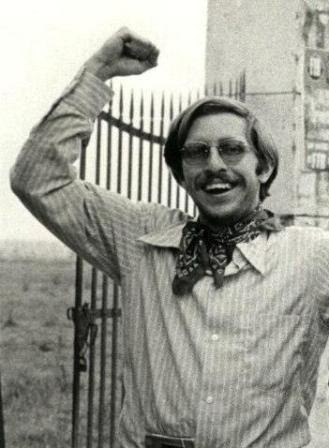
Student and journalist Frank  Terrugi is one of the most recent IWW deaths recorded in D.J. Alperovitz's file IWW Members Killed Year by Year.  He was "went missing" and was executed along with tens of thousands of others after the 1973 Chilean Coup.  His case was among the inspirations for the film Missing starring Jack Lemon and Sissy Spacek.

Among the earliest listed are several members killed in the IWW’s 1909 Press Steel Car Strike in McKees Rocks, Pennsylvania.  Seven members were gunned down and murdered in the Columbine Massacre in 1924 in Colorado when the state Militia opened fire with machine guns on a camp of coal strikers and their families.  Several other strikes had multiple fatalities.  The list also includes Wobs who died in the Baja Rebellion of 1913, Mexican Revolution, in the Soviet Union during and after the Russian Civil War, and while fighting as volunteers in the Spanish Civil War.  The last two listed were student, journalist Frank Terrugi, and IWW member killed in the 1973 Chilean Coup whose story was an inspiration for the film   Missing with Jack Lemon and Sissy Spacek and journalist Frank Gould who disappeared in 1974 while covering the Moro Rebellion in the Philippines.
 

A WPA mural depicting the Memorial Day Massacre in Chicago.

Of course, we should remember the labor dead beyond the IWW.  A far from comprehensive list would include those killed in the Great Railway Strike of 1877, decades of mine wars in Pennsylvania, West Virginia, Kentucky, Illinois, and Colorado including the Battle of Blair Mountain, the 1919 Steel Strike, and the 1937 Memorial Day Massacre in Chicago.

So much to remember….