Showing posts with label Ku Klux Klan. Show all posts

Tuesday, June 23, 2026

It Was an Equal Opportunity Mississippi Lynching—Chaney, Goodman, and Schwerner


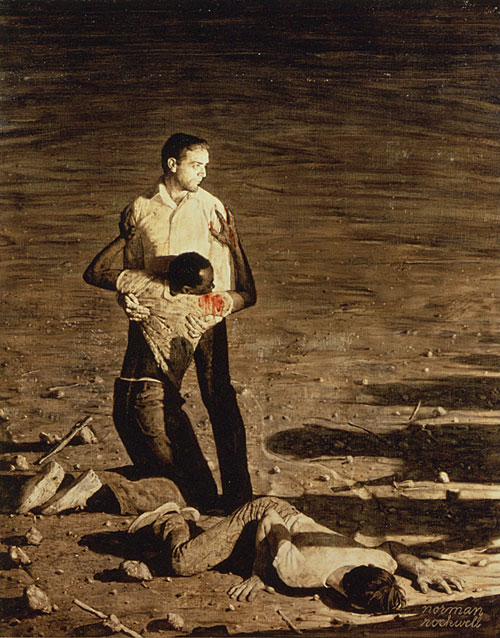
 Norman Rockwell, the beloved painter and illustrator of a pleasant America, was deeply moved by the Civil Rights movement and shocked the nation with his depiction of the murder of Chaney, Goodman, and Schwerner.  

June 21 was the anniversary of an important and tragic event in the struggle for social justice in America—the murder of three young civil rights workers in Mississippi in the summer of 1964.  Their story reminds us that before young white people took to the streets in unprecedented numbers in support of the Black Lives Matter movement and in protest to the police killings of George Floyd and other African-Americans and People of Color, an earlier generation put their lives on the line in the segregationist South where the Ku Klux Klan still terrorized with near impunity. 

They were fewer in number than the young BLM activists who took to the streets in every corner of the country including small towns and white suburbs where they were totally unexpected.  The Freedom Riders and voting rights activists of the ‘60s came mostly from Northern university enclaves and were often red blanket babies and frequently Jewish.   My own best friend from high school, Jon Gordon, went down in the summer of 1967 and thankfully returned safely.  I wished then that I had gone with him instead of spending the summer washing dishes at a Skokie Howard Johnsons.

Many of us of a certain age still have vivid snowy black and white TV images stuck in our heads keeping alive the memory of the murders of those three young civil rights activists in the Freedom Summer of 1964.  


Andrew Goodman, James Chaney, and Michael Schwerner. 

It still made news 52 years later in 2016 when Mississippi Attorney General Jim Hood announced an end to the active Federal and State investigations into the 1964 killings of James Chaney, Andrew Goodman, and Michael Schwerner in Mississippi.  The announcement came just days after the death of Judge Marcus D. Gordon, who oversaw the 2005 murder trial at which Edgar Ray Killen, a Ku Klux Klansman and Baptist preacher who was believed to be the prime mastermind of the crime was finally convicted.  Hood told reporters: 

The FBI, my office and other law enforcement agencies have spent decades chasing leads, searching for evidence and fighting for justice for the three young men who were senselessly murdered...It has been a thorough and complete investigation. I am convinced that during the last 52 years, investigators have done everything possible under the law to find those responsible and hold them accountable; however, We have determined that there is no likelihood of any additional convictions. Absent any new information presented to the FBI or my office, this case will be closed.

The news came as no surprise to any of the victims’ families.  After so many years most, if not all of the others involved in the crime are likely dead—Killen turned 91 in prison—as are almost any witnesses.  The likelihood that new physical evidence may show up has diminished to the vanishing point.

The case was kept alive in the press and public awareness due to the diligent work of the Andrew Goodman Foundation which encourages young people of all religious backgrounds to be engaged in social justice work and continues to campaign for the preservation and extension of voting rights which are under pressure from a wave of suppression laws enacted across the Old South and states with Republican governors and Legislatures Andrew Goodman’s brother, David is the effective public face of the foundation.

Then there was the troubling role of FBI informants within the Klan.  Although J. Edgar Hoover planted spies in both the civil rights camp and in various Klan groups and White Citizens Councils, he was clearly more fixated on discrediting the Civil Rights Movement, particularly its charismatic leaders like the Rev. Martin Luther King, Jr., than he was with White terrorists.  He was also loath to disclose how deeply his informants were involved in several high-profile cases, including the murders of the Rev. James Reeb and Viola Liuzzo during the Selma Campaign—so deeply they may have been directly complicit in brutal crimes.


The film Mississippi Burning starring Gene Hackman and Willem DaFoe as the lead FBI investigators on the case started a trend in films about the Civil Rights movement that put white heroes at the center of Black stories. 

1988’s award winning Mississippi Burning told the brutal tale of entrenched Southern racism.  It starred Gene Hackman and Willem Dafoe as a pair of FBI agents who diligently and doggedly investigated the crime.  Widely praised at the time of its release, the film set a pattern for other movies about the Civil Rights era which always centered on white heroes relegating Black victims and civil rights workers alike to secondary roles in their own stories.  And the irony of the FBI as heroes was not lost on many who lived through those times.

By the summer of 1964 the Civil Rights movement had matured.  The non-violent civil disobedience campaigns of the Southern Christian Leadership Council (SCLC), Congress of Racial Equality (CORE), Student Nonviolent Coordinating Committee (SNCC), and other groups had won some local victories and the near passage of the Civil Rights Act of 1964, which had cleared a 57 day long Senate Filibuster just two days before the murders.  But progress was painfully slow and everywhere bitterly resisted, often with violence.  The Movement was experiencing internal stresses due to tactical differences, jealousies, and rivalries between groups and leaders, and the early stages of restiveness among younger militants over the limitations of non-violence in the face of increasingly brutal attacks.

CORE was gaining a reputation for both a more confrontational approach than Dr. King’s SCLC and for going into the heart of the Black Belt to work in small towns and rural communities with long-term organizing projects.  It declared that summer to be Freedom Summer and publicly vowed to bring up to 30,000 volunteers into Mississippi to set up Freedom Schools and conduct voter registration drives.  Although that number was wildly exaggerated, it got the attention of Whites, many of whom flocked to join the White Knights of the Ku Klux Klan, a splinter group founded and led by Samuel Bowers which had a reputation of being much more aggressive than older Klan organizations.  It was also very active in recruiting among local law enforcement officers.

Andrew Goodman was a 20 year old New York student and activist from a Red Blanket secular Jewish background.  Michael Schwerner was a 24-year-old from a comfortable suburban background who graduated from Cornel University and was in graduate school at Columbia University.  Like Goodman he came from a Jewish family.  His classmate and friend at Columbia, the diminutive Robert Reich, later a Secretary of Labor and now a progressive social media star, remembered him as a “Gentle giant” who protected him from campus bullies.  Both Goodman and Schwerner became involved with CORE while in school and eagerly signed up to join the volunteers heading to Mississippi for the Freedom Summer.


 Student volunteers for COREs Freedom Summer voter registration project in Mississippi join hands and sing as the prepare to head south.

Once in state they were teamed with James Chaney, a 21 year old working class Black man from Meridian, Mississippi who was already a Civil Rights veteran.  Two years earlier in 1962 he had and endured the attacks on the Freedom Riders on interstate busses.  He had joined CORE and was already experienced in organizing voter registration drives in his hometown.  Of the three young men Chaney was the only one remotely aware of how dangerous their work would be.

Chaney and Schwerner were assigned to organize Freedom School in Neshoba County to prepare local Blacks to pass the tough comprehension and literacy tests required by the state.  These tests were a huge hurdle to voting and even answering every question correctly did not guarantee that it would be correctly marked.   Many would-be voters had to take the test repeatedly.  Part of the training at the school was in how to behave when turned down to prevent immediate arrest for causing a disturbance.  


The ruins of the Mt. Zion Methodist Church in Longdale, Mississippi where  James Chaney and Mickey Schwerner spoke on Memorial Day.  

The pair kicked off their organizing attempt with speeches at Mount Zion Methodist Church in Longdale, Mississippi Local members of the White Knights of the Klan immediately got word of the effort and began monitoring the pair’s travels and activities.  They also wanted to attract more CORE volunteers to the area with the intent of targeting them.   They burned the Mount Zion Church knowing that CORE would respond.  It did and Goodman soon joined the other two.

Early on June 21the trio met in the Meridian offices of CORE’s ally in the Freedom Summer project, the Council of Federated Organizations (COFO) to investigate the Mount Zion arson.  Schwerner told the staff to start searching for them if they were not back by 4 p.m.   After visiting Longdale they began the return to Meridian on State Rt. 16 to the county seat at Philadelphia where they planned to pick up Rt. 19 back to their base. 

Just inside the Philadelphia city limits they experienced a flat tire, probably the result of sabotage to the vehicle or sharp objects strewn it its path.  As the car limped down the road they were almost immediately pulled over by Deputy Sheriff Cecil Ray Price who apparently had been following them.   Price radioed Harry Wiggs and E. R. Poe of the Mississippi Highway Patrol for assistance.  Chaney, the driver was arrested on the impossible charge of speeding over 65 MPH.  The other two were held for investigation.  All were taken to the Neshoba County Jail on Myrtle Street and held incommunicado. 

By 4:45 alarmed staffers began calling authorities, including the Highway Patrol, in search of information on their whereabouts.  They were given no information.

Still prevented from making a phone call, all three were released at 10 that night.   They were followed by Deputy Price as they headed south on Rt. 19.  A Highway Patrol car sitting conspicuously outside Pilgrims Store dissuaded them from trying to stop and use the phone.  Meanwhile a mob of White Knights gathered in two cars drinking and arguing who would have the privilege of killing the men who were now literally fleeing for their lives. Philadelphia Police Officer Burkes told the men in the cars where to find the trio with instruction to “go get them.”

One of the two cars broke down and six of the men jammed into Horace D. Barnettes ’57 Ford Fairlane for the pursuit.  Meanwhile Deputy Price stopped the CORE station wagon which had turned west on State Rt. 492 in an attempt to elude any pursuers.  He turned the men around and moved them back on Rt. 19 to Philadelphia, strait into path of the oncoming lynchers.  The police cruiser and Fairlane boxed in the station wagon and steered it onto nearly deserted Rock Cut Road where they stopped at a secluded intersection with another County Highway.  The three Civil Rights workers were dragged from their car.

Alton W. Roberts, 26, a dishonorably discharged U.S. Marine who worked as a salesman in Meridian shot both Goodman and Schwerner at point blank range after asking Schwerner, “Are you that Nigger lover.”  Chaney was singled out for a beating and then shot in the stomach by James Jordan and then finished off with another shot to the head by Roberts.

After the murders the bodies were loaded into their station wagon which was driven by prior arrangement to Old Jolly Farm owned by Olen L. Burrage southwest of Philadelphia and placed on a red clay dam on the property.  Herman Tucker, a heavy machinery operator, was at the dam waiting for the lynch mob’s arrival with his bulldozer, which he used to cover the bodies. 

Goodman was apparently not yet dead when he was covered.  When his body was finally recovered red clay was found in his lungs and clenched hands.

After the job was done Deputy Price told the men:

Well, boys, you’ve done a good job. You’ve struck a blow for the white man. Mississippi can be proud of you. You’ve let those agitating outsiders know where this state stands. Go home now and forget it. But before you go, I’m looking each one of you in the eye and telling you this: “The first man who talks is dead! If anybody who knows anything about this ever opens his mouth to any outsider about it, then the rest of us are going to kill him just as dead as we killed those three sonofbitches tonight. Does everybody understand what I’m saying. The man who talks is dead, dead, dead!
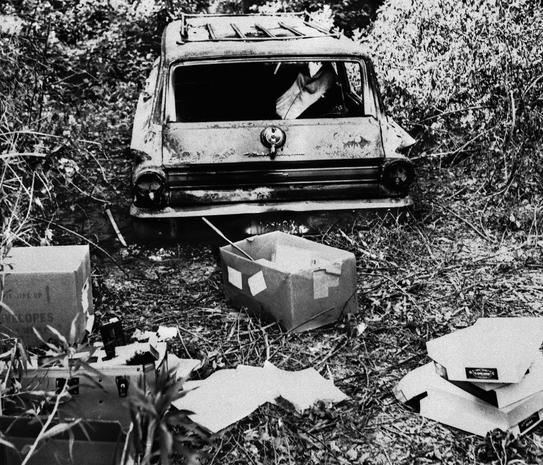
 

 The burnt out station wagon used by the Civil Rights Workers was quickly discovered confirming the worst fears for their fate.

Tucker was assigned to dispose of the CORE station wagon by driving it to Alabama.  Instead. he ditched it near a river along Highway 21 in northeast Neshoba County and set it ablaze.  That proved to be a fatal mistake.  After the Meridian COFO office, the initial target of an FBI surveillance team already stationed in town, reported its three volunteers missing, J. Edgar Hoover reluctantly moved to begin a search.  He was acting under pressure from Attorney General Robert Kennedy who also ordered 150 additional agents from New Orleans to the scene.  The burnt-out station wagon was accidently discovered the next day by two Native Americans who reported it to the Meridian Agent in charge, John Proctor Kennedy then ordered hundreds of sailors from the Naval Air Station Meridian to search the swamps of Bogue Chitto for the bodies.  Top Special Agent Joseph Sullivan was brought in from Memphis to lead the investigation.  Proctor and Sullivan were the models for the fictional FBI agents in Mississippi Burning.

That search turned up unexpected results.  The bodies of college student Charles Eddie Moore and a sawmill worker from Franklin County, Mississippi were found badly decomposed in a river chained to a Jeep motor.  Although neither 19-year-old Black men was known to be involved in Civil Rights work, they were picked up while hitch hiking in May on suspicion, beaten, tortured, and interrogated before being dropped into the river alive.  The bodies of five other recently murdered young black men from rural towns in the area who were never reported missing were also turned up.  It was grizzly evidence of a well-oiled and active night riding operation.

Acting on a tip from a mysterious Mr. X the FBI dispatched searchers to Burrage’s farm where the bodies were discovered 44 days after their abduction and murder.  The case unraveled from there.


Outrage over the murders help secure passage of the Civil Rights Act of 1964.  Lyndon Johnson presents Rev. Martin Luther King, Jr with a ceremonial pen following a signing ceremony at the White House. 

National outrage about the murder of the idealistic young Northern volunteers was used by President Lyndon Johnson to leverage final passage of the 1964 Civil Rights Act on July 2.  As many noted even at the time, the death of their Black comrade Chaney alone would hardly have caused a ripple in Congress.  The case along with the deaths of White volunteers Rev. James Reeb and Viola Liuzzo during the Selma Campaign the next year was also credited with the passage of the Voting Rights Act of 1965.

You may have noted the great and specific detail known about exactly how the murders were committed and by whom.  Exactly how do we know so much?  Good question.  Although the FBI may not have had informants within the inner circle of those who plotted and planned the murder as well as the lynch mob that carried it out—although some historians believe that at least one of the men may have been a deep cover informant never revealed by the Feds because he was actively involved in the killings—there were informants in the wider White Knights of the Klan organization.  Take Mr. X.  Forty years after the fact he was identified as Mississippi State Trooper and Klan member Maynard King who was enlisted as an informant by Agent Sullivan.

Other informants were on hand on for instance on June 7 when White Knights Imperial Wizard Bowers told a secret rally:

This summer the enemy [CORE] will launch his final push for victory in Mississippi…there must be a secondary group of our members, standing back from the main area of conflict, armed and ready to move. It must be an extremely swift, extremely violent, hit-and-run group.

So, the FBI was aware that a serious and violent plot against Freedom Summer volunteers was afoot weeks before the murders.  After the fact other informants associated with the Klan but never identified by Federal agents passed bits and pieces of information they picked up from the loose lips of participants or second hand from others.

In late November 1964 the FBI accused 21 men of conspiracy to injure, oppress, threaten, and intimidate Chaney, Goodman, and Schwerner.  Most of the suspects were arrested by the FBI on December 4, 1964.  Mississippi officials declined to prosecute any of the men for murder so Assistant Attorney General John Doar led a star-crossed Federal prosecution for conspiring to deprive the three activists of their civil rights.  18 men including Sherriff Rainey and Deputy Price were originally indicted.  Travis M. Barnette, owner of a Meridian garage where much of the planning was done, and James Jordan who was the first to shoot Chaney both confessed and testified at upcoming trials.  Jordan’s testimony was particularly damming.


The faces of evil--members of the lynch mob who carried out the murders: Top Row, L-R: Deputy Cecil R. Price, Travis M. Barnette, Alton W. Roberts, Jimmy K. Arledge, Jimmy Snowden. Bottom Row, L-R: Jerry M. Sharpe, Billy W. Posey, Jimmy L. Townsend, Horace D. Barnette, and James Jordan who confessed and testified against the others. 

Despite strong evidence, the case hit snag after snag.  After several false starts and bringing the case back to a Grand Jury once, the U.S. v. Cecil Price et. al. came to trial on October 7, 1967 in the Meridian with Federal Judge William Cox, an ardent segregationist, presiding.  An all-White jury included one admitted former Ku Klux Klan member.  When the jury deadlocked despite overwhelming evidence, Cox admonished them with an Allen charge for the minority to reconsider its judgement. 

On October 20 Cecil Price, Imperial Wizard Bowers, Alton Wayne Roberts, Jimmy Snowden, Billey Wayne Posey, Horace Barnett, and Jimmy Arledge were convicted and sentenced to between 3 to 10 years.  After losing their appeal they all went to prison, but no one served more than six years.  They were the first White men convicted of a fatal crime against civil rights workers.  The cases of E. G. Barnett, a candidate for Sheriff, and preacher Edgar Ray Killen, believed to be the principal mastermind of the plot ended in a hung jury.  Prosecutors declined to re-try them.  No charges were brought against several other men known to be involved in the wide-spread plot.


Edgar Ray Killen, mastermind of the plot was finally convicted of the three murder in a Mississippi court in 2005. 

After years of investigation by intrepid journalist Jerry Mitchell of the Jackson Clarian-Ledger and the work of high school teacher Barry Bradford at Stevenson High School in Lincolnshire, Illinois and three of his students, Allison Nichols, Sarah Siegel, and Brittany Saltiel who produced a documentary film on the case and helped uncover new evidence, Mississippi prosecutors were finally pressed into bring murder charges against Killen.  At age 80 he was convicted and sentenced to three consecutive 20-year terms in 2005.  He died in prison on January 11, 2018, six days before his 93rd birthday.


Monday, February 9, 2026

Revered Film Classic Was KKK Propaganda


                                                   There was no mistaking the heroes of The Birth of a Nation in the most widely used of several posters.

The premiere of D. WGriffithepic The Birth of a Nation on February 8, 1915 was just the beginning of its vast influence for good and bad.  One of the most celebrated films in cinema history has been lauded and reviled.  On one hand the schizophrenic flick was a stunning technical and artistic breakthrough from Americas most accomplished director—an epic on a scale never before seen chocked full of camera and editing techniques that exploded the visual vocabulary of the medium, made long-form cinema viable, and raised the ante on the low-brow comedies, turgid melodramas, and shoot-‘em-ups that had dominated the silver screen.  On the other hand it was proudly and avowedly racist, romantic propaganda for night riding terrorists, and the inspiration for a resurgence of lynching and wide-spread attacks on Black communities like East StLouis that year; the race riots of 1919 in Chicago, Washington, D.C., and elsewhere; and the destruction of the prosperous Greenwood neighborhood in Tulsa in 1921 and the town of Rosewood, Florida in 1925. 

Fresh American racial tensions and the rise of neo-Jim Crowism in the new Alt-Right and the empowered voice of a new generation in the Black Lives Matter movement revived attention to this powerful cultural skeleton that can’t be kept in the nations closet 

Symbolic of that is the PBS Independent Lens film Birth of a Movement, which premiered in 2017. The documentary chronicled: 

…Boston-based African American newspaper editor and activist William M. Trotter [who] waged a battle against D.W. Griffith’s technically groundbreaking but notoriously Ku Klux Klan-friendly The Birth of a Nation, unleashing a fight that still rages today about race relations, media representation, and the power and influence of Hollywood. Birth of a Movement, based on Dick Lehr's book The Birth of a Movement: How Birth of a Nation Ignited the Battle for Civil Rights, captures the backdrop to this prescient clash between human rights, freedom of speech, and a changing media landscape. 


D.W. Griffith, right, directs a scene as his trusty cinematographer Billy Blizer cranks the camera.

Griffith was born the son of a Confederate officer on January 22, 1875 in rural Kentucky.  His father died when he was 10 leaving the family in poverty and costing them the family farm.  His mother’s attempt to operate a Louisville boarding house collapsed, and Griffith was forced to leave school at 15 to support the family by clerking in a dry goods store and then a bookstore.  The bookstore offered an opportunity for self-education.  Later, he became stage struck and signed on to one of the touring companies that came through town working his way up from walk-ons and bit parts.  He also dabbled unsuccessfully as a playwright. 

In 1907, he submitted a script to Edison Studios in New York.  Producer Edwin Porter was not impressed with the script but gave the young actor a part in Edison’s most ambitious picture to date, Rescued from an Eagles Nest.  The next year he landed a small part in a Biograph film.  After the company’s main director Wallace McCutcheon took ill and was unable to work, company co-founder Harry Marvin tapped the young man as his replacement. It was a testament to how new the medium was and how little regard those who ran the business had for directors and actors, who were considered disposable and interchangeable. 

After his first short, The Adventures of Dollie, Griffith churned out 47 more one and two-reelers on Biograph’s assembly line.  Each film was an on-the-job education, and Griffith was a fast learner working with innovative camera man G. W. “Billy Bitzer.  Griffith’s films were successful in helping to establish the struggling studio as an industry leader.  He was given his own quasi-independent production unit. 

In 1910 Griffith took the unit to the West Coast where he shot Old California, the first film shot in the Los Angeles development of Hollywood Land, and which first paired him with Biograph’s rising young star Lillian Gish.  Griffith stayed out west enjoying the reliable sunshine and good weather for outdoor shooting frequently working with Gish.  

But Griffith itched for more ambitious projects.  In 1914 he pushed the reluctant studio into allowing him to make his first feature film—one of the first ever shot in the U.S.—the Biblical epic Judith of Bethulia starring Blanche Sweet and Griffith’s favorite leading man, the diminutive Alabaman Henry B. Walthall.  But it was an expensive film costing more than $30,000 to shoot to his exacting standards.  Biograph was appalled and resisted his efforts to make more features causing him to exit the company.  Still, when the film was released, it was a hit and made money. 

Griffith took his entire unit and stock company first to competing Mutual Films and then formed a studio with the Majestic Studio manager Harry Aitken which became known as Reliance-Majestic Studios, later renamed Fine Arts Studio.  To launch his new venture, Griffith searched for source material with the epic historical sweep that appealed to him.  What he found was Thomas F. DixonJr.’1905 novel The Clansman and the successful play that Dixon penned based on it. 


                                           The title page of Dixon's The Clansman in its first edition.

The book was already famousand both controversial and notorious for its portrayal of the rise of the Ku Klux Klan in the Reconstruction Era as the heroic defenders of pure White womanhood and valiant resistance to tyrannical oppression by carpetbagging Yankees and their crude and dangerous Black political puppets Griffith resonated with the tale with every fiber of his un-reconstructed Confederate being 

Although some claim that he was naïve about the backlash that making the film would cause, Griffith was eager to use the property to shovel the last spadesful of dirt onto the corpse of Black equality.  Dixon was at first skeptical about making the film, but Griffith won him over with an offer of $10,000—a huge sum—for the rights to the play and Dixon’s work on a script 

It was money Griffith didn’t have and couldn’t pay especially as production costs for the epic piled up.  He already had to borrow much of the capital from the savings of his cinematographer Blitzer.  When he could not make good on the promised payment, he instead offered Dixon 25% of the profitsthe first such arrangement in film history.  It turned out to be a very good deal for Dixon when the movie became the biggest money maker of all time, a claim it held unchallenged until the release of Gone With the Wind in 1939.  Dixon made millions from the film—far more than Griffith who owed everybody to pay for it. 

As production got underway, Griffith and Blitzer collaborated on the innovative techniques that would thrill and captivate cinema buffs for generations including close-ups, fade-outs, and certain kinds of tracking and panning shots.  A carefully staged battle sequence made with the technical advice of West Point instructors who also lent Civil War era artillery pieces and authenticated arms and uniforms employed hundreds of extras carefully staged to look like thousands.  The long form allowed the script to carefully build tension over time to a dramatic climax, and the film was one of the first to mix fiction with historic scenes and personages. In post-production, tinting was used for dramatic effect in some scenes, and a score for full orchestra was composed by Joseph Carl Breil to be performed with screenings of the three-hour epic.


Henry B. Walthall was the dashing hero as the Confederate Little Colonel in the most realistic battle scenes yet filmed--so realistic that some Civil War veterans swore that they had to have been shot in the heat of real battle. 

In addition to stars Lillian Gish and Henry B. Walthall as the “Little Colonel”—the heroic Confederate officer who rallies oppressed Whites to strike against Reconstruction and uppity Negros in the robes of the Ku Klux Klan—the cast included several notables including another major female star, Mae Murray, and future stars and character actors Wallace Reid, future director Joseph Henabery as Abraham LincolnDonald Crisp as Ulysses S. Grant, future Tarzan Elmo LincolnEugene Pallette, directing great Raoul Walsh as John Wilkes Booth, and western reliable Monte Blue Blacks were sometimes portrayed by white actors in blackface like George Siegmann as the mulatto henchman to a carpetbagging YankeeWalter Long as a lusty renegade who attacks a pure white woman, and Jennie Lee as Mammy helping to invent an enduring cinema stereotypes. 

Even as shooting and post-production was underway, intense publicity about the upcoming epic began to stir concern and opposition, especially from the infant National Association for the Advancement of Colored People (NAACP) which was founded only six years earlier by W. E. BDuboisIda B. Welles, Mary OvingtonHenry Moscowitz, and others.  Defiant and undaunted Griffith push ahead with plans to unveil his film. 


The NAACP objected to scenes like this where a would-be black rapist is terrorized,  The miscreant was played by white actor Walter Long in blackface.

The film opened at Clunes Auditorium in downtown Los Angeles, still bearing the title of the book and play, The Clansman.  The very name was a red flag to Blacks and their liberal allies.  The public furor intensified, especially in Northern cities where newspapers editorialized against it Petitions were launched to ban it, and noisy public meetings were raising a ruckus.  The South, on the other hand, was in rapturous anticipation of its release to their theaters, and it was hailed as vindication.  Much of the country was simply eager to see the much-hyped spectacle. 

Before bringing his film east, Griffith re-named it The Birth of a Nation.  Some saw it as an attempt to placate critics.  But Griffith stuck by his opinions he just tried to finesse them by claiming that the U.S. emerged from the Civil War and Reconstruction as a nation unified by a common faith in White racial superiority and the necessity of suppressing Black animal urges. “The former enemies of North and South are united again in defense of their Aryan birthright” a title card at the end of the picture reads. From a public relations standpoint, he reaped the box office benefits of the original title in the South while placating the qualms of the least aware white Northerners. 


After the film's release rioting erupted in Philadelphia, Boston, and other cities with mobs of whites attacking Black that they found on the streets.

The film opened in New York and other major cities beginning on March 3 and was greeted by NAACP pickets.  Major and minor riots erupted in BostonPhiladelphia, and elsewhere, mostly attacks on protestors and any Blacks that White mobs could lay their hands on.  Several murders around the country were attributed to men who had recently seen the film.  Despite, and probably because of, the violence and controversy record crowds thronged theaters. 

And Griffith still had an ace up his sleeve.  Dixon was a former college classmate of President Woodrow Wilson.  The former Princeton President, New Jersey Governor, and leading Democratic progressive, was the son of a Virginia mother with unreconstructed Confederate sympathies.  As President he already dismantled the tattered shreds of voting rights enforcement and other protections under the 14th Amendment effectively driving a stake into the heart of remnants of Reconstruction.  He had also re-segregated all Federal agencies and services.  Wilson was more than happy to host a screening of The Birth of a Nation in the White House—the first film ever shown there—and to enthusiastically tell the press it was “like writing history with lightning.”  Not only did Griffith exploit the endorsement in his well-oiled publicity campaign but he added a title card to the film quoting from Wilson’s History of the American People. 


A title card exploited Wilson's reported praise of the film by quoting from his History of the American People.

Although some cities, including Chicago, did ban the film in fear of explosive racial unrest, huge crowds in other cities more than made up for it.  And even in most of those cities, the movie was eventually screened after the initial wave of protests subsided. 

Griffith marketed the film as no picture ever had been before.  He invented the road show.  Instead of being shown in the shoe box movie houses of the era, little more commodious and comfortable than the nickelodeons of the film industry’s infancy he rented the leading auditoriums, legitimate theaters, opera houses, concert halls, and vaudeville palaces in each city.  Instead of plucking down a nickel or a dime at the box office, movie goers were advised to buy reserve tickets at up to $1 a pop.  That might not seem like much today, but it was 20 times the cost of most movie admissions.  Local orchestras had to be engaged and rehearsed in the elaborate score.  Meanwhile, the city was flooded with handbills, posters, and newspaper advertising.  The local elite turned out in white ties and tails, furs and ball gowns as if attending the opera.  The working class scrimped and saved for reduced admissions for Saturday and Sunday matinees and showed up in their best mail-order suits, celluloid collars, and most stylish dresses.  The film ran not just for two or three days, but for as long as the crowds kept coming—weeks in some cities. 

Griffith had several units touring the country visiting the big cities first and working their way down to smaller burgs in the sticks.  In this way it remained in circulation for two or three years, sometimes returning for second engagements in some towns.  Afterwards it remained available for rent for special screenings by private groups. 

The cost of all of this was enormous, but so were the profits.  The film played at the Liberty Theater in New York City for 44 weeks with tickets priced at a jaw dropping $2.20.  Total revenue from the film is difficult to gauge because of the various agreements and splits with local theater owners and sometimes state distributors.  Estimates vary widely.   Epoch picture reported to its shareholders cumulative receipts of $4.8 million for all of 1917 which would have represented about 10% of total ticket sales.  By 1919, that had grown to $5.2 million in world-wide revenue.  Some estimate that first run box office sales ran to $50 million.  And money continued to pour in. 


Sweet, pure White womanhood represented by Lillian Gish is being held captive and awaiting a forced marriage to the evil Mulatto Silas Lynch in her star turn in the film.  Never fear, the Little Colonel and the Knights of the Klan are on the way to save the day.

The movie’s success changed the whole industry.  Studios shifted production to feature films.  And exhibitors began to build ever larger and more elaborate movie palaces to accommodate the films and the expanded audience for them, a trend only briefly interrupted by World War I.  The powerful operators of theater chains became the owners of the most important Hollywood studios, all a direct result of the astonishing success of The Birth of a Nation. 

The film also boosted the reputation of cinema as art rather than low-brow novelty entertainment.  Newspapers added movie critics to their stables along with those covering the theater and fine performing arts including reporters like Carl Sandburg in Chicago.  Performers like Lilian Gish, once semi-anonymous, were catapulted to the glittering status of movie stars.  Griffith himself became a lionized celebrity. 

But there was a much darker side to all of this success.  On the revived interest in the Reconstruction Era night riders William Joseph Simmons inaugurated the so-called second Ku Klux Klan at Stone Mountain in Georgia where on Thanksgiving night 1915 15 men in robes burnt a cross.  The new Klan grew slowly in its first five years but used showings of The Birth of a Nation as a major recruitment tool.  Membership exploded in 1919 and after during the Red Scare and during the 1920’s the Klan was a major national organization with widespread membership not only in the old Confederacy but in many northern states like Indiana where Klan members captured the state government.  Much of the continued revenue stream generated by The Birth of a Nation in that decade came from Klan sponsored private showings. 


By the mid 1920's the revived Ku Klux Klan that inspired The Birth of a Nation was large and powerful enough to stage an impressive march in Washington D.C. 

Despite all the accolades and profits the film earned, Griffith was still stung by criticism.  His answer was his next blockbuster, Intolerance.  Griffith’s many admirers for his undoubted creative innovation multiple contributions to the advancement of film as art have tended to become his apologists and often assert that Intolerance was made as a kind of atonement for the offences of The Birth of a Nation.  Even as astute an observer as Roger Ebert, who usually had a nose for bullshit and a sharp political and moral consciousness fell into the trap of this interpretation—“... stung by criticisms that the second half of his masterpiece was racist in its glorification of the Ku Klux Klan and its brutal images of blacks, Griffith tried to make amends in Intolerance (1916), which criticized prejudice.” 


                                The NAACP continued to picket revivals of The Birth of a Nation like this demonstration in 1947.

But Griffith regretted nothing.  Instead, he felt he was the victim of intolerance by critics of his film.  He reiterated this feeling of wounded self-righteousness in multiple interviews promoting his new film. 

Although Intolerance is today best remembered for its stupefying grand scenes of the Fall of Babylon it intertwined four separate morality tales spanning millennia—the Babylonian tale, a Judean story picturing The Nazarene brought to crucifixion by intolerance, the French St. Bartholomews Day Massacre of Protestant Huguenots, and a modern tale of a working class family destroyed by greed and busy-body do-gooders.  In his interviews Griffith often compared his persecution to Christ’s.  

The two newer stories are instructive.  The blame for the persecution of the Huguenots was, of course, laid straight on the shoulders of the Catholic Church, the object of scorn and prejudice of many of the same folks that upheld Jim Crowe violence.  Catholics also meant dirty immigrants to many.  The newly reborn KKK made a point of adding Catholics as well as Jews to their list of enemies and indeed it was anti-Catholicism as much as anything that spurred its growth in the North in states like Indiana.  The chief villain of the modern story is a liberal moral uplift society which precipitates a deadly labor strike when a capitalist cuts wages to give money to his sister’s charity.  Later, the same charity intervenes to take the beloved child of the innocent Dear One when the family falls on hard times.  They stand for all the white liberals who allied with the NAACP and especially do-gooders like pioneering social worker Jane Adams who harshly criticized the film. 


Star Mae Murray struggles to keep her baby from the clutches of The Uplifters--the busy-body liberal lady villains of the modern tale in D.W. Griffith's Intolerance.

Intolerance cost a record shattering $2.5 million to make—far more in relationship to the value of the dollar than the extravagant costs of the Elizabeth Taylor/Richard Burton version of Cleopatra or the legendary fiasco Heavens Gate both of which nearly ruined and bankrupted their studios.  Intolerance did the same.  The film was not the complete box office failure of legend, but it failed to match the success of The Birth of a Nation and came nowhere near recouping its costs or paying off its investors.  Griffith’s studio collapsed and was sold off at fire sale prices.  He financed most of the film himself with his earnings from The Birth of a Nation.  He was personally ruined and never recovered financially.  The failure made other studios reluctant to work with him. 

He continued to make films, most notably the Lillian Gish vehicle Way Down East, but he had to relinquish his absolute control over his product and could never again attempt a grand scale epic.  In 1919 he joined Charlie ChaplinMary Pickford, and Douglas Fairbanks to form independent United Artists.  The company produced Way Down East and Orphans of the Storm successfully, but other films failed and by 1924 he left the company.  He never had another hit but continued working sporadically into the early sound era.  Abraham  Lincoln starring Walter Huston as Abe and Una Merkle as Ann Ruttlage, with a script partly written by poet Stephen Vincent Benét was a critical and popular success, but like The Birth of a Nation played fast and loose with the facts around the Civil War and was highly colored by Griffith’s pro-Confederate bias.  

Griffith then made The Struggle, an alcoholism melodrama inspired by his own battles with the bottle for a minor studio financed by what was left of his own money.  It flopped.  Griffith never made another film. 

He died on July 28, 1948, of a cerebral hemorrhage in the lobby of the Knickerbocker Hotel in Los Angeles, where he lived alone.  He spent his last years embittered and dissolute largely forgotten by Hollywood. 

He remained, however, honored by film buffs.  His greatest creation, The Birth of a Nation is high on any list of the greatest and most influential films of all time. Because it reflected the dominant pro Southern, anti-Reconstruction, and racist interpretation that was central to almost all American high school and college texts of the era, the themes of the film were little challenged until well into the 1950’s when historians like Eric Foner began a reassessment of the Reconstruction era in light of the Civil Right Movement.  By the late ‘60’s the film was under full frontal attack by Black scholars and sympathetic critics. 

Although it retains admirers on a technical level and several restorations have been made and are available on CD, screenings usually result in protests.  In 1995 Turner Classic Movies (TCM) canceled a showing of a restored print during racial tensions over the O.J. Simpson case, although it has subsequently been shown.  

None-the-less, the film was selected for preservation by the Library of Congresss National Film Registry.  The American Film Institute (AMI) lists it as #44 in the 100 Year….100 Movies list.  Rotten Tomatothe film buff web page that compiles reviews, gives The Birth of a Nation a rare 100% rating. 

So, there you have it—the good, the bad, and the ugly.  Take your choice. 


Today dozens of Klan sects are active and flourishing.   They were active in the 2021 Siege of the Capitol and at other events.

By the way, some of the dozens of KKK splinter sects that fester in the White supremacist swamp still use the film, or clips from it as a recruiting tool and on their web pages.