 |
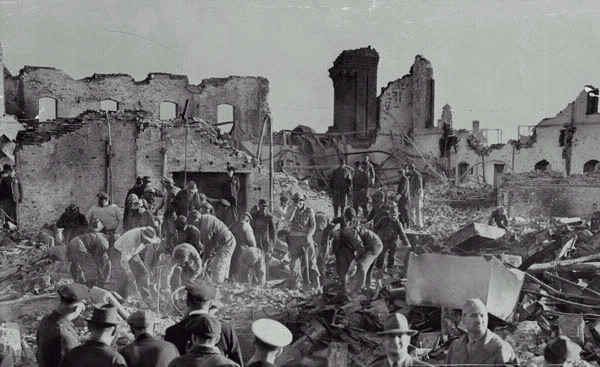
| This is not Europe in 1944. It is Cleveland as authorities and volunteers search for survivors in the rubble of some of the ruins left by the East Ohio Gas Company LNG explosion. |
Plenty
of things and places in the world were
going boom with deadly intent and
effect in 1944. Perhaps that is why except for a dwindling
few survivors, the families of victims, and the scarred heart of a city that
the explosions and fires set off by a leaking above ground storage
tank containing Liquefied Natural Gas (LNG) on Friday, October 20,
1944 in Cleveland, Ohio are largely forgotten.
The
East Ohio Gas Company tank farm set
near the shores of Lake Erie on 61st Street. The plant was
the very first LNG facilities built in the United
States and was still relatively new having been opened in 1941.
Surrounding
it was one of the city’s older
neighborhoods, mostly small frame
houses occupied by European
immigrants and second generation
industrial workers. Mixed in were factories, churches, schools, and small shops along the arterial
streets. It was mid-afternoon. Many were
gone from their homes, away at work in the plants
and mills of the city humming at
full war time capacity. Children were in school. Some women were marketing for their families’
dinner.
But there were plenty of women at home, smaller children, and retired
folks. In Jewish homes, the women were busy with the ritual cleaning to prepare for Shabbat—the
Sabbath.
About
2:30 that afternoon a seam on Holding Tank #4 containing 90 million
cubic feet of LNG failed leaking heavier
than air vapor which sank to the ground and was pushed into the surrounding
neighborhood by prevailing winds off
of Lake Eerie. It rapidly found and sank
into the open catch basins along the
streets of the city sewer system. It continued to flow through the system
and mixed with natural methane gas
always present in the system.
No
alarm or warning was made by the Gas plant operators.
What happened next was inevitable. Almost anything
could have set it off—a cigarette flicked
away through an open sewer grate, an
electrical spark, the rapid build-up of pressure in some pocket.
Within minutes a tremendous blast
ripped through the sewer system. Heavy manhole covers were blown
hundreds of feet in the air. One cover
was later found miles to the east in the Glenville
neighborhood. Roaring geysers of flames shot
into the air. Sections of streets collapsed. In homes and other buildings the flames
erupted through toilet, tub, sink, and
Floor drains, blowing the roof off
the buildings and popping the walls
outward like balloons. The intense heat literally vaporized many
victims.
Stunned survivors wandered the streets, many
seriously wounded as fiery debris rained down infighting more fires. The capricious
flow of the gas through the sewers meant that damage was spotty through the
neighborhood, some homes left standing alone or in small islands.
As the Fire
Department struggled to respond to the enormous
catastrophe the Nuns at St. Vitus School and the teachers at a
nearby public school, both of which were fortuitously by-passed
by the explosion, quickly calmed and
gathered their students and evacuated
their buildings, preventing distraught children
from rushing home. They herded the charges to neighborhoods away from the damage.
The initial explosion shook the whole city. Flames and smoke could be seen for
miles. Being war time, many at first believed
the city had been attacked by Nazi
bombers or that saboteurs had
been at work at the gas plant. As word spread, workers began to stream
out of their factories and head home desperate to find their loved ones.
 |
| Fires raged through whole blocks of modest working class homes. |
After several minutes and as the fires from the
sewers began to subside, many residents concluded that the Fire Department had
the situation in hand and returned to their intact or slightly damaged
homes. Twenty minutes after the first
blast, a tank adjacent to the leaker exploded leveling the whole Gas Works and
pushing new flows of fire through the sewers igniting many of the houses to which
survivors had just returned.
The Fire Department struggled for more than a day to
completely extinguish the last of
the smoldering ruins. Hospitals across the city and suburbs were overwhelmed with casualties, many of them gruesomely burned. It took
days to reunite scattered families.
Dr. Samuel
Gerber,
the visibly distraught Cuyahoga County Coroner told the local
press that the death toll could
exceed 200 but might never be known due to the complete destruction of many
bodies.
After weeks of accounting for the missing, authorities
finally set the actual death toll at about 130.
The explosions had destroyed most of an area covering more than a square
mile of the east side St. Clair-Superior
neighborhood. 600 people were left homeless, and seventy houses, two
factories, numerous cars and miles
of underground infrastructure and
street surfaces were destroyed.
In addition to the loss of their homes, furnishings,
clothing, and other tangible property many of the families, traditionally distrustful of banks especially after the Depression,
lost hoarded cash,
huge amounts of War Bonds, stock
certificates, deeds, insurance
policies, and other documents for
which they could never be made whole.
Because of the uncertainty of these kinds of losses, total losses have
been estimated at between $7,000,000 and $15,000,000, including losses at the
Gas Works and other industries.
 |
| Early headlines did not yet grasp the scope of the disaster. |
East Ohio Gas shelled
out about $7 million to rebuild homes and repair streets. Victims and survivors got very little compensation
for their injuries, medical expenses, or the loss of loved ones.
LNG storage practices were reformed in the wake of
the disaster. New high-pressure, seamless tanks were developed. Underground tanks for high volume storage
became the norm. But changes took
years. There were other disasters. But none as devastating at the one that
shattered an autumn afternoon in
Cleveland.


