Showing posts with label Admiral Orin G. Murfin. Show all posts

Thursday, September 6, 2012

It’s International Murfin Day! Woot, Woot!

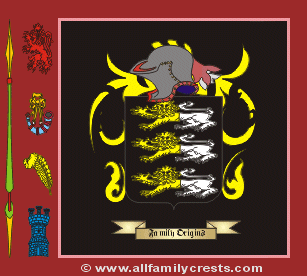
A rendering of the supposed Murfin family Arms.


It may have escaped your attention but today is International Murfin Day!  Break out the Champaign!  Bring on the dancing girls!  Pass the biscuits and jam!  Some Murfins are more adventuresome than others, you see.
We owe this fabulous observation to Charles Edward Murfin, Jr. better known simply as Ed, a Disciples of Christ minister living in retirement in Jacksonville, Florida.  For years Ed has doggedly been compiling genealogical info on Murfins around the world.  His astonishing diligence has resulted in detailed family line histories, some going back far into the mists of time, which he shares at http://www.murfingenealogy.com/ .
Not content to just do the research, Ed’s dream is to connect Murfins everywhere and all of those with the many variations on the name.  His motto is “All Murfins should be friends.”  Murfins can be found from ancestral England to Ireland (Ulster), Canada, the United States, Australia, New Zealand, South Africa and other locations.
Ed’s dream for International Murfin Day is to raise public awareness of the name and the many families it is part of, and possibly to turn up yet more Murfins and more information that may be able to fill in the inevitable blanks and gaps of any family history.  To this end he is encouraging public messages—letters to the editor, articles in local papers, and maybe even blog entries like this.  Also he is hoping to get all of the major search engines to really notice Murfins by encouraging folks to log on to Google, Bing, Yahoo, and/or your other favorites and enter a search for Murfin.  Go ahead now, do as you’re told.  I’ll wait for you to finish and you can come back and finish this.
Back so soon?  You probably noticed a lot of entries, including local businesses, and numerous individuals with Facebook or other social media pages.  But several names keep repeating.  These best known Murfins include such historic figures as Admiral Orin Murfin who commanded forces who searched for Amelia Earhart and compiled the official U.S. Navy report on the attack on Pearl Harbor: playwright/screen writer Jane Murfin; and less happily, Melody Ann Murfin, a drug addicted prostitute who became a victim of Seattle’s Green River Killer.  Ed’s late brother James V. Murfin was a noted historian of the U. S. Parks Service and author of one of the very best Civil War battle histories, The Gleam of Bayonets:  The Battle of Antietam and Robert E. Lee’s Maryland Campaign.
Contemporary notables include Ross C Murfin, a professor of English and administrator at Southern Methodist University, who’s literary criticism is widely admired; Justin Murfin, an assistant professor of finance at Yale; and David Murfin, the owner of Murfin Drilling, the leading oil exploration company in Kansas and recipient of several industry awards.  My nephew Ira S. Murfin, a playwright, performer,  and poet, is a Murfin with a bullet by his name as an up and comer.
Because of this blog and my books, my name pops up embarrassingly often on some of the search engines when compared to honest folks.  As I have noted before, I dangle precariously from the family tree—an adopted son with no actual Murfin blood.  Ed is generous about including me anyway.
Growing up, we were told that our name was derived from the Irish Murphy, and had been changed when our ancestors arrived in the U.S. after the American Revolution.  Although the time frame for the arrival was seemingly correct—a Pennsylvania Long Rifle made about 1785 which got a replacement barrel in Cincinnati, Ohio in 1802 hangs on my living room wall and has been handed down for generations—the origins were not.  Much to my own personal astonishment, Ed’s research showed that Murfins originated in Great Britain.
Some researchers identify the name as Welsh in origins.  Others cite Northumberland just south of Scotland which had a large Celtic population.  Both origin tales trace the name to variation on Merlyn, the legendary Druid or Wizard who figures prominently in the Arthurian legends and other folk lore.  Many Murfins can still be found in the north of England in Yorkshire and a little further south in Derbyshire.  One of those Murfins was Sir Thomas Murfin who became Lord Mayor of London in 1518.  A good many Murfins were apparently Round Heads—Puritans—in the English Civil War.

There are many variant forms of the name.  The oldest known form is the Gaelic Myrddin (Merlin) which was first found in an Anglo-Saxon form as Mervin in the Doomsday Book of Durham in 1086.  Other early variations were Mirfyne, Myrfyn and Mirfin. More modern variant spellings include Marvin, Mervin, Mirfin and Mervyn.  The Murfin spelling seems to have first been used in the  15th Century.

At the top of the page is a rendering of a coat of arms apparently awarded to some Murfin at some time.  It probably by right only belonged to the gentleman to which it was originally granted or at most his immediate family.  However different companies market the arms as the official Murfin family crest and it can be purchased on coffee mugs, t-shirts, and even mouse pads.  Or framed to hang on the wall like the copy I got for Christmas one year.  Almost assuredly by the rules of Heraldry virtually no modern Murfin is entitled to use it.  But that doesn’t stop us.
Like any clan with wide tendrils, there were undoubtedly as many horse thieves, drunks, and bigamists in our lineage as heroes, gentlefolk and scholars.  None the less, today we celebrate them all.
Now, get back to those search engines so Ed won’t be disappointed. 

Wednesday, December 7, 2011

Admiral Murfin and the No Good, Very Bad, Terrible Day

The Court of Inquiry:  Admiral Edward Kalbfus; Admiral Orin G. Murfin, President;Vice Admiral Adolphus Andrews. 

Today is December 7, a date so significant in American history almost every one—except recent high school graduates who never got that far in their pitiful history survey classes—immediately recognizes.  Yes, it is “a date that shall live in infamy,” in the words of President Franklin D. Roosevelt, the day when the Empire of Japan attacked Pearl Harbor, Hickam Field, and other naval and military installations in Hawaii.  

I’m betting you know at least the rough details of that catastrophe, so this post is not going to detail them.  If not, look it up.

I am going to take the opportunity to explore a kinship relationship, albeit a distant one, with a historical personage connected to the events.  Actually, I also have a much closer connection, too.  Lemuel Mills, my maternal grandfather, was a civilian construction worker on Ford Island who came under personal fire that Sunday morning.  He shared the story in a letter to his daughter, my mother, Ruby Irene Mills Murfin.  She was not pleased to hear from the nasty, drunken, abusive father who had abandoned her mother, to no one’s regret, years before.  Even dodging Japanese bullets couldn’t make a hero out of the man so despised by his family that when he died in Arizona years later my Uncle Pearl Mills—no that isn’t a typo, that was his name—went all the way there from South Dakota just to make sure the bastard was dead and piss on his grave.

Anyway, my distant kinsman Admiral Orin Gould Murfin, is the one I want to write about today.  Not that he was there that Sunday.  The Admiral had recently retired stateside after serving from 1936 to late 1940 as Commander of the 14th Naval District, headquartered at Pearl Harbor.  But in 1944 he was called out of retirement to become the President of the Navy Court of Inquiry of the attack.  This is his story.

Murfin was born on April 13, 1876 at Hanging Rock, Ohio.  His father was an engineer of the coal fired furnaces used in the iron and steel industries.  By the age of four the family had relocated to Wellston, Ohio where his father was made superintendent of Superior Coal Plant #1.

The boy was such a bright and eager student that he obtained an appointment to the Naval Academy after completing his junior year of high school.  He graduated from the Academy in 1897 and although he saw no action in the Spanish-American War advanced rapidly in the Navy.  He was a full Lieutenant in 1902, very rapid advancement indeed.

By World War I Murfin was a Captain.  He was decorated for his service as the commander of U.S. mine laying bases in Scotland.  His greatest achievement was laying the Northern Mine Barrage--57,000 mines laid across the North Sea from the Orkney Islands off Scotland to the three mile limit off Bergen, Norway.  The mine field effectively hemmed in the German fleet to  home waters and cut off virtually all remaining maritime trade.  His citation for the Navy Distinguished Service Medal cited “the pioneer work performed by Captain Murfin in the establishment of the bases and the development and administration of the industrial organization required.”

Those organizational and technical skills excelerated Murfin’s career even through the period of Naval Disarmament of the 1920’s.  He was the final Captain of the venerable cruiser the USS Alabany (CL-23) and was named in 1929 Captain of the USS West Virginia, then the largest and newest of the Navy’s battleships.

In 1930 he made rear admiral and in 1931 was named Judge Advocate of the United States Navy. This shore assignment gave the newly minted Admiral experience in legal and administrative affairs that would be called on in the future.
 
But you can’t keep a blue water sailor ashore for long.  After three years at a desk he was named Commander of the 3rd Division of the Battleship Fleet in the Atlantic.

As the Navy’s attention shifted to Asia and the Pacific so did Murfin’s career.  After serving as President of the board of inquiry of the crash of the Navy Airship Macon into the Pacific in 1935, he was advanced to Commander-in-Chief of the Asiatic Fleet. During this assignment he gained public notice for conducting the search for missing aviatrix Amelia Earhardt.  During this assignment, he was promoted to full four star Admiral.

Murfin’s final duty assignment was as Commander of the 14th District at Pearl Harbor.  At first glance, this might seem a come down from a Fleet command.  But it came as the Navy was increasingly alarmed by Japanese aggression and growing naval might and was beefing up its greatest naval base, Pearl Harbor.  Admiral Murfin was expected to bring his noted administrative skills to upgrading and expanding the facilities, along with forward bases at Midway and Wake Islands while making plans to defend them from possible attack. 

When he retired, those plans were well underway.  I am sure the Admiral thought he had done everything in his considerable powers to carry out his duty.

How his heart must have sunk as, like most Americans, he heard the news of he attack on December 7 on the radio.  Within days the scope of the disaster became clear—the destruction of much of the heart of the Pacific Fleet, including many of its great battleships, at their moorage or in dry dock.  Only the fortunate fact that the Fleets’s two carriers were at sea averted total disaster.

The Admiral hoped to be recalled to active duty.  It didn’t happen.   But then in 1944 he was recalled to the Presidency of the Board on Inquiry.  He was perfectly qualified by his experience as Judge Advocate and as President of the Macon Board of Inquiry, but the appointment raised eyebrows in and out of the Navy.  He would be called to judge the performance of many close former comrades, some of whose careers he had personally mentored and who he had appointed to high positions as well as those of his superiors in Washington.  And it was a fact that a good portion of the defense plans for Pearl Harbor had been drawn up under his watch, although they had been somewhat modified by the time of the attack.

No matter how you looked at it, the assignment was a hot potato.  Inside the Navy and Army officer corps was a wide spread belief that the first official inquiry, hastily assembled at President Roosevelt’s direction by General George C. Marshall, was something of a kangaroo court aimed at scapegoating the on scene commanders, Admiral Husband Kimmel, of the  Pacific Fleet, and Lieutenant General Walter C. Short, Army’s Hawaiian Department to protect higher-ups in Washington including General Marshal himself and Chief of Naval Operations Admiral Herald Stark.

On the other hand, pressure was growing in Congress for a more complete investigation. 
 
Murfin’s Board of Inquiry wove a path in between.  It was critical enough of high command to earn the wrath of both Marshall, who thought that it was too harsh on the high command  and Secretary of the Navy James Forestall, who felt it was to lenient.  But it still lay most of the blame on Kimmel and Short.  Missing from the equation was the full knowledge of the extent to which Naval Intelligence had broken Japanese Naval codes and exactly what was known about enemy intentions and movements in Washington when.  Most of the intelligence, which might have effected operational decisions, was denied to the commanders in the Pacific.

Today Admiral Murfin is most frequently noted by authors in the mini-industry that has sprung up around investigating Pearl Harbor.  Ranging from crack-pot conspiracy nuts to serious historians, most have criticized Murfin and his investigation as being lax on Washington.  Thus an extraordinary officer with an unblemished record enters history as a footnote and a failure.

The Admiral died October 22, 1956 at the age of 80.