Showing posts with label Baptists. Show all posts

Monday, March 26, 2018

Looking Backward at the Utopian Socialism of Edward Bellamy

Edward Bellamy in 1889.

Edward Bellamy was a literary man of no great distinction.  Frail and tubercular, he had to abandon journalism as too strenuous and took up writing novels in a desperate attempt to make a living. The novels sold moderately, perhaps enough to eke out a living on the bottom rung of middle class respectability.  They had no particular merit or anything to distinguish them from hundreds of others published annually.  Certainly none would be remembered or read today.
Then he tried his hand at a social fantasy.  Overnight, it seemed he and his book Looking Backward were both famous and the center of an exciting popular reform movement.
Bellamy was born March 26, 1850 in Chicoppee Falls in western Massachusetts. He was the son and grandson of Baptist ministers.  A word about New England Baptists of this period.  Do not get them confused with today’s Southern Baptists.  Although Evangelical the Baptists were radically egalitarian and having been oppressed by the established churches of the Standing Order—the Congregationalists and, yes, the Unitarians—they reveled in the status of dissenters and outsiders.  Since members of the established churches tended to be first Federalists, then Whigs, and finally Republicans, Baptists tended to be Democrats largely out of loyalty to Thomas Jefferson and his steadfast devotion to Freedom of Religion.
After what public education Chicoppee Falls could offer and reading in his father’s library, Bellamy went off to Union College in Schenectady, New York.  For whatever reason, he dropped out of school after completing just two semesters.  He somehow found the money for a trip to Europe, spending most of his time in Germany, still the epicenter of romanticism and a hotbed of Biblical criticism and various socialist schemes.  It was enough to shake out any cobwebs of theological and economic orthodoxy he may have retained.
On returning to the States he seemed a young man at loose ends.  He tried his hand at reading law but quickly abandoned it.  He drifted into newspaper work.  Probably through connections from Union College, he found work at the New York Daily Post which was co-owned and managed by John Bigelow, an 1835 Union graduate and benefactor of the college.  Editor-in-chief, William Cullen Bryant, the noted poet and former abolitionist was also a vigorous advocate and defender of labor.  Although he did not spend long on the paper, as a young man absorbing influences like a sponge, it was formative.
Bellamy chose to move closer to home, taking a job with the most important paper in western Massachusetts, Springfield Union.  Now we come to the scene where, if this was a bio-flick, we would see Bellamy hunched over a desk, pen in hand.  Probably in his shirtsleeves with arm garters, cravat loosened, celluloid collar unhooked, hair a tad disheveled.  He is working furiously by oil lamp.  He coughs. Foreboding music swells.  He presses a handkerchief to his mouth, coughs again, and stares at the crimson splotch of blood on the cloth.  We know in an instant that he has consumption and is ultimately doomed.
In 1877 Bellamy went to the Hawaiian Islands for a yearlong rest cure.  Most New Englanders of the period were going south to places like Charleston or even Cuba.  A few were taking the long train trip to the desert southwest.  Bellamy’s choice was influenced by reading Mark Twain’s popular accounts of his time in the Sandwich Islands nearly a decade before.  He took to the palm trees, sea, and native girls.  He also took to writing.  He completed his first novel, Six to One while there. 
The book did not make much of a splash, but sold well enough to Bellamy to decide that he could no longer stand the stress and demands of daily journalism. 
In his second novel, Dr. Heidenhoff’s Process, published in 1880 Bellamy dabbled in some fantastic elements.  A doctor invents a process which can erase painful memories from the brain.  When the woman he loves is seduced and abandoned by a cad he uses the process on her.  She is cured and about to fall gratefully into his arms when the doctor awakes, realizes it was all a dream, and his beloved has committed suicide.  Pot boiler stuff.
In real life, despite his inevitably fatal condition, Bellamy fell in love and in 1882 married Emma Augusta Sanderson. Their marriage was apparently happy and produced two children, a boy and a girl.
After another novel, Miss Ludingto’s Sister, in 1884, Bellamy tried something daringly new.  Utopian novels were not new.  They dated back to Sir Thomas Moore’s Utopia published in Latin in 1516 which gave birth to the genre.   But such novels were not common.  Bellamy was probably inspired by the work of pioneer science fiction author Jules Verne whose work in translation from the French was beginning to be popular stateside. 
He was also well aware of a body of works on cooperative societies, Christian socialism, and even Marxism that included Charles Fourier, Robert Owen and Henri Saint-Simon, as well as to the Associationism of Albert Brisbane whom Bellamy had met in the 1870s.  Two more recent works were also influential in his thought, Laurence Gronlund’s The Co-operative Commonwealth in 1884, and August Bebel’s Woman in the Past, Present, and Future in 1886.

The First edition of Looking Backward: 2000-1887
In Looking Backward: 2000-1887 Julian West falls into a deep, hypnotic induced sleep in Boston in 1887 and awakens in the same city, but utterly transformed city in the year 2000.  He is introduced to his new surroundings by a kindly and scholarly Doctor Leete who regards the cut throat world of the 19th Century as a barbaric Dark Age.
In the new world all industrial production is controlled by the state and it products shared equally among the population.  Technical innovation has greatly reduced the hours of labor needed to produce any item and distribution though common warehouse like stores has cut out layers of middlemen and the goods are delivered to the door.  Everyone is paid in equal credits on which they can draw to purchase the necessities of life and access to enriching culture.  Those doing hard physical labor work a few hours a day.  Those whose work requires intellectual rigor and specialized training are rewarded with even fewer hours.  Everyone retires at age 45 with the same guaranteed benefits as working members of society.

These lines from Looking Backward sumarize its central theme,
With all of the extra leisure, everyone has the opportunity to enjoy the arts.  Symphony concerts and lectures by the greatest minds in the world are delivered to homes over the telephone lines in a manner later readers have compared first to radio and more recently to the internet.
Most people eat daily at communal dining halls where nutritious meals are deliciously prepared by expert chefs.  Travel is provided on free public transportation.  Despite these communal aspects to society, every family has their own comfortable home with the privacy that entails.
On the social level, women are respected and treated as equals and partners both professionally and in the home.  Most crime, which arose out of want, privation, and ignorance, has been eliminated.  Remaining crime is considered the result of disease and atavism, a tendency in some to revert to a savage ancestral type.  These conditions can be medically treated.  What criminals exist are tried by a triumvirate consisting of a chief judge, a prosecutor, and a defender, all of whom must ultimately agree on a sentence after dispassionately reviewing the evidence and the accused’s  prospects for ultimate rehabilitation.
In dialog, one by one West brings up objections to the new order, asking pointed questions and Dr. Leete patiently explains the near perfection of the new system.
West arouses from his slumber, but is convinced that he has been shown the future:
I had visited a world incomparably more affluent than this, in which money was unknown and without conceivable use.... These exchanges money effected—how equitably, might be seen in a walk from the tenement house districts to the Back Bay—at a cost of an army of men taken from productive labor to manage it, with constant ruinous breakdowns of its machinery, and a generally debauching influence on mankind which had justified its description, from ancient time as the “root of all evil”.          
Bellamy shied away from, but did not totally shun, the use of the word socialism which then, as now, was burdened with political and social baggage.  He preferred to call the system he described as Nationalism because all of the means of production and distribution had been nationalized.  This is not to be confused with the use of nationalism as the exhalation of the nation state in its fierce, self-interested  completion with all other nation states.

Bellamy was idolized by his followers
No one was more astounded than Bellamy, who at first insisted that he did not mean to spark a social revolution only to offer “a literary fantasy, a fairy tale of social felicity,” when the book became an overnight sensation, flying off shelves faster than the publisher could issue new editions.  There were not then whole books shops filled with alternative universes and visions of the future.  This was new and exciting to most readers.
It also struck a deep chord in a nation that was in the midst of a brutal ongoing class war  in which the capitalists and bosses offered no quarter—11 years after the era began with the Great Railroad Strike of 1877 and just two years after the launch of a national movement for the Eight Hour Day and the Haymarket Affair.
Literate workers were inspired by any vision of a socialist utopia.  The middle class, particularly the educated elite, were charmed with a vision of socialism that did not seem rooted in the implacable class conflicts of Marxism, but offered a cooperative solution that erased class differences without destroying comfortable civilization.
How popular was Looking Backward?  In the little more than a decade remaining in the 19th Century, it became the second most widely read American novel, trailing only the ante bellum Uncle Tom’s Cabin, and edging out the wildly popular Ben Hur by Lew Wallace published in 1880.
Overnight Bellamy and Nationalist Clubs sprang up first to discuss the ideas in the book and quickly to find ways of implementing them.  By 1890 there were more than 160 such clubs all around the country.  Among the leading intellectuals that were involved were heavy weights like William Dean Howells and Edward Everett Hale. Eugene V. Debs, Grand Secretary and Treasurer of the Brotherhood of Locomotive Firemen and other labor leaders were also attracted.
At first Bellamy held himself aloof from the movement he had inspired.  But within a year he became energized with the idea that his Utopia might just be achievable.  He threw himself into the movement, touring and speaking widely and writing articles in many of the top publications in the country.  In 1891 he established his own magazine, The New Nation as an organ of the movement.
Bellamy believed that political action by an educated leadership could usher in his vision of socialism.  He and many of his followers threw themselves behind the new People’s Party or Populists as a vehicle for that transformation.  After a while efforts of the Nationalist Clubs and the People’s Party became so enmeshed as to be indistinguishable.  Many elements of the Nationalist program did make it into the Populist’s platforms.  But there were also other forces and visions at work, especially the agrarian populism growing out of the Grange Movement, remnants of the Green Back Party, and followers of Henry George, exponent of another popular reform plan the Single Tax.
Meanwhile the class war was only getting uglier with the Homestead Strike of 1892, and industrial warfare in the coal fields and Western metal mining districts.  Labor leaders like Debs were growing disenchanted with the Nationalists gradualist approach and the reliance on middle class leadership rather than working class self liberation. 
The coalition behind the Nationalist movement began to fall apart almost as quickly as it formed.   Bellamy had to close The New Nation in 1894 for lack of revenue.  Most clubs had dissolved.  Working class militants looked increasingly to Marxism and the middle class looked for milder reform models.

Bellamy's vision of complete moral, political, and social equality of women was perhapsis  more deeply radical than his socialism.  Which may be why Equality was not nearly as popular as his Utopian novel.

By 1895 Bellamy, increasingly fragile, retreated from active political activity.  He dedicated himself to writing a sequel to Looking Backward that would concentrate on his vision of equality of women.   Equality expanded many of the themes of the first book.   But its time had already passed.  It sold moderately well to devotees, but was not a huge success.
It was Bellamy’s last effort.  On May 22, 1898 he succumbed at last to tuberculosis in the ancestral home in  Chicoppee Falls where he had long lived with his wife and children.  He was only 48 years old.  

Saturday, January 24, 2015

Levi Boone—Chicago’s Know Nothing Mayor

Dr. Levi D. Boone, 17th Mayor of Chicago.


Dr. Levi Boone was a mess of contradictions.  A twig of the expansive Boone family tree—he was Daniel’s great-nephew—he overcame early poverty to become a university trained medical doctor and established a practice in Chicago just as the former trading post village was establishing itself as a city.  He was admired for his skill, commitment to the community, and as a lay pillar of the Baptist Church.  Yet he was also an avowed racist and a nativist who made keeping the city White, native born, and Protestant the hinge of his political career which included a tumultuous term as Mayor.  You can see how well that project turned out.  When he died on January 24, 1882 it was in a city where the “alien scum he despised already outnumbered the “real Americans.”
Levi Day Boone was the seventh son of Squire Boone, Daniel’s nephew, and was born on the family farm near Lexington, Kentucky on December 8, 1808.  In the tradition of the Boone family Squire marched off to join General Andrew Jackson in his war against the Creeks in 1814.  He was severely injured at the climactic Battle of Horseshoe Bend which crushed the Red Sticks.  Squire returned home a cripple and never really recovered. He died of the lingering after effects of the wounds in 1818 when Levi was only nine years old.
The family was left in dire poverty, but was still respectable.  That helped young Levi gain admission Transylvania University, the first college west of the Appalachians and the training ground of the upper South’s political and social elite. While Levi was reading medicine there, Henry Clay was professor of law.  He graduated in 1829.  His medical degree made him one of only a handful of college trained doctors in the West.
In the Boone family tradition, Levi looked for opportunities yet further west. By 1831 he established practice in Hillsboro, Illinois, a still rustic pioneer village southwest of Springfield.  When the Black Hawk War broke out he enlisted in the Militia.  He rode with the cavalry under the command of Major Isaiah Stillman and took part in the humiliating defeat known as Stillman’s run.  After his first enlistment expired, Boone re-enlisted in the more appropriate role of surgeon.
Back in Hillsboro, the young Doctor’s prospects immensely improved by the time honored method of marrying up and well.  He wooed and won Louise M. Smith, daughter of Theophilus W. Smith, a Justice of the Illinois Supreme Court.  The fertile couple would go on to have 11 children.
The conclusion of the Black Hawk War opened up previously closed territory to the west and north of Chicago and the village began its rapid expansion as a regional transportation hub.  Chances to advance in the world were much greater there than in a rural backwater like Hillsboro.  Boone relocated there and hung up his shingle in 1834.  A year later he was already a prominent citizen and was a founder and first Secretary of the Cook County Medical Board.
He was also an early and leading member of the First Baptist Church which was organized in 1833 just before his arrival and was just the third church in the town.  His tenure there as an Elder was not without controversy.  In 1843 he delivered a lecture at the church on the justification of slavery in The Bible which caused a schism in the congregation.  Outraged, thirty-two members resigned their memberships and founded the rival Tabernacle Baptist Church which resolve in its Charter that “Slavery is a great sin in the sight of God, and while we view it as such, we will not invite into our communion or pulpit those who advocate or justify from civil policy or the Bible, the principle or practice of slavery.”  Boone and pro-slavery Southerners remained in firm control of First Baptist.  In an ironic modern note, First Baptist is now the Chicago anchor of the liberal American Baptist Convention (Northern Baptists) and has been an overwhelmingly Black church since the late 1960s.
Levi Boone was not the only member of the sprawling Boone clan to settle in Northern Illinois in those years up north in western Lake County, soon to be split off as McHenry County, Levi’s cousins and Daniels grandsons George and John Boone where they became the first White settlers of McHenry Township and established a grist mill on the Fox River.  Within a few years after a nasty spate of land claim lawsuits, the brothers pulled up stakes and moved further west were they helped found Boone County.
Meanwhile Chicago received it City Charter in 1837 and the construction of the wagon roads and work on the Illinois and Michigan Canal began to attract large numbers of immigrant laborers to the area.  Although most settled south of the new city limits, some had begun to bleed into the municipal boundaries alarming men like Boone.  For them, the situation rose to a crisis when the Canal was finally opened in 1848 causing an explosion in population.  Even more immigrants poured into the region spurred by the Potato famine in Ireland and the failed revolutions in the German states in 1848.
Bridgeport, at the head of the canal fast became a transportation hub and manufacturing center where Germans refugees and more recent Irish immigrants crowded alongside the families of the Irish laborers who had built the canal.  When it was annexed into the City, the native Protestant ascendency was suddenly threatened.
A Know Nothing cartoon depicted Irish and Germans as alcohol fueled rioters and perpetrators of vote fraud.  But in Chicago Levi Boone stole the votes instead.

Levi Boone saw the threat clearly and sprang into action.  He hitched his star to the rising American Party, the political face of the semi-secret Know Nothing anti-Catholic and anti-Immigrant movement that was reaching its peak of national influence.  In 1855 he swept to victory to be elected Mayor of Chicago over incumbent Lawrence Milliken with nearly 53% of the vote.  His coat tails were long enough to carry along with him 7 members of the Board of Aldermen. 
On close examination, Boone’s election might have been the result of the most massive voter fraud in the city’s tainted political history.  Somehow few of the ballots from newly annexed Bridgeport were collected or counted.
Despite the sputtering outrage of his new, but disenfranchised constituents, Boone pressed forward with a broad and aggressive anti-immigrant agenda.  The first order of business was banning the non-native born from city employment regardless of citizenship status.  Next up was a complete reorganization of the city’s multiple police forces.  He combined the Day Police and the Night Watch into a single police force with 3 eight-hour shifts and required the police to wear uniforms for the first time. 
Although this seems like a harmless, even progressive, step, the ouster of foreign born officers of the two original forces had disastrous consequences.  The Germans, who were on those forces in large numbers, were culturally attuned to order and discipline and made excellent, and by the standards of the time, largely incorruptible servant of the local power structure.  The Irish provided the muscle needed in crime ridden slum neighborhoods.  The American born street toughs recruited by the city turned out to be, form the outset, highly corruptible and undisciplined.  That was overlooked since their main function was not preventing crime or capturing offenders, but the intimidation of immigrants in their communities and at their jobs.  They were an occupying army out to harass and intimidate a despised minority.  Sounds familiar, doesn’t it. 
Next on the agenda was a so-called Temperance campaign.  Boone himself was not an abstainer.  He indulged in the perfectly American beverage of choice—whiskey.  But as a Baptist he was pledged to temperance, which was understood as a movement to prevent the lower classes from becoming burdens on society from the abuse of alcohol and resulting crime, idleness, and destruction of families.  It had been a current in Protestant reformism since the late 18th Century but had taken off as a social movement in tandem with the rise of immigrant populations in big cities.  It was the respectable, posing as beneficent, face of Know Nothing bigotry.  In Chicago respectable upper and middle class reformers who would not publicly associate themselves with the crudities of Know Nothingism had supported Boone’s slate because of his pledge to rid the city of saloons.
It seems that the main enemy was that alien drink, Beer.  Real Americans drank whiskey.  But Germans made their Beer Halls the social centers of their communities—and a place where their radicals could stir up trouble.  The Irish congregated in their grubby taverns and although traditional consumers of poteen and other liquors, had taken to beer as a cheaper way to get falling down drunk. 
A state wide ban on liquor sales and taverns backed by the Know Nothings and powerful Protestant preachers, based on a recently enacted law in the state of Maine was widely expected to pass.  Boone moved first in anticipation of that.

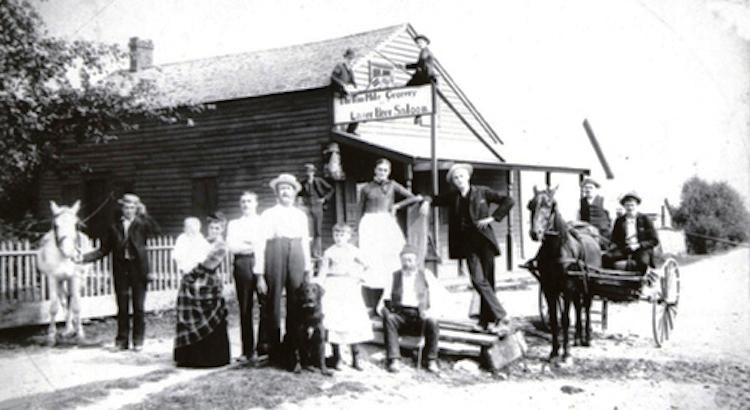
Boone's move to close working class taverns like this on Sundays led to the Logger Beer Riots.


Boone launched his assault by pushing through new license fees which raised the annual cost from $50 to $300, well beyond the means of many small proprietors, but affordable to the downtown Hotels, middle class resorts, and private clubs frequented by the better Protestant classes.  Not only that, but licenses had to be renewed every three months with all of the attending bureaucratic inconvenience, inspections, and opportunities to deny renewal for petty offences.  Almost immediately hundreds of taverns and beerhalls were unable to obtain or renew their licenses.  Many, probably most, defiantly remained open anyway or moved to thinly disguise their operations as restaurants or grocery stores.
Things really came to a head, however, when Boone ordered his new Police Force to enforce a long ignored ordinance forbidding alcohol sales on the Sabbath.  Sunday was the only day of rest for workers who labored ten, twelve, even fourteen hours the other six days at back-breaking jobs.  In working class neighborhoods men—and often their wives and whole families—adjourned directly from Sunday morning Mass to friendly watering holes for the only social conviviality they were apt to enjoy all week.  The attack on Sunday drinking was, directly, an attack on immigrants and Catholics.  The targets understood that perfectly.
On April 21 several tavern owners were arrested in a police sweep.  Outraged patrons chased the police and their Paddy Wagons—guess how they got that name—down town to near the Cook County Court House where street fighting erupted.  As word spread across south side working class neighborhoods, more headed to the central business district.  Mayor Boone ordered the swing bridges over the Chicago River pivoted to prevent access.  Scores were trapped on the bridges and police opened fire on them with their pocket revolvers.  Some armed rioters returned scattered fire. 
In the end the Lager Beer Riots resulted in tens of thousands of dollars of property damage in the business district, at least one dead rioter and scores more injured, and one police officer shot in an arm that required amputation.  Even many of the cities hard drinking native workers lost sympathy with the Know Nothings.  And the business classes who had supported the anti-saloon campaign were losing their enthusiasm for the project.
State wide the emerging new Republican Party checked the American Party’s ambitions and by means of an alliance with the growing German population largely engineered by a downstate lawyer name Abraham Lincoln, they state-wide alcohol sales ban was easily defeated.   Meanwhile the national American Party was deflating almost as fast as it had blown up, divided by the rising issue of slavery. 
In Chicago, Boone realized that he would not be able to disenfranchise Bridgeport and other immigrant neighborhoods a second time.  Armed militias were being organized to guard the polls and ballot boxes and make sure that votes would be delivered safely to the County Court House for counting.
Boone was licked and he knew it.  He didn’t even bother to run for a second one year term.  His aldermen also either withdrew or were dumped by voters. 
Boone’s short lived political career may have been over, but not his brushes with controversy.  After the election of his old nemesis Lincoln as President and the outbreak of the Civil War the doctor swung his affiliations to the Copperhead Democrats.  His primary allegiance was to the South and the preservation of slavery.  In 1862 he was arrested on suspicion of helping a rebel prisoner of war escape and being part of network of southern sympathizers running a sort of reverse Underground Railroad.  He was held for several weeks without being formally charged at Camp Douglas on the South Side until his friend secured his release on the grounds of his service to the community as a physician.
After that, Boone lived out his life quietly, practicing medicine and presumably basking in the affection of his large family and a few close friends.  The city practically forgot him and little notice was taken when he died at the age 73.  He was buried safely among the Chicago Protestant elite at Rosehill Cemetery