Showing posts with label Bishop of Myra. Show all posts

Sunday, December 6, 2020

Jolly Old St. Nicholas—Murfin ’s Carols for Corona and Winter Holiday Music Festival

                                                        Jolly Old St. Nicholas by the Ames Brothers.

This is St. Nicholas Day, a day when children in the Netherlands and across much of Northern Europe awake to find their stockings or shoes filled with candy, nuts, oranges, and small toys left behind in the night by the sanctified Bishop.  It is also still observed in some American families, though the practice seems to be fading.  Our three daughters always found their stockings filled until they were adults.  It is also a good day to trot out Jolly Old St. Nicholas, America’s oldest secular Christmas song—if you discount Jingle Bells which was not intended to be linked to the holiday.

A traditional Catholic Feast Day in the West, it celebrates the day Nikolaos of Myra, the Greek Bishop of Myra in Asia Minor died in 346.  He is one of the most important Saints in the Orthodox tradition as well and is venerated in Greece and especially in Russia where he is the national patron.

                                St. Nicholas in a traditional Byzantine Orthodox icon.

But in the West Nicholas was celebrated as a patron of children and gradually morphed into the lanky, bearded Bishop in a red miter or cowl dolling out the goodies.  In America he was ultimately transformed into Santa Claus with a workshop full of elves at the North Pole, a jolly cookie baking wife, and a sleigh pulled by flying reindeer.  And he makes his rounds on Christmas Eve, not on the Feast of St. Nicholas.  Quite a transformation.

St. Nicholas came to North America with the Dutch settlers of New York and the Hudson Valley.  He was alien to the rest of the colonies, especially in New England which frowned of Christmas and all things smacking of Bishops, Saints, and Popery.

By the post-Revolutionary era he had passed on to English residents of New York.  Washington Irving, who preserved the old Dutch folk tales—and made more than a few up himself—noted that at some point prior to the 1820’s, St. Nicholas had shifted his gift giving to Christmas in areas of the Hudson Valley.

In 1823 a newspaper in Troy, New York published an anonymous poem titled A Visit from St. Nicholas that was later attributed to Clement Clark Moore.  Within years it was being re-printed annually in newspapers across the United States.  In the poem, Moore invented many of the “traditions” associated with St. Nicholas’s visit on Christmas Eve, including his reindeer and sleigh transport and a physical description of the jolly old elf that strips him of his Bishop’s regalia, dresses him in fur, and transforms him from a tall, regal figure to a rotund, bearded little man.

This new character was called Santa Claus, derived from the Dutch Sinterklass regionally, but remained better known as St. Nicholas through most of the following century.  Thomas Nast’s mid-century cartoons helped define his appearance, including the fur trimmed cap instead of the miter, top hat, or cowl depicted in earlier illustrations.  There was not much agreement on the color of his outfit, which was often pictured as brown fur trimmed in ermine or as green or blue, until the spread of cheap popular color lithography in which artists used the bishop’s red of Europe because it showed up so brilliantly.

Jolly Old St. Nicholas on a tea box circa 1880--not quite yet our Santa Claus.

Enter Emily Huntington Miller who submitted a poem called Lilly’s Secret to The Little Corporal Magazine in December 1865, just as Nast’s drawings were cementing the new vision of St. Nick and a war weary nation was eager to devote time and love to their families and children. 

In 1867 John Piersol McCaskey, a school principal and former Mayor of Lancaster, Pennsylvania adapted Miller’s words with a few changes to music.  McCaskey included the song and his songwriting claim in his 1881 book, Franklin Square Song Collection, No. 1 and noted that it had previously been published in 1874 in School Chimes, A New School Music Book compiled by hymnist James Ramsey Murray.  McCaskey, by the way, is a direct ancestor of the Chicago Bears team owners familyMake of that what you will.

By the late 19th Century the song was a parlor piano sing-along favorite and was a staple at the Christmas pageants that were becoming a fixture in public schools.

                             Santa by Norman Rockwell.

St. Nicholas, St. Nick, and Santa Claus were all commonly used, with St. Nicholas holding the edge until Santa Claus won out sometime around 1930 and popular magazine cover art and commercial art by the likes of Norman Rockwell and the Saturday Evening Post and Haddon Sundblom for Coca Cola firmly fixed the modern image of the gift giver.

The song has been recorded many times beginning with Edison cylinders and early RCA discs.  Among the more notable versions were by Ray Smith in 1949, Chet Atkins in 1961, Eddy Arnold in 1962, The Chipmunks in 1963, Andy Williams in 1995, Anne Murray in 2001, and Carole King in 2017.  Perhaps the most commonly heard version was included in the Ray Conniff Singers 1963 album We Wish You a Merry Christmas.

But today we are listening to a version by the popular quartet the Ames Brothers recorded in 1951 on Coral RecordsSiblings Joe, Gene, Vic, and Ed hailed from Malden, Massachusetts.  Their surname at birth was  Urick and they were the sons of  were Russian Jewish immigrants from Ukraine.  During World War II the three youngest brothers and a cousin entertained at Army and Navy bases then were booked into The Fox and Hounds nightclub, one of the fanciest night clubs in Boston under the name the Amory Brothers

As their local post-war popularity grew, older brother Joe joined the group replacing the cousin.  In 1948 they signed with Decca Records in New York but could not record for a year when American Federation of Musicians (AFM) President Joe Petrillo imposed a ban on commercial recordings to improve royalty payments to musicians.  When the ban was lifted the group, renamed again as the Ames Brothers, was the first act to record on Decca’s new Coral label. 


                        The Ames Brothers in 1955--clockwise from top: Ed, Vic, Joe and Gene

They were swept into national top billing with their first hit record, Rag Mop, in January 1950.  Over the next 13 years until the group broke up, the Ames Brothers reached the charts 49 times, were featured regulars on Arthur Godfrey’s radio show, and were one of the first acts on Ed Sullivan’s Talk of the Town TV show, and frequent guests on other shows on both media.  After the group broke up Ed Ames went on to even greater fame as a solo artist with hits like Try to Remember from The Fantasticks and portraying side kick Indian Mingo on Fess Parker’s TV series Daniel Boon.

The version of Jolly Old St. Nicholas feature an orchestra directed by Marty Manning. 

Tuesday, December 6, 2016

A Real Miracle—How the Bishop of Myra Became the Fat Guy in the Red Suit

An Orthodox icon of St. Nicholas the Wonder Worker, Bishop of Myra.


Note:  A hardy perennial here at the Blog, back around on a sixth time with a tweak or two.
When our children were young, they always found stockings filled on December 6, St. Nicholas Day.  It was a custom in my wife’s Polish family which originated in Prussia where the peasantry was Slavic and the aristocrats German. I’m told that Poles from southern parts of the country are mystified by this.
Today is St. Nicholas Day.  A traditional Catholic Feast Day in the West, it celebrates the day Nikolaos of Myra, the Greek Bishop of Myra in Asia Minor died in 346.  He is one of the most important Saints in the Orthodox tradition as well and is venerated in Greece and especially in Russia where he is the national patron.  The bishop was considered a vigorous defender of what became orthodox belief after the Council of Nicaea in 325.  As legend has it, Nicholas actually slapped the Presbyter Arius, the leader of a minority who held a crypto-unitarian theology.
Despite this, Nicholas is best remembered in the West for his kindness to children and his gifts of alms to the poor.  The major miracle attributed to him, told in many variations, is that he discovered the murder of three children by a butcher who was curing their bodies in a barrel to sell as ham.  Nicholas discovered the ruse, had the villain arrested and then resurrected the innocent children.
Nicholas came from a very wealthy family.  Orphaned at an early age, he was raised by an uncle, also named Nicholas who was Bishop of Patara.  Later the very devout young man began discretely using his wealth to make gifts to the poor.  He supposedly did so anonymously, often by throwing purses of coins over garden walls or through open windows in the dead of night. 
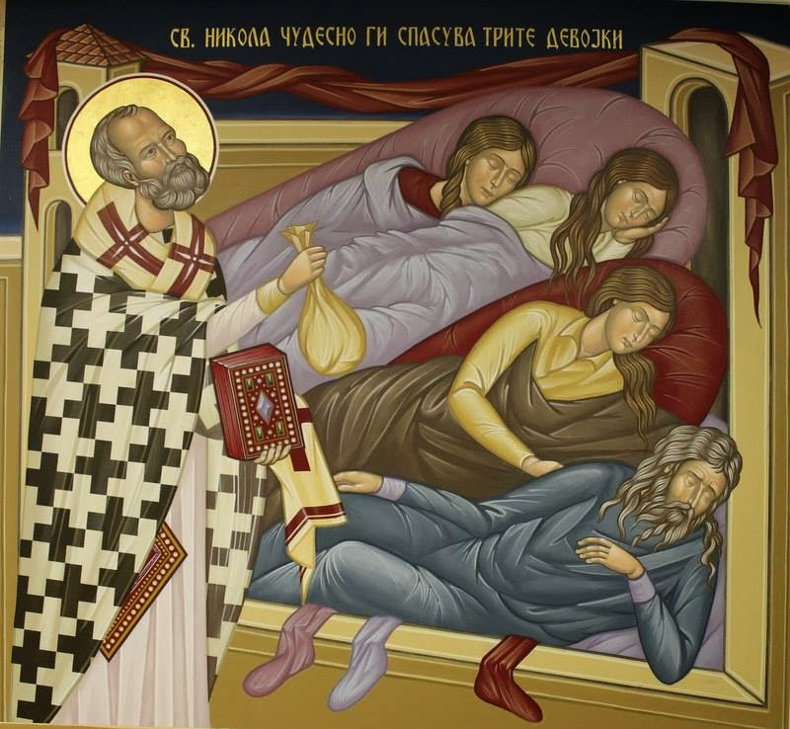
The most famous story, also told with many variations, is that he took pity on a poor man with three daughters who could not marry because they had no dowry.  For three nights running, or once a year for three years, or once each girl reached marriageable age depending on the version being told, Nicholas tossed a customary purse of gold into the man’s home.  The third time the man sought to hide himself so that he could thank his benefactor.  Seeing this, Nicholas supposedly tossed the final bag down the chimney, where it dropped into the stocking of the youngest girl who had hung it to dry.  This is the origin of gifts in shoes or stockings associated with Nicholas in later folklore.

St. Nicholas with a purse off gold for one of the three daughters of a poor man with the stockings into which it fell.
In commemoration of this story, most icons of St. Nicholas show him with three purses tied to his belt, which were often stylized into three golden balls.  In the Netherlands, where so much of the gift giving tradition associated with him became popularized, the three golden balls became associated with oranges, which the Saint would bring with him on his annual visits from Spain.  This part of the legend is associated with the long rule of the Netherlands by the Spanish Hapsburg dynasty.
In an even stranger twist, the three balls morphed into the three balls traditionaly emblematic of pawn brokers.  St. Nicholas is the patron of these petty money lenders, supposedly because they, like him, are the last resort of the poor.  Nicholas is also venerated as the patron of sailors, children, scholars, and thieves as well Russia and several other nations.
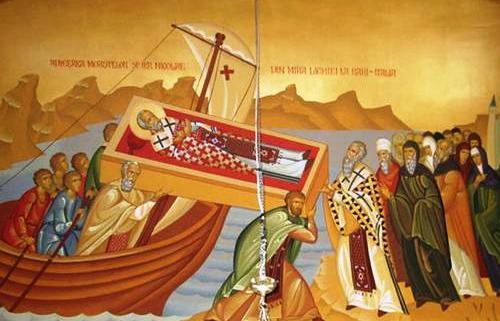
Myra was overtaken by the Seljuk Turks early in the reign of the Byzantine Emperor Alexius I Comnenus around 1085.  To save them from the Islamic invaders sailors from Bari, an important port on the Adriatic coast of southern Italy, seized the relics of Saint Nicholas, from the Cathedral in Myra over the objections of the local monks.  They arrived on May 9, 1087, and a new tomb was built for the intact body of the Saint.  Bari became a pilgrimage site and the relocated Bishop is often called St. Nicholas of Bari in the west. 

The Relics of St. Nicholas--his undecomposed body--are brought by sailors to Bari in Italy to save them from the Seljuk Turks who had captured Myra.
 
About this time, iconography in the Orthodox and Catholic traditions began to divide.  In the East he his generally shown bare headed and bald in rich golden vestments.  In the West he is usually portrayed in a bishop’s miter and red cloak, symbolic of his office.
Much of the change into a folkloric figure took place in the Netherlands and spread across Northern Europe, where, particularly in eastern Germany, it was blended with even older pagan traditions associated with the worship of Odin.
As the Dutch story evolved, St. Nicholas would arrive every year by ship from Spain about two weeks before his feast day.  With the help of a small, dark skinned helper named Zwarte Piet, Black Peter, he would check on the behavior of children.  Carrying a pack of goodies on his white horse, St. Nicholas would travel from town to town on the eve of his feast day and leave gifts in the wooden shoes of poor children.  This story spread over much of northern Europe and was adapted to local customs.  The names of St. Nicholas and his helper also changed from place to place.  In Dutch he was called Sinterklass.  

St. Nicholas in his Dutch incarnation on his white charger accompanied by his black servant Zwarte Piet on an ass bringing presents to good children on the eve of his Feast Day.
St. Nicholas Day was a separate tradition from Christmas.  But because it fell early in the Advent season, it was probably inevitable that the celebrations and the Saint would become intertwined.  Scholars are unsure of exactly when St. Nicholas added Christmas to his rounds of gift giving, but most believe it did not take hold until the early years of the 19th Century in America.
The Dutch settlers of New Amsterdam undoubtedly brought the tradition of St. Nicholas Day with them to the New World.  By the post-Revolutionary era it had passed on to English residents of  New York.  Washington Irving, who preserved the old Dutch folk tales—and made more than a few up himself—noted that at some point prior to the 1820’s, St. Nicholas had shifted his gift giving to Christmas in areas of the Hudson Valley.
In 1823 a newspaper in Troy, New York published an anonymous poem titled A Visit from St. Nicholas that was later attributed to Clement Clark Moore.  Within years it was being re-printed annually in newspapers across the United States.  In the poem, Moore invented many of the “traditions” associated with St. Nicholas’s visit on Christmas Eve, including his reindeer and sleigh transport and a physical description of the jolly old elf that strips him of his Bishop’s regalia, dresses him in fur, and transforms him from a tall, regal figure to a rotund, bearded little man.
This new character was called Santa Claus, derived from the Dutch Sinterklass regionally, but remained better known as St. Nicholas through most of the following century.  Thomas Nast’s mid-century cartoons helped define his appearance, including the fur trimmed cap instead of the miter, top hat, or cowl depicted in earlier illustrations.  There was not much agreement on the color of his outfit, which was often pictured as brown fur trimmed in ermine or as green or blue, until the spread of cheap popular color lithography in which artists used the bishop’s red of Europe because it showed up so brilliantly.

Thomas Nast's Civil War era illustration of St. Nick a/k/a Santa Claus began to form the American image of the Jolly Old Elf.

Nast also dreamed up and illustrated for the first time Santa’s workshop and home located at the North Magnetic Pole, then—1872—located on ice packed land on an island in the Canadian Artic Archipeligo.  And he populated it with the industrious elves of Nordic and Germanic legend.
The name Santa Claus did not really begin to overtake St. Nicholas nationally until the New York Sun published its famous editorial Yes, Virginia, There is a Santa Claus in 1897.  It, too, “went viral” and became an annual event in papers across the country.  In 1902 L. Frank Baum, the creator of the Wizard of Oz published a now largely forgotten book, The Life and Adventures of Santa Claus, which was so popular at the time that it virtually completed the metamorphosis of St. Nicholas to Santa Claus.
The physical image of Santa was refined by the illustrators of popular magazine covers in the early decades of the 20th Century, including many by Norman Rockwell.   The fully definitive modern Santa Claus was created by artist Haddon Sundblom for Coca Cola advertising that ran from 1931 to 1964.
Katherine Lee Bates's Goody Santa Claus, a feisty feminist, helped popularize Mrs. Claus.  Hardly a trace was left of the celibate old Bishop.
Along the way Santa Claus picked up many accouterments that had nothing in common with the Bishop of Myra.  The most obvious of these is Mrs. Claus.  Although there were some passing references to a spouse for the gift giver as early as the 1850s, she first got wide exposure in a poem by Katherine Lee Bates, best known as the writer of America the Beautiful.  In Goody Santa Claus on a Sleigh Ride, she is an uncompromising feminist who shows Santa what she can do by making his deliveries one year.  She really took off as a separate character in stories and films from the 1950’s on, where she is stripped of Bates’s feminism and is pictured as an adoring, chubby helpmate to her husband.
The power of American film, music, and television has brought Santa Claus to every corner of the globe.  Even in countries with strong St. Nicholas traditions, he has taken on the characteristics of the American Santa.  He also appears in countries with no religious celebration of Christmas and is popular in Japan and Korea.  Under the Soviets, the Russians transformed their patron saint into Father Winter, as Santa Claus clone who visits on New Year’s Eve.

Haddon Sundblom's advertising illustrations of Santa Claus for Coka-Cola settled the image of the modern American Santa, now know all over the world.

Symbolic of the eclipse of St. Nicholas by Santa Claus was the fate of the statue of St. Nicholas in the town of Demre, Turkey, near the site of historic Myra.  In order to facilitate tourism the now Muslim town commissioned a statue of St. Nicholas to be placed in the town square by a Russian Iconographer.  The Russian government made it a gift to the city and it was dedicated in 2000.  After just a few years, however, the local Mayor discovered that tourists were disappointed.  They had not come to venerate a Saint, but visit the home of Santa Claus.  So the mayor had the original statue removed and replaced by a plastic Santa in a red suit—a Santa modeled after Haddon Sundblom’s Coca Cola creation.