Showing posts with label Chalice lighting. Show all posts

Tuesday, May 6, 2025

On Beauty in a Difficult Time—Revisiting Murfin Verse


The worship service at the Tree of Life UU Congregation in McHenry for which I wrote a Chalice Lighting in verse.

I was asked to do the Chalice Lighting one Sunday three years ago at the Tree of Life Unitarian Universalist Congregation in McHenry, Illinois.  If you are not familiar with a Chalice Lighting, it is one of the few U.U. worship rituals.  A short reading usually accompanies igniting a flame in a chalice, the symbol of our faith, which helps to set the tone of the service.  At our congregation we have monthly themes for worship.  That month that theme was Beauty.  Instead of searching out an apt quotation from literature or by some minister, I undertook a short original poem.
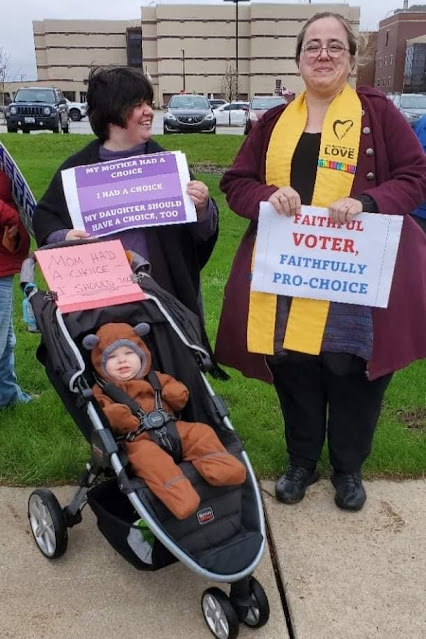
 

Rev. Jenn Gracen with her wife Virginia and daughter Adalee at a protest of the expected Supreme Court ruling overturning Roe v Wade in Woodstock the week before the service.

Like our Interim Minister back then, the Rev. Jenn Gracen, I was having some difficulty reconciling beauty with some of the ugly realities were living in [and still do].  In her Ministers Musing shared with the congregation in an e-mail she wrote:

“How beautiful on the mountains are the feet of those who bring good news.” These words come from the Book of Isaiah in the Hebrew Bible and are later echoed in the Christian scriptures as well. Our Soul Matters theme for the month of May is “beauty.” When I think about beauty, images of feet are not the first that come to mind. But then I reflect on the events of the past few days—a leaked Supreme Court ruling that suggests that, for the first time, we are likely to see constitutional rights revoked rather than expanded. I reflect on the events of the past few months—an   unprovoked and devastating war brought by Russia against the people of Ukraine. I reflect on the events of the past few years—a pandemic that has killed over 6 million people around the world, 38 thousand of them right here in Illinois.

We could really use some good news right now. But bringing good news to a suffering world means we must get up and get moving. We must do the active work of teaching and preaching, of writing and speaking, of meeting and marching, of stretching and sharing our resources.

If we’re doing the work we are called to, our feet (and hands and hearts and pocketbooks) are probably going to be sore and dirty at the end of most days. Is it any wonder that in ancient cultures, guests were welcomed to a home with foot washing? When we’re going out into the world to do what we are called to do, sore and dirty feet are part of the package.

So the writer of those ancient words—“How beautiful on the mountains are the feet of those who bring good news” —was most certainly not picturing a person coming fresh from a pedicure. They were picturing the rough, worn, tired feet of those had taken on a long and difficult journey, proclaiming peace, good tidings, salvation, and the reign of God to a people who had suffered captivity and exile.

May we be such proclaimers today.

I was wrestling with some of the same stuff.  So much so that I roused from a sound sleep with this short poem mostly formed.  I rushed to scribble it down before it evaporated and tinkered with it for a few days.  

 

One of the can't-unsee-it images burned in my mind when I wrote this poem.

Like many of the verses I have shared in worship over the years, this one stretched the bounds of what is in good taste for church.  I think of it as a challenge to complacency. 

On Beauty in a Difficult Time

For Tree of Life UU Service

May 8, 2022


Lilacs in a morning dew,

            the memory of cupable breast

            gently rising,

            a vista of a glacial lake

            shimmering among golden aspen.


Loving easy beauty isn’t hard.

            It delights and refreshes

            and even comforts us in revelry

            like the Rose in the Wintertime

            in that old hymn.


Hard beauty is something else—

            a fallen oak twisted and shattered

            in morning fog,

            the smoldering ruins

of a bombed out city,

a naked woman kneeling and

face down on the floor

bled out and cold.


What beauty in these facts before us?


Truth is not beauty

            nor beauty truth,

            Mr. Keats.


Patrick Murfin


Saturday, May 7, 2022

On Beauty in a Difficult Time—New Murfin Verse

The worship Service this week at the Tree of Life UU Congregation in McHenry.

I was asked to do the Chalice Lighting this Sunday morning at the Tree of Life Unitarian Universalist Congregation in McHenry, Illinois.  If you are not familiar with a Chalice Lighting, it is one of the few U.U. worship rituals.  A short reading usually accompanies igniting a flame in a chalice, the symbol of our faith, which help set the tone of the service.  At our congregation we have monthly themes for worship.  This month that theme is Beauty.  Instead of searching out an apt quotation from literature or by some minister, I undertook a short original poem.

Rev. Jenn Gracen with her wife Virginia and daughter Adalee at a protest of the upcoming Supreme Court ruling overturning Roe v Wade in Woodstock this week.

Like our Interim Minister, the Rev. Jenn Gracen, I was having some difficulty reconciling beauty with some of the ugly realities we are living in.  In her Minister’s Musing shared this week with the congregation in an e-mail she wrote:

“How beautiful on the mountains are the feet of those who bring good news.” These words come from the Book of Isaiah in the Hebrew Bible and are later echoed in the Christian scriptures as well. Our Soul Matters theme for the month of May is “beauty.” When I think about beauty, images of feet are not the first that come to mind. But then I reflect on the events of the past few days—a leaked Supreme Court ruling that suggests that, for the first time, we are likely to see constitutional rights revoked rather than expanded. I reflect on the events of the past few months—an   unprovoked and devastating war brought by Russia against the people of Ukraine. I reflect on the events of the past few years—a pandemic that has killed over 6 million people around the world, 38 thousand of them right here in Illinois.

We could really use some good news right now. But bringing good news to a suffering world means we must get up and get moving. We must do the active work of teaching and preaching, of writing and speaking, of meeting and marching, of stretching and sharing our resources.

If we’re doing the work we are called to, our feet (and hands and hearts and pocketbooks) are probably going to be sore and dirty at the end of most days. Is it any wonder that in ancient cultures, guests were welcomed to a home with foot washing? When we’re going out into the world to do what we are called to do, sore and dirty feet are part of the package.

So the writer of those ancient words—“How beautiful on the mountains are the feet of those who bring good news” —was most certainly not picturing a person coming fresh from a pedicure. They were picturing the rough, worn, tired feet of those had taken on a long and difficult journey, proclaiming peace, good tidings, salvation, and the reign of God to a people who had suffered captivity and exile.

May we be such proclaimers today.

I was wrestling with some of the same stuff.  So much so that I roused from a sound sleep with this short poem mostly formed.  I rushed to scribble it down before it evaporated and have tinkered with it for the last few days. 

One of the can't-unsee-it images burned in my mind when I wrote this poem.

Like many of the verses I have shared in worship over the years, this one will stretch the bounds of what is in good taste for church.  I think of it as a challenge to complacency

On Beauty in a Difficult Time

For Tree of Life UU Service

May 8, 2022


Lilacs in a morning dew,

            the memory of cupable breast

            gently rising,

            a vista of a glacial lake

            shimmering among golden aspen.


Loving easy beauty isn’t hard.

            It delights and refreshes

            and even comforts us in revelry

            like the Rose in the Wintertime

            in that old hymn.


Hard beauty is something else—

            a fallen oak twisted and shattered

            in morning fog,

            the smoldering ruins

of a bombed out city,

a naked woman kneeling and

face down on the floor

bled out and cold.


What beauty in these facts before us?


Truth is not beauty

            nor beauty truth,

            Mr. Keats.


Patrick Murfin 

Sunday, December 1, 2019

World AIDS Day/First Sunday in Advent Redux—Murfin Verse


Back in 2001 World AIDS Day coincided with the First Sunday of Advent.  AIDS was then a death sentence.  Homosexual communities were stalked by a merciless plague.  Panic about the disease had spread far into the safe, middleclass hinterlands.  Misinformation and disinformation was rife—you could catch it from public toilet seats, the most casual physical contact.   Alvin Querhammer who owned the funeral home next door to me and doubled as the McHenry County Coroner wrote a piece for the Northwest Herald claiming that the HIV virus could be spread through the air circulation of jet liners and recommending that those infected be rounded up and kept in remote detention camps.
The opinion that AIDS was God’s justifiable wrath and just punishment for sodomites and fornicators was routinely propagated from many a pulpit.
There were signs that thing were ever-so-slowly changing.  Indiana teenager Ryan White had become the face of acceptably innocent victims.  Movie star Rock Hudson had become the first celebrity widely to be an acknowledged victim.  Elizabeth Taylor and Elton John lent their star power to awareness and charities for research and palliative care.  Panels of the AIDS Memorial Quilt were being made, assembled, and displayed across the country.  Red ribbons were being worn widely.  World AIDS Day was established in 1988 and was marked annually on December 1.
In 2001 churches across the country were asked to ring their bells that day in a display both in memoriam and offering hope.  Our congregation, then known as the Congregational Unitarian Church in Woodstock had already been doing educational work to counter the hysteria and fear in the community.  We agreed to participate.  As far as I knew we were then the only church in McHenry County to participate.  I was the regular bell ringer at the old Church—the Quasimodo of Dean Street.  It fell to me to toll the bell during our Advent service.
I also prepared a poem to be read as our Chalice Lighting.
The serendipitous alignment of AIDS Awareness Day and the First Sunday in Advent has rolled around again this year.  Circumstances have changed.  Drug treatments can now control the HIV infection allowing people to live long lives in remission—if they can afford the expensive drug cocktails.  Awareness campaign dramatically reduced transmission in the Gay community but it continues to spread among women, intravenous drug users, and now among the elderly in retirement communities.
Worse, AIDS is still pandemic in much of sub-Saharan Africa and parts of southern Asia.  Medical treatment is inadequate, drugs to expensive, and prevention crippled by the U.S. gag order that forbids dissemination of information on prophylactic protection by health agencies receiving American aid even indirectly.
An Advent Wreath--First Sunday.
So there is still much to remember this year as we light the first candle in the Advent wreath.  
My poem was included in my 2004 Skinner House Books collection We Build Temples in the Heart.
AIDS Advent Sunday
We Light a candle and await, 
            await the coming of light and hope,
            the promise foretold, fulfilled.

We light a candle and await,
            await the pealing of the bells in joy triumphant,
            where now they toll in somber mourning.

We light a candle and await,
            await the hour of reunion,
            prodigal and patriarch alike embraced,
            alike forgiven,
            all that was sundered made whole again.

We light a candle and await,
            await the gifts a million shortened lives
            could have wrapped for us
            and our delight at their discovery.

We light a candle and await,
            await the day the Quilt is at last finished,
            can be lovingly folded and nestled in cedar,
            and taken out only on cold nights
            to wrap us in the warmth of remembrance.

We light a candle and await.

—Patrick Murfin