Showing posts with label Chartists. Show all posts

Tuesday, January 18, 2022

William Price—The Welsh Druid Doctor Who Burned Jesus Christ

                                      Dr. William Price in full Druid regalia.

On January 18, 1884 an old man with white beard nearly to his knees and dressed in green clothing, a red sash, and a fox fur draped across his head, ascended a mountain overlooking the Welsh town of Llantrisant.  Muttering invocations in a form of “ancient Welsh” of his own invention, he lit a pyre and laid the body of his five-month-old son, Iesu Grist, Welsh for Jesus Christ, on it.  Townspeople investigating the fire fell upon the old man in a rage and pulled the unconsumed body of the infant from the flames.

Dr. William Price had to be rescued from the mob by the local constabulary who promptly charged him with the illegal disposal of a corpse under the assumption that cremation, long banned by Church tradition which held a belief in bodily resurrection on Judgment Day, was illegal.  He escaped a charge of infanticide when an autopsy showed that the boy died of natural causes. 

Dr. Price attempting to cremate his son Iesu Grist.  His arrest and highly publicized court case would pave the way for full recognition, legalization, and regulation of cremation in Great Britain.

Price was brought to trial at Cardiff before the riveted attention of the British press.  He argued that there were no statutes that either sanctioned or forbad cremation.  It turned out he was right.  The judge was forced to free him.  Price returned to Llantrisant and before a crowd of hundreds of supporters, completed the cremation.  He erected a 60 foot high pole surmounted by a crescent moon on the site and declared his intention to be burned there in his own time.

There was already a small movement to permit cremation in Britain based on various religious beliefs and for reasons of sanitation.  The new Cremation Society of Great Britain saw the ruling as precedent.  They promoted cremations at Working in 1885 and encouraged the founding of the first British crematorium at Manchester in 1892.  But it was not until the Parliamentary Cremation Act of 1902 that the practice gained the full sanction and regulation of law.

For his part, Dr. Price enjoyed the national celebrity the case bestowed upon him and took advantage of it by selling medallions and religious tracts promoting his Neo-Druid sect and the Welsh nationalism he had long embraced.

But the case was just one episode in the long life of a man described as “both one of the most colourful characters in Welsh history, and one of the most remarkable in Victorian Britain.”

Price was born in a cottage at Tyn-y-coedcae Farm (The House in the Wooded Field) in Risca, Monmouthshire, Wales on March 4, 1800.  His father was an Anglican priest and his mother had been an illiterate servant girl—a scandalous marriage across class lines.  The first surviving son and fourth child, he was raised in a Welch speaking home and knew no English until he began his formal schooling.  His father was a Welch nationalist and by local accounts quite mad, often speaking to trees, spitting on stones, and apt to fits of violence.

Young William attended school in nearby Machen from the ages of 10 in 13.  He proved to be a brilliant student and not only mastered English but completed his course work in only three years and successfully passed his examinations.  In defiance of his father, who wanted his son to be a solicitor, the boy apprenticed himself to successful surgeon, Evan Edwards, at Caerphilly in south Wales. 

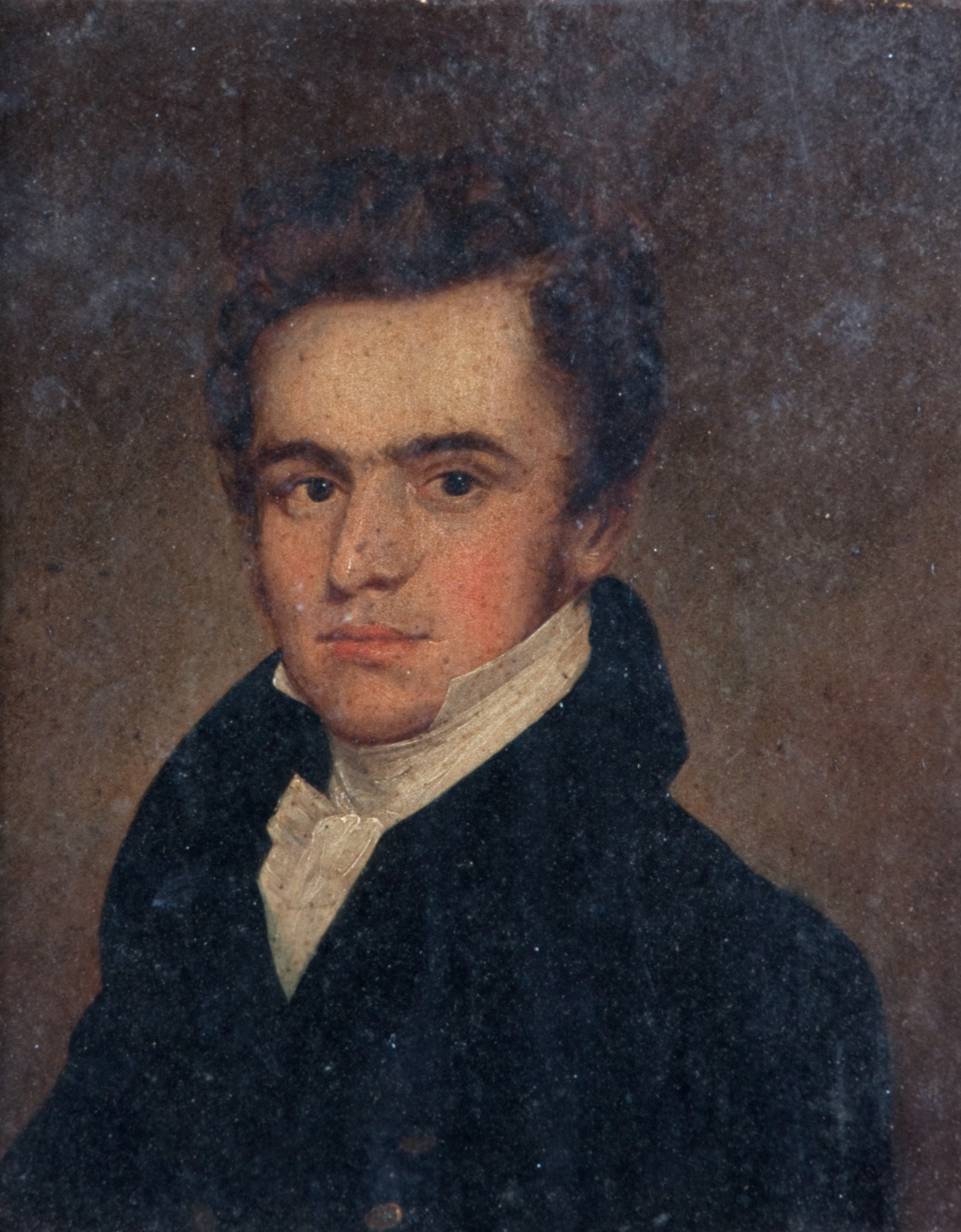
                    William Price in 1822 as a medical student.

Completing his apprenticeship in 1820, Price entered the London Hospital in Whitechapel for a year of instruction under Sir William Blizard and then at St. Bartholomew’s Hospital studying with surgeon John Abernethy.  He found private employment caring for wealthy patients to finance his studies.  By 1823 he had earned his place in the Royal College of Surgeons.

Despite being tempted to go to India, Price decided to return to Wales and set himself up as a general practitioner.  For seven years he practiced at Craig yr Helfa in Glyntaff and rented a nearby farm on which he raised goats.  But some sort of trouble arose, and he was evicted from the farm.

While maintaining his Glyntaff practice, Price moved to the industrialized Taff Valley near to Pontypridd.  Serving the working people there, he was elected in 1823 as chief surgeon at the Brown Lenox Chainworks, a job he kept—with as we will see some interruptions—until 1871.  He also became a private physician to the wealthy Crawshaw family who owned the ironworks at Merthyr and Treforest.

The Crawshaws were ardent Welsh nationalists and helped Price renew his interest in Welsh culture and identity.  He began to be noticed in nationalist circles when he delivered an impassioned address at the Royal Eisteddfod, a Welsh festival of literature, music, and performance, in 1834 and became judge of the annual bardic competition at the Eisteddfod.  He awarded a prize to Taliesin, the son of the famous Welsh nationalist and Druid, Iolo Morganwg, perhaps sparking his interest in the religion of the ancient Celts.

He joined the Society of the Rocking Stone, a Neo-Druidic group that met at the Y Maen Chwyf stone circle in Pontypridd, and by 1837 had become one of its leading members.  He also began the first of repeated efforts to establish a Druidic museum of in the town.

At the same time his close association with the workers and the time he spent in Treforest, a hot bed of working class radicalism, drew him into the Chartist Movement.  Although the movement’s goals of electoral reform and one man, one vote seem mild in retrospect, to the national Tory establishment it was considered revolutionary and anarchical.  Welsh workers were among the most militant in the nationwide movement and many were convinced that it would take armed revolution to achieve their ends.

Price joined the movement and rapidly rose in local leadership.  Price sided with the revolutionaries and began helping them amass arms for the day of insurrection.  By 1839 he had secured seven pieces of field artillery and assorted small arms.  Despite his militancy, Price feared that a planned march on Newport was premature and sure to be crushed by the Army.  He and his followers stayed away from what became known as the Newport Rising and the bloody battle with the Army that left more than 20 workers dead and 50 wounded.  In the aftermath scores of Chartist leaders were arrested and 24 were put on trial for their lives.

Although an active Welsh Chartist leader, Dr. Price feared the march on Newport was premature and doomed.  He and his group sat out the attack but in its wake he still had to flee the country.

Rightly figuring that he was in danger, Price fled the country disguised in women’s clothing.  He wound up in the traditional European home of political exiles, Paris.   It was there while visiting the Louvre that he had a religious epiphany and a vision which has been compared to that of Joseph Smith and the Gold Tablets of Mormonism.  He became fixated with an ancient Greek stone with an inscription which he believed depicted an ancient Celtic bard addressing the Moon.  That no one else shared this insight did not bother him in the least.  In fact, he intuited a whole story from the stone that it represented prophecy given by an ancient Welsh prince named Alun, that a man would come in the future to reveal the true secrets of the Welsh language and to liberate the Welsh people.  Price was sure that he was that liberator.

When it was safe, Price returned to Pontypridd and set himself up as a chief Druid.  Charismatic, he drew a following.  He began to grow his hair and beard and took to wearing special costumes both in daily life and at the rituals he led at Rocking Stone.  He carried a long staff surmounted by a crescent moon.  Many of his followers carried elaborately carved sticks and staffs as well.

After declaring that marriage was an illegitimate exploitation of women that reduced them to chattel, Price took as a partner Ann Morgan who presented him with a daughter in 1842.  At a Rocking Stone ritual, he named the girl Gwenhiolan Iarlles Morganwg (Gwenhiolan, Countess of Glamorgan).

As time went by his vision became more grandiose.  He allied himself with the Order of True Ivorites, a so-called Friendly Society, which conducted all of its business in Welsh, and which fostered working class solidarity and mutual aid.  In place where trade unions were suppressed the secret society gave them cover under which to operate.  In 1855 Price then led a parade of the Ivorites, through the streets of Merthyr Tydfil, accompanied by a half-naked man calling himself Myrddin (Merlin) and a goat.

Price resurrected his dream of a Druid museum and school and secured the patronage of a local landowner.  But he had a falling out with the patron and the scheme once again fell through, this time leaving Price heavily in debt.  Once again he fled to Paris in 1861.

While in the City of Life, he began to send letters to the Welsh and English press with new claims.  He proclaimed himself Lord of the Southern Welsh.  He also made claims that “All the Greek Books are the Works of the Primitive Bards, in our own Language!!!!!!!… Homer was born in the hamlet of Y Van near Caerphili. He built Caerphili Castle… the oldest Books of the Chinese confess the fact!!”  Then, as now, writing with extraneous exclamation marks was considered a sign of mental instability.

Yet Price pressed on.  Upon returning to Wales in 1866 he settled in Llantrisan opening a new medical practice which thrived despite his eccentricities. By this time Ann Morgan had died and his daughter Gwenhiolan had grown up and was living an independent life.  

He began work on a master opus, in what he claimed was the pure and original form of Welch, from which the Greeks learned.  It was an invented dialect that no one but he and his most devoted followers could read.  In The Will of My Father, Price described the universe being created out of a snake’s egg by a supreme Father God.  Perhaps this recalled one of his own father’s many eccentricities—collecting and carrying small snakes by the pocketful on his wild roaming.

The book, which no one could read, was published in 1871 and sank into almost immediate obscurity.

Dr. Price with his young wife Gwenllian Llewelyn and their two surviving children, Penelopen and the second Iesu Grist.

In 1881 the now elderly Price with his famous long beard took a new partner, a 21 year old farmer’s daughter named Gwenllian Llewelyn.  Despite his previous declarations against marriage, he wed her in a Druidic ceremony on March 4, 1881.   In 1883 Gwenllian gave Price the ill-fated son who died after only five weeks of life.  Together they would have two more children, including a second Jesus Christ and a daughter Penelopen.

Price died on January 23, 1893 after drinking a final glass of Champaign.  On January 31 10,000 people gathered to watch him be laid on a pyre of two tons of coal beside the spot where his son was burned.  By all accounts it was a spectacular sight.

Gwenllian abandoned Druidism, married the road inspector for the local Council, was baptized Christian, and changed her son’s name to Nicholas.

                          The statue of Dr. William Price in Llantrisant.

Today Price is a kind of folk hero in Wales.   A statue of him was erected his long-time home of Llantrisant in 1982, depicting the doctor in his characteristic fox-skin headdress, arms outstretched in an odd Christ-like pose.

Wednesday, August 25, 2021

Allan Pinkerton— Spy Master, The Original Private Eye, and Union Buster


Allan Pinkerton in 1861 as he gained fame a Lincoln's protector and secret agent.

Allan Pinkerton, America’s first detective and the founder of the security company that still bears his name was born on August 25, 1819 in Glasgow, Scotland.  Admired as a hero to some, he was despised by generations of workers as a union buster and scab herder. 

Pinkerton started as a class conscious working man.  The son of a duty disabled policeman, he apprenticed as a cooper and participated in the Chartist movement to obtain the franchise for working men and other political reforms.  Chartist “riots” were violently suppressed by troops in many cities. 

Newly married and deeply disappointed by the failure to achieve the vote, Pinkerton decided to immigrate to the Canada at the age of 23 in 1842.  He and his wife were shipwrecked off Nova Scotia and came ashore penniless with only the clothes on their back.  A friend tipped him off to a job at a Chicago brewery.  He worked at his trade there for five years before relocating to rural Dundee, Illinois nearly fifty miles northwest of the city. 

He apparently wanted to go into business providing oak wood from the abundant local woodlots to the brewery but reportedly accidentally stumbled on a ring of counterfeiters, which he reported to local authorities.  In those days when each bank issued their own paper notes, counterfeiting was a common crime.  Several well organized gangs found the remote farmsteads of recently settled Kane and McHenry counties—good places to set up operations far away from police but close enough to the city to get their bad paper quickly into circulation. 

Pinkerton began using disguises, false identities and other tricks to track down counterfeiting gangs.  He was appointed a part time deputy sheriff and later began to work on contract for the banks whose notes were being counterfeited.  Pinkerton thought he had found a niche and a home. 

But he also supported the Underground Railway which used the rural area as a transportation path for the same reasons as it was chosen by the crooks.  His known abolitionist sentiments led to a crushing electoral defeat in a run for local office. 

But his daring exploits chasing counterfeiters had been picked up in the popular press.  He packed up his new reputation and returned to Chicago where he hired himself out as a freelance detective.  Among his customers were the Treasury Department in the pursuit of more counterfeiters and the Cook County Sheriff, who hired him to locate two girls who had been kidnapped and taken to Michigan.  He found the girls and shot one of the captors, making headlines for his daring do. 

The Sheriff hired him as a full time detective—the first such officer in any Illinois police agency.  He also continued to take private clients on the side.

Pinkerton's "seeing eye" became one of America's first and most recognizable company logos.

In 1855 he formed his own private agency, the North-Western Police Agency, soon to become The Pinkerton National Detective Agency. Its famous logo was an All Seeing Eye with the motto “We never sleep”—thus the origin of the term private eye.  Pinkerton quickly built a large operation with many operatives who were trained in surveillance and under-cover operations.  He demanded his operatives keep detailed records of their cases and on all known criminals they encountered.  He kept the records, including descriptions, aliases, known associates, and modes of operation of hundreds of criminals.  He even became the first to use photographs to identify suspects.  No other private law enforcement agency and few public ones had anything like the manpower or sophistication of Pinkerton’s operations.

 Among the frequent customers of the new agency were the railroads, which is how Pinkerton came the attention of a railroad lawyer and politician, named Abraham Lincoln.  Pinkerton’s steadfast support of the Republican Party didn’t hurt either.  Lincoln tapped Pinkerton to assist his personal friend and bodyguard Ward Hill Lamon for security as he made his way from Illinois to Washington for his inauguration.  Pinkerton operatives uncovered a plot by Confederate sympathizers to kill Lincoln as he changed trains in Baltimore and allegedly foiled the attempt by sneaking the lanky Lincoln through town disguised as an old woman. 

Pinkerton, rear and Lincoln's friend and bodyguard Ward Hill Lamon with the goatee escorted President elect Lincoln on his perilous journey by train for the 1861 inauguration.

As the Civil War erupted, Lincoln learned to his chagrin that the Army had no real intelligence service.  He tapped Pinkerton to become the first head of the new Intelligence Service, forerunner of the U.S. Secret Service.  Pinkerton deployed his operatives behind the lines, often disguised as Confederate soldiers and employed various tipsters.  He personally went on some missions in enemy territory using the name Major E.J. Allen.  He was very close to another old acquaintance from the Illinois Central Railroad, General George McClellan. 

Unfortunately, Pinkerton consistently overestimated the size of opposing Confederate forces by as much two times their actual numbers.  That caused the cautious McClellan to avoid battle with the main Confederate forces when possible while demanding ever more men and arms for the President.  Military historians agree now that had McClellan moved his vastly larger and better equipped army more quickly and with greater determination to follow up on successes, the war could have been significantly shorter. 

Pinkerton on horseback in George McClellan's headquarters provided disastrous over-estimates of Confederate numbers and strength which caused the cautious commanding general from taking decisive action.

Eventually Lincoln grew tired of both McClellan’s dithering and Pinkerton’s exaggerations.  Pinkerton left the Service after 1862, but his agency continued to contract with the government for numerous intelligence operations through the rest of the war. 

In post war years Pinkerton’s agencies pursued gangs of bank and train robbers, most notoriously Missouri outlaws Frank and Jesse James.  The Pinkerton Agency got a public black eye when its men threw a bomb killing a child and blowing the arm off the James boys’ stepmother.  After an operative who got a job working on an adjacent farm was discovered and killed, Pinkerton withdrew from the case.  He considered it the biggest failure of his career. 

Pinkerton range detectives like these played a bloody roll in range wars between Western cattle barons and small ranchers and homesteaders accused of rustling cattle.

Soon rapid post war industrialization led to growing labor unrest.  Pinkerton, the former Chartist, had no trouble enlisting his men as strike breakers and spies against unions.  One of the most famous early examples was the infiltration of the Molly McGuires, a secret organization of Irish miners in the Pennsylvania anthracite coal fields by Irish-born operative James McParland.  Identities of Molly leaders and members were passed to local employers who employed vigilantes, who may or may not have included other Pinkerton men, to ambush and kill them and their families.  McParland’s testimony in court also led to the execution of six men and the destruction of the Molly McGuires. 

Pinkerton detective James McParland infiltrated the Molly Maguires in the Pennsylvania coal fields sending several to the gallows.  He had a long career with the agency and years later arranged for Big Bill Haywood and Charles Moyers of the Western Federation of Miners to be kidnapped from Colorado to stand trial in Idaho on bogus charges of planting a bomb that killed a former governor.

McParland was rewarded with rapid promotion through the company ranks and specialized in labor cases.  Twenty years later he kidnapped Big Bill Haywood, Charles Moyers and other leaders of the Western Federation of Miners from Colorado and took them on a sealed train to Idaho where they were put on trial for the bombing murder of a former governor. 

Pinkerton in a Harper's Weekly illustration shortly before his death.

Pinkerton died in Chicago on July 1, 1884 at the age of 64.  He fell on the pavement and bit his tongue.  It became infected and he died in agony.

 By that time a huge amount of his company’s business was anti-union activity.  Company agents were involved in the gun battle with striking steelworkers during the Homestead Strike of 1891, suppressing the Pullman Strike of 1894, and in the infamous Ludlow Massacre of 1914 to list only a few of the most infamous cases. 

The agency also was hired by foreign governments to suppress local radicals, most famously by Spain to work against nationalists in Cuba who included the abolition of slavery as one of their top goals.

Dashiell Hammett, the inventor of tough guy detective fiction based his character the Continental Op on his experience as a labor spy in Butte, Montana.  He may have been involved in investigations that lead to the lynching of legendary IWW organizer Frank Little.  The bitter experience made him a life-long radical.

Dashiell Hammett became a young Pinkerton operative before World War I and became so disillusioned by the anti-union work he was called on to do, including work that may have led up to the lynching of Industrial Workers of the Word (IWW) organizer Frank Little in Butte, Montana, that the famous creator of hard-boiled detective fiction dedicated much of the rest of his life to supporting radical causes. 

In the 1930’s a Senate Committee led by Wisconsin Progressive/Republican Robert M. La Follette, Jr. investigated the Pinkerton Agency for its systematic use of spies to infiltrate labor unions.  To this day Pinkerton is a curse word to unionists and the company is still used to protect scabs and harass picket lines. 

In 1999 the Pinkerton Agency and was acquired by the Swedish based international security firm Securitas AB.  It merged with its chief rival, the William J. Burns Detective Agency, in 2001.  Today it operates as an American subsidy of the Swedish firm under the name Pinkerton Consulting and Investigations.  And the work goes on.


Thursday, January 18, 2018

When a Druid Doctor Burned Jesus Christ

Dr. William Price in full Druid regalia.


On January 18, 1884 an old man with white beard nearly to his knees and dressed in green clothing, a red sash, and a fox fur draped across his head, ascended a mountain overlooking the Welch town of Llantrisant.  Muttering invocations in a form of “ancient Welsh” of his own invention, he lit a pyre and laid the body of his five-month-old son, Iesu Grist, Welsh for Jesus Christ.  Townspeople investigating the fire fell upon the old man in a rage and pulled the unconsumed body of the infant from the flames.
Dr. William Price had to be rescued from the mob by the local constabulary who promptly charged the old man with the illegal disposal of a corpse under the assumption that cremation, long banned by Church tradition which held a belief in bodily resurrection on Judgment Day, was illegal.  He escaped a charge of infanticide when an autopsy showed that the boy died of natural causes.  
Dr. Price attempting to cremate his son Iesu Grist.  His arrest and highly publisized court case would pave the way for full recognition, legalization, and regulation of cremation in Great Britain.
Price was brought to trial at Cardiff before the riveted attention of the British press.  Price argued that there were no statutes that either sanctioned or forbad cremation.  It turned out he was right.  The judge was forced to free him.  Price returned to Llantrisant and before a crowd of hundreds of supporters, completed the cremation.  He erected a 60 foot high pole surmounted by a crescent moon on the site and declared his intention to be burned there in his own time.
There was already a small movement to permit cremation in Britain based on various religious beliefs, and for reasons of sanitation.  The new Cremation Society of Great Britain saw the ruling as precedent.  They promoted cremations at Working in 1885 and encouraged the founding of the first British crematorium at Manchester in 1892.  But it was not until the Parliamentary Cremation Act of 1902 that the practice gained the full sanction and regulation of law.
For his part, Dr. Price enjoyed the national celebrity the case bestowed upon him and took advantage of it by selling medallions and religious tracts promoting his Neo-Druid sect and the Welsh nationalism he had long embraced.
But the case was just one episode in the long life of a man described as “both one of the most colourful characters in Welsh history, and one of the most remarkable in Victorian Britain.”
Price was born in a cottage at Tyn-y-coedcae Farm (The House in the Wooded Field) in Risca, Monmouthshire, Wales on March 4, 1800.  His father was an Anglican priest and his mother had been an illiterate servant girl—a scandalous marriage across class lines.  The first surviving son and fourth child, he was raised in a Welch speaking home and knew no English until he began his formal schooling.  His father was a Welch nationalist and by local accounts quite mad, often speaking to trees, spitting on stones, and apt to fits of violence.
Young William attended school in nearby Machen from the ages of 10 in 13.  He proved to be a brilliant student and not only mastered English but completed his course work in only three years and successfully passed his examinations.  In defiance of his father, who wanted his son to be a solicitor, the boy apprenticed himself to successful surgeon, Evan Edwards, at Caerphilly in south Wales.  
William Price in 1822 as a medical student.
Completing his apprenticeship in 1820, Price entered the London Hospital in Whitechapel for a year of instruction under Sir William Blizard and then at St. Bartholomew’s Hospital studying with surgeon John Abernethy.  He found private employment caring for wealthy patients to finance his studies.  By 1823 he had earned his place in the Royal College of Surgeons.
Despite being tempted to go to India, Price decided to return to Wales and set himself up as a general practitioner.  For seven years he practiced at Craig yr Helfa in Glyntaff and rented a nearby farm on which he raised goats.  But some sort of trouble arose and he was evicted from the farm.
While maintaining his Glyntaff practice, Price moved to the industrialized Taff Valley near to Pontypridd.  Serving the working people there, he was elected in 1823 as chief surgeon at the Brown Lenox Chainworks, a job he kept—with as we will see some interruptions—1871.  He also became a private physician to the wealthy Crawshaw family who owned the ironworks at Merthyr and Treforest.
The Crawshaws were ardent Welsh nationalists and helped Price renew his interest in Welsh culture and identity.  He began to be noticed in nationalist circles when he delivered an impassioned address at the Royal Eisteddfod, a Welsh festival of literature, music and performance, in 1834 and became judge of the annual bardic competition at the Eisteddfod.  He awarded a prize to Taliesin, the son of the famous Welsh nationalist and Druid, Iolo Morganwg, perhaps sparking his interest in the religion of the ancient Celts.
He joined the Society of the Rocking Stone, a Neo-Druidic group that met at the Y Maen Chwyf stone circle in Pontypridd, and by 1837 had become one of its leading members.  He also began the first of repeated efforts to establish a Druidic museum of in the town.
At the same time his close association with the workers and the time he spent in Treforest, a hot bed of working class radicalism, drew him into the Chartist Movement.  Although the movement’s goals of electoral reform and one man, one vote seem mild in retrospect, to the national Tory establishment it was considered revolutionary and anarchical.  Welsh workers were among the most militant in the nationwide movement and many were convinced that it would take armed revolution to achieve their ends.
Price joined the movement and rapidly rose in local leadership.  Price sided with the revolutionaries and began helping them amass arms for the day of insurrection.  By 1839 he had secured seven pieces of field artillery and assorted small arms.  Despite his militancy, Price feared that a planned march on Newport was premature and sure to be crushed by the Army.  He and his followers stayed away from what became known as the Newport Rising and the bloody battle with the Army that left more than 20 workers dead and 50 wounded.  In the aftermath scores of Chartist leaders were arrested and 24 were put on trial for their lives

Although an active Welsh Chartist leader, Dr. Price feared the march on Newport was premature and doomed.  He and his group sat out the attack but in its wake he still had to flee the country.
Rightly figuring that he was in danger, Price fled the country disguised in women’s clothing.  He wound up in the traditional European home of political exiles, Paris.   It was there while visiting the Louvre that he had a religious epiphany and a vision which has been compared to that of Joseph Smith and the Gold Tablets of Mormonism.  He became fixated with an ancient Greek stone with an inscription which he believed depicted and ancient Celtic bard addressing the Moon.  That no one else shared this insight did not bother him in the least.  In fact he intuited a whole story from the stone that it represented prophecy given by an ancient Welsh prince named Alun, that a man would come in the future to reveal the true secrets of the Welsh language and to liberate the Welsh people.  Price was sure that he was that liberator.
When it was safe, Price returned to Pontypridd and set himself up as a chief Druid.  Charismatic, he drew a following.  He began to grow his hair and beard and took to wearing special costumes both in daily life and at the rituals he led at Rocking Stone.  He carried a long staff surmounted by a crescent moon.  Many of his followers carried elaborately carved sticks and staffs as well.
After declaring that marriage was an illegitimate exploitation of women that reduced them to chattel, Price took as a partner Ann Morgan who presented him with a daughter in 1842.  At a Rocking Stone ritual he named the girl Gwenhiolan Iarlles Morganwg (Gwenhiolan, Countess of Glamorgan).
As time went by his vision became more grandiose.  He allied himself with the Order of True Ivorites, a so-called Friendly Society, which conducted all of its business in Welsh and which fostered working class solidarity and mutual aid.  In place where trade unions were suppressed the secret society gave them cover under which to operate.  In 1855 Price then led a parade of the Ivorites, through the streets of Merthyr Tydfil, accompanied by a half-naked man calling himself Myrddin (Merlin) and a goat.
Price resurrected his dream of a Druid museum and school and secured the patronage of a local landowner.  But he had a falling out with the patron and the scheme once again fell through, this time leaving Price heavily in debt.  Once again he fled to Paris in 1861.
While in the City of Life, he began to send letters to the Welsh and English press with new claims.  He proclaimed himself Lord of the Southern Welsh.  He also made claims that “All the Greek Books are the Works of the Primitive Bards, in our own Language!!!!!!!… Homer was born in the hamlet of Y Van near Caerphili. He built Caerphili Castle… the oldest Books of the Chinese confess the fact!!”  Then, as now, writing with extraneous exclamation marks was considered a sign of mental instability.
Yet Price pressed on.  Upon returning to Wales in 1866 he settled in Llantrisan opening a new medical practice which thrived despite his eccentricities. By this time Ann Morgan had died and his daughter Gwenhiolan had grown up and was living an independent life.  
He began work on a master opus, in what he claimed was the pure and original form of Welch, from which the Greeks learned.  It was an invented dialect that no one but he and his most devoted followers could read.  The Will of My Father, Price described the universe being created out of a snake’s egg by a supreme Father God.  Perhaps this recalled one of his own father’s many eccentricities—collecting and carrying small snakes by the pocketful on his wild roaming.
The book, which no one could read, was published in 1871 and sank into almost immediate obscurity.
Dr. Price with his young wife Gwenllian Llewelyn and their two surviving children, Penelopen and the second Iesu Grist.
In 1881 the now elderly Price with his famous long beard took a new partner, a 21 year old farmer’s daughter named Gwenllian Llewelyn.  Despite his previous declarations against marriage, he wed her in a Druidic ceremony on March 4, 1881.   In 1883 Gwenllian gave Price the ill-fated son who died after only five weeks of life.  Together they would have two more children, including a second Jesus Christ and a daughter Penelopen.
Price died on January 23, 1893 after drinking a final glass of Champaign.  On January 31 10,000 people gathered to watch him be laid on a pyre of two tons of coal beside the spot where his son was burned.  By all accounts it was a spectacular sight.
Gwenllian abandoned Druidism, married the road inspector for the local Council, was baptized Christian, and changed her son’s name to Nicholas.
The statue of Dr. William Price in Llantrisant
Today Price is a kind of folk hero in Wales.   A statue of him adorns his longtime home of Llantrisant in 1982, depicting the doctor in his characteristic fox-skin headdress, arms outstretched in an odd Christ like pose.