Showing posts with label Democrats. Show all posts

Sunday, August 9, 2026

Free Soilers Failed as a Third Party and Prospects for Successful New Ones now are Dim


An anti-Free Soil cartoon shows party leaders as warlocks brewing up a poison pot.

Note--You would think the political chaos of the second Trump residency would invite new third party challengers to the polarized warring establishments but once promising alternatives--Libertarians on the Right and Greens on the Left have faded as adherents of each answered the call not to divide forces in an Armageddon like final battle.  Anti-Trump Republicans have failed to rally an alternative to the MAGA cult.  Instead of taking the opportunity to launch a new Socialist party on the heels of recent election triumphs, the DSA (Democratic Socialists of America) are locked in an increasingly bitter battle with establishment centrists for the future of the Democratic Party. 

The history of third party movements in this country is strewn with failure, futility, and frustration.  Yet often they set the stage for great change to come.  That was certainly true of the first important third party, the Free Soilers, born on August 9, 1848 at an outdoor convention in Buffalo, New Yorks Court House Park.

The party arose from the bitter debate about the status of territories recently obtained by conquest in the Mexican War.  Southern zealots wanted the whole territory including parts of Texas, New Mexico (including the future Arizona), California, and parts of the future states of Colorado, Utah, and Nevada open to slavery without reservation.  Northern states had enough power in Congress to block that.

Northern Democrats, always seeking accommodation, officially advanced the doctrine of Popular Sovereignty—letting the citizens of the new territories decide their status by popular election.  

The areas shown in tan on this map of U.S. territorial growth include Texas and the lands acquired by conquest in the Mexican War.  The Wilmont Proviso would have banned slavery from all but Texas.  It was doomed to failure in Congress, but its ardent supporters would form the nucleus off the new Free Soil Party.

This outraged anti-slavery Northern Whigs and a minority of Democrats centered in Up State New York. These factions endorsed the Wilmot Proviso as an 1846 proposed rider to an appropriation bill for the costs of negotiating a peace with Mexico.  The Proviso would have banned slavery in any territory to be acquired from Mexico.  Although it was defeated, advocates hoped to resurrect it in some form.

In the run-up to the 1848 Presidential Race the Whigs, always an unstable coalition of former anti-Jacksonians, side-stepped the issue in their platform but nominated war hero Zachary Taylor, a Louisiana plantation and slave owner who was presumed to be sympathetic to the extension of slavery.  Although it later turned out that Taylor was not, outraged anti-slavery Whigs centered in Massachusetts and New England began to look for alternatives.

Up-state New York Democrats dubbed Barn Burners for threatening to split the party in support of the opposition to the extension of slavery into Western territories, a policy first advanced in Congress as the Wilmont Proviso.

Meanwhile the Democrats nominated Michigan Senator Lewis Cass, the leading proponent of Popular Sovereignty leading to a similar crisis among anti-slavery elements of that party.

Things came to a head earlier in 1847 at the New York State Democratic Convention where the majority refused to endorse the Wilmot Proviso.  Almost half of the members of the convention, the so-called Barn Burners, centered in heavily anti-slavery Up State, walked out.  But they did not entirely abandon the party until Cass’s nomination.

Opponents of the Free Soil Party--and they were legion--mocked its embrace of the tiny, largely symbolic abolitionist Liberty Party. A reluctant Martin Van Buren, third from left is shown being shoved into the arms of Negros by Democratic Barn burners and Boston Whig snobs.

A meeting was called in Utica at which it was decided to invite anti-slavery Whigs and members of the tiny abolitionist Liberty Party to join the Buffalo Convention and form a new party.

Although the meeting was engineered by the Barn Burners and supporters of the old Albany Regency, the nation’s first state-wide political machine, which had been put together by Martin Van Buren in the late 1820’s, the leading strategists at the convention became Ohios Salmon B. Chase, a Whig and erstwhile maverick Democratic Senator John P. Hale of New Hampshire.  Since his election to the Senate by a surprise coalition of minority Whigs and anti-slavery Democrats in the New Hampshire legislature in 1847, Hale had quickly established himself as the most voracious opponent of slavery in the Senate.  His experience led him to have faith in the possibilities of a fusion of the anti-slavery factions of the two established parties.

Although the Free Soilers were a party devoted to stemming the expansion of slavery, they were not the single-issue party often portrayed in history.  Their platform adopted planks shrewdly designed to appeal to former partisans of the older parties.  On the one hand they endorsed Federal spending on internal improvements, a cause dear to Henry Clay Whigs and Westerners and on the other opposed protective tariffs, long a cornerstone of Democratic platforms.  They also advanced a proposal for disposing of government land in the West by homesteading.

Still, their party platform proclaimed, “...we inscribe on our banner, ‘Free Soil, Free Speech, Free Labor and Free Men,’ and under it we will fight on and fight ever, until a triumphant victory shall reward our exertions.”

The convention turned for the head of its national ticket to former President Van Buren, who had been ousted after one term by the Whigs who smeared him, unfairly, as an elitist fop and William Henry Harrison who aped the populism of Andrew Jackson.  The aging former Red Fox of the Kinderhook was a shrewd politician and saw a possibility of a comeback, or at least a vindication of his tarnished reputation.  But Van Buren had been strangely mum about slavery in national office, understandable as Andrew Jackson’s Secretary of State, second Vice President, and protégée.  As President he maneuvered for the annexation of Texas, which was bitterly opposed by anti-slavery factions.

But Van Buren announced he had always been an opponent of slavery’s expansion in his heart.  And hoping that a ticket led by a former President would give them instant respectability, the convention went along.

Opponents of the Free Soil Party--and they were legion--mocked its embrace of the tiny, largely symbolic abolitionist Liberty Party. A reluctant Martin Van Buren, third from left is seen as being shoved into the arms of Negros by Democratic Barn burners and Boston Whig snobs.

For Vice President the convention turned to a familiar family name—Adams.  Charles Francis Adams was the son and grandson of Presidents.  His father, John Quincy Adams was lionized by Massachusetts Whigs as Old Man Eloquent for his long post-presidential service in the House of Representatives as an outspoken anti-slavery man.  The studious young Adams was supposed to garner support among the Boston elite.

The new party gained some important support, notably from intellectuals like educator Horace Mann, who had filled John Quincy Adams’s House seat after his death; journalist and editor Richard Henry Dana, Jr.; Charles Sumner leader of Boston’s Conscience Whigs and future Senator; poet/editor William Cullen Bryant of New York City; the Quaker Hoosier John Greenleaf Whittier; and Walt Whitman who became a Brooklyn party leader and editor of the Brooklyn Freeman, a party newspaper.

The Free Soilers also ran candidates for Congress and for several state legislature seats.

This Massachusetts Free Soil rally featured former anti-slavery Whig, rising Party star, and future U.S., Senator Charles Sumner.

The party was careful to pitch itself as moderate.  It did not attack slavery as a fundamental evil or advocate for its abolition where it was in force.  Instead, it argued that the extension of slavery was a threat to Free Labor and that blocking expansion would eventually cause it to “wither away” even in the Deep South.  That drew the scorn of Abolitionists like William Lloyd Garrison who charged that it was “White manism.”  Still, a lot of moderate slavery opponents were drawn to the party.

During the campaign it became apparent that things were not working out as hoped and planned. Of course, the party had no hope in the South.  That region was split between Democrats supporting Cass, and Whigs in the corner of slave holding Taylor.  But Van Buren could not shake the elitist reputation so successfully hung on him damaging his appeal to Northern voters, particularly in the big cities.  Worse, New England Whigs deeply distrusted him as Jackson’s former crony.  Many held their noses and voted for Taylor or sat on their hands in the election.

When the votes were counted, the ticket of Van Buren and Adams got a respectable 291,501 votes and 10.1% of popular votes cast for a distant third place.  They failed to get a single Electoral College vote and were probably the margin of difference that gave the close race between Taylor and Cass to the old general.

On the bright side, the party won seats in Congress and enough state legislative seats so that in combination with liberal Democrats and anti-slavery Whigs they were able to elect candidates like Sumner to the Senate.  Although a small minority in both houses, the Free Soilers in Congress became an important voice in the national debate.

After the Compromise of 1850 most Democrats drifted back to their old party.  But a stalwart few remained steadfast with the Free Soilers.

In the election of 1852, the Party offered little known John P. Hale for President and Representative George Julian of Indiana for Vice President.  The ticket garnered half of the popular votes won by Van Buren and just over 5% of the total.

Salmon P. Chase of Ohio led the remnants of the Free Soil Party into the new Republican Party and in 1860 was a major contender against Abraham Lincoln and others for the Presidential nomination.  Lincoln held his nose and appointed Chase as his Secretary of the Treasury. 

After Northern outrage against the Kansas Nebraska Act, most remaining Free Soilers followed leaders like Salmon P. Chase into becoming an important part, even the backbone, of the new Republican Party, which in the four short years between its nominations of John C. Frémont in 1856 and Abraham Lincoln in 1860 became the first and only third party ever to achieve major party status.

Tuesday, May 20, 2025

Opportunities to Hit the Bricks In McHenry County in Resistance

 Support Social Security organized by Indivisible

No, we haven’t forgotten our commitment to resistance to tyranny.  Here are important upcoming opportunities to take a stand.

Hands off Social Security Rally—Protest the Republican Plan to Gut and Privatize Social Security

Friday, May 23, 4 to 6 pm at the south east corner of Northwest Highway (US-14) and Lake Shore Drive in Woodstock.

This highly visible corner is directly across Lake Shore Drive from the Food Shed Co-Op, and very near the Woodstock Social Security office on the west side of Northwest Highway at 2450 Lake Shore Drive.

Who gave us Social Security?  President Franklin Delano Roosevelt and the Democrats, back in the 1930s.  Who’s been trying to take it away ever since?  Republicans.  Please join this protest, hosted by the Indivisible NE McHenry County chapter.

Republicans in Congress recently confirmed Trump supporter Frank Bisignano as the head of the Social Security Administration (SSA). Bisignano and his wife contributed hundreds of thousands of dollars to Trump’s campaign, so it’s no surprise that he has now been given an important job in the Trump administration. Bisignano has a reputation for gutting and privatizing companies, and although he claims that he has no intention of privatizing Social Security, his history with other organizations has proven otherwise.  Additionally, the plans to close some SSA field offices and lay off more than 7000 SSA staff will make it more difficult for recipients to get help, and it puts Social Security benefits at immediate risk.

Contact NE McHenry County Indivisible at nemchenrycountyilindivisible@gmail.com.

Ed Gogol at Democratic Party of McHenry County

Protest in Front of Trump Store in Huntley

Huntley Area Democrats have called a protest across from the Trump Store on Route 47, which has been a blot on our community for quite a while now.  Saturday, May 31Noon to 2 pm on the West side of Route 47, between Borden Street on the south and 4th Street on the north

Set your GPS to IL-47 & Borden St.  (Of course, carpooling is a great idea.)  The Trump Store is on the east side, and we’ll be on the west side on a wide public sidewalk.

See Info at huntleyareadems@gmail.com.


United We Resist Woodstock

About 3,000 people came out for the wildly-successful United We Resist protest on April 5, and McHenry County NOW is doing it again in early June, this time right in the middle of Woodstock.  Sunday, June 81 3 pm on historic Woodstock Square.

Please RSVP on EventBrite.

Here’s the event on Facebook.

McHenry County NOW writes:

Since 1777, the American flag has represented freedom and unity for Americans and millions of others. Flag Day allows us to celebrate not only freedom but the symbol of it as well, as we unite alongside our community organizations who are experiencing the firsthand effects of the administration's budget cuts taking away essential services they are providing to our community.

Bring your friends, family, and anyone who believes in the core tenants of the Constitution. Let’s make this a day of strength and community where “We the People” unite to support all of our neighbors and protect our Democracy!

Also watch this space for information on Pride Month activities and Juneteenth.  Let’s piss ‘em off all Summer.

Tuesday, November 5, 2024

Election Day at Last--Civic Marathoners Ready to Collapse After the Finish

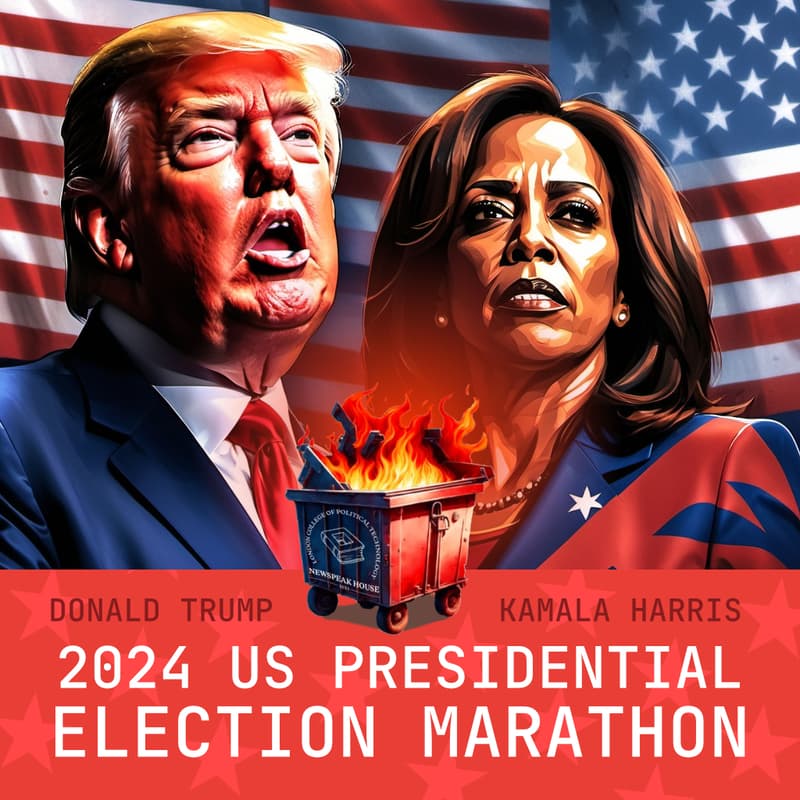
Newspeak House US Election Night Marathon · Luma 

In a nation deeply and bitterly divided Election Day angst and exhaustion are the order of the day.  Will it be a dumpster fire for democracy? 

It's finally Election Day.  Here in Northern Illinois and adjacent states like vital Wisconsin it is raw. raining on and off, and blustery giving it a suitable Sturm und Drang cast that matches the anxiety so many of us feel.  In conventional wisdom these conditions suppress voter turn out.  People getting off of work did not like to stand in miserable lines outside jammed polling places or drive on rain slick pavement in the dark.  Casual or not deeply connected voters were discouraged.  Suburban Democrats in Red collar counties were notoriously easily daunted because they had faint hope that they had any chance for representation in important down ballot local races.  Increasingly right wing Republicans from the Tea Party to the MAGA crowd would, as I have observed many times over the years, "crawl through glass" to elect their candidates.  Advantage GOP.

But mail-in and early voting has changed that.  Democrats have pushed early voting here since Barack Obama's first election and the percentage of their supporters opting for it has grown steadily giving them an increasing edge.  In the last election Trump and his minions vilified early voting and falsely charged it as an opportunity for election fraud.  Instead, he urged his supporters to turn out on election day to insure that early returns before early and mail in ballots were counted to show election night leads.  

Trump thought otherwise this time out.  Now he encouraged his most loyal supporters to vote early to match or offset the Democratic advantage.  The question is, did the reprogramming actually work?  Older White men, the Orange Menace's prime demographic, still seem to prefer traditional balloting.

(Side note--as a member of that cohort I have to ask, just what the hell is wrong with men?)

Of course Illinois is one of the safest Blue States in the nation and has strengthening that tendency since the 1960 razor thin victory of John F. Kennedy.  Suburban Cook County and metropolitan collar counties which once nearly balanced the huge Democratic advantage in Chicago and conservative rural and Down State areas.  but many of those areas have turned purple or even flipped Blue like former bastions Lake and Dupage counties.  Even here in McHenry County where the Republicans still dominate local offices,  Obama won in 2008,  Joe Biden came withing a hair, and local voters have gone for Democrats for state constitutional offices, and U.S. Senate.

Neighbors and even family members are deeply split this election.  Personal relationships are ruptured adding yet more stress.

The difference has been women whose drift away from the GOP has accelerated and finally become a panicked stampede after the Trump puppets on the Supreme Court overturn Roe v. Wade.

The national the Gender Gap is wider than ever and higher percentages of women actually cast ballots than men.

The pundits and talking heads still beat the band that the electorate is still split nearly in half and flickers either side of a dead heat in the critical six or seven battleground states that hold the key for an Electoral College victory and they have polls to prove it and keeping us all on jagged edge.

I think those polls under represent the rage and determination of women who have been the targets of intense voter turnout campaigns.  They will out-perform expectations.  So will blocks of voters with other key issues--youth voters and anti-gun violence advocates, climate change, LGBTQ+ rights and safety, election integrity and saving democracy, and minority rights.  Some "experts" wave their hand at the potential extra margins provided by these citizens claiming "liberals all stick together on a broad range of issues with the overlap of concerns limiting extra advantageTrue, as far as it goes, but at least some of those "single issue" voters are less motivated when they are not immanently threatened. Much depends on whose ox gets gored.  And all of these folks are likely under reported in the polls.

In addition, the drumbeat of traditional Republican conservatives like Liz Cheney, George Wills, and former Trump Cabinet members and national security heavies,  seems to be eroding Trump's base.  Dems recognized that when they began to assure Republican women that they could safely and secretly vote differently from their husbands.  Many will boycott the top of the ticket or vote for Harris without tipping their hands to voracious and possibly dangerous neighbors.  Another edge to Democrats.

I boldly predict the Harris-Waltz ticket will out-preform exceptions, win the popular vote, carry most swing states, and even bring others into play as the late Des Moines Register poll that show Harris up by 3% in that deep Red state suggests.  In Pennsylvania 400,000 Puerto Rican voters, easily enough to swing the state, are reported outraged by the "Floating Island of Garbage" comments at last week's Madison Square Garden hate fest.  On the other hand hundreds of thousands of Muslims in Michigan could boycott the top of the Democratic ticket over the War in Gaza.

Finally, many voters are sick to death after years of Trump psychodrama and just want it to end. 

The influx of Harris support will likely carry down ballot giving Democrats a good chance of retaining control of the Senate and even re-capturing the House.

Of course, my record of electoral prognostication is somewhat sketchy.

Here in McHenry County many Democrats will gather for this watch party at the historic Woodstock Opera House, but we won's know the final outcome of the Presidential election when the venue closes at 11 pm.

It could be days before the final results are known because of delays in counting mail in early ballots and likely Trump court challenges meant to once again undermine faith in election integrity and results evoking traumatic memories of four years ago.

There is nothing left for us to do but suck it up and be ready for a wild ride.


Monday, September 2, 2024

American Labor Day is a Consolation Prize Working Class Holiday


Note—This is an updated version of an almost annual holiday blog post.

Today is officially Labor Day in the United States, a Federal Holiday celebrated on the first Monday of September since 1894.  For most people it is just the last hurrah of summer, an occasion for one last cookout and the gateway to fall and football season.  In most cities and towns, the labor movement is not even perfunctorily acknowledged.  The press mostly uses the occasion to annually either write the obituary of unions or to denounce them as powerful and greedy bullies, depending on the political inclination of the outlet.

While most of us working schlumps are grateful for the day off (if we get one), I for one, wish I could officially celebrate Labor Day with virtually the whole rest of the world on May 1.  International Labor Day was proclaimed by the Second International in honor of the memory of Chicagos Haymarket Martyrs at the suggestion of none other than American Federation of Labor (AFL) chief Samuel Gompers himself and which quickly spread around the world.  American unions celebrated it too.

But within just a few years Gompers was at the heart of a deal that substituted the September observance for May Day, a few crumbs from the Bosss table, and a pat on the head by the Civic Federation in exchange for a promise to oppose labor radicalism and the growth of industrial style unionism in rapidly expanding basic heavy and the extractive industriesmining, forestry, agriculture, etc.

The official U.S. labor movement points to this massive 1882 New York City parade as the origin for celebrating Labor Day in September.

It is true that a September Labor Day observance pre-dated the 1886 Haymarket Affair.  In 1882 the New York Central Labor Union, made up of skilled craft unions belonging to a prototype of the AFL and lodges of the rival Knights of Labor cooperated in a call for a giant parade followed by picnics, games and amusements, and educational talks.  It was designed to showcase the pride and power of the labor movement and also to press for the chief demand of labor reformers—the Eight Hour Day—the same cause that would be marked by an attempted nationwide General Strike on May 1, 1886, an event that led up the attack by police on a workers rally in Chicagos Haymarket on May 4 and the bomb blast blamed on the mostly German and anarchist leaders of the local labor movement.

New York City officials, eager to appease workers after a number of local strikes were suppressed with violence, gave their official approval to the parade.  On September 5, 1882 an estimated 30,000 workers marched in military order behind elaborate banners representing local unions of all the trades, job shops, and Knights of Labor lodges.  It was an impressive display, but despite later claims by the AFL that observance of Labor Day spread quickly, only a few other cities, mostly in New York, began holding September celebrations.  

The Eight Hour Day was the main demand of both the New York 1882 parade and the mass strikes of 1886 that led to the establishment of May First as International Labor Day.  But the demand was much older as shown in this photo of what is believed to have been the first Eight Hour banner by working men in 1856.

In the meantime, huge May Day parades and rallies spread across the country.  But the late 1880s and early 1890s were the beginning of a nearly 40 year period of virtual open class warfare with strikes being violently suppressed by local, state, and federal authorities, and armies of private goons and strikebreakers.  And workers often fought back with equal violence.  Episodes like the Homestead Steel Strike with its running gun battles between Pinkertons and workers, the nationwide Pullman Strike of 1882, and virtually continuous battles in the coal fields and hard rock mines nationwide, made many fear for revolution or civil war.

Democratic President Grover Cleveland, who ordered the Army to crush the Pullman Strike, wanted a symbolic peace offering to Labor without actually granting the movement any of its demands. 

Republican king pin Ohio Senator Marc Hanna, soon to anoint William McKinley as the next President, was even more ambitious—he proposed a pact of cooperation between capital and “responsible labor.”  He offered Gompers, the Cigar Rollers Union chief who headed the AFL, a seat in his new Civic Federation alongside the robber barons and captains of industry.  Hanna did not make the same offer to Grand Master Workman Terrance V. Powderly of the Knights of Labor, who personally opposed strikes and advocated arbitration of disputes, because the members of Knights lodges included unskilled workers clamoring for recognition in heavy industry.  Gompers’s AFL would be allowed to pursue organizing skilled workers strictly by trade but not organize the great mass of unskilled, largely immigrant workers.  Gompers would also be called on to use his unions to oppose labor radicalism, and even to break strikes led by unions outside the grand agreement.

                                            Early Labor Day was wrapped in patriotic symbolism..

With Gompers in his pocket, Hanna engineered enough Republican support in Congress to get Cleveland’s official Labor Day proposal passed.  Cleveland signed it in to law just six days after Eugene V. Debss industrial union of railroad workers was smashed at the end of the Pullman Strike. 

Within a few years all states either aligned their existing Labor celebrations with the Federal holiday or enacted state proclamations echoing the U.S. call. 

Meanwhile authorities everywhere tried to suppress May Day observances, which continued to be supported by militant unionists and radicals of every sort—social democrats, anarchists, and Marxists.  The Knights of Labor withered away, but aggressive industrial unions, especially in the mining industry, continued to fight both the bosses and the AFL’s attempt to divide the aristocracy of labor from the mass rank and file.  In little more than a decade the radical Industrial Workers of the World (IWW) would be formed to intensify that battle.

                                Modern feminists updated this post World War I image to help drive women to the polls.

During the Depression and the presidency of Franklin D. Roosevelt, Democrats became the party of labor.   Labor Day became the official kick-off of Democratic election campaigns. Labor Day parades and rallies often seemed more of a platform to launch candidacies than a labor union celebration.

Even that has faded as the percentage of Americans in unions continued to shrink year after year after a high tide in the early ‘60’s.  By the Clinton era, Democrats continued to get support from labor, but seemed to try to disassociate themselves from it, shunning identification as the party for of labor in favor of being seen as the champion of the Middle Class.

As half-assed a holiday as Labor Day is, I hope we all will take a moment to thank the American Labor movement for largely creating that Middle Class.

Of late the organized labor movement has bestirred itself led by aggressive drives in the service industries including hospitality, fast food, and retail spurred by demands for a living minimum wage.  Public employees especially teachers and healthcare workers have also been militant and are extending their union representation.  Labor shortages in the wake of the Coronavirus pandemic gave unions leverage not seen in decades. 

Divisive and contentious turmoil has re-politicized the holiday.  Some, notably police and law enforcement organizations and skilled crafts have loudly supported Republicans and Trumpistas.  Even rank-and-file members industrial unions fearing job loss to China and/or replacement by “illegal immigrants” offered support to Trump in the last two elections.  But most organized labor has recognized the essential enmity by a cult being used create and oligarchy of the very wealthy who always hope to crush any effective labor organization.  Even the Teamsters who had been cozying up to Republicans since the Nixon Era but who now represent or are organizing among low wage workers in service industries including many immigrants of all legal status have returned to the Democrats.  Led by the United Auto Workers critical in battleground states like Michigan, Ohio, Pennsylvania, and Wisconsin industrial labor has rallied to the Democrats and the Kamala Harris/Jim Waltz ticket.  They also draw critical support among public employ unions at all levels of government including education and the health sector.

Although “Big Labor” no longer dominates Democratic fundraising, as the hysterical right always claims,  it remains a vast reservoir of potential volunteers of all sorts and individual members are active bridges to disaffected communities susceptible to right-wing populism.

The unfocused and bewildered Trump campaign appears to be taking a low-profile Labor Day weekend, while Harris and her campaign will hit several key swing states Monday.  Following a solo visit to Detroit Harris will return to Pennsylvania for a big rally with President Joe Biden.  Tim Walz will rally in Milwaukee in battleground Wisconsin.  Down ballot Democrats around the country a reinvesting in a Labor Day start of the sprint to November.  

Your scribe addressing a Labor Day rally on Woodstock Square in 2016 using a version of the text of this blog entry.