Showing posts with label ESPN. Show all posts

Monday, November 6, 2023

Intercollegiate Football Makes its Bloody Bow

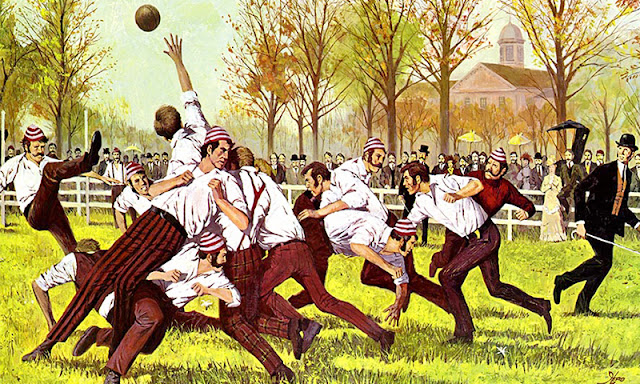
A Rutgers student later painted this imagined view of the first official college football game.

According to historians of American sports the first official college football season got underway on November 6, 1869 when teams from Rutgers College, now Rutgers University, and the College of New Jersey, now Princeton University, got together on the Rutgers campus for a rough and tumble game of football which was sanctioned and approved by both colleges.  It was a short season.  The next game was played by the same teams at Princeton one week later.  Season over.  Just two teams and two games.

The Queensmen of Rutgers won the first game by a score of 6-4 but the New Jersey Tigers came back in the re-match to win 8-0.  The anal retentive record keepers of intercollegiate sports are torn on who to retroactively declare the first unofficial national Champion since a third and possibly decisive game was never played as originally intended, probably because the two teams could not agree under what rules to conduct the contest.  Princeton was named the champion by the Billingsley Report and the National Championship Foundation, but respected college football research historian Parke H. Davis named the two teams co-champions.

But for the players—there were no coaches yet—the split season had to be a lot like kissing your sister, pleasant enough but not thrilling.

To say that an intercollegiate sport of any kind was in its infancy is hardly an exaggeration.  Only rowing was widely contested and had been since Harvard and Yale first went at it in 1852.  A few colleges were playing a form of the new bat and ball game called baseball beginning with Amherst vs. Williams Colleges in 1859 and that was pretty much it.

Students had been playing rough kick ball goal games on a casual pick-up team basis on several campuses for at least twenty years, maybe longer.  There were few, if any rules, no set number of players on a team—anyone could jump in the game—and no set field dimensions.  Students let off steam and tended to emerge with black eyes, broken teeth, fractured bones, and a deep abiding thirst quenchable only with quantities of beer or rum punch.  College administrators took a dim view of it but considered the games preferable to another popular college pastimerioting.  By the post-Civil War era football clubs were formed on some campuses and informal—actually illegal—matches between unofficial teams sometimes occurred.  Heavy betting by players, students, and faculty rode on some of these clandestine games.

The colleges of Rutgers and New Jersey finally decided it was best to sanction the competition to control the violence and debauchery that the unofficial matches had encouraged.  Still the serious academics were unsure and dubious about games and frivolity in general which ran against the entrenched Puritanism that prevailed among most of the faculties.

Arranging the official matches was not easy because each team played by different rules which had evolved independently over time.  Finally, it was determined to play each game by the home team’s rules—which turned out to be a decisive advantage in each game.  The decision of what rules to use in a final third game was put off.  In the end neither team would agree to an advantage over the other and the third game had to be called off.

This view of the game better captures bloody melee of the game--young gentlemen with blood in their eyes.

Modern Americans would hardly recognize the game that was played on November 6 as Football.  It more closely resembled a crude version of what we now call soccer with some elements of Rugby, our form of the game’s most immediate ancestor.  The ball was round.  Players wore neither helmets nor identifying uniforms and ran in slick, leather soled street shoes or boots.  Twenty-five men on each side played both offense and defense.  There were no time outs, even for injuries and wounded players had to be dragged off the field by spectators dodging the action.  There also were no substitutions so knocking an opponent unconscious or breaking a leg was advantageous.  Players were forbidden to pick up and run with the ball.  The ball was advanced by kicking.  The field was 125 yards long and 75 yards wide, and unmarked. Under the circumstances the game could only be bloody and brutal.   

Rutgers had the advantage of both using its own rules and of some speedier runners who could occasionally break out of the mob scene and advance the ball.  Thus, they won the first game.

At New Jersey the rules allowed a player to catch the ball with his hands on the fly and execute a free kick which could send the ball high over player’s heads and well down field.  This erased Rutgers’ advantage and allowed the Tigers to blank their rivals.  Rutgers was outraged by the “unfair tactics” but there was nothing they could do about it.

Interest at both colleges in the games was so high that during the short “season” students could hardly concentrate on their studies, so wrapped up in the games were they.  Faculty members pontificated about the moral collapse of a generation and wrung their hands over the distractions—setting up another time honored tradition.

Over the next decades America went sports crazy.  Baseball erupted seemingly overnight into the National Pastime.  Boxing was closely followed from mens club smokers to ballyhooed World Championships in multiple weight divisions covered in detail in illustrated magazines like the Police Gazette.  Thoroughbred racing and county fair pacers and trotters attracted racetrack crowds and fueled a burgeoning bookmaking industry.  College football would be swept up in the general rise.

It wasn't until 1886 that Yale footballer Walter Camp wrote his standardized rules of the game.  He went on to a long career as a coach and was honored as the father of football.

Sports writers for major newspapers began to cover the games and clamor for standardization of the rules.  Reformers demanded rule changes that made the games less of a blood bath.  On different campuses rules evolved differently.  It was not until June 4, 1875 that a form of the game recognizable to us—running with an oval ball, 11-man sides, and tackling to end a play would be contested between Harvard and Tufts Universities.  The next year Yale player Walter Camp drew up standardized rules based on the Rugby game being played by McGill University in Toronto. Harvard, Columbia, and the College of New Jersey—formed the Intercollegiate Football Association, the first league.  Yale joined three years later in 1879.  The rest, as they say, is history.  

On the 50th anniversary of the first game Rutgers honored the surviving members of the 1869 team.

Rutgers has always been particularly proud to have hosted the first college football game.  In fact, their boasting about it has kept their claim alive.  In 1919, the fiftieth anniversary of the game the University honored all the surviving members of the team at their Homecoming celebration.  Members continued to attend until the last one, George H. Large died in 1939, seventy years after the most memorable day of his life.


                                      For the 150th anniversary of the game in 2019 ESPN issued a souvenir Marvel comic.

Friday, November 5, 2021

Intercollegiate Football Takes a Bloody Bow

A Rutgers student later painted this imagined view of the first official college football game.

According to historians of American sports the first official college football season got underway on November 6, 1869 when teams from Rutgers College, now Rutgers University, and the College of New Jersey, now Princeton University, got together on the Rutgers campus for a rough and tumble game of football which was sanctioned and approved by both colleges.  It was a short season.  The next game was played by the same teams at Princeton one week later.  Season over.  Just two teams and two games.

The Queensmen of Rutgers won the first game by a score of 6-4 but the New Jersey Tigers came back in the re-match to win 8-0.  The anal retentive record keepers of intercollegiate sports are torn on who to retroactively declare the first unofficial national Champion since a third and possibly decisive game was never played as originally intended, probably because the two teams could not agree under what rules to conduct the contest.  Princeton was named the champion by the Billingsley Report and the National Championship Foundation, but respected college football research historian Parke H. Davis named the two teams co-champions.

But for the players—there were no coaches yet—the split season had to be a lot like kissing your sister, pleasant enough but not thrilling.

To say that an intercollegiate sport of any kind was in its infancy is hardly an exaggeration.  Only rowing was widely contested and had been since Harvard and Yale first went at it in 1852.  A few colleges were playing a form of the new bat and ball game called baseball beginning with Amherst vs. Williams Colleges in 1859 and that was pretty much it.

Students had been playing rough kick ball goal games on a casual pick-up team basis on several campuses for at least twenty years, maybe longer.  There were few, if any rules, no set number of players on a team—anyone could jump in the game—and no set field dimensions.  Students let off steam and tended to emerge with black eyes, broken teeth, fractured bones, and a deep abiding thirst quenchable only with quantities of beer or rum punch.  College administrators took a dim view of it but considered the games preferable to another popular college pastimerioting.  By the post-Civil War era football clubs were formed on some campuses and informal—actually illegal—matches between unofficial teams sometimes occurred.  Heavy betting by players, students, and faculty rode on some of these clandestine games.

The colleges of Rutgers and New Jersey finally decided it was best to sanction the competition to control the violence and debauchery that the unofficial matches had encouraged.  Still the serious academics were unsure and dubious about games and frivolity in general which ran against the entrenched Puritanism that prevailed among most of the faculties.

Arranging the official matches was not easy because each team played by different rules which had evolved independently over time.  Finally, it was determined to play each game by the home team’s rules—which turned out to be a decisive advantage in each game.  The decision of what rules to use in a final third game was put off.  In the end neither team would agree to an advantage to the other and the third game had to be called off.

This view of the game better captures bloody melee of the game--young gentlemen with blood in their eyes.

Modern Americans would hardly recognize the game that was played on November 6 as Football.  It more closely resembled a crude version of what we now call soccer with some elements of Rugby, our form of the game’s most immediate ancestor.  The ball was round.  Players wore neither helmets nor identifying uniforms and ran in slick, leather soled street shoes or boots.  Twenty-five men on each side played both offense and defense.  There were no time outs, even for injuries and wounded players had to be dragged off the field by spectators dodging the action.  There also were no substitutions so knocking an opponent unconscious or breaking a leg was advantageous.  Players were forbidden to pick up and run with the ball.  The ball was advanced by kicking.  The field was 125 yards long and 75 yards wide, and unmarked. Under the circumstances the game could only be bloody and brutal.   

Rutgers had the advantage of both using its own rules and of some speedier runners who could occasionally break out of the mob scene and advance the ball.  Thus, they won the first game.

At New Jersey the rules allowed a player to catch the ball with his hands on the fly and execute a free kick which could send the ball high over player’s heads and well down field.  This erased Rutgers’ advantage and allowed the Tigers to blank their rivals.  Rutgers was outraged by the “unfair tactics” but there was nothing they could do about it.

Interest at both colleges in the games was so high that during the short “season” students could hardly concentrate of their studies, so wrapped up in the games were they.  Faculty members pontificated about the moral collapse of a generation and wrung their hands over the distractions—setting up another time honored tradition.

Over the next decades America went sports crazy.  Baseball erupted seemingly overnight into the National Pastime.  Boxing was closely followed from men’s club smokers to ballyhooed World Championships in multiple weight divisions covered in detail in illustrated magazines like the Police Gazette.  Thoroughbred racing and county fair pacers and trotters attracted racetrack crowds and fueled a burgeoning bookmaking industry.  College football would be swept up in the general rise.

It wasn't until 1886 that Yale footballer Walter Camp wrote his standardized rules of the game.  He went on to a long career as a coach and was honored as the father of football.

Sports writers for major newspapers began to cover the games and clamor for standardization of the rules.  Reformers demanded rule changes that made the games less of a blood bath.  On different campuses rules evolved differently.  It was not until June 4, 1875 that a form of the game recognizable to us—running with an oval ball, 11-man sides, and tackling to end a play would be contested between Harvard and Tufts Universities.  The next year Yale player Walter Camp drew up standardized rules based on the Rugby game being played by McGill University in Toronto. Harvard, Columbia, and the College of New Jersey—formed the Intercollegiate Football Association, the first league.  Yale joined three years later in 1879.  The rest, as they say, is history. 

On the 50th anniversary of the first game Rutgers honored the surviving members of the 1869 team.

Rutgers has always been particularly proud to have hosted the first college football game.  In fact, their boasting about it has kept their claim alive.  In 1919, the fiftieth anniversary of the game the University honored all the surviving members of the team at their Homecoming celebration.  Members continued to attend until the last one, George H. Large died in 1939, seventy years after the most memorable day of his life.

                                    For the 150th anniversary of the game in 2019 ESPN issued a souvenir Marvel comic.

Saturday, November 2, 2013

Cheering Through the Ages—How It Became a Girl Thing

A Columbia University Cheer Squad circa 1920


It’s Saturday so college football will be breaking out across the country.  Basketball and hockey tonight, the NFL wall to wall tomorrow.  A sports fan’s wet dream come true.  That wet dream is in no small way enhanced by the presence at virtually all of these contests of attractive cheerleaders in tight sweaters and short skirts with smiles on their lovely faces and enthusiasm in their voices. 
You might ask, to whom do we owe this froth on the beer stein of athletic bliss?  It you don’t ask, I am about to tell you anyway.
Team sports emerged slowly from the elite colleges and universities on the East Coast in the 19th Century.  What began as rough pick-up games of primitive football on the Quad with few rules, or even set numbers of players, slowly evolved into more organized contests between fraternities or clubs.  Eventually schools began to challenge each other.  The first interscholastic games usually credited to Harvard and McGill from Montreal, which played rugby style games with an oblong ball in 1874 and ’75.
That general style of play spread to other schools—Yale, Princeton, and Columbia which had originally played a soccer like game in which carrying the ball had been prohibited.  By 1876 the schools agreed on new, mutually acceptable rules and the Ivy League was off and running.  The game was soon refined by Yale’s Walter Camp.  Newspapers began to carry stories of the heroics on the field.  Competition spread.  By 1880 eight universities, including the University of Michigan in the wilds west of the Allegany’s were competing.  Ten years later the number had swollen to 43.
About that time Princeton lads who could not make the team, decided to get in on the fun by organizing the first pep squad—a club in matching beanies and jackets who sat together in the stands and chanted special cheers for their team.  Other members of the crowds learned to join in.  Players reported that they were energized by the show of loyalty and support and played even harder for the glory of the school.
Like other innovations, pep squads spread quickly to other schools and soon college games were almost as much a contest between yelling fans as players on the field.  But still, alas, no real cheerleaders.
That is until November 2, 1898.  Out on the northern hinterlands the University of Minnesota had taken up football and four years earlier a Princeton grad had introduced the Pep Squad to the school.  Naturally, they had their own special cheer which went something like “Rah, Rah, Rah! Ski-U-Mah! Hoo-Rah! Hoo-Rah! Varsity! Varsity! Minn-e-so-ta!”  Catchy, eh?  In the fall of ’98 the team had fallen on hard times and lost four games in a row.  They were discouraged.  The fans were glum. 
On this particular afternoon they were set to play snooty Northwestern University, a power house which liked to cast itself as the equal of the old eastern Ivies.  The Pep Squad got together and decided to try something desperate.  Instead of just sitting together and chanting the cheers in the hopes the crowd would pick it up, they appointed Yell Leaders who stood up, turned around and urged the fans to join the cheers.  Most of them stayed in the stands.  But during a lull in the action one of the Yell Leaders, Johnny Campbell actually ran onto the field and led the cheer through a megaphone.  The crowd went wild, and the inspired team rose up and whipped Northwestern. 
Thus the early modern cheerleader was born.  Soon other members of the pep squad came down from the stands to work along the sidelines with their megaphones.  The custom spread like wild fire.
So much so that by the 1920’s and early ‘30’s cheerleaders were a regular feature in the college comedies that were popular in silent films and early talkies.
Meanwhile cheerleaders were jazzing up their acts a little—adding fight songs, a greater variety of cheers, arm movements, and a bit of acrobatics to the sidelines.
In 1923, it was again the University of Minnesota, which shocked the sporting world by allowing co-eds to cheer alongside he men.  The innovation seemed like an attack on a manly preserve.  It was slow to catch on.  It wasn’t until the Draft in 1940 followed shortly by World War II started draining campuses of men that the ranks of women cheerleader really took off.  By war’s end they were the majority.
When Johnny came marching home, he did not, by in large, use the GI Bill a become cheerleader.  In what could be a case study about how feminization of any activity tends toward ghettoization, by the early ‘50’s outside of the few remaining bastions of all male schools, cheerleading was dominated by women. 
Even in those male bastions, cheerleading lost its luster a bit and its practitioners sometimes derided for their girly pursuit. When George Bush attended Yale he was a baseball star.  When son George W. went there in the ‘60’s he was a cheerleader and was mocked for it.
That trend continued until 90% of collegiate cheerleaders are women, according to something called the International Cheer Union (ICU).  Of late, however, a few previously all-female teams have added a few men for muscle for the increasingly complex and daring acrobatics that have become the center of modern cheering.
The new elements that revolutionized cheerleading can be traced to one man--Lawrence “Herkie” Herkimer, a cheerleading coach at Southern Methodist University.  In 1948 he founded the first cheerleading clinic at Sam Houston State Teacher’s College.  Texas rapidly became the epicenter of cheering culture.  According to the breathless description on the ICU web page:
Herkie went on to develop his signature “Herkie” jump, the spirit stick, the “pom pon” (also called “shakeroos” in that time), all important elements in cheerleading to this day.  Separate cheerleading pom pon teams (also termed “Cheerdance”) are also trained by Herkimer and begin to develop on sport sidelines around the United States as an added entertainment and game leadership component of cheerleading. 
The change in Cheerleading was reflected in popular culture.  Romance between cute cheerleaders and hunky athletes became a staple of TV and movies in the ‘50’s and ‘60’s.  But when teen angst comedies caught on in the eighties, cheerleaders took on a darker, more menacing aspect.  They were seen as the cold and haughty unapproachable objects of outcast nerds’ fantasies or often as the vicious leaders of high school cliques tormenting sensitive girls.
By the ‘70’s things were changing again.  On the pro level the sensationally popular Dallas Cowboy Cheerleaders made cheering sexy.  Girls on squads down to Jr. High were soon liberated from bulky sweaters, pleated skirts, and knee socks.  If not quite as much cleavage or thigh got flashed on high school sidelines, it was a matter of degree. 
The Cowboy Cheerleaders also introduced much more dance and complicated choreography.  Pretty soon the second stringers of the Pom Pon squads were doing most of the pep work leading the star cheerleaders to concentrate on sideline performance and half-time spectaculars.
In the mid-70’s entrepreneur Jeff Webb founded the a new cheerleading camp that introduced the “cheerleading routine”—a mini-show incorporating dance and acrobatics.  That led to cheerleading as an athletic completion in its own right.  He founded that ubiquitous ICU and began franchising his camps and systems worldwide.  He made a deal with the infant and content starved new cable network ESPN to feature his National Cheerleading Championships which were also syndicated for over-the-air broadcast.
Now in addition to high school and college teams there are competitive All Star teams not associated with any other athletic teams to cheer for. 
These competitions, high school, college, and All Star have become the focus of a new genre of cheerleading movies—usually a variation on the tried and true Bad News Bears formula in which scrappy misfits and underdogs come together to unseat a nasty and arrogant team for a championship and glory.
No wonder little girls still dress up as cheerleaders on Halloween—and almost no boys do.