Showing posts with label Eid-al-Fitr. Show all posts

Tuesday, March 4, 2025

Celebrating Ramadan in Verse


Note—I missed the beginning of Ramadan in this part of the world last Friday, February 28.  I blame my old style wall calendar hanging by my desk where your low tech scribe keeps track of such things.  But the Holy month continues.

 In most of the Islamic world Ramadan the ninth month of the Muslim Calendar, began last Friday at sun down. The date is calculated by the first sighting of the crescent after the New Moon.  Since this can vary in different parts of the world, so can the marked beginning of the month.  In the United States the western calendar date was February 28.

Observation of the rising of the crescent new moon marking the start of the month officially begins Ramadan.

Ramadan was the month in which the first verses of the Qur’an were revealed to the Prophet Mohammad

The month of cleansing as the faithful rededicate themselves to Allah by emphasizing patience, humility, and spirituality by an absolute fast observed by all Muslims over the age of puberty each day between dawn and dusk.  The observant are also called to be more reverent and fervent in prayer.  During Ramadan the entire Qur’an is often read in mosques in 30 installments.

Customs connected to the Ramadan observance vary somewhat culturally and between Sunni and Shi’a traditions.  In more secular Islamic countries evenings after the fast are often filled with feasting and entertainment, while attendance to evening services following a modest breaking of the fast is customary in more traditional societies.  Acts of charity to the poor are encouraged. 

British Muslims share an Iftar meal breaking the fast of Ramadan after sunset.

The holiday of Eid-al-Fitr marks the end of the fasting period of Ramadan and the first day of the following month, after another new moon has been sighted, 29 or 30 days after the onset of Ramadan.  This is the most festive of Islamic holidays and is marked by the donning of new clothes, feasting, and family gatherings.

There are rich traditions of poetry in both Arabic speaking societies and in Iran, formerly Persia which is the spiritual center of Shi’a Islam.  Poets have been considered to have a special duty to speak to social and moral conditions and to hold rulers to the high standards of Allah.  While they are often revered by the masses they are often harassed, imprisoned, or even killed by unamused religious and state authorities.

Kazim Ali.

Kazim Ali is a British born Muslim of Indian descent.  He was educated in the United States with a BA from University of Albany-SUNY, and an MFA from New York University.  Ali’s poetry collections include The Far Mosque (2005), The Fortieth Day (2008), Sky Ward (2013), and Inquisition (2018).  Today’s selection, Ramadan, comes from The Fortieth Day.

Ramadan

You wanted to be so hungry, you would break into branches,
and have to choose between the starving month’s

nineteenth, twenty-first, and twenty-third evenings.
The liturgy begins to echo itself and why does it matter?

If the ground-water is too scarce one can stretch nets
into the air and harvest the fog.

Hunger opens you to illiteracy,
thirst makes clear the starving pattern,

the thick night is so quiet, the spinning spider pauses,
the angel stops whispering for a moment—

The secret night could already be over,
you will have to listen very carefully—

You are never going to know which night’s mouth is sacredly reciting
and which night’s recitation is secretly mere wind—

Kazim Ali
Ramadan: A Poem was written by Musa Burki and was found on the website Virtual Mosque.

Ramadan: A Poem

A time for our hearts to become unsealed
Reflecting on the divine words revealed
The month which we hope to never end
Unable to count the infinite blessings it sends

Asked by our Lord to give up our worldly pleasures
So that we may receive His divine treasures
It’s a time that comes but once a year
Yet the moments which we hold most dear
The nights spent in prayer and reflection
Prepares the soul for redemption
Praying to our Creator for mercy and wisdom
Pleading to be admitted into His kingdom

We welcome you, O Ramadan, with joy as our guest
Having to subdue our egos as a test
You mend our hearts and give us tranquility
As we engage in battling our iniquity

Solidifying the bonds of kith and kin
Washing away the stain of sin
Fasting not only of body but of speech
It is Your benevolence which we beseech

O Ramadan, you have blessed us with your presence
Teaching us to grow from our spiritual adolescence
Continue to be the month which will always bless
Helping us to alleviate our fears and distress

         —Musa Burki


Sunday, April 26, 2020

Poetry for Ramadan—National Poetry Month 2020

Observation of the rising of the crescent new moon marking the beginning of the month officially begins Ramadan.
In most of the Islamic world Ramadan the ninth month of the Muslim Calendar, began Thursday at sun down. The date is calculated by the first sighting of the crescent after the New Moon.  Since this can vary in different parts of the world, so can the marked beginning of the month.  In the United States the western calendar date was April 23.
Ramadan was the month in which the first verses of the Qur’an were revealed to the Prophet Mohammad.
The month of cleansing as the faithful rededicate themselves to Allah by emphasizing patience, humility, and spirituality by an absolute fast observed by all Muslims over the age of puberty each day between dawn and dusk.  The observant are also called to be more reverent and fervent in prayer.  During Ramadan the entire Qur’an is often read in mosques in 30 installments.


Customs connected to the Ramadan observance vary somewhat culturally and between Sunni and Shi’a traditions.  In more secular Islamic countries evenings after the fast are often filled with feasting and entertainment, while attendance to evening services following a modest breaking of the fast is customary in more traditional societies.  Acts of charity to the poor are encouraged
  
The holiday of Eid-al-Fitr marks the end of the fasting period of Ramadan and the first day of the following month, after another new moon has been sighted, 29 or 30 days after the onset of Ramadan.  This is the most festive of Islamic holidays and is marked by the donning of new clothes, feasting, and family gatherings.

There a rich traditions of poetry in both Arabic speaking societies and in Iran, formerly Persia which is the spiritual center of Shi’a Islam.  Poets have been considered to have a special duty to speak to social and moral conditions and to hold rulers to the high standards of Allah.  While they are often revered by the masses they are often harassed, imprisoned, or even killed by unamused religious and state authorities.

Kazim Ali.


Kazim Ali is a British born Muslim of Indian descent.  Educated in the United States with a B.A. from University of Albany-SUNY, and an MFA from New York University.  Ali’s poetry collections include The Far Mosque (2005), The Fortieth Day (2008), Sky Ward (2013), and Inquisition (2018).  Today’s selection, Ramadan, comes from The Fortieth Day.

Ramadan
You wanted to be so hungry, you would break into branches,
and have to choose between the starving month’s

nineteenth, twenty-first, and twenty-third evenings.
The liturgy begins to echo itself and why does it matter?

If the ground-water is too scarce one can stretch nets
into the air and harvest the fog.

Hunger opens you to illiteracy,
thirst makes clear the starving pattern,

the thick night is so quiet, the spinning spider pauses,
the angel stops whispering for a moment—

The secret night could already be over,
you will have to listen very carefully—

You are never going to know which night’s mouth is sacredly reciting
and which night’s recitation is secretly mere wind—

Kazim Ali


Ramadan: A Poem was written by Musa Burki and was found on the website Virtual Mosque.

Ramadan: A Poem

A time for our hearts to become unsealed
Reflecting on the divine words revealed
The month which we hope to never end
Unable to count the infinite blessings it sends

Asked by our Lord to give up our worldly pleasures
So that we may receive His divine treasures
It’s a time that comes but once a year
Yet the moments which we hold most dear
The nights spent in prayer and reflection
Prepares the soul for redemption
Praying to our Creator for mercy and wisdom
Pleading to be admitted into His kingdom

We welcome you, O Ramadan, with joy as our guest
Having to subdue our egos as a test
You mend our hearts and give us tranquility
As we engage in battling our iniquity

Solidifying the bonds of kith and kin
Washing away the stain of sin
Fasting not only of body but of speech
It is Your benevolence which we beseech

O Ramadan, you have blessed us with your presence
Teaching us to grow from our spiritual adolescence
Continue to be the month which will always bless
Helping us to alleviate our fears and distress
—Musa Burki

Tuesday, May 15, 2018

The Crescent Moon of Ramadan Rises Over Gaza Mayhem

Observation of the rising of the crescent new moon marking the begining of the month officially begins Ramadan.

Note—Yesterday as the United States opened its new embassy in Jerusalem presided over by Presidential daughter Ivanka, her husband Jarred, an assortment of apocalypse-rooting, anti-Semitic Evangelical preachers, a Chief Rabbi who thinks Blacks are monkeys, and gloating ghoul Benjamin Netanyahu, at least 54 unarmed Palestinians were murdered on the Gaza border.  Today is the 60th anniversary of the beginning of the 1948 Arab-Israeli War which established the State of Israel and which is marked by Palestinians as the beginning of the Nakba—the Catastrophe—in which a whole people were deprived of their nation, made homeless, and forced into generations of harrowing existence in refugee camps.  Tiny, crowed Gaza would be the home of many of those refugees.  Today will also herald the beginning of Ramadan, the holiest month of Islam in most of the world.  Ponder the multiple ironies.

The perfect wordless meme describes Amerian hypocracy and collusion in crimes against humanity on the eve of Ramadan.
In most of the Islamic world sun down tonight will start Ramadan, the ninth month of the Muslim Calendar, a holy period of fasting.  The date is calculated by the first sighting of the crescent after the New Moon.  Since this can vary in different parts of the world, so can the marked beginning of the month.  In the United States the western calendar date is May 15.
A movement to mark the beginning by astronomical calculation, rather than by visual confirmation thus standardizing the observance is embraced in some of the Islamic world, but bitterly resisted by some traditionalists. 
This year in deeply traditional Saudi Arabia and the United Arab Emirates religious leaders observe the new crescent using powerful telescopes are expected to spot the moon in the usual crystal-clear skies over the desert.  Religious authorities there will declare that tomorrow May 16, will be the first full day of of Ramadan for Hijri year 1439. 
Because it is calculated by a lunar, rather than the western solar calendar, Ramadan floats backward 10 or 11 days each year in relationship to the Gregorian Calendar.
Ramadan was the month in which the first verses of the Qur’an were revealed to the Prophet Mohammad
The month of fasting is a period of cleansing as the faithful rededicate themselves to Allah by emphasizing patience, humility, and spirituality by an absolute fast observed by all Muslims over the age of puberty each day between dawn and dusk.  The observant are also called to be more reverent and fervent in prayer.  During Ramadan the entire Qur’an is often read in mosques in 30 installments

British Muslims share an Iftar meal breaking the fast of Ramadan after sunset.
Dawn to dusk fasting is significantly longer every day for Muslims in northern latitudes where the day is longer than close to the equator.  This affects the growing number of believers across North America, northern Europe, and parts of Russia and China.  That has caused tensions between traditionalists and moderates in some countries.  In Britain moderate scholar Dr. Usama Hasan of the Quillian Foundation issued a Fatwa—simply a ruling or opinion by a recognized Islamic scholar—that Muslims there should observe the hours of fasting at Mecca, around 12 hours a day, instead of during the up to 20 hours of daylight in the northern Scotland.  Traditionalists in Great Britain’s diverse Muslim population still demand a dawn to dusk fast.  It is unclear how many believers will embrace the new Fatwa.
Islam is the world’s fastest growing religion due to a population explosion across much of its traditional territories, migrations, and conversions particularly in Africa and North America.  And that, along with the emergence of violent fundamentalist movements, causes much anxiety. 
In the United States resentment against Muslims is on the rise yet fueled by xenophobic hysteria and exploited by Donald Trump. 

American Muslims in Oklahoma observe the duty to provide charity by feeding the needy during Ramadan.
Customs connected to the Ramadan observance vary somewhat culturally and between Sunni and Shi’a traditions.  In more secular Islamic countries evenings after the fast are often filled with feasting and entertainment, while attendance to evening services following a modest breaking of the fast is customary in more traditional societies.  Acts of charity to the poor are encouraged.  

The joyous embrace after final Ramadan prayers on Eid=al-Fitr.
The holiday of Eid-al-Fitr marks the end of the fasting period of Ramadan and the first day of the following month, after another new moon has been sighted, 29 or 30 days after the onset of Ramadan.  This is the most festive of Islamic holidays marked by the donning of new clothes, feasting, and family gatherings.
The proprietor of this blog sincerely wishes his Muslim friends Ramadan Mubarak!

Monday, June 6, 2016

The Crescent New Moon Marked Islam’s Holy Ramadan

The Crescent Moon was spotted in Saudi Arabia.


Note—In light of the bigotry and hatred that has now been enshrined by a once progressive American political party with its embrace of an open racist and only mildly closeted fascist as its Presidential nominee, it has never been more important to understand Islam and honor the traditions that have brought meaning to the lives of millions. 
In most of the Islamic world sun down last night was the start Ramadan, the ninth month of the Muslim Calendar, a holy period of fasting.  The date is calculated by the first sighting of the crescent after the New Moon.  Since this can vary in different parts of the world, so can the marked beginning of the month.  In the United States the western calendar date was June 5.
A movement to mark the beginning by astronomical calculation, rather than by visual confirmation thus standardizing the observance is embraced in some of the Islamic world, but bitterly resisted by some traditionalists. 
This year in deeply traditional Saudi Arabia and the United Arab Emirates religious leaders observed the new crescent using powerful telescopes was sited late yesterday in crystal clear skies.  Religious authorities there declared that today, June 6, the first full day of the sighting will mark the beginning of Ramadan for Hijri year 1437. 
Because it is calculated by a lunar, rather than the western solar calendar, Ramadan floats backward 10 or 11 days each year in relationship to the Gregorian Calendar.
Ramadan was the month in which the first verses of the Qur’an were revealed to the Prophet Mohammad

The month of fasting is a period of cleansing as the faithful rededicate themselves to Allah by emphasizing patience, humility, and spirituality by an absolute fast observed by all Muslims over the age of puberty each day between dawn and dusk.  The observant are also called to be more reverent and fervent in prayer.  During Ramadan the entire Qur’an is often read in mosques in 30 installments.


Muslims pray at the Central London Mosque during Ramadan.   Longer days at Northern latitudes can mean up to 20 hours of daylight and fasting,

Dawn to dusk fasting is significantly longer every day for Muslims in northern latitudes where the day is longer than close to the equator.  This affects the growing number of believers across North America, northern Europe, and parts of Russia and China.  That has caused tensions between traditionalists and moderates in some countries.  In Britain moderate scholar Dr. Usama Hasan of the Quillian Foundation issued a Fatwa—simply a ruling or opinion by a recognized Islamic scholar—that Muslims there should observe the hours of fasting at Mecca, around 12 hours a day, instead of during the up to 20 hours of daylight in the northern Scotland.  Traditionalists in Great Britain’s diverse Muslim population still demand a dawn to dusk fast.  It is unclear how many believers will embrace the new Fatwa.
Islam is the world’s fastest growing religion due to a population explosion across much of its traditional territories, migrations, and conversions particularly in Africa and North America.  And that, along with the emergence of violent fundamentalist movements, causes much anxiety.  Nowhere more so than in China where officials have once again clamped down on the Turkic-speaking Uighur in the semi-autonomous northwest region of Xinjiang—called call East Turkestan by local activists.  After years of low-key unrest and a handful of case of bombings, Chinese official fear the development of the kind of insurgency that occurred across the Caucuses in areas of the former USSR.  Mirroring crackdowns on Tibetan Buddhists, Christians, and minority sects, Chinese officials have banned the observance of the fast, forced restaurants to stay open during the day and shops to sell tobacco and liquor, and ordered schools and workplaces to serve lunches and compel participation.  Naturally this only builds resentment to the central government and to local Communist Party officials charged with carrying the edict out.
In the United States resentment against Muslims is on the rise yet again after the widely reported atrocities of ISIS in France, Belgium, Syria and Iraq and attacks by other groups in Africa.  A few arrests of Americans for allegedly trying to join ISIS or al Qeada, using social media for recruitment, or trying to hatch their own domestic attacks has revived some hysteria and fed right wing hate groups.  Across the country mosques and Islamic centers are appealing to authorities for extra protection and beefing up their own security during Ramadan.

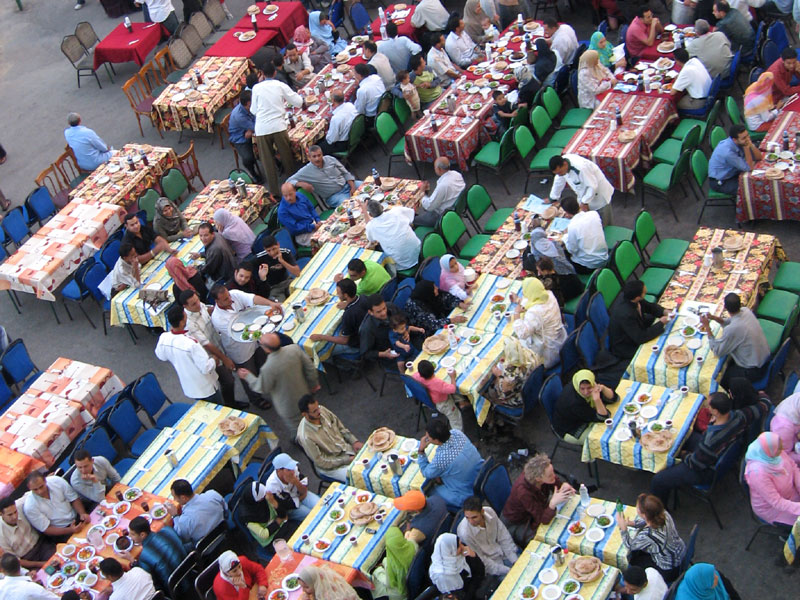
After sunset in Cairo there are festive communal dinners known as Iftar.

Customs connected to the Ramadan observance vary somewhat culturally and between Sunni and Shi’a traditions.  In more secular Islamic countries evenings after the fast are often filled with feasting and entertainment, while attendance to evening services following a modest breaking of the fast is customary in more traditional societies.  Acts of charity to the poor are encouraged. 
The holiday of Eid-al-Fitr  marks the end of the fasting period of Ramadan and the first day of the following month, after another new moon has been sighted, 29 or 30 days after the onset of  Ramadan.  This is the most festive of Islamic holidays marked by the donning of new clothes, feasting, and family gatherings.
The proprietor of this blog sincerely wishes his Muslim friends Ramadan Mubarak!