Showing posts with label English translation. Show all posts

Sunday, December 18, 2022

O Come O Come Emmanuel—The Murfin Winter Holidays Music Festival 2022-‘23

                                                 O Come, O Come Emmanuel sung by Enya with Latin lyrics.

Today is the Fourth and Final Sunday of Advent and time to share the most famous of all Advent hymns, O Come, O Come Emmanuel which also has some of the oldest roots.  As a boy it always perplexed me—who the hell was this Emmanuel, what did he have to do with Christmas, and how did Israel become involved?


It turns out that Emmanuel—from Hebrew meaning “God is With Us” is mentioned almost in passing in the Old Testament book of Book of Isaiah in connection with prophecies about a war between the Kingdom of Judea and an Assyrian Empire with it’s vasal the Kingdom of Israel in 735-734 BCE.  One verse said, “The Lord himself shall give you a sign; Behold, a virgin shall conceive, and bear a son, and shall call his name Immanuel.”  The name, is mentioned a second time that the lands of the “two kings you dread” will be laid waste before the child is old enough to “reject the wrong and choose the right.”  Neither Isaiah nor Jewish scholars connected these prophecies to those predicting the coming of a Messiah.

But early Christians did, at least the unknown author the Gospel of Matthew did when and angel appeared to Joseph in a dream who was about to end his engagement to teenage Mary because she was carrying the child of another and told him the child’s divine origin was the fulfillment of Scripture.  “Now all this was done, that it might be fulfilled which was spoken of the Lord by the prophet, saying, Behold, a virgin shall be with child, and shall bring forth a son, and they shall call his name Emmanuel, which being interpreted is, God with us.”

So, by these slender threads hung the notion that Emmanuel was another name for Jesus who was also the Messiah, Savior of Humankind, and Son of God.

                                  An Orthodox icon of Emmanuel from 1688.

The text of the song we know was originally written in Latin, a paraphrase of the O antiphons, a series of plainchant antiphons attached to the Magnificat at Vespers over the final days before Christmas. The hymn has its origins over 1,200 years ago in monastic life in the 8th or 9th Century. Seven days before Christmas Eve monks would sing the O antiphons in anticipation of Christmas Eve when the eighth antiphon, O Virgo virginum (O Virgin of Virgins) would be sung before and after Mary’s canticle, the Magnificat (Luke 1:46b-55).

                                     John Mason Neal, the English translator for the most commonly used version of O Come, O Come Emmanuel.

The words and the music of O come, O come, Emmanuel developed separately. A Latin text was first documented in Germany in 1710, but the tune most familiar in the English-speaking world had its origins in 15th Century France.  The 1851 translation by John Mason Neale from Hymns Ancient and Modern is the most prominent by far in the English-speaking world, but other English translations also exist.  Anywhere from four to eight verses are attached to the melody. The hymn text was embraced both a Romantic interest in poetic beauty and medieval exoticism and a concern for matching hymns to liturgical seasons and functions rooted in the Oxford Movement in the Church of England.  Despite this pedigree a seven verse version was not included in the official hymnal of the Episcopal Church in the United States.  Catholics, Lutherans, and many other Protestant denominations include versions and variants in their hymnals.


        Enya's album And Winteer Came includes O Come, O Come Emmanuel.

The hymn is now a choral set piece at many Advent services and Christmas concerts.  But today we are featuring a lovely solo version by Irish New Age singer Enya.


Sunday, December 19, 2021

O Come O Come Emmanuel—Murfin Winter Holidays Music Festival

                                            O Come, O Come Emmanuel sung by Enya with Latin lyrics.

Today is the Fourth and Final Sunday of Advent and time to share the most famous of all Advent hymns, O Come, O Come Emmanuel which also has some of the oldest roots.  As a boy it always perplexed me—who the hell was this Emmanuel, what did he have to do with Christmas, and how did Israel become involved?


It turns out that Emmanuel—from Hebrew meaning “God is With Us” is mentioned almost in passing in the Old Testament book of Book of Isaiah in connection with prophecies connected to a war between the Kingdom of Judea and an Assyrian Empire with it’s vessel the Kingdom of Israel in 735-734 BCE.  One verse said, “The Lord himself shall give you a sign; Behold, a virgin shall conceive, and bear a son, and shall call his name Immanuel.”  The name, is mentioned a second time that the lands of the “two kings you dread” will be laid waste before the child is old enough to “reject the wrong and choose the right.”  Neither Isaiah nor Jewish scholars connected these prophecies to those predicting the coming of a Messiah.

But early Christians did, at least the unknown author the Gospel of Matthew did when an angel appeared to Joseph in a dream who was about to end his engagement to teenage Mary because she was carrying the child of another and told him the child’s divine origin was the fulfillment of Scripture.  “Now all this was done, that it might be fulfilled which was spoken of the Lord by the prophet, saying, Behold, a virgin shall be with child, and shall bring forth a son, and they shall call his name Emmanuel, which being interpreted is, God with us.”

So, by these slender threads hung the notion that Emmanuel was another name for Jesus who was also the Messiah, Savior of Humankind, and Son of God.

                        An Orthodox icon of Emmanuel from 1688.

The text of the song we know was originally written in Latin, paraphrase of the O antiphons, a series of plainchant antiphons attached to the Magnificat at Vespers over the final days before Christmas. The hymn has its origins over 1,200 years ago in monastic life in the 8th or 9th Century. Seven days before Christmas Eve monks would sing the O antiphons in anticipation of Christmas Eve when the eighth antiphon, O Virgo virginum (O Virgin of Virgins) would be sung before and after Mary’s canticle, the Magnificat (Luke 1:46b-55).

                           John Mason Neal, the English translator for the most commonly used version of O Come, O Come Emmanuel.

The words and the music of O come, O come, Emmanuel developed separately. A Latin text was first documented in Germany in 1710, but the tune most familiar in the English-speaking world had its origins in 15th Century France.  The 1851 translation by John Mason Neale from Hymns Ancient and Modern is the most prominent by far in the English-speaking world, but other English translations also exist.  Anywhere from four to eight verses are attached to the melody. The hymn text was embraced both a Romantic interest in poetic beauty and medieval exoticism and a concern for matching hymns to liturgical seasons and functions rooted in the Oxford Movement in the Church of England.  Despite this pedigree a seven verse version was not included in the official hymnal of the Episcopal Church in the United States.  Catholics, Lutherans, and many other Protestant denominations include versions and variants in their hymnals.

Enya's album And Winteer Came includes O Come, O Come Emmanuel.

The hymn is now a choral set piece at many Advent services and Christmas concerts.  But today we are featuring a lovely solo version by Irish New Age singer Enya.


Thursday, October 3, 2019

No Easy Path for Translator of the First English Bible in Print

Miles Coverdale, maker of Bibles.

On this day in 1535 the first complete printed English translation of the Bible into was published.  Because its translator Miles Coverdale had been on the lam in Europe for some years due to religious turmoil at home, the book was printed on the continent.  For many years the exact printer and his location were in dispute, but has fairly recently been established to be Merten de Keyser in Antwerp.  The book was evidently financed by leading Low Countries Reformers.

Coverdale himself was born in Yorkshire around 1488.  He was ordained a priest in Norwich, a hotbed of religious fervor.  In 1514 he joined the scholarly convent of Austin friars at Cambridge where he was also allowed to pursue his studies at the University.  He was a supporter of Prior Robert Barnes who was sympathetic to the Reformation on the continent.  Barnes was tried for heresy in 1526 and Coverdale was active in his defense.

He left the convent to resume preaching shortly thereafter, but was forced to flee the country in as pressure mounted against dissenters in the English Church.  Whether he had already begun his work on a Bible translation is unknown.  But once in Europe, where making the Word of God available in the languages of the people was considered essential to Reform, he was undoubtedly encouraged and financed in his efforts.  

                                    The title page of the Coverdale Bible.


The trouble for Coverdale was that although scholarly by bent, he was far from well equipped to undertake such a massive translation.  Although proficient in Latin, he was barely competent in Greek and knew only rudimentary Hebrew.  That meant that he had to rely on either Latin texts or other translations into modern language instead of working from near original material.  He claimed to have consulted “five soundry interpreters” in Latin, English and German as source texts.

His main sources were German texts including Luther’s Bible and the Swiss-German version Zürich Bible of Zwingli.  That meant he was working from sources several times removed from original Hebrew, Aramaic, and Greek texts.

In fact Coverdale also drew heavily on both the Latin Vulgate, a more recent translation from the Greek made possible by the research of Erasmus and the early Humanists, and on the translation of the New Testament and a handful of Old Testament books into English by William Tyndale which had been printed in 1525.  

                                                         John Wycliffe, a supressed earlier translator, in his study.


 He did not claim to have used the infamous Wycliffe’s Bible, translated into Middle English way back around 1390.  That had circulated only hand to hand in manuscript and had resulted in the execution several churchmen over a number of decades who possessed or passed it along.

But Coverdale helped himself to big chunks, barely disguised from Tyndale.  Tyndale himself ran afoul of the Counter Reformation and was executed by strangulation as heretic in 1536, the year after Coverdale’s version first appeared.

Obviously things were getting dangerous in Europe for Bible translators.  On the other hand, things were becoming more congenial back home in England.

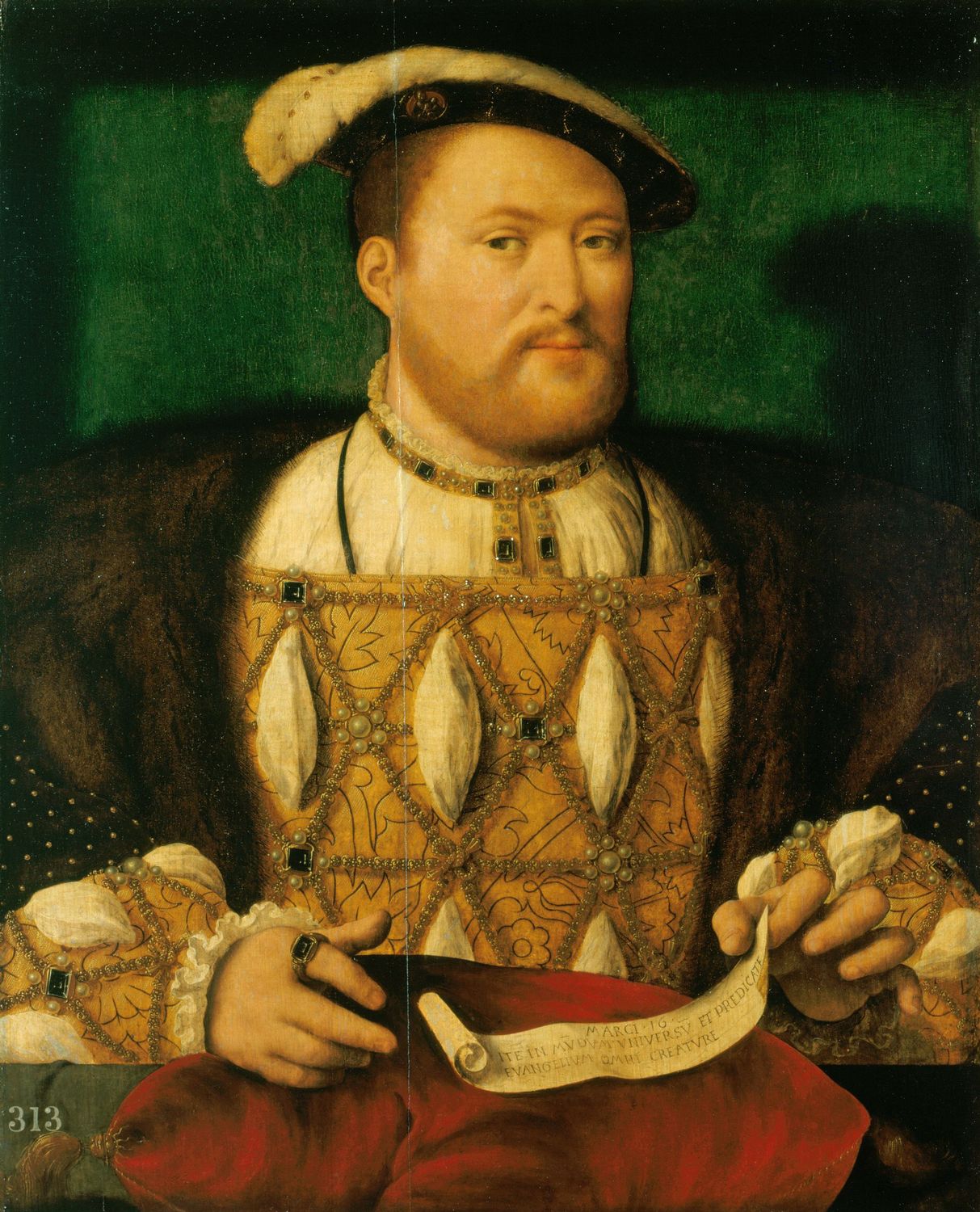
                       Henry VIII, painted here in 1431, sponsored Coverdale's two Bible translations before turning on him.


 Coverdale had managed to dash back to Cambridge in 1531 to finish his bachelor’s degree at the University and had managed to make it back to Antwerp with his head still attached to his body.  Then in 1534 Henry VIII, the former Defender of the Faith—Catholicism—broke with the Roman Church over certain domestic matters and established a new national Church with himself at its head.
Originally it was expected that the new Church would simply continue Catholic practice and usage intact.  But almost from the beginning Reformers sought to make the church over in the manner of the Lutherans and other Protestants.  When Henry decided to break up the Monasteries and appropriate their lands and wealth for the Crown, he found more reason than ever to be sympathetic of that trend.

Coverdale arrived back in England to find himself a favorite of the King in 1539.  His Bible was printed for the first time in the country in folio and quarter-folio editions, carried the Royal license and was therefore the first officially approved Bible translation in English.  

For better or worse Coverdale's fortunes were linked to his patron, Thomas Cromwell who fell from Henry VIII's favor.


He was already at that time editing on yet another new version of the Bible known as the Great Book. This version drew even more strongly on Tyndale than his first effort under the sponsorship of Thomas Cromwell, the king’s first minister. Henry was so enthusiastic in fact that he ordered every parish in England to procure a copy and keep chained but publicly available in every chapel so the any literate person would have direct access to the Scripture in the vernacular.

Despite the success of the newer version, Coverdale’s first version continued to be printed in new editions through 1553.

But favor of the mercurial monarch was a hard thing to hold.  In 1440 Coverdale’s friend and main sponsor at court, Thomas Cromwell, the king’s former first minister lost his head. Cromwell was also the leading voice for remaking the Church of England along Protestant lines.  With the balance of power swinging back to the Anglo-Catholic party, Coverdale had to return to Europe for this own safety.

He lived in impoverished exile in the German states.  From 1543 to 1547 he was a pastor and schoolmaster at Bergzabern in the Palatinate Electorate. 

Winds of change blew fortunate for Coverdale when Henry’s son Edward VI assumed the throne.  He was made personal chaplain to the boy king and then appointed Bishop of Exeter in 1653.

Coverdale prospered briefly as chaplain to the Boy King Edward VI and as Bishop of Exeter.  The young king's heir, his very Catholic sister Mary, was not ammused.

When Henry’s daughter Mary, who had remained a good Catholic, assumed the throne in 1657, Coverdale was ousted from his See and once again went into exile.  For the next several years he bounced around Europe.

It was safe to return again 1654 but unable to reclaim his Bishopric.  He served a modest parish as Rector of St. Magnus’s, near London Bridge increasingly drawn to Puritanism.  He died, however, still in the good graces of the Church of England.

The Anglican Church still has a soft spot in its heart for the old maker of Bibles.  It still uses his translation of the Psalter in the Book of Common Prayer.

Want to know what Coverdale’s work sounded like?  First here is the familiar VIII Psalm as he rendered it in The Coverdale Bible:

The Lord is my shepherde, I can wante nothinge. He fedeth me in a grene pasture, ād ledeth me to a fresh water. He quickeneth my soule, & bringeth me forth in the waye of rightuousnes for his names sake. Though I shulde walke now in the valley of the shadowe of death, yet I feare no euell, for thou art with me: thy staffe & thy shepehoke cōforte me. Thou preparest a table before me agaynst mine enemies: thou anoyntest my heade with oyle, & fyllest my cuppe full. Oh let thy louynge kyndnes & mercy folowe me all the dayes off my life, that I maye dwell in the house off the LORD for euer.
And here it is in the Book of Common Prayer Psalter:
The Lord is my shepherd therefore can I lack nothing. He shall feed me in a green pasture and lead me forth beside the waters of comfort. He shall convert my soul and bring me forth in the paths of righteousness, for his Name's sake. Yea, though I walk through the valley of the shadow of death, I will fear no evil for thou art with me; thy rod and thy staff comfort me. Thou shalt prepare a table before me against them that trouble me thou hast anointed my head with oil, and my cup shall be full. But thy loving-kindness and mercy shall follow me all the days of my life and I will dwell in the house of the Lord forever.

Not yet the majestic cadences of the King James Version but getting there.

Tuesday, October 4, 2016

The Ups and Downs of the First English Bible in Print

Miles Coverdale, maker of Bibles.


On this day in 1535 the first complete printed English translation of the Bible into was published.  Because its translator Miles Coverdale had been on the lam in Europe for some years due to religious turmoil at home, the book was printed on the continent.  For many years the exact printer and his location were in dispute, but has fairly recently been established to be Merten de Keyser in Antwerp.  The book was evidently financed by leading Low Countries Reformers.

Coverdale himself was born in Yorkshire around 1488.  He was ordained a priest in Norwich, a hotbed of religious fervor.  In 1514 he joined the scholarly convent of Austin friars at Cambridge where he was also allowed to pursue his studies at the University.  He was a supporter of Prior Robert Barnes who was sympathetic to the Reformation on the Continent.  Barnes was tried for heresy in 1526 and Coverdale was active in his defense.

He left the convent to resume preaching shortly thereafter, but was forced to flee the country in as pressure mounted against dissenters in the English Church.  Whether he had already begun his work on a Bible translation is unknown.  But once in Europe, where making the Word of God available in the languages of the people was considered essential to Reform, he was undoubtedly encouraged and financed in his efforts. 

The trouble for Coverdale was that although scholarly by bent, he was far from well equipped to undertake such a massive translation.  Although proficient in Latin, he was barely competent in Greek and knew only rudimentary Hebrew.  That meant that he had to rely on either Latin texts or other translations into modern language instead of working from near original material.  He claimed to have consulted “five soundry interpreters” in Latin, English and German as source texts.

His main sources were German texts including Luther’s Bible and the Swiss-German version Zürich Bible of Zwingli.  That meant he was working from sources several times removed from original Hebrew, Aramaic, and Greek texts.

The title page of the Coverdale Bible.

In fact Coverdale also drew heavily on both the Latin Vulgate, a more recent translation from the Greek made possible by the research of Erasmus and the early Humanists, and on the translation of the New Testament and a handful of Old Testament books into English by William Tyndale which had been printed in 1525. 

He did not claim to have used the infamous Wycliffe’s Bible, translated into Middle English way back around 1390.  That had circulated only hand to hand in manuscript and had resulted in the execution several churchmen over a number of decades who possessed or passed it along.

But Coverdale helped himself to big chunks, barely disguised from Tyndale.  Tyndale himself ran afoul of the Counter Reformation and was executed by strangulation as heretic in 1536, the year after Coverdale’s version first appeared.

Obviously things were getting dangerous in Europe for Bible translators.  On the other hand, things were becoming more congenial back home in England.

Coverdale had managed to dash back to Cambridge in 1531 to finish his bachelor’s degree at the University and had managed to make it back to Antwerp with his head still attached to his body.  Then in 1534 Henry VIII, the former Defender of the Faith—Catholicism—broke with the Roman Church over certain domestic matters and established a new national Church with himself at its head.

Henry VIII, painted here in 1431, sponsored Coverdale's two Bible translations before turning on him.
Originally it was expected that the new Church would simply continue Catholic practice and usage intact.  But almost from the beginning Reformers sought to make the church over in the manner of the Lutherans and other Protestants.  When Henry decided to break up the Monasteries and appropriate their lands and wealth for the Crown, he found more reason than ever to be sympathetic of that trend.

Coverdale arrived back in England to find himself a favorite of the King in 1539.  His Bible was printed for the first time in the country in folio and quarter-folio editions, carried the Royal license and was therefore the first officially approved Bible translation in English. 

He was already at that time editing on yet another new version of the Bible known as the Great Book. This version drew even more strongly on Tyndale than his first effort under the sponsorship of Thomas Cromwell, the king’s first minister. Henry was so enthusiastic in fact that he ordered every parish in England to procure a copy and keep chained but publicly available in every chapel so the any literate person would have direct access to the Scripture in the vernacular.

Despite the success of the newer version, Coverdale’s first version continued to be printed in new editions through 1553.

Thomas Cromwell was an ardent supporter but when he fell out of favor with the King and lost his head, Coverdale's fortunes fell.
But favor of the mercurial monarch was a hard thing to hold.  In 1440 Coverdale’s friend and main sponsor at court, Thomas Cromwell, the king’s former first minister lost his head.. Cromwell was also the leading voice for remaking the Church of England along Protestant lines.  With the balance of power swinging back to the Anglo-Catholic party, Coverdale had to return to Europe for this own safety.

He lived in impoverished exile in the German states.  From 1543 to 1547 he was a pastor and schoolmaster at Bergzabern in the Palatinate Electorate. 

Winds of change blew fortunate for Coverdale when Henry’s son Edward VI assumed the throne.  He was made personal chaplain to the boy king and then appointed Bishop of Exeter in 1653.

When Henry’s daughter Mary, who had remained a good Catholic, assumed the throne in 1657, Coverdale was ousted from his See and once again went into exile.  For the next several years he bounced around Europe.

It was safe to return again 1654 but unable to reclaim his Bishopric.  He served a modest parish as Rector of St. Magnus’s, near London Bridge increasingly drawn to Puritanism.  He died, however, still in the good graces of the Church of England.


An American 1893 edition of the Palster from the Book of Common Prayer which used the Coverdale translation.  It is still in use today.


The Church still has a soft spot in its heart for the old maker of Bibles.  It still uses his translation of the Psalter in the Book of Common Prayer.

Want to know what Coverdale’s work sounded like?  First hear is the familiar VIII Psalm as he rendered it in The Coverdale Bible:

The Lord is my shepherde, I can wante nothinge. He fedeth me in a grene pasture, ād ledeth me to a fresh water. He quickeneth my soule, & bringeth me forth in the waye of rightuousnes for his names sake. Though I shulde walke now in the valley of the shadowe of death, yet I feare no euell, for thou art with me: thy staffe & thy shepehoke cōforte me. Thou preparest a table before me agaynst mine enemies: thou anoyntest my heade with oyle, & fyllest my cuppe full. Oh let thy louynge kyndnes & mercy folowe me all the dayes off my life, that I maye dwell in the house off the LORD for euer.
And here it is in the Book of Common Prayer Psalter:
The Lord is my shepherd therefore can I lack nothing. He shall feed me in a green pasture and lead me forth beside the waters of comfort. He shall convert my soul and bring me forth in the paths of righteousness, for his Name's sake. Yea, though I walk through the valley of the shadow of death, I will fear no evil for thou art with me; thy rod and thy staff comfort me. Thou shalt prepare a table before me against them that trouble me thou hast anointed my head with oil, and my cup shall be full. But thy loving-kindness and mercy shall follow me all the days of my life and I will dwell in the house of the Lord forever.

Not yet the majestic cadences of the King James Version but getting there.