Showing posts with label Federal Marshals. Show all posts

Monday, October 21, 2013

Marching to the Beat of a Different Drummer—At the Pentagon in ‘67

Troops push protestors from the steps of the Pentagon.


There were other big marches in Washington in opposition to the Vietnam War.  Starting in 1965 they had practically become a semi-annual event.  There would be more—and larger—ones later.  But the March to Confront the War Makers on October 21, 1967 was different.  It signaled a new phase in the anti-war movement that incorporated the rising youth counter   culture on a large scale for the first time and willingness for more aggressive confrontation of authority.  It also introduced onto a national stage some figures who would become house hold names within a year.

The march was organized, as were previous ones, by the National Mobilization Committee to End the War in Vietnam—universally referred to simply as the Mobe—a shaky coalition of more than 150 organizations including traditional pacifists, Ban the Bomb groups, liberals, the Old Left, the New Left, Viet Cong sympathizers, a sliver of the Civil Rights Movement, student groups like the Students for a Democratic Society (SDS), and anti-war veterans groups.  It was united only in opposition to the war.

The organization was so shaky that after the tumultuous events of this demonstration it fell apart.  It was re-assembled, minus its less militant components as the New Mobe the following year in time to organize protests at the Democratic National Convention.

The Mobe was led by veteran radical pacifist Dave Dellinger, the fifty-something editor of the Madison, Wisconsin based Progressive magazine.  In order to reach out to more young people—earlier marches, in retrospect seem like the sedate affairs of the middle class—Dellinger recruited California activist Jerry Rubin to be project coordinator for the march.  It was Rubin’s idea to add a March on the Pentagon after the main rally on the National Mall broke up.

The rally and March were just part of a series of actions in and around Washington.  A day earlier a march of hundreds on the Justice Department organized by the American Friends Service Committee (AFSC) and other anti-draft groups presented more than 1,000 returned Draft Cards to a reluctant Assistant Attorney General.  Other small demonstrations and picketing were organized by various component groups in the Mobe around Washington.

A highlight of the Rally on the Mall was to be the arrival of the Peace Torch, lit in Hiroshima on August 6.  It was carried across country from San Francisco in a highly publicized relay reminiscent of the journeys of the Olympic Torch.

Although several Blacks were spoke from the podium of the Mall Rally—mostly long time members of Old Left parties—most African Americans boycotted the main demonstration where President Lyndon B. Johnson was sure to come under attack.  Many were grateful for his steadfast support of major Civil Rights legislation.  A separate rally was held at Howard University where opposition to the war was largely separated from opposition to the President.  The most important Black leader to come out strongly against the war, Rev. Martin Luther King, was absent from both events. 

The huge rally was typical of others of its type—a parade of speakers representing the component organizations interspersed with brief entertainment.  Dellinger hinted at a shift in anti-war strategy by saying that it was time to “to go from protest to resistance.”  Norman Mailer, then the most celebrated novelist in America, famously spoke.  His role in the Rally and later events was celebrated in his book Armies of the Night, winner of the Pulitzer Prize

The main speaker was Dr. Benjamin Spock, whose baby care book was the bible by which most of the young members of the crowd had been raised.  Spock had supported Johnson in 1964 and felt betrayed by his escalation of the war.  The kindly Spock was one of the last nods at getting the parents of Baby Boomers on board the anti-war movement.  But the days when he and organizations like Another Mother for Peace could be the face of the movement were ending.

When the main Rally broke up, a large portion of the crowd began the two and a half mile march to the Pentagon.  By some estimates as many at 50,000 began the long walk, which took them across the Memorial Bridge over the Potomac and up a long service road to the Defense Department headquarters.  Many did not finish the trip.  The line strung out so that it took well over an hour for everyone to get into the site.

When marchers got there they were confronted with a building encircled by 2,500 Federal troops and 200 U.S. Marshals.  A rope line was set up in advance of the security forces and authorities announced that anyone crossing the line would be arrested.

Marchers also encountered a smaller group already at the Pentagon.  Organized by Rubin and Abbie Hoffman, festooned in an American flag shirt and Uncle Sam hat, the newly formed Youth International Party—the Yippies, an organization that hardly existed except in flyers circulated on college campus in big city youth culture enclaves, were there to supposedly levitate the Pentagon.

Many of those first on the scene peacefully approached the defense line.  Images of young people putting flowers in the barrels of Army M-15s became iconic.  But soon more militant demonstrators were challenging the line.  Arrests began.  Small groups managed to get partially up the steps of the building.  Others found an unguarded access ramp and charged in.  They were met with rifle butts and particularly by the aggressive batons of Federal Marshals who busted several heads. Tear gas was used on the crowd and there was some chaos and panic.

But the majority of the demonstrators continued to stand by.  Many sang America the Beautiful and other patriotic and anti-war songs as the battle raged.  By 7 pm things had settled down.  Authorizes announced that the permit for the demonstration had expired.  Most of the remaining demonstrators drifted away, but about 7,000 chose to stay.  No move was made to dislodge them, but as overnight temperatures dropped, many more left.

At dawn a few hundred left to march to the White House to “wake up LBJ.”  There were more arrests there, including those charged with picking flowers in Lafayette Park.  A few hundred others stayed behind to keep a vigil at the Pentagon.  At midnight the remaining 200 were rousted or arrested.

In all 681, including Hoffman and Mailer, were arrested over the two days.  Many demonstrators were bloodied or overcome by tear gas.  Over 100 demonstrators were documented to have been treated for injuries.  Many more were undoubtedly hurt.  In addition some soldiers, marshals, and police sustained minor injuries, mostly from objects thrown at them during the confrontation at the Pentagon or scuffles during arrests.

The events in Washington that weekend set the stage for even more tumultuous and confrontational protests around the country in the next few years.

Monday, October 22, 2012

Russell Means at Wounded Knee—A Look Back

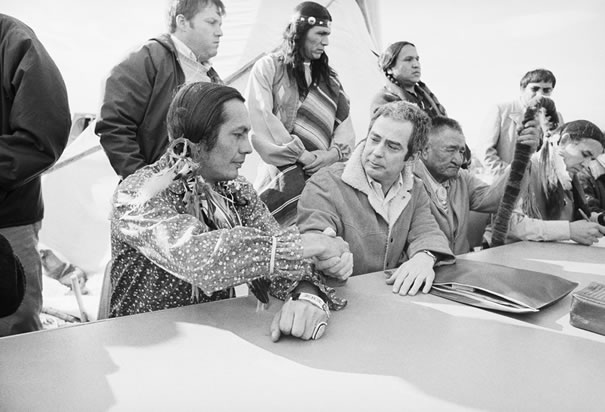
Russell Means and Assistant Attorney General Kent Frizell signed the the agreement ending the Wounded Knee siege in 1973.  That's Dennis Banks in the head band and serape standing center.


Note:  Russell Means died early this morning at his ranch in Porcupine, South Dakota after a long bout with throat cancer.  He was 72 years old. This is a look back at the Siege at Wounded Knee which brought him to national attention.  It first appeared in this blog on May 8, 2010.

On May 8, 1973 the Siege at Wounded Knee was lifted after 73 days in a negotiated truce in which members of the American Indian Movement (AIM) who had occupied the small South Dakota town and the Federal Marshalls who had besieged it lay down their arms.

The siege had two different roots.

In 1968, inspired by the militancy and self-defense philosophy of the Black Panthers and similar organizations beginning to take root in Latino communities, young urban Native American activists including Dennis Banks and Clyde Bellecourt founded AIM in Minneapolis.  It aim was to resurrect Indian (they preferred that term to Native American) culture and pride, assert tribal treaty rights, monitor police activities against Indians, and to provide direct services to native people both on and off reservations.  Their movement spread rapidly to urban centers and reservations from coast to coast as their confrontational style drew headlines and consternation from government authorities, and tribal leaders who had grown comfortable in a dependent status. 

Early protests like seizing a replica of the Mayflower on Thanksgiving 1970, occupying Mount Rushmore and the offices of the Bureau of Indian Affairs (BIA) in Washington made AIM leaders heroes to both Indian communities and the left. 

The second root was a virtual civil war that was brewing among the Ogallala Sioux on the Pine Ridge Reservation in South Dakota.  The reservation was listed as the poorest county in the United States beset by chronic unemployment, ramshackle housing, inadequate medical care with soaring infant mortality, wide spread alcohol abuse, and crime.  Traditional chiefs who struggled to maintain tribal identity, culture and language clashed with the tribal government under Richard “Dick” Wilson which was supported by the BIA.  The Tribal Council pursued a policy of economic development that included leasing tribal lands for grazing, allowing strip mining, and even considering selling the sacred Black Hills, and was bitterly opposed by the traditionalists and many young people who had returned to the reservation from the cities.

Wilson organized Guardians of Our Oglala Nation (GOON) to harass and assault his tribal opponents.  By early ’73 violent confrontations between the two sides had become routine both on the reservation and in near-by South Dakota towns.  The Traditionalists invited AIM members to assist and aid them. 

Wilson, who had narrowly survived an impeachment vote expected trouble and fortified his tribal headquarters at Pine Ridge with barbed wire, bunkers, and machine gun emplacements on the roof of the building.  He also appealed to the BIA, which requested Federal Marshals.  Fifty arrived in the area on February 25.  It was obvious that any confrontation at Pine Ridge would lead to wide spread violence. 
Instead AIM members led by Banks and Russell Means turned their attention to the tiny village of Wounded Knee just outside the boarder of the Reservation and the site of the notorious Wounded Knee Massacre of 1890. 

Accounts by AIM and the government vary widely, but AIM claims it came to an open meeting in the village and found themselves surrounded by Federal Marshals.  The government claims that they acted only after the activists had “seized” the town by force.  By February 28 both sides were entrenched, heavily armed and exchanging gun fire.  At this point AIM leaders and a handful of Ogallala supporters did declare that they were reclaiming the town as Indian land. 

Media from around the world converged on the site for the dramatic confrontation.  Means and Banks used radios to communicate while AIM leaders on the outside drummed up support.  The Marshalls, reinforced with FBI and possibly some covert military personal, cut off electricity and water to the town and set up a blockade to prevent any re-supply hoping to starve the occupiers out.  Despite increasing privation, AIM leaders repeatedly refused to surrender. 

There were attempts, some successful, to smuggle in food, medical supplies, and ammunition by back pack at night.  AIM claims that 12 volunteer smugglers were intercepted by Wilson’s police and never heard from again.  Searches for a mass grave, half heartedly pursued by Federal authorities and quickly abandoned, never turned up anything.  Other backpackers were arrested and detained by the Marshalls.  There was at least one re-supply by air drop from a private, single engine air craft. 

Shooting was a daily occurrence.  Sometimes the fire was intense.  Marshalls employed snipers with orders to kill anything that moved in the no-man’s land between the two positions.   They also took aim when targets presented themselves inside buildings.  Government forces had 130,000 rounds of ammunition, automatic rifles, grenade launchers, 15 armored personnel carriers, fixed wing air craft for observation, and helicopters which sometime carried snipers. 

For their part AIM and their allies had ample ammunition for an assortment of old military rifles, sporting rifles, shot guns, pistols, and perhaps some explosives.  They were far out gunned, but their defensive position was strong and the government did not want to chance an all out assault. 

On April 17 AIM member Frank Clearwater was shot in the head as he slept, probably by random, harassing fire regularly laid down by the government.  On April 25 Ogallala tribal member Lawrence Lamont was shot through the heart by a sniper. On April 30 U.S. Marshal Lloyd Grimm was shot and paralyzed.  

As early as March 13 Deputy U.S. Attorney General Harlington Wood, Jr. had entered the compound under a flag of truce to begin negotiations.  Banks and Means flatly refused to surrender for arrest.  Wood continued his talks for days establishing some personal trust until he had to be relieved for exhaustion.  Others took up the talks, all the while Wilson was encouraging an assault. 

On May 5 and agreement was made to disarm and three days later on the May 8 the siege was lifted and the AIM members and supporters marched out unmolested. 

But AIM leaders were not off of the hook.  Within a few days Means was arrested in San Francisco. 

And inter-tribal violence on the reservation only increased.  From March 1, 1973 to March 1, 1974 the murder rate on the Pine Ridge soared to 170 per 100,000, by far exceeding the nearest completion, Detroit, with a rate of 20.2 per 100,000.  Most cases were unsolved.  While some could be blamed on high levels of alcohol violence and general despair, Traditionalists claim that many were known opponents of Wilson’s leadership and others were AIM members from other tribes. 

On June 26 two FBI agents were shot and killed in a shoot out near Wounded Knee.  AIM member Leonard Peltier, who claimed he was only acting in self defense was indicted, tried, and sentenced to two consecutive life terms.  He remains in prison to this day despite many attempts to either win a new trial or a reprieve. 

AIM continued to conduct high profile protests, and has extended its reach to supporting the struggles of indigenous groups in Nicaragua and other Latin American Countries. 

On a personal note the Wounded Knee siege affected me.  I was sentenced to prison for draft refusal on my birthday, March 17, 1973 and surrendered for my sentence in Chicago about April 1.  I was supposed to be immediately transferred to the Federal Prison at Sandstone, Minnesota, but because all available Federal Marshalls, who were supposed to escort prisoners, were deployed to Wounded Knee, I was stuck in Cook County Jail for about a month.  Shortly after I arrived at Sandstone I watched news reports of the end of the siege with Native American prisoners.  They cheered.  So did I.