Showing posts with label Flying Boat. Show all posts

Sunday, November 24, 2024

The Maiden Flight of the China Clipper Was Romance of the Air


Note--Technical problems here at Heretic, Rebel, a Thing to Flout world headquarters delayed this post and may continue to disrupt service until your scribe and editor and get some damn thing fixed.

She was without a doubt the most famous--and romantic--single commercial aircraft ever to take wing, an icon of a shrinking world, and an honest-to-God movie star in her own right.  It all began on November 22, 1935 when the Pan-Am World Airlines China Clipper lifted out of the water of Alemeda, California with a cargo of air-mail bound for Manila in the Philippines.

Heavily laden with cargo and fuel the mighty four-engine Martin M-130 struggled to gain altitude.  A scheduled loop around San Francisco for the befit of the press and newsreel cameras had ti e scrubbed and pilot Edwin Musick realized he could to get over the San Francisco-Oakland Bridge then still under construction so he dramatically flew under the span.  It was a risky start bt the plane was on her way.

It was epic, arduous, and took seven days with lay-overs for fuel and to rest the crew at Honolulu, Midway Island, and Guam.  Setting down in Manila Bay her cargo of 110,000 pieces of mail was cause for national celebration.  The Clipper was soon in regular scheduled service and carrying passengers.

Pan-Am President Juan Trippe following flight progress on maps and a globe.

 The flight was a long time coming.  It was the vision Pan-Am founder and President Juan Trippe, a swashbuckling Wall Street investor turned aviation entrepreneur.  After earlier forays into the infant industry, Tripp founded the Aviation Corporation of America which opened Latin American air mail service with a flight from Key West to Havana in 1917 with Musick at the controls.  He saw the future of international commercial aviation was in flying boats and put Pan-Am's resources into helping develop and put them into operation.  With planes like the Sikorsky S-42 which made Trans-Atlantic service feasible.  With well-established routes to South America, Africa, and Europe Pan-Am was the unofficial U.S, flag carrier.  Trippe turned his gaze East.

But Asia was far Away and regular service would require new, larger, and more powerful aircraft.  Trippe commissioned a new plane from the Glen L. Martin Company of Baltimore, Maryland.  The builder designated the new planes as the M-30 Martin Ocean Transports--all-metal flying boats with streamlined aerodynamics and four Pratt & Whitney radial engines.  The planes could accommodate 36 day or 18 overnight sleeper passengers and carry a flight crew of 7 plus cabin attendants for passenger service.  Three of them were built for Pan-Am.

The China Clipper was the first one built and was test flown on December 30, 1934.  It was delivered to the airline fleet on October 9, 1935.  Her sister ships were the Philippine Clipper and the Hawaii Clipper.

Meanwhile Tripe sent Musick, now Pan-Am's senior captain on two flights in a Sikorsky @-42 to scout routes to the Philippines and from Manila to China.  Musick was then one of the most famous aviators in the world holding more the 10 world records for long-distance and flying boats.  He was also by far the most experienced pilot in world having racked up nearly two million trans-oceanic air miles.

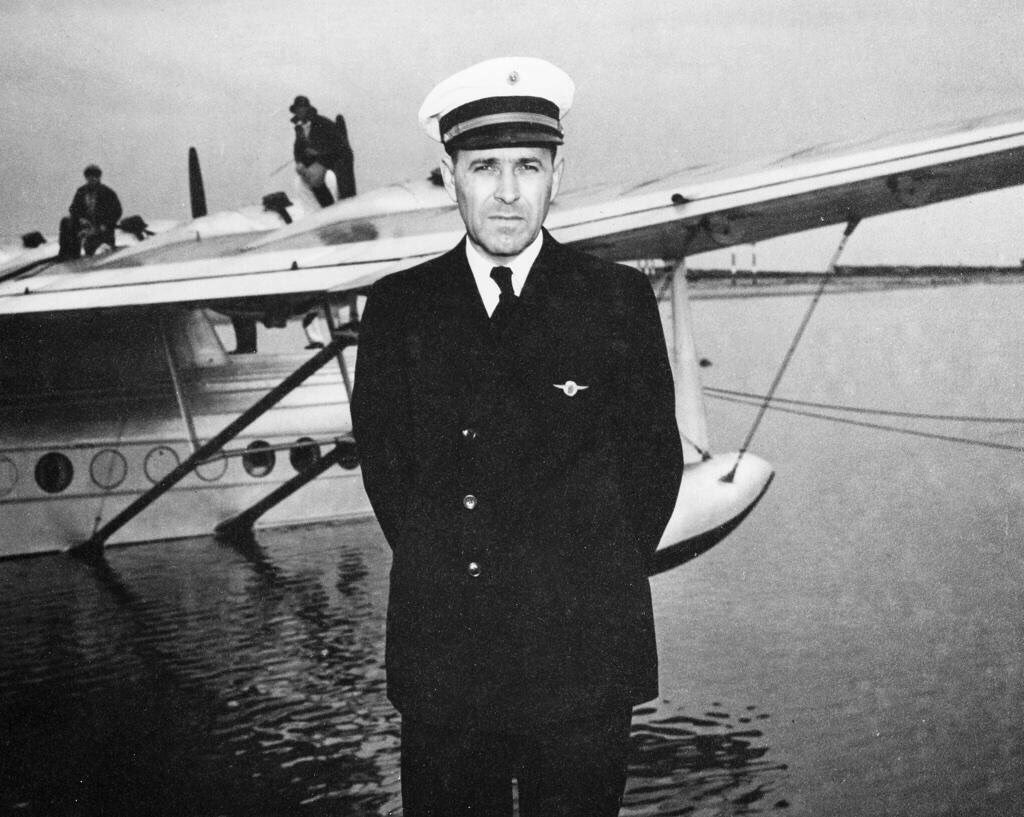
Captain Edwin Musick was the most experienced global pilot and had personally scouted and laid out the routes of the China Clipper.

With the route laid out, Musick was the easy choice for senior captain on the inaugural flight.  The rest of the crew were also respected veterans and included First Officer R.O.D Sullivan and navigator Fred Noonan, later famed for doing the same duty on Amelia Earhart's doomed round the world flight.

Weekly passenger flights across the Pacific began in October 1936 with the Hawaii Clipper.  Connecting service from Manila to Hong Kong began in 1937 using S-42 with the Clipper class Martins taking over that leg a year later.  All three Martins flew these routes but in the public's eye they were all China Clippers.


A lobby card for Warner Bros. 1936 China Clipper starring Pat O'Brien, Hmphry Bogart, Henry B. Walthall, Ross Alexander, and, of course, the China Clipper herself.

Public fascination with the Clipper was so high that Warner Bros/First National Pictures rushed into production a film aptly named China Clipper staring Pat O'Brien as a thinly disguised Trippe who was single-minded and ruthless in his aim to establish trans-Pacific service no matter the cost.  The turgid melodrama was noted as an early non-gangster role for Humphey Bogart as a safety conscious pilot at odds with his boss but saved the day by flying the plane safely through a storm and into a mail contract.  The movie used newsreel and stock footage of the real Clipper including a clip of Edwin Musick flying under the bridge.

The China Clipper was featured in other films including the 1937 comedy Fly-Away Baby and the 1939 adventure Secret Service of the Air and was referenced in others.  Much later Alec Baldwin portrayed Trippe in the bio-flick of his rival Howard Hughes in The Aviator.  She also figured in radio serial and popular pulp fiction.

The China Clipper and her sister aircraft and two crew of that inaugural flight all met disastrous ends, a reminder of how dangerous long distance air travel still was in even the most advanced planes.

On January 28, 1938 Musick and his crew of six died in the crash of the S-42 Samoan Clipper near Pago Pago, American Samoa, on a cargo and survey flight to Auckland, New Zealand.  A few month later in July the Hawaii Clipper disappeared between Guam and Manila with the loss of nine crew and six passengers and Amelia Erhart's twin engine plane vanished somewhere over the Pacific with navigator Fred Noonan on board.

The Philippine Clipper survived a Japanese air raid on Wake Island, an event depicted in the 1942 moral boosting film Wake Island.  Pressed into war-time service with the Navy along with the China Clipper, she was lost in January 1943 between Ukiah and Boonville, California on a flight from Honolulu killing Pacific submarine force commander Admiral Robert H. English and 18 others.

 That left the original China Clipper as the sole survivor of the fleet.  Released from Navy service she was assigned to the inaugural flight of Pan-Am service between Miami and Leopoldville in the Belgian Congo via Rio de Janero.  The plan was attempting to touch down at Port of Spain, Trinidad with an inexperienced pilot at the controls under the supervision of a veteran captain.  After aborting one approach the pilot misjudged his altitude and came in nose down hundreds of yard short of his designated landing zone.  The plane's hull smashed on impact, took water, and quickly sank.  All 28 on board were killed.

I'm surprised the History Channel has not had a breathless Curse of the China Clipper feature, or maybe it has.  But no mystery curse or cover-up conspiracy is needed--aviation was still that dangerous over vast distances and violent storms.

Trippe would go on to lead Pan-Am for decades introducing more innovations like  the Boing 747, the workhorse of international aviation.  He died in 1981 at the age of 81.  Mercifully, he did not live to see the ignominious failure of what had been the world's premier airline a decade later.


Sunday, November 22, 2020

The Maiden Flight of the China Clipper and the Romance of the Air


She was without doubt the most famous—and romantic—single commercial aircraft ever to take wing, an icon of a shrinking world, and an honest-to-god movie star in her own right.  It all began on November 22, 1935 when the Pan American World Airways China Clipper lifted out of the water off of Alameda, California with a cargo of airmail bound for Manila in the Philippines. 

Heavily laden with cargo and fuel the mighty four-engine Martin M-130 struggled to gain altitude.  A scheduled loop around San Francisco for the benefit of an eager press and newsreel cameras had to be scrubbed and pilot Edwin Musick realized he could not get over San Francisco-Oakland Bridge, then still under construction, so he dramatically flew under the span.  It was a rocky start, but the plane was on her way.

It was epic, arduous and took seven days with lay-overs for fuel and to rest the crew at Honolulu, Midway Island, Wake Island, and Guam.  Setting down in Manila Bay with her cargo of 110,000 pieces of mail was cause for national celebration.  The Clipper was soon in regular scheduled service and also carrying passengers.

Pan Am President Juan Trippe charts out trans-oceanic routes for his flying boats.


The flight was a long time coming.  It was the vision of Pan Am founder and President Juan Trippe, a swashbuckling Wall Street investor turned aviation entrepreneur.  After earlier forays into the infant industry, Trippe founded the Aviation Corporation of the Americas which opened Latin American air mail service with a flight from Key West to Havana in 1927 with Musick at the controls.  He saw the future of international commercial aviation was in flying boats and put Pan Am’s resources into helping develop and put them in operation.  With planes like the Sikorsky S-42 which made trans-Atlantic service feasible.  With well-established routes to South America, Africa, and Europe, which made Pan Am the unofficial United States flag carrier, Trippe turned his gaze east. 

But Asia was far away and regular service would require a new, larger, and more powerful aircraft.  Trippe commissioned a new plane from the Glenn L. Martin Company of Baltimore, Maryland.   The builder designated the new planes as the M-30 Martin Ocean Transports, all-metal flying boats with streamlined aerodynamics and four powerful Pratt & Whitney radial engines.  The planes could accommodate 36 day or 18 overnight sleeper passengers and carried a flight crew of 7 plus cabin attendants for passenger service.  Three were built for Pan Am.

The China Clipper was first built and was test flown on December 30, 1934.  It was delivered to the Pan Am fleet on October 9, 1944.  Her sister ships were the Philippine Clipper and the Hawaii Clipper.

Meanwhile Trippe sent Musick, now Pan Am’s chief pilot on two flights in a Sikorsky S-42 to scout routes to the Philippines and from Manila to China.  Musick was then one of the most famous aviators in the world holding more than 10 records for long distance and flying boats.  He was also, by far, the most experienced pilot in the world having racked up nearly 2 million trans-oceanic air miles. 

Pan Am Chief Pilot Captain Edwin Musick, the most experienced aviator in the world, mapped out the Trans-Pacific route and flew the inaugural service of the China Clipper.

With the route laid out, Musick was the easy choice for senior captain on the inaugural flight of the China Clipper.  The rest of the crew were also respected veterans and included First Officer R.O.D. Sullivan and navigator Fred Noonan, later famed for doing the same duty on Amelia Earhart’s doomed round the world flight.

Weekly passenger flights across the Pacific began in October 1936 with Hawaii Clipper.  Connecting service from Manila to Hong Kong began in 1937 using S-42’s with the Clipper class Martins taking over that leg of the route a year later.  All three of the Martins flew these routes, but in the public’s eye they were all the China Clipper.  


A lobby card for Warner Bros. 1936 China Clipper starring Pat O'Brien, Humphrey Bogart, Henry B. Walthall, Ross Alexander and, of course, The China Clipper herself.

Public fascination with the Clipper was so high that Warner Bros./First National Pictures rushed into production with a film China Clipper starring Pat O’Brian as a thinly disguised Trippe single minded and ruthless in his aim to establish trans-Pacific service no matter the cost.  The turgid melodrama is noted for an early non-gangster role for Humphrey Bogart as a safety conscious pilot at odds with O’Brian who eventually saves the day by flying the plane safely through a storm and into a mail contract.  The film used much newsreel and stock footage of the real China Clipper, including dramatic footage of passing under the Bay Bridge.

The China Clipper was featured in other films including 1937 comedy Fly-Away Baby and the 1939 adventure film Secret Service of the Air and referenced in several others.  Later Alec Baldwin would play Juan Trippe in the bio-flick of his rival Howard Hughes in The Aviator starring Leonardo DiCaprio. It also figured in radio serials and popular pulp fiction.

The China Clipper and her sister ships as well as the famous pilot of that first flight all met disastrous ends, a reminder of how dangerous long distance air travel still was even in the most advanced aircraft.

On January 28, 1938 Musick and his crew of six died in the crash of the S-42 Samoan Clipper near Pago Pago, American Samoa, on a cargo and survey flight to Auckland, New Zealand.  A few months later in July the Hawaii Clipper disappeared between Guam and Manila with the loss of nine crew and six passengers.

The Philippine Clipper survived a Japanese air raid on Wake Island, an event depicted in the 1942 film Wake Island.  Pressed into wartime service for the Navy along with the China Clipper, she was lost in January 1943 between Ukiah and Boonville, California on a flight from Honolulu killing Pacific submarine force commander Admiral Robert H. English and 18 others. 

Pan Am promoted the return of its most famous and glamorous plane to post-war civilian service by putting her on a heavily promoted new route from Miami to Leopoldville in the Belgian Congo via South America.  With an inexperienced flying boat pilot at the controls, she crashed attempting to set down in Trinidad on the inaugural flight killing all on board.

That left the original China Clipper the sole survivor of the fleet.  Released from Navy service she was assigned to the inaugural flight of Pan Am service between Miami and Leopoldville in the Belgian Congo via Rio de Janeiro.  The plane was attempting to touch down at Port of Spain, Trinidad with an inexperienced pilot at the controls but under the supervision of a veteran pilot.  After aborting one approach the pilot misjudged his altitude and came in nose down hundreds of yards short of his designated landing zone.  The plane hull smashed on impact, took water, and quickly sank.  All 28 on board were killed.

Trippe would go on to lead Pan Am for decades introducing new innovations like the Boing 747, workhorse of international aviation.  He died in 1981 at the age of 81.  Mercifully he did not live to see the ignominious failure of what had been one of the world’s premier airlines a decade later.

Wednesday, December 28, 2016

U.S. Claims First Overseas Possession—Midway

A satalite view of Midway Atoll, its two largest islands and lagoon.


Technically the one of nothwestern outliers of the Hawaiian archipelago, Midway Atoll lies in mid-Pacific isolation roughly half way between North America and Asia.  It may have been encountered by far-ranging Polynesian mariners, but it apparently had never been inhabited when Captain N.C. Middlebrooks a/k/a Captain Brooks of the American sealer Gambia spotted it on July 5, 1859.  He modestly named the small islands of the atoll after himself and dubiously claimed them under the Guano Islands Act of 1856, which authorized Americans to occupy uninhabited islands temporarily to obtain guano they highly prized bird poop used for fertilizer.  Despite the pretext neither the Captain nor no one after actually went into the guano mining business.
Perhaps it was because the U.S. was soon busy with its fratricidal Civil War, but the lonely atoll was promptly mostly forgotten.  Then in the years after the war some seamen began to think that it might be a useful spot for long-at-sea whalers or perhaps a fueling and water station for the burgeoning trade with China, Japan, and the Orient.  On August 28, 1867, Captain William Reynolds of the USS Lackawanna formally took possession of the atoll for the United States.  Shortly after that it’s was name changed to Midway on official charts. It was the first Pacific island and overseas possession annexed by the U.S. and was designated as the Unincorporated Territory of Midway Island administered by the Navy.

Captain William Reynolds of the USS Lackawanna formally claimed Midway in 1867
It was not an auspicious start for a far-flung empire.  It was so inconsequential that the British did not try to register any claim to the island as they usually did to any speck in the Pacific. The problem was that the lagoon of the atoll, which might make an attractive harbor was inaccessible to seagoing ships because of it impenetrable reef. 
Hoping to use the atoll as a coaling station, in 1871 the Pacific Mail Steamship Company somehow—one suspects encouraging emoluments may have changed hands—wrung money from Congress to attempt to blast and dredge a passage through the reef.  A construction crew was landed, evidently the first ever inhabitants.  The expensive project was a failure and after a few months the Navy had to dispatch a ship to rescue the abandoned and nearly starving workers.  The USS Saginaw ran aground on Kure Atoll, 40 miles further east of Midway stranding both its crew and the workers.  Eventually all were rescued except for four of the five intrepid souls who sailed to Kauai in an open boat for help.
The atoll languished once again unused for 32 more years until the Commercial Pacific Cable Company established a supply station for the ships laying that communications link in 1903.  Personnel at the station complained to the Navy that Japanese fishermen were visiting the islands and “poaching” from the vast seabird rookeries.  Surely they were not worried about the loss of the birds.  But they were probably suspicious the Japanese were spying on the cable project.  So evidently was the Navy which responded by establishing a radio station for quick communication.  From 1904 and 1908, President Theodore Roosevelt stationed a platoon of 21 Marines assert U.S. sovereignty discourage further unauthorized visits from the Japanese.  That was the beginning of the Navy’s   on the islands.

The Midway Cable Station compound in 1913.
Even the handful of civilians and Naval personnel had a devastating effect on the atoll’s fragile ecosystem by introducing many non-native species including canaries, plants like cycad, Norfolk Island pine, she-oak, coconut, and various deciduous trees, plus ants, cockroaches, termites, centipedes, and other creepy-crawlers.
Through the 1930’s as Japan’s aggressive expansionism became more threatening Naval facilities on the atoll slowly grew and it became considered a strategic asset for the Pacific Fleet.  But it got a major boost in public consciousness in 1935 when Pan American Airlines made it a stop for their island hopping Martin M-130 flying boats flying from San Francisco to China.  Pan Am built a luxury hotel nicknamed the Gooneyville Lodge in honor of the islands’ famous albatrosses for the wealthy tourist laying over between the stops in Honolulu and Wake Island.

The Philippine Clipper, a Pan Am Martin M-130 flying boat, tied up in Midway lagoon.
When tensions with Japan raised even more sharply the Navy began major improvements to their Midway facilities in 1940 and ’41 with airstrips, gun emplacements, and a seaplane base quickly added.  In February of ’41 President Franklin Roosevelt established the Midway Island Naval Defensive Sea Area and the Midway Island Naval Airspace Reservation to strictly control access to the atoll by land and sea.  Other than the Pan Am flights, all non-Naval flights to the islands had to be personally cleared by the Secretary of the Navy.
On December 7, 1949 the island defenses successfully repelled an attack by Japanese destroyers which was touted as the first American victory of the war.  Unlike Wake Island which fell after withstanding air raids, naval bombardments, and one landing attempt before falling on December 23, Midway remained in U.S. hands, a virtual stationary aircraft carrier deep in hostile waters.   In February another submarine based attack was repulsed. 
Of course Midway is most famous not so much for what happened on the islands of the atoll—although they did come under air attack—but for the epic battle in the vast ocean around it that broke out on June 4, 1942. 
The Japanese with a massive force of 4 aircraft carriers, 2 Battleships, 2 heavy cruisers, 1 light cruiser, 12 destroyers, and 248 carrier-based aircraft hoped to lure the battered American carriers into a trap, destroy the last fighting capacity of the U.S. Navy, and capture Midway in preparation for an assault on Hawaii. Instead Naval Intelligence had cracked the Japanese code and was fully aware of the operation.  Admiral Chester Nimitz, Commander in Chief of the United States Pacific Fleet (CinCPac) planned an ambush of the Japanese with an inferior force.  He had at his disposal three of the Navy’s surviving carriers—a taskforce including the Enterprise and Hornet under the temporary command of Admiral Raymond Spruance and another led by the damaged Yorktown speeding from Pearl Harbor with a slapped together air crew and still under repair as she sailed under Admiral Frank Jack Fletcher, who had overall command of both taskforces. 
On Midway itself there were four squadrons of PBYs—for long-range reconnaissance duties, and 6 brand-new TBF-1 Avengers; the Marine Corps 19 SBD Dauntlesses, 7 F4F-3 Wildcats, 17 SB2U-3 Vindicators dive bombers, and 21 F2A-3s, the latter two types of aircraft already obsolete; and the Army Airforce a squadron of 17 B-17 Flying Fortresses and 8 B-26 Marauders equipped with torpedoes for a total of 126 aircraft.

An official U.S. Navy diorama of the Japanes air raid on Midway on June 4, 1942 which set off the great naval Battle of Midway.
When the Japanese carrier force attacked Midway, the U.S. Navy sprang its trap.  In three days of fighting the Imperial Navy lost all four of the they had engaged—Akagi, Kaga, Soryu, and Hiryu and a heavy cruiser.  On the American side the Yorktown was heavily damaged and at the end torpedoed and sunk by an enemy submarine along with a single destroyer.
The Americans lost just those two ships, about 150 aircraft and 307 killed.  The Japanese lost the four carriers and the heavy cruiser plus a second cruiser heavily damaged, 340 aircraft, and 3.057 killed.  The lop-sided victory ended Japanese naval superiority in the Pacific and cost ships, planes, men—particularly pilots and aircraft technicians—which could not be easily replaced while American industry and a vast reservoir of men quickly greatly expanded their capacity.
Most historians consider the Battle of Midway to be the turning point of the war in the Pacific.
After the battle the Navy beefed up its Midway Naval Air Station and built a foreword base for submarine operations.  Army Airforce heavy bombers pounded Japanese controlled Wake Island and supported General Douglas MacArthur’s island hopping campaign.
The Naval Air Station, decommissioned at war’s end, was recommissioned in support of the Korean War and continued in operations through the Vietnam War.  The Navy also had a top secret underwater listening post to monitor Soviet submarine activity and WV-2 Willy Victor radar aircraft flew night and day as an extension of the Distant Early Warning Line.
At the peak of the Cold War more than 3,000 Naval personnel and civilian employees were station on the atoll, most at facilities on Sand Island.   But the end of the Vietnam War and the development of satellite technologies to replace its intelligence gathering  capabilities caused the Department of Defense to start winding down activity.  In 1978, the Navy downgraded Midway from a Naval Air Station to a Naval Air Facility and large numbers of personnel and dependents began leaving the island.  In 1993 as part of the Base Realignment and Closure program the Navy closed all of its facilities although some personnel continued to perform environmental clean-up, mostly from oil spills and expended or un-exploded ordinance as result of World War II action.
Previously World War II facilities on Sand and Eastern Islands were designated National Register of Historic Places and National Historic Landmarks in 1987 and the whole atoll was made a National Wildlife Refuge for the tens of thousands of sea birds in it rookery.  The Navy maintained control until President Bill Clinton transferred jurisdiction to the Department of the Interior’s Fish and Wildlife service.

Today on Midway the seabird rookery coexists with relics of the World War II Battle at the Midway National Wildlife Refuge.
There has been no regular passenger service to Midway since the Navy closed its bases and no hotel facilities for tourists.  Periodically the atoll has been opened to specially organized ecotourism and occasional tours for veterans and military history buffs.  The last program was suspended during the government shut down face off in 2012 and never officially resumed, although special chartered flights can be arranged.  Last year less than 350 people made the expensive visit.
There are no longer any permanent residents on Midway, although at any given time there may be up to 40 FWS service personnel on temporary assignment there.
America’s first overseas possession is now a part of the Papahānaumokuākea Marine National Monument.  It is an unorganized, unincorporated U.S. territory and for statistical purposes it is listed as part of the U. S. Minor Outlying Islands.
The lonely atoll seems to be slipping back into the sleepy obscurity in which it was found all of those years ago.

Tuesday, November 22, 2016

Romance of the Air—The Maiden Flight of the China Clipper


She was without doubt the most famous—and romantic—single commercial aircraft ever to take wing, an icon of a shrinking world, and an honest-to-god movie star in her own right.  It all began on November 22, 1935 when the Pan American World Airways China Clipper lifted out of the water off of Alameda, California with a cargo of airmail bound for Manila in the Philippines.  Heavily laden with cargo and fuel the mighty four-engine Martin M-130 struggled to gain altitude.  A scheduled loop around San Francisco for the benefit of an eager press and newsreel cameras had to be scrubbed and pilot Edwin Musick realized he could not get over San Francisco-Oakland Bridge, then still under construction, so he dramatically flew under the span.  It was a rocky start, but the plane was on her way.
It was epic, arduous and took seven days with lay-overs for fuel and to rest the crew at Honolulu, Midway Island, Wake Island, and Guam.  Setting down in Manila Bay with her cargo of 110,000 pieces of mail was cause for national celebration.  The Clipper was soon in regular scheduled service and also carrying passengers.

Pan Am President Juan Trippe charts out trans-oceanic routes for his flying boats.

The flight was a long time coming.  It was the vision of Pan Am founder and President Juan Trippe, a swashbuckling Wall Street investor turned aviation entrepreneur.  After earlier forays into the infant industry, Trippe founded the Aviation Corporation of the Americas which opened Latin American air mail service with a flight from Key West to Havana in 1927 with Musick at the controls.  He saw the future of international commercial aviation was in flying boats and put Pan Am’s resources into helping develop and put them in operations.  With planes like the Sikorsky S-42 which made trans-Atlantic service feasible.  With well-established routes to South America, Africa, and Europe, which made Pan Am the unofficial United States flag carrier, Trippe turned his gaze East. 
But Asia was far away and regular service would require a new, larger, and more powerful aircraft.  Trippe commissioned a new plane from the Glenn L. Martin Company of Baltimore, Maryland.   The builder designated the new planes as the M-30 Martin Ocean Transports, all-metal flying boats with streamlined aerodynamics and four powerful Pratt & Whitney radial engines.  The planes could accommodate 36 day or 18 overnight sleeper passengers and carried a flight crew of 7 plus cabin attendants for passenger service.  Three were built for Pan Am.
The China Clipper was first built and was test flown on December 30, 1934.  It was delivered to the Pan Am fleet on October 9, 1944.  Her sister ships were the Philippine Clipper and the Hawaii Clipper.
Meanwhile Trippe sent Musick, now Pan Am’s chief pilot on two flights in a Sikorsky S-42 to scout routes to the Philippines and from Manila to China.  Musick was then one of the most famous aviators in the world holding more than 10 records for long distance and flying boats.  He was also, by far, the most experienced pilot in the world having racked up nearly 2 million trans-oceanic air miles.  

Pan Am Chief Pilot Captain Edwin Musick, the most experienced aviator in the world, mapped out the Trans-Pacific route and flew the inaugural service of the China Clipper.
With the route laid out, Musick was the easy choice for senior captain on the inaugural flight of the China Clipper.  The rest of the crew were also respected veterans and included First Officer R.O.D. Sullivan and navigator Fred Noonan, later famed for doing the same duty on Amelia Earhart’s doomed round the world flight.
Weekly passenger flights across the Pacific began in October 1936 with Hawaii Clipper.  Connecting service from Manila to Hong Kong began in 1937 using S-42’s with the Clipper class Martins taking over that leg of the route a year later.  All three of the Martins flew these routes, but in the public’s eye they were all the China Clipper.  
A lobby card for Warner Bros. 1936 China Clipper starring Pat O'Brien, Humphrey Bogart, Henry B. Walthall, Ross Alexander and, of course, The China Clipper herself.


Public fascination with the Clipper was so high that Warner Bros./First National Pictures rushed into production with a film China Clipper starring Pat O’Brian as a thinly disguised Trippe single minded and ruthless in his aim to establish trans-Pacific service no matter the cost.  The turgid melodrama is noted for an early non-gangster role for Humphrey Bogart as a safety conscious pilot at odds with O’Brian who eventually saves the day by flying the plane safely through a storm and into a mail contract.  The film used much newsreel and stock footage of the real China Clipper, including dramatic footage of passing under the Bay bridge.
The China Clipper was featured in other films including 1937 comedy film Fly-Away Baby and the 1939 adventure film Secret Service of the Air and referenced in several others.  Later Alec Baldwin would play Juan Trippe in the bio-flick of his rival Howard Hughes in The Aviator starring Leonardo DiCaprio. It also figured in radio serials and popular pulp fiction.
The China Clipper and her sister ships as well as the famous pilot of that first flight all met disastrous ends, a reminder of how dangerous long distance air travel still was even in the most advanced aircraft.
On January 28, 1938 Musick and his crew of six died in the crash of the S-42 Samoan Clipper near Pago Pago, American Samoa, on a cargo and survey flight to Auckland, New Zealand.  A few months later in July the Hawaii Clipper disappeared between Guam and Manila with the loss of nine crew and six passengers.
The Philippine Clipper survived a Japanese air raid on Wake Island, an event depicted in the 1942 film Wake Island.  Pressed into wartime service for the Navy along with the China Clipper, she was lost in January 1943 between Ukiah and Boonville, California on a flight from Honolulu killing Pacific submarine force commander Admiral Robert H. English and 18 others. 

Pan Am promoted the return of its most famous and glamorous plane to post-war civilian service by putting her on a heavily promoted new route from Miami to Leopoldville in the Belgian Congo via South America.  With an inexperienced flying boat pilot at the controls, she crashed attempting to set down in Trinidad on the inaugural flight killing all on board.


That left the original China Clipper the sole survivor of the fleet.  Released from Navy service she was assigned to the inaugural flight of Pan Am service between Miami and Leopoldville in the Belgian Congo via Rio de Janeiro.  The plane was attempting to touch down at Port of Spain, Trinidad with an inexperienced pilot at the controls but under the supervision of a veteran pilot.  After aborting one approach the pilot misjudged his altitude and came in nose down hundreds of yards short of his designated landing zone.  The plane hull smashed on impact, took water and, quickly sank.  All 28 on board were killed.
Trippe would go on to lead Pan Am for decades introducing new innovations like the Boing 747, workhorse of international aviation.  He died in 1981 at the age of 81.  Mercifully he did not live to see the ignominious failure of what had been one of the world’s premier airlines a decade later.