Showing posts with label Fredrick Douglas. Show all posts

Monday, September 23, 2019

Victoria Claflin Woodhull—Con Artist, Feminist, Broker, Presidential Candidate Too Hot to Handle

Victoria Claflin Woodhull at the height of her fame.
Note—In the 147 years since Victoria Claflin Woodhull became the first woman nominated for president only one woman—Hillary Clinton—earned the nomination of a major political party and despite her fame, long political resume, and declared status as a prohibitive favorite but lost—albeit by Electoral College smoke and mirrors—to a grafter and transparent idiot.  This year there is raising expectations that the Democrats might give the nod to another woman, most likely Elizabeth Warren.  But some semi-respectable pundits still cluck their tongues and warn that it is still not time for a woman President.  Looking back the platform that Woodhull ran on seems strikingly modern and even a preview of current intersessional theory.  
Victoria Claflin Woodhull was nominated for President of the United States on April 10, 1872 almost 50 years before the passage of the 19th Amendment gave women the right to vote in all of the United States.  Woodhull stood apart from other leaders of the Suffrage movement by her audacity, frank embrace of the most radical social causes, her shocking open challenge to Victorian sexual mores, and her mesmerizing effect on the public and press
As early as 1870 Woodhull used the pages of Horace Greeley’s New York Herald to announce her candidacy for President in the 1872 election.  It was a bold move.  Not only were women barred from the vote, but she would not even reach the constitutionally mandated age of 35 until months after the March 1873 inauguration of the next President.  She maintained that while the law forbad women from voting, there was not a statutory ban on women running for, or being elected to office.  In the hubbub created by her announcement over the unprecedented distaff candidacy, her age never became an issue.
She used the pages of her own newspaper, Woodhull and Claflin’s Weekly which was founded the same year, and the lecture platform to keep her name and promised candidacy before the public.  Able to command press attention, which then as now liked a sexy and sensational show, she attracted the support of not only the most daring womanists and suffrage supporters, but of radical trade unionists, early socialists, prison and death sentence reformers, some former abolitionists, and free thinkers.  She took on a broad range of social issues and took a consistently radical and progressive stance.
On May 10, 1872 a meeting was held at Apollo Hall in New York City where the new Equal Rights Party was formed and announced its intentions to nominate Woodhull.  The meeting consisted almost entirely of Woodhull’s friends and inner circle of supporters.   A formal convention was called and held on June 8 with broader participation.  A platform was announced drafted by Woodhull, and her personal friend, the great Black abolitionist Fredrick Douglass was nominated for vice president.  Douglas, however, was not present at the Convention and never acknowledged or accepted the nomination although he never officially renounced it.  In fact that fall he would be elected as a Republican New York Presidential Elector

Woodhall printed a campaign poster on her own press.
The issue of Woodhull and Claflin’s Weekly dated the same day as the Convention announced the ticket and platform:
The Equal Rights Party has selected Victoria C. Woodhull for the office of President, because it deems that the demand for the personal, social, legal, and political liberties of woman have been better advocated by her actions and in her speeches and writings than by any other woman. Religious liberty is not mentioned above, because it is held that, in the case of woman, it has not been specially infringed.  It is claimed as a right pertaining to all the people; one which the Equal Rights Party hold itself pledged to maintain against any national or State interference with (or infringement of) in any way whatever.
The Equal Rights Party has selected Frederick Douglass for the office of Vice President, because though born a slave, he has himself achieved both his education and his liberty; because he has waged a life-long, manful battle for the rights of his race, in which those of mankind were included; because he has proved that he knows how to assert the liberties of the people, and consequently it is assumed that he knows how to maintain them.
This announcement and its tone of radical defiance were picked up by the press across the country.  And all hell soon broke loose.  The candidate was in for a very bumpy ride
Woodhull was born in Homer, Ohio on September 23 1838, the daughter of a ne’er-do-well con artist and patent medicine peddler who may have passed on some of his persuasive flair to his beautiful older daughter. 
At the age of 15 she married a 28 year old doctor—and perhaps a quackCanning Woodhull.  The couple had two children including a boy with an “intellectual disability.” Victoria soon discovered that her husband was an alcoholic, a chronic womanizer, and was abusive.  Unable, or unwilling, to support the family, he relied on his wife to provide income.    In San Francisco she worked as a cigar girl in rough and tumble saloons, and likely at least occasionally as a prostitute
Later in New York she began her long collaboration with her younger sister Tennessee Claflin presenting themselves as clairvoyants and spiritual healers.  When her husband essentially abandoned the family, the sisters successfully took their act to Cincinnati and Chicago and began touring as spiritualist lecturers.  After 11 years Victoria obtained a divorce from her husband.

Husband Number 2, Col. James Blood.
Her experience would inform her public rejection of conventional marriage as a form of chattel slavery for women.  She became attracted to the Free Love movement that percolated on the very most advanced frontiers of Free Thinking.  Around 1866 she either married or took up a common law relationship with Col. James Blood, a kind and cultured gentleman who subscribed to Free Love. 
They settled back in New York with sister Tennessee and her extended family.  Living in relative comfort and respectability, the sisters established a popular salon where advanced thinkers and practical politicians rubbed shoulders.  Among her admirers was Benjamin Butler, the Radical Republican politician and former Civil War general who espoused both suffrage for women and free love. 
Virginia proved a brilliant and daring conversationalist and advocated by turns and in combinations anarchism, socialism, Spiritualism, and racial equality

Victoria's younger sister and partner, Tennessee Claflin.
Sister Tennessee caught the fancy of 76 year old Commodore Cornelius Vanderbilt, who took her for a lover, consulted with her for spiritual advice and returned the favor by offering inside stock tips.  Armed with such information, the sisters invested and reaped fabulous profits.  Vanderbilt helped set them up in the first woman owned brokerage firm on Wall Street, Woodhull, Claflin & Company.  The press hailed them as Queens of Finance. Susan B. Anthony regarded the venture as “a new phase of the woman’s rights question.”  Victoria, with typical blunt frankness noted that, “Woman’s ability to earn money is better protection against the tyranny and brutality of men than her ability to vote.”


A popular men's sporting and gossip newspaper--a competitor of the Police Gazzette--found the Woodhull and Claflin Brokerage house a topic of amusement.

In 1870 the sisters took advantage of their fame by launching their own weekly newspaper, Woodhull and Claflin’s Weekly.  Victoria was the principle editor and writer.  The paper took on and advanced all of the most progressive causes of its day.  But it also pioneered in muckraking and investigative journalism, exposing fraudulent stock schemes, insurance frauds, and shady Congressional land deals.  The newspaper, which was often sold under the counter and was sometimes banned from the mails, had a very respectable circulation of more than 20,000 copies weekly for most of its seven year run.  
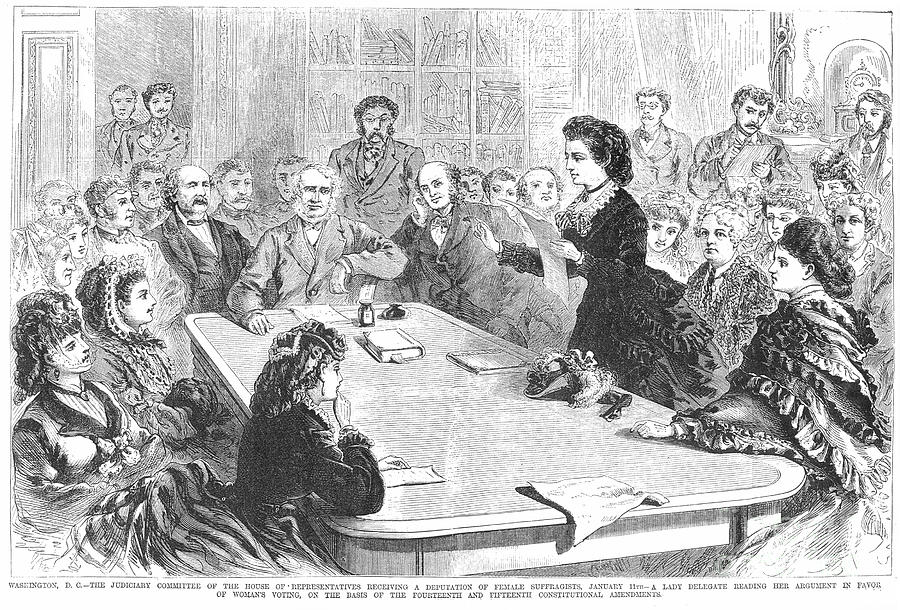
In January 1871 Woodhull personally petitioned Congress on behalf of women’s suffrage.  She argued that the recently enacted 13th and 14th Amendments extended to women the same rights as newly freed slaves. Her argument attracted wide attention and admiration.  Although a majority report rejected her assertions, Benjamin Butler filed a minority report in her favor.  Leaders of the Suffrage movement including Anthony, Lucretia Mott, and Elizabeth Cady Stanton invited her to address a meeting of the National Women Suffrage Association (NWSA) the next day. 

Woodhull presented a women's suffrage petition to the House Judiciary Committee.  Benjamin Butler with the balding head and mustache is seen at the top of the table and Elizabeth Cady Stanton is seated directly behind Woodhull.
But the spotlight of the Presidential campaign was thrown soon thrown on Woodhull’s most unusual household, which included not only her present husband, but also her first who had shown up penniless and addicted to morphine and was taken in out of charity; her sisters and their liaisons; and her parents including the father who still was running patent medicine scams.  When her mother tried to blackmail Vanderbilt posing as Tennessee, he naturally withdrew his support and advice and turned his significant power against the sisters, who were soon forced out of their mansion ending their Salon. 
Woodhull simply replaced the money lost from her business with speaking fees
Taking on the Rev. Henry Ward Beecher, the most influential and popular minister in America, and two of three of his powerful sisters, ultimately took down Woodhull even as it tarred his reputation.
The powerful Beecher family, evangelist Henry Ward Beecher and his sisters Harriet Beecher Stowe and Catherine began a concerted campaign against Woodhull for her advocacy of Free Love.  A third sister, Isabella Beecher Hooker, a leader in the NWSA, supported her. 
Woodhull became aware that Henry Ward was carrying on an adulterous affair with the wife of an associate.  She attempted to use that knowledge to get the Reverend not only to back off his attacks, but to introduce her at a major public lecture at Steinway Hall.  Despite the thinly veiled blackmail attempt, Beecher backed out at the last moment and Woodhull was introduced by Theodore Tilton, the cuckolded husband of Beecher’s lover. 
The speech itself went well until Woodhull’s younger sister Utica, bitter over Victoria’s fame and notoriety stood up in a box and directly challenged her sister to publicly proclaim her support of free love.  “Yes, I am a free lover!” Woodhull defiantly retorted, “I have an unalienable, constitutional, and natural right to love whom I may, to love as long or as short a period as I can, to change that love every day if I please! And with the right neither you nor any law you can frame have any right to interfere.” 

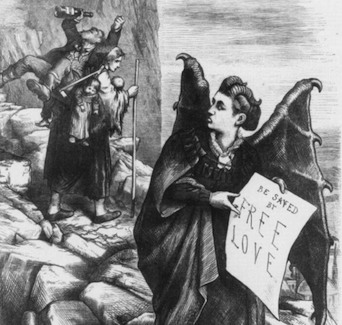
Woodhull was depicted as Satan for her advocacy of Free Love.

The subsequent scandal rocked the country and split the suffrage movement.  None-the-less the NWSA stood by her and even recommended nominated her for President with Fredrick Douglas for Vice President in January of 1872. 
Woodhull ran against Republican incumbent Ulysses S. Grant and the Democratic nominee, famed maverick editor and publisher Horace Greeley, a former liberal Republican and erstwhile ally.  Victoria attempted to concentrate her campaign on the highly progressive Woodhull Platform.  But her now considerable enemies beset her at every turn. 
Susan B. Anthony broke with other NWSA leaders to support Grant in an attempt to distance the movement from the increasingly scandalous Woodhull.  After the family was evicted from their home, they could not even find a house to rent and for a while had to sleep on the floor of their newspaper offices.  Business deals fell through and speaking engagements were cancelled.  The paper had to suspend publication for four months.  When it returned it ran a full expose of the Beecher/Tilton affair and another on a prominent broker with a predilection for young girls.  While circulation soared, the sisters were sued for libel and prosecuted for pornography
Woodhull spent Election Day in jail.  No votes were recorded for her, but it is assumed that some of the 4000 or so rejected ballots in the election were for her. 
Her legal difficulties dragged on.  In 1874 both sisters were finally cleared of criminal charges.  But they had to pay fines and court costs amounting to an astonishing half a million dollars.  All of the sisters’ assets, including their brokerage accounts, printing press, personal papers, and even their clothing were seized to pay the fines.  By 1876 she was divorced from Col. Blood and her beloved newspaper was silenced. 
She turned to the comforts of religion while continuing to eke out a living as a lecturer.  After Cornelius Vanderbilt died unhappy heirs attempted to subpoena the sisters for testimony that he was not of sound mind.  Somehow—and speculation runs heavily to the Vanderbilt estate—money was found to send the sisters to England with a comfortable stipend on which to live.  Victoria lectured there, but her message was subdued. 
Both sisters married well and prospered.  
Tennessee married Francis Cook, chairman of Cook, Son & Co., drapers, and also Viscount of Monserrate in Sintra on the Portuguese Riviera. Within months of their marriage, Queen Victoria made Cook a Baronet created a Cook Baronetcy and Tennessee was Lady Cook.  in Portugal was known as the Viscountess of Monserrate. The couple lived at Doughty House in Richmond Hill, Surrey, now part of Greater London and at Monserrate Palace.
Although she never abandoned her radical viewpoints, Claflin lived the remainder of her life out of the public eye. She died in England on January 18, 1923.

Victoria in her later years as Mrs. John Biddulph Martin as a respectable English lady and humanitarian.
Victoria met a wealthy and conservative banker, John Biddulph Martin and married him in 1882 and settled into a life of respectability and sponsorship of various humanitarian causes.  On a trip back to the U.S. she joined the tiny Humanitarian Party and was nominated as their candidate for President in 1892.  It was a last hurrah in the United States. 
Back in England Victoria divided her husband’s estates after his death and backed a scheme to rent small plots to impoverished women so that they could become self-sufficient, founded an experimental school, and sponsored an annual agricultural fair.  She was active in World War I relief work.  She died in her sleep on June 9, 1927 at the age of 88 at her estate in Bredon, Worcestershire.

Tuesday, July 9, 2019

Dr. Daniel Hale Williams and the First Open Heart Surgery

Dr. Daniel Hale Williams performing the first successful open heart surgery at Provident Hospital in Chicago.
Things were tense in the operating room of two year old Provident Hospital in Chicago on July 10, 1893.  James Cornish had been carried to the hospital with what was surely a fatal wound—a knife was sticking out of his chest and lodged in the heart.  The only way to save him—open the chest, remove the knife and suture the pericardium—the tough double layered membrane which covers the heart—would probably kill him.  No one had previously survived the handful of attempts at the procedure.
Dr. Daniel Hale Williams, a 37 year old surgeon and founder of the only hospital in Chicago with an integrated staff, was used to breaking new ground and confident in his skills.  He was also a pioneer of the sterile operating room, being one of the first American surgeons to heed the ground breaking research of Louis Pasteur and Joseph Lister at a time when older doctors were still performing multiple operations on the same bloody table without washing their hands in between.  That reform alone had greatly boosted survival rates among his patients.
Dr. Daniel Hale Williams.
Without the benefit of modern antibiotics and with unreliable anesthetics he went to work.  And he had to work fast because he also had no access to blood transfusions.  He quickly and skillfully cracked the chest, removed the knife, sutured the pericardium, closed and sutured the chest.  Within ten days Cornish had fully recovered and went on to live a normal life for many years.
Dr. Williams had just performed the first successful open heart surgery.
James Cornish recovering from his heart surgery
Did I mention that he was Black?
Williams was born on January 18, 1856 in Hollidaysburg, Pennsylvania.  His parents were free Blacks and his father made a good living as a barber.  The elder Williams was also a community leader and active in the Equal Rights League, an early civil rights organization active during the Reconstruction Era.
At the age of ten the boy’s security was shattered with the sudden death of his father.  He was sent to live with relatives in Baltimore where he got a little more basic education before being unhappily apprenticed to a shoemaker.
Dissatisfied, he left Maryland to join his mother and other members of his family who had relocated to Chicago.  He took up his father’s trade and was soon made enough money to better himself by apprenticing to Dr. Henry Palmer, a highly accomplished surgeon. He then completed formal training at Chicago Medical College, one of the few schools in the country to accept Black students.
Unable to gain a position or admitting status at any Chicago hospital because of his race, Williams set up a private practice on the South Side.  Then he was hired as a doctor for the Chicago Street Railway, treating mostly white workers and injured passengers.  Despite the general racism of the times, he was well thought of by the men and affectionately called Dr. Dan.
Private practice or the Railway offices, however did not offer the kind of recovery facilities necessary to perform the most difficult and challenging operations.  For that he needed a full service hospital.  He also wanted to encourage more blacks to enter medicine, not only as doctors, but as nurses and other support personnel.  
The original Providence Hospital building.
So in 1891 Dr. Williams founded Provident Hospital and Training School for Nurses, the nation’s first hospital with a nursing and intern program that had a racially integrated staff.
Dr. Williams work soon attracted the attention of the aging abolitionist Fredrick Douglas who championed him among friends in Washington.  As a result in 1894 Williams was appointed the chief surgeon of the Freedmen’s Hospital, serving former slaves.  It was a daunting task.  Poorly equipped and funded from its beginning in the Reconstruction Era, it had been allowed to deteriorate and offered substandard care with an astonishing mortality rate.
Freedmen's Hospital in Washington, D.C.
Williams worked feverishly on the turn-around, instituting modern hygienic standards, re-training the staff, improving surgical procedures including public viewing of surgeries which he believed would be an incentive to the staff to operate on the highest level.  He also added specialists in more fields, launched an ambulance service, and on the model of Provident, adding a multiracial staff, continuing to provide opportunities for black physicians and nursing students.
The following year, in 1895 William co-founded the National Medical Association, an alternative to the American Medical Association, which didn’t allow African-American membership.
The school for nursing was an important part of Provident hospital and bringing Black women into medical careers one of the most treasured parts of Dr. Williams' legacy.
In his years in Washington, Williams met Alice Johnson who he married in 1898.  The couple returned to Chicago where he resumed his position at Provident.  Later he would practice at Cook County Hospital and St. Luke’s, major modern hospitals who could no longer deny privileges to one of the most distinguished surgeons in the nation.
From 1901 he spent part of every year in Nashville where he was a voluntary visiting clinical professor at Meharry Medical College for more than two decades. He became a charter member of the American College of Surgeons in 1913.
Dr. Williams was active until he suffered a stroke in 1926.  On August 4, 1931 he died in Idlewild, Michigan.
Williams was widely honored in his lifetime and his story has become a staple of Black History Month commemorations.  But he is largely unknown to white Americans.
Williams’s beloved Providence Hospital, one of the few full service hospitals on the under-served South Side, was forced to close in 1987 due to financial problems.  In 1993 it reopened in as Provident Hospital of Cook County, part of the Cook County Bureau of Health Services.  Finances continue to threaten the public hospital and its future is far from certain.

Wednesday, May 11, 2016

Victoria Claflin Woodhull—Too Hot to Handle and Candidate for President

Victoria Woodhull in her prime.


Victoria Claflin Woodhull was nominated for President of the United States on April 10, 1872 almost 50 years before the passage of the 19th Amendment gave women the right to vote in all of the United States.  Woodhull stood apart from other leaders of the Suffrage movement by her audacity, frank embrace of the most radical social causes, her shocking open challenge to Victorian sexual mores, and her mesmerizing affect on the public and press. 
As early as 1870 Woodhull used the pages of Horace Greeley’s New York Herald to announce her candidacy for President in the 1872 election.  It was a bold move.  Not only were women barred from the vote, but she would not even reach the constitutionally mandated age of 35 until months after the March 1873 inauguration of the next President.  She maintained that while the law forbad women from voting, there was not a statutory ban on women running for, or being elected to office.  In the hubbub created by her announcement over the unprecedented distaff candidacy, her age never became an issue.
She used the pages of her newspaper, Woodhull and Claflin’s Weekly which was founded the same year, and the lecture platform to keep her name and promised candidacy before the public.  Able to command press attention, which then as now liked a sexy and sensational show, she attracted the support of not only the most daring womanists and suffrage supporters, but radical trade unionists, early socialists, prison and death sentence reformers, some former abolitionists, and free thinkers.  She took on a broad range of social issues and took a consistently radical and progressive stance.
On May 10, 1872 a meeting was held at Apollo Hall in New York City where the new Equal Rights Party was formed and announced its intentions to nominate Woodhull.  The meeting consisted almost entirely of Woodhull’s friends and inner circle of supporters.   A formal convention was called and held on June 8 with broader participation.  A platform was announced, personally drafted by Woodhull, and her personal friend, the great Black abolitionist Fredrick Douglas was nominated for vice president.  Douglas, however, was not present at the Convention and never acknowledged or accepted the nomination although he never officially renounced it.  In fact that fall he would be elected as a Republican New York Presidential Elector. 
The issue of Woodhull and Claflin’s Weekly dated the same day as the Convention announced the ticket and platform:
The Equal Rights Party has selected Victoria C. Woodhull for the office of President, because it deems that the demand for the personal, social, legal, and political liberties of woman have been better advocated by her actions and in her speeches and writings than by any other woman. Religious liberty is not mentioned above, because it is held that, in the case of woman, it has not been specially infringed.  It is claimed as a right pertaining to all the people; one which the Equal Rights Party hold itself pledged to maintain against any national or State interference with (or infringement of) in any way whatever.
The Equal Rights Party has selected Frederick Douglass for the office of Vice President, because though born a slave, he has himself achieved both his education and his liberty; because he has waged a life-long, manful battle for the rights of his race, in which those of mankind were included; because he has proved that he knows how to assert the liberties of the people, and consequently it is assumed that he knows how to maintain them.
This announcement and its tone of radical defiance was picked up by the press across the country.  And all hell soon broke loose.  The candidate was in for a very bumpy ride. 
Woodhull was born in Homer, Ohio on September 23 1838, the daughter of a ne’er-do-well con artist and patent medicine peddler who may have passed on some of his persuasive flair to his beautiful older daughter. 
At the age of 15 she married a 28 year old doctor—and perhaps a quackCanning Woodhull.  The couple had two children including a boy with an “intellectual disability.” Victoria soon discovered that her husband was an alcoholic, a chronic womanizer, and was abusive.  Unable, or unwilling, to support the family, he relied on his wife to provide income.    In San Francisco she worked as a cigar girl in rough and tumble saloons, and likely at least occasionally as a prostitute. 
Later in New York she began her long collaboration with her younger sister Tennessee Claflin presenting themselves as clairvoyants and spiritual healers.  When her husband essentially abandoned the family, the sisters successfully took their act to Cincinnati and Chicago and began touring as spiritualist lecturers.  After 11 years Victoria obtained a divorce from her husband. 
Her experience would inform her public rejection of conventional marriage as a form of chattel slavery for women.  She became attracted to the Free Love movement that percolated on the very most advanced frontiers of Free Thinking.  Around 1866 she either married or took up a common law relationship with Col. James Blood, a kind and cultured gentleman who subscribed to Free Love. 
They settled back in New York with sister Tennessee and her extended family.  Living in relative comfort and respectability, the sisters established a popular salon where advanced thinkers and practical politicians rubbed shoulders.  Among her admirers was Benjamin Butler, the Radical Republican politician and former general who espoused both suffrage for women and free love. 
Virginia proved a brilliant and daring conversationalist and advocated by turns and in combinations anarchism, socialism, Spiritualism, and racial equality. 
 
A popular men's sporting and gossip newspaper--a competitor of the Police Gazzette, found the Woodhull and Claflin Brokrage house a topic of amusement.


Sister Tennessee caught the fancy of 76 year old Commodore Cornelius Vanderbilt, who took her for a lover, consulted with her for spiritual advice and returned the favor by offering inside stock tips.  Armed with such information, the sisters invested and reaped fabulous profits.  Vanderbilt helped set them up in the first woman owned brokerage firm on Wall Street, Woodhull, Claflin & Company.  The press hailed them as Queens of Finance. Susan B. Anthony regarded the venture as “a new phase of the woman’s rights question.”  Victoria, with typical blunt frankness noted that, “Woman’s ability to earn money is better protection against the tyranny and brutality of men than her ability to vote.”
In 1870 the sisters took advantage of their fame by launching their own weekly newspaper, Woodhull and Claflin’s Weekly.  Victoria was the principle editor and writer.  The paper took on and advanced all of the most progressive causes of its day.  But it also pioneered in muckraking and investigative journalism, exposing fraudulent stock schemes, insurance frauds, and shady Congressional land deals.  The newspaper, which was often sold under the counter and was sometimes banned from the mails, had a very respectable circulation of more than 20,000 copies weekly for most of its seven year run.  
Woodhull presented a women's suffrage petition to the House Judiciary Committee.  Benjamin Butler with the balding head and mustache is seen at the top of the table and Elizabeth Cady Stanton is seated directly behind Woodhull.
In January 1871 Woodhull personally petitioned Congress on behalf of women’s suffrage.  She argued that the recently enacted 13th and 14th Amendments extended to women the same rights as newly freed slaves. Her argument attracted wide attention and admiration.  Although a majority report rejected her assertions, Benjamin Butler filed a minority report in her favor.  Leaders of the Suffrage movement including Anthony, Lucretia Mott, and Elizabeth Cady Stanton invited her to address a meeting of the National Women Suffrage Association (NWSA) the next day. 
But the spotlight of the Presidential campaign was thrown soon thrown on Woodhull’s most unusual household, which included not only her present husband, but also her first who had shown up penniless and addicted to morphine and was taken in out of charity; her sisters and their liaisons; and her parents including the father who still was running patent medicine scams.  When her mother tried to blackmail Vanderbilt posing as Tennessee, he naturally withdrew his support and advice and turned his significant power against the sisters, who were soon forced out of their mansion ending their Salon. 
Woodhull simply replaced the money lost from her business with speaking fees. 
The powerful Beecher family, evangelist Henry Ward and his sisters Harriet Beecher Stowe and Catherine began a concerted campaign against Woodhull for her advocacy of Free Love.  A third sister, Isabella Beecher Hooker, a leader in the NWSA, supported her. 
Woodhull became aware that Henry Ward was carrying on an adulterous affair with the wife of an associate.  She attempted to use that knowledge to get the Reverend not only to back off his attacks, but to introduce her at a major public lecture at Steinway Hall.  Despite the thinly veiled blackmail attempt, Beecher backed out at the last moment and Woodhull was introduced by Theodore Tilton, the cuckolded husband of Beecher’s lover. 
The speech itself went well until Woodhull’s younger sister Utica, bitter over Victoria’s fame and notoriety stood up in a box and directly challenged her sister to publicly proclaim her support of free love.  Yes, I am a free lover!” Woodhull defiantly retorted, “I have an unalienable, constitutional, and natural right to love whom I may, to love as long or as short a period as I can, to change that love every day if I please! And with the right neither you nor any law you can frame have any right to interfere.” 
Woodhull was depicted as Satan for her advocacy of Free Love.
The subsequent scandal rocked the country and split the suffrage movement.  None the less the NWSA stood by her and even recommended nominated her for President with Fredrick Douglas for Vice President in January of 1872. 
Woodhull ran against Republican incumbent Ulysses S. Grant and the Democratic nominee, famed maverick editor and publisher Horace Greeley, a former liberal Republican and erstwhile ally.  Victoria attempted to concentrate her campaign on the highly progressive Woodhull Platform.  But her now considerable enemies beset her at every turn. 
Susan B. Anthony broke with other NWSA leaders to support Grant in an attempt to distance the movement from the increasingly scandalous Woodhull.  After the family was evicted from their home, they could not even find a house to rent and for a while had to sleep on the floor of their newspaper offices.  Business deals fell through and speaking engagements were cancelled.  The paper had to suspend publication for four months.  When it returned it ran a full expose of the Beecher/Tilton affair and another on a prominent broker with a predilection for young girls.  While circulation soared, the sisters were sued for libel and prosecuted for pornography. 
Woodhull spent Election Day in jail.  No votes were recorded for her, but it is assumed that some of the 4000 or so rejected ballots in the election were for her. 
Her legal difficulties dragged on.  In 1874 both sisters were finally cleared of criminal charges.  But they had to pay fines and court costs amounting to an astonishing half a million dollars.  All of the sisters’ assets, including their brokerage accounts, printing press, personal papers, and even their clothing were seized to pay the fines.  By 1876 she was divorced from Col. Blood and her beloved newspaper was silenced. 
She turned to the comforts of religion while continuing to eek out a living as a lecturer.  After Cornelius Vanderbilt died unhappy heirs attempted to subpoena the sisters for testimony that he was not of sound mind.  Somehow—and speculation runs heavily to the Vanderbilt estatemoney was found to send the sisters to England with a comfortable stipend on which to live.  Victoria lectured there, but her message was subdued. 
She met a wealthy and conservative banker, John Biddulph Martin and married him in 1882 and settled into a life of respectability and sponsorship of various humanitarian causes.  On a trip back to the U.S. she joined the tiny Humanitarian Party and was nominated as their candidate for President in 1892.  It was a last hurrah in the United States. 
Back in England Victoria divided her husband’s estates after his death and backed a scheme to rent small plots to impoverished women so that they could become self-sufficient, founded an experimental school, and sponsored an annual agricultural fair.  She was active in World War I relief work.  She died in her sleep on June 9, 1927 at the age of 88 at her estate in Bredon, Worcestershire