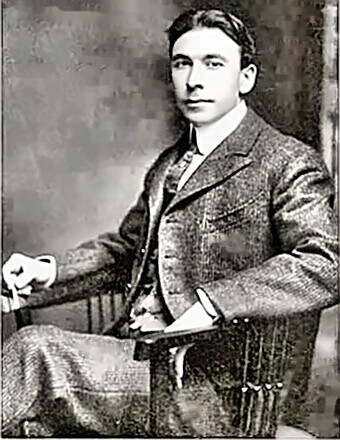
|
Disdained by Eastern critics, James Whitcomb Riley at least looked every inch a respectable poet.
|
high minded, serious folk— the worst
high school English teachers, academics whose careers depend on
culling ever diminish heard of obscure poets for publish-or-perish theses that no one reads, and critics convinced that only the obscure
and arcane are worthy of notice and that popularity
is vulgar. Together these folks have just about beat to death any chance
that the general public might
consider reading and enjoying poetry.
Today we offer up a poet sure to set
fire to these folks hair.
The Hoosier poet James Whitcomb
Riley may not have been the greatest American
poet. But for a good many years he was the most popular—and the most beloved.
Many of his verses were written for, and loved, by children and there was a
time when most could recite at least one of his poems by heart.
Riley was born on October 7, 1849 in
the extremely rustic village of Greenfield,
Indiana. Although his father was a lawyer with political ambitions—the boy was named for a governor of
the state—the family was still crowded into a two room log cabin.
What passed for a super highway, the
planked National Road, ran by the
cabin’s dooryard. In those days with inns
and taverns scarce, travelers on
the road often pulled up at the cabin, the largest in the village, for supper
or a place to sleep by the hearth or in the soft hay of the barn. From
the time he was a small boy, James listened to and absorbed the accents and the
stories of the visitors and entertained his family and friends with imitations.
 |
Riley grew up in this comfortable frame home in Greenfield, Indiana which replaced the rustic log cabin of his birth. It is now preserved and open to the public.
|
As the village and fortunes of the
family grew, they replaced the cabin with a handsome two story white frame
house.
James was an indifferent, make that
horrible, student in the local one room academy. His mind was always
wandering to the meadows, woods, and creeks and the play of his friends.
He learned well enough to read and write, but seemed totally indifferent to
anything else. One teacher told his exasperated father, “He doesn’t know which
is more—twice ten or twice eternity.” He dropped out of school to work
odd jobs in town and on nearby farms.
His father convinced him to try
reading law with him. But that was a failure, too.
Despite his love of his town and his
friends among the lively local youths, Riley had itchy feet and a hankering to
see a bit more of the world. He took up the tramp profession of traveling sign
painter, roaming the Midwest. Later,
he became a barker in a traveling medicine show where he honed stage
skills that would later help make him famous and where he cultivated a lifelong
taste for the product, heavily laced with alcohol.
Riley didn’t write his first known
poem until the age of 21 in 1870. He sent it to a newspaper, which published it. It became a habit. The
poems, usually in dialect, reflected
his memories of the rural childhood. Newspapers began, in the custom of
the time, to reprint the poems “on exchange.”
He even started to get paid a dollar or two for a submission.
Despite this modest success, Riley
suspected that as a rural bumpkin he would never be taken seriously as a poet
by the Eastern literary establishment.
To prove his point, he perpetuated a hoax. He submitted Leonanie
an “undiscovered poem” by Edgar Allan
Poe which was universally proclaimed as a masterpiece. The Eastern
critics failed to note that Poe himself was a famous hoaxer, having published at least six in his life, the most
famous about a supposed 1844 crossing of the Atlantic by balloon.
When Riley revealed himself there were a lot of embarrassed—and
angry—critics. It is seems likely that tribe holds the grudge to this
day.
He established himself enough as a
writer to get a full time job on the Indianapolis Journal where he did
reporting and regularly contributed verse, still a popular part of any American
newspaper.
In 1883 he self-published an edition of 1000 copies of a collection, The
Old Swimmin’ Hole and ‘Leven More Poems under the pen name of Benjamin F. Johnson, of Boone. Most
poets trying this gambit ended up with crates full of unsold books and ruinous debts to the printer. Riley’s book sold out its first printing in only a
few months.
 |
Riley was saluted with that singular 19th Century honor, a cigar brand and box.
|
That got the attention of local
Indianapolis publisher Merrill, Meigs
and Company which published a beautifully bound second edition under his
real name. It sold like hot cakes. Riley would be associated with
the company, which eventually became Bobbs-Merrill,
for the rest of his life. In
fact that well known publishing house was largely built on the success of its
Riley books. The first of the original ones was The Boss Girl.
Riley was able to give up his day
job, cater to his wanderlust, and promote his books when he took to the lecture
platform. With his charming wit, and theatrical style of reading he
became one of the most sought after public speakers in the country, a genuine
star of the Lyceum Circuit.
And everywhere he spoke, he sold even more books.
One of the few critics who
appreciated him, fellow Midwesterner Hamlin
Garland, noted that of American writers only Mark Twain “who had the same amazing flow of quaint
conceits. He spoke ‘copy’ all the time.” In an interview in 1892 in
Greenfield, Riley told him, “My work did itself. I’m only the willer bark
through which the whistle comes.”
Twain, by the way, was not fond of
Riley. In their only appearance together on the same program, he felt
that he was upstaged by someone plowing similar ground. There after he
avoided those literary dinners where Riley might make an appearance and
occasionally derided his adversary.
Riley’s lectures and book sales made
him the best paid writer America for
a while, surely another bitter pill
for struggling “serious” scribes. It was said copies of his books were
found in homes that contained no other save the Bible.
Riley never married. He said a
failed teenage romance back in
Greenfield had made him decide not to commit his heart. But serious
alcoholism, that all too common malady of writers, was more likely the cause.
At least one lecture tour was aborted do to drunkenness. Several attempts
of stop drinking all ultimately failed.
In 1893 Riley began boarding at the
home of his friends, Charles and Magdalena Holstein in the Indianapolis
neighborhood of Lockerbie. It
was his home for the rest of his life and his friends took care of him through
bouts of drinking and later severe health problems.
 |
Although ravaged by alcoholism and in declining heath, Riley enjoyed regaling the neighborhood children with his yarns and verse.
|
By 1895 he had largely stopped
touring and his attempts to publish more “serious” poems were savaged even by
critics who had warmed to his rustic style. At home in Lockerbie he
appointed himself an uncle to neighborhood children who flocked to hear his
stories and tales.
That inspired his last, and
ultimately most successful, original book, Rhymes
of Childhood with illustrations by Howard
Chandler Christy. It was so popular through so many editions—it
remains in print today—that Riley was proclaimed the Children’s Poet, much as Henry
Wadsworth Longfellow had been years before. Twain was so moved by
this collection—and probably the memory of his dead children—that he finally
had good things to say about Riley.

In 1902 Boobs-Merrill began issuing
elegantly appointed volumes of his complete works, an honor few poets lived to
see. Riley spent his last years editing the texts. Eventually 16
volumes were issued.
Riley purchased the family homestead
in Greenfield and his brother John lived
in the house. Riley would make occasional visits.
Riley’s health had been in steady
decline since 1901. He suffered a debilitating stroke in 1910 which
confined him to a wheel chair. The loss of the use of his writing hand bothered him and he later
relied on dictation to George Ade
for his last poems and biographical sketches. By 1912 he had recovered
enough to begin recording readings
for Edison cylinders. The same
year the Governor of Indiana declared his birthday James Whitcomb Riley Day, a state
holiday observed until 1968.
He made his last visit to Greenfield
in 1916 for the funeral of a boyhood friend. A week later back in
Lockerbie, he suffered a second stroke and died on July 22nd.
Riley was widely mourned. His
books continued to be popular through the next two decades, finally falling out
of favor.
 |
The James Whitcomb Riley Museum Home in Indianapolis, a National Historic Site.
|
His boyhood home in Greenfield is
now a preserved historical site and his home in Lockerbie is the James Whitcomb Riley Museum Home and a
designated National Historic Site.
Our Hired Girl
Our hired girl, she’s ‘Lizabuth Ann;
An’ she can cook best things to eat!
She ist puts dough in our pie-pan,
An’ pours in somepin’ ‘at's good an’ sweet;
An’ nen she salts it all on top
With cinnamon; an’ nen she’ll stop
An’ stoop an' slide it, ist as slow,
In th’ old cook-stove, so's 'twon't slop
An’ git all spilled; nen bakes it, so
It's custard-pie, first thing you know!
An’ she can cook best things to eat!
She ist puts dough in our pie-pan,
An’ pours in somepin’ ‘at's good an’ sweet;
An’ nen she salts it all on top
With cinnamon; an’ nen she’ll stop
An’ stoop an' slide it, ist as slow,
In th’ old cook-stove, so's 'twon't slop
An’ git all spilled; nen bakes it, so
It's custard-pie, first thing you know!
An’ nen she’ll say,
“Clear out o’ my way! They’s time fer work, an’ time fer play!
Take yer dough, an’ run, child, run!
Er I cain’t git no cookin’ done!”
“Clear out o’ my way! They’s time fer work, an’ time fer play!
Take yer dough, an’ run, child, run!
Er I cain’t git no cookin’ done!”
When our hired girl ‘tends like she’s mad,
An’ says folks got to walk the chalk
When she's around, er wisht they had!
I play out on our porch an' talk
To Th’ Raggedy Man ‘at mows our lawn;
An’ he says, “Whew!” an’ nen leans on
His old crook-scythe, and blinks his eyes,
An’ sniffs all ‘round an’ says, “I swawn!
Ef my old nose don’t tell me lies,
It ‘pears like I smell custard-pies!”
An’ says folks got to walk the chalk
When she's around, er wisht they had!
I play out on our porch an' talk
To Th’ Raggedy Man ‘at mows our lawn;
An’ he says, “Whew!” an’ nen leans on
His old crook-scythe, and blinks his eyes,
An’ sniffs all ‘round an’ says, “I swawn!
Ef my old nose don’t tell me lies,
It ‘pears like I smell custard-pies!”
An’ nen he’ll say,
“Clear out o’ my way!
They’s time fer work, an’ time fer play!
Take yer dough, an’ run, child, run!
Er she cain’t git no cookin’ done!
“Clear out o’ my way!
They’s time fer work, an’ time fer play!
Take yer dough, an’ run, child, run!
Er she cain’t git no cookin’ done!
Wunst our hired girl, when she
Got the supper, an we all et,
An’ it wuz night, an’ Ma an’ me
An’ Pa went wher’ the “Social’ met,--
An’ nen when we come home, an’ see
A light in the kitchen door, an’ we
Heerd a maccordeun, Pa says, “Lan’--
O’-Gracious! who can her beau be?’
An’ I marched in, an’ ‘Lizabuth Ann
Wuz parchin’ corn fer The Raggedy Man!
Got the supper, an we all et,
An’ it wuz night, an’ Ma an’ me
An’ Pa went wher’ the “Social’ met,--
An’ nen when we come home, an’ see
A light in the kitchen door, an’ we
Heerd a maccordeun, Pa says, “Lan’--
O’-Gracious! who can her beau be?’
An’ I marched in, an’ ‘Lizabuth Ann
Wuz parchin’ corn fer The Raggedy Man!
Better say,
“Clear out o’ the way!
They’s time fer work, an’ time fer play!
“Clear out o’ the way!
They’s time fer work, an’ time fer play!
Take the hint, an’ run, child, run!
Er we cain’t git no courtin’ done!”
Er we cain’t git no courtin’ done!”
—James Whitcomb Riley