They are calling this year’scommemorationThe Selma Bridge Crossing Jubilee--All Boots on the Ground which will mark the 61st anniversaryofBloody Sunday—the day on March 7, 1965, that day in Selma,Alabama when massed Alabama State Police attackedpeaceful demonstrators attempting to cross theEdmund Pettus Bridgeon a march from Selma to the state capital at Montgomery to protest suppression of voting rights.
Alabama State Police beat SNCC march leader John Lewis, on ground center, after charging voting rights marchers trying to cross Edmund Pettus Bridge from Selma on the way to the state capitol in Montgomery in 1965.
Members of the Student Non-violent Coordinating Committee (SNCC) had been conducting voter registration drives in the area since 1963 and had encounteredescalating violence. After the passage of the Civil Rights Act of 1964, efforts stepped up. On July 6 of that year SNCC leader John Lewis attempted to lead a march on the county courthouse to register voters. He and other marchers were beaten and arrested. A few days later a local judge handed down a sweeping injunction against more than two people assembling to even talk about voter registration.
Two SCLC organizers arrived to join the voter registration effort. Diane Nash like John Lewis was a veteran of the Nashville public accommodation sit-in campaign of 1960. Her husband, Rev. James Bevel was also a seasoned non-violent activist. Together they were two of the best the organization had.
SNCC leaders appealed to the Southern Christian Leadership Conference (SCLC).SCLC leaders including the Rev. James Bevel, who had been conducting his own voter registration projects, and his wife, Diane Nash, a SNCC founder who cut her teeth in the Nashville youth crusade sit-ins with Lewis, came to Selma to join the effort. But the national organization, busy with other efforts, had not yet committed.
Finally, on January 2 Dr. Martin Luther King, Jr. came to Selma bringing with him the national spotlight and officially launched a new Selma Voting Rights Movement. Marches on court houses resumed there and in surrounding counties.
The body of Jimmie Lee Jackson, first martyr of the Selma campaign. After leading a night march to the Perry County Court House in Marion, Jackson was shot trying to protect his mother and grandfather from a beating by police who charged into a cafe where they had taken refuge. His death galvanized the campaign locally but attracted little national press attention.
On February 18 a young man, a Baptist elder who had tried four times to register, Jimmie Lee Johnson was shottrying to defend his mother and grandfather from police clubs after a night marchon the Perry County Courthouse in Marion.When Johnson died of his wounds days later, Bevel called for a protest marchon thestate capital from Selma on March 7.
On the day of the march John Lewis, the Rev. Hosea Williams of the SCLC, and local leaders like Amelia Boynton led about 600 marchers. When they attempted to cross the bridge, they were met bymassed troopersandordered to disperse. Lewis attempted to speak to thecommanding officer but was shoved to theground and beaten. Police chargedthe crowd with clubs and gas. Mounted officers attacked from theflanks. Scenes of horrific violence were capturedon film and soon broadcaston television helping to swing public sympathy to the marchers.
King responded with a call torally in Selma for a second march. Hundreds from around the country, including manyclergy, respondedto the call. Lawyersappealed to Federal JudgeFrank Minis Johnson, who was suspectedto be sympathetic, to liftthe local ban on marches. The judge took the issue underadvisement but issued a temporary restraining order against resuming the march until he could make hisruling.
With thousands gathered, King felt he had to move but did not want to alienatethe judge. On March 9 he led about 7,000 to the bridge but then knelt inprayer and turned the crowdback, a move that was harshly criticized by SNCC leaders.
Rev. James Reeb, a young Unitarian Universalist minister, was with two others when he was beaten to death by Klansmen in Selma on the eve of a second march. The death of a white minister did grab attention and President Lyndon Baines Johnson used it to advance the Voting Right Act of 1965.
That evening three Unitarian Universalist ministers, James Reeb, Clark Olsen, and Orloff Miller who responded to King’s call were attacked and beaten outside a Selma cafe known to be a hangoutfor Klansmen.Reeb died of his wounds on March 11 in Birmingham after the Selmahospital refusedto treat him.
On hearing of Reeb’s death the Board of the Unitarian Universalist Association meeting in Boston voted to adjourn and re-convene in Selma. UUA President Dana McLean Greeley and eventually half of the active ministers in the Association headed to the South.
The death of awhite ministergalvanized public opinion in a way that Jimmie Johnson’s had not. A shaken President Lyndon Johnson submitted a Voting Rights Act to Congress on March 15 after failing to get Governor George Wallace to back off from attacks on demonstrators.
A week after Reeb’s death Judge Johnson finally issued the long-anticipated rulingupholding the First Amendment rights to assemble and protest.
John Lewis, Rosa Parks, Ralph Abernathy, Juanita Abernathy, Ralph Bunche, Martin Luther and Coretta Scott King, Frederick Reese and Hosea Williams lead the March through Montgomery to the Capitol.
On March 21 the finaland successful march on Montgomery set off with King, Lewis, Bevel, and Williams leadingthe way with a bevyof national clergy. They were protected by 2,000 Federal troops and U. S. Marshalls on the four-day march through hostile territory to the capitol.
After a triumphant rally on the capitol steps, Viola Liuzzo, a young Detroit mother andU.U. laywoman was driving ablack marcher back to Selma, when she was shot by Ku Klux Klan members. A federal informant was in the Klansmen’s car. She was the final fatality in the Selma campaign.
Tennessee born Viola Liuzzo, a white U.U. laywoman and mother from Detroit marched from Selma to Montgomery often barefoot as in this photo. She was murdered driving a Black Marcher back to Selma after the final rally at the State Capital. She was the third of four of the Martyrs of Selma who also included Episcopal seminarian Jonathan Myrick Daniels who was shotgunned to death on August 30 after spending a week in jail for a Lowndes County, demonstration, a part of the greater Selma campaign.
The Voting Rights Act passed Congress and was signedinto law by the President on August 6. Within a year 7000 new Black voters were enrolled in Selma’s Dallas County.
In 1966 Sheriff Jim Clark, who was responsible for much of the early violence in Selma, lost his bid for re-election. John Lewis went on to be elected to Congress. The Edmund Pettus Bridge is now marked as part of the Selma to Montgomery Voting Rights Trail, a National Historic Trail.
The 50th Anniversary march included President Barack Obama and his family, Congressman John Lewis and other veterans of the original march and former President George W. Bush and his wife Laura. Always outspoken, Diane Lewis boycotted the reunion march to protest Bush's inclusion.
In the 50th Anniversary year of 2015, tens of thousands joined Congressman Lewis and other veterans of the original marches along with President Barack Obama, his family,and former President George W. Bush and his wife Laura in a symbolicand triumphant march across the Bridge.
The same year the film Selma directedby Ana DuVernay and starring David Oyelowo, Carmen Ejogo, Tom Wilkinson,and Oprah Winfrey opened to high praise, great reviews,and a slew of awardsand nominations.
Ana DuVernay's acclaimed film Selma was an accurate depiction of the voting rights campaign and marches. Unlike earlier popular movies about the Civil Rights campaigns, there was no white savior and the vision was unfiltered by white eyes. The film also honored the work and sacrifice of ordinary folk as well as Martin Luther King and other marquee movement names.
In 2020 Congressman Lewis, who was battling pancreatic cancerwas joined by four Democratic presidential candidates—Senators Elizabeth Warren and Amy Klobuchar, former South Bend Mayor Pete Buttigieg,former New York City Mayor Michael Bloomberg for the march. In his comments Congressman Lewis said:
Fifty-five years ago, a few of our children attempted to march ... across this bridge. We were beaten, we were tear-gassed. I thought I was going to die on this bridge. But somehow and some way, God almighty helped me here…We must go out and vote like we never, ever voted before…
I’m not going to give up. I’m not going to give in. We’re going to continue to fight. We need your prayers now more than ever before. We must use the vote as a nonviolent instrument or tool to redeem the soul of America…
To each and every one of you, especially you young people ... go out there, speak up, speak out. Get in the way. Get in good trouble. Necessary trouble, and help redeem the soul of America.
Four Little Girls: Ada Mae Collins, Carole Robertson, Denise McNair, and Cynthia Wesley.
Note—Murderous hatred is not new to the U.S.It never really went away and is making a strong comeback today.
Of all of the many battlegrounds for Civil Rights in the South,
Birmingham, Alabama stood out for
the level of sheer ferocity and brutality of opposition to change.Then, on September 15, 1963 the already blood-soaked city was rocked by a Sunday morning bomb blast at
the 16th Avenue Baptist Church.When the dust and smoke cleared, four young girls were deadand 22 other people were injured.It was a crime of suchsickening brutality
that shocked the nation.If it happened today, it would be called what
it surely was then—an act of terrorism.
Birmingham was not a rural backwater.It was one of the South’s major industrial centers, the self-proclaimed Miracle City that grew in an economybased on steel production.After a war time boom, the city settled into a period of prosperity in the 1950’s—a prosperity that the
approximately one third of its population, Blacks,
did not fully share in.The large White working class population of the city, mostly no more than a generation or so from rural poverty themselves, were particularly
fearful of competition from Blacks
for jobsand resources.That fueled a culture that was as resistant
to change as any in the South.
Local Blacks, led by the Rev.Fred Shuttlesworth of the Bethel
Baptist Church, began to organizeprotests in the mid 1950’s.After the State of Alabamaoutlawed the
National Association for the Advancement
of Colored People (NAACP), of
which Shuttlesworth was state Membership
Chair, in 1956, the minister organized the Alabama Christian Movement for Human Rights to continue the
work.On Christmas Day that year a bombmade of 16 sticks ofdynamite nearly destroyed Shuttlesworth’s parsonage home.He survived and defied threatening
warnings bypolice to leave town.The next day he launched an attempt todesegregatethecity bus system.He and 21
others were arrested and
launched a law suit as a result.
Tenacious and pugnacious the Rev. Fred Shuttelsworth drove Birmingham
Civil Rights campaigns with a righteous fury and was the target of
bombs, mob attacks, attempted assassination, and repeated jailings.
It was just the beginning.In
January, 1957 Shuttlesworth joined Martin
Luther King, Jr., Joseph Lowery, Ralph Abernathy, Bayard Ruskin, and other to establish
what would become the Southern
Christian Leadership Council (SCLC).The pugnacious Shuttlesworthsometimes bedeviled King and other leaders while pressing for moreaggressive action.He said
that “flowery speeches” were empty unless acted upon.
Shuttlesworth continued to act.When
trying to registerhischildren at an all white school later that year the
minister and his wife were attacked
by a mob of known Ku Klux Klansmen with police notable
for their absence.Shuttlesworth was beaten unconsciouswith chains and his wife stabbed.The next year he survived another bombing attempt.He organized and participated in lunch
counter sit-ins in 1960 and was part of the Freedom Rides in 1961.
Through it all, his mostvisible opponent was Police Commissioner Eugene “Bull” Connor an ardent and outspoken segregationist who frequently arrested Shuttlesworth and other civil rights leaders
while his department refused to investigate the many attacks that by 1960 had earned the city the nickname Bombingham.Connor was supported by most
of thelocal establishment
under the banner of a local White Citizen’s Council.Businessmen and professionalswho showed any tendency to towardcompromise were threatened and harassed themselves.And behind everything was a large, if
sometimes fractured, Ku Klux Klan, which included manysworn
police officers, ready to do almost
anything.
Birmingham Public Safety Commissioner Bull Connor ran virtual parallel
city government, commanded Police and Fire Departments riddled with
Klansmen, and vowed never to give an inch to Civil Rights protestors.
As the Birmingham campaign leaders expected, he became a nationally
visible symbol Jim Crow violence.
In 1961, the Bethel Church, which itself had been
bombed twice, grew tired of Shuttlesworth’s obsessionwith theCivil Rights
movement at the expense of regularpastoral
duties.The minister left town to
take up another pulpit in Cincinnati but returned regularly and continued to lead the Birmingham
movement.
In 1962 local Black leaders, with the
encouragement of Shuttlesworth, began a boycott of major downtown
business to demand equal access and employment opportunity.Enforced
bycommunity patrols, the
boycott successfullyreduced sales downtown by as much a 40%.Business leaders, led by the Chamber of
Commerce, sought a compromise.They fielded
acandidateformayor against Bull Connor, who was running for the same office, in the
November 1962.
When their candidate wonthe
election, however, Connor asserted that histerm as the almost completelyindependent
Police Commissioner did not expire until 1965 and he retained the support of other lame duck Commissioners.The
city essentially operated withtwo city governments—but Connor’s side had thegunsandmuscle.
After the Easter shopping seasonwas ruined, many took the Whites only and Colored only signsout of their windows only to be threatened by Connor with the revocationof theirbusiness licenses.
At this point Shuttlesworth and other boycott
leaders decided to call in Dr. King and the SCLC.The new initiative was dubbed Plan C.Devised
by SCLC leader Wyatt Tee Walker,
the plan was to defyConnor and fill the jailswith daily protests that would inevitably
result inbrutal suppression by Connor leading topublic condemnationaround the country.They also felt that they had to keep local
business leaders’ feet to the fire to give them courage to defy Connor.
There were daily demonstrations including lunch counter sit-ins, kneel-insat white-only churches,
demonstrations at libraries and
other segregated city facilities,
and, perhaps most frightening of all, a marchto register voters at the Jefferson
County Court House. The
aggressivenessof the campaign frightened and alienated even many in the Black
community, but leaders were undeterred.
Connor played his role as predicted.On April 10 he got a blanket
injunction against all demonstrations from a state judge.He began to arrest
anyone even attempting to demonstrate and held them on bondsof $1,200 each.The King and SCLC leaders who had obeyedan injunction during an earlier failed campaign in Albany, Georgia, struggled with what to do.Shuttlesworth and others accusedKing of being indecisive
and hisclosest aides reported that he was “more troubled than they had
ever seen him” about the prospects of leading a march directly into Connor’s
brutal hands.After prayer, however, he decided to go
ahead.
On April 12, Good Friday, King,
Abernathy, and 50 Birmingham residents were arrested.At first King was held without being able to
see a lawyer and was not allowed to communicate with his family, including wife
Coretta Scott King who had just given birthto her fourth child.Mrs.
King received a call from President John F. Kennedy the following
Monday.
Dr. Martin Luther King behind bars wrote his Letter from Birmingham Jail for an audience of squeamish white moderates and sit-on-their-hands liberals.
On Tuesday King released his famous Letter from a Birmingham Jail, which
berated White moderatesfor failing to act.Publicity surrounding King’s jailing and the
letter alarmed the owners of several majornational chain stores with
businesses downtown who urgedKennedy
to intervene to resolve the problem.On
April 20 King was released.
Demonstrations and arrests continued, but finding more volunteersfor abuse and incarceration was getting harder.The campaign was in danger of collapse until James Bevel, the SCLC's Director of Direct Action and Nonviolent
Education, devised a plan for a Children’s
Crusade.After getting King’s reluctant approval, Bevel began to recruit
and trainhigh school students, local Black college students, and even elementary age children.He
thought them the basics ofnon-violence and shared films of
earlier Civil Rights confrontations.He counted on the social cohesion of students to stay together.
On May 2 more than 1000 students skipped
school and gathered at the 16th Street Church. Marching indisciplined small groups
and coordinated withwalkie-talkies, the students set out
at intervals on different routes,
each group assigned a target.The first group was to attempt to meet with
the new Mayor.Others were to go to various
stores and public facilities.Astonished
by the discipline of the students, Connor arrested more than600 on the first day swelling the total number of demonstrators
incarcerated in the city jail to more than 1,200, far exceeding themaximum capacityof 900.
The use of fire hoses and dogs against Rev. James Bevel's Children's Crusade marchers shocked the nation.
On the May 3, Connor first used high
pressure fire hoses against the marching students and then attacked
demonstrators and bystandersalike with police dogs.The whole
scene was captured on film for national televisionand dramaticstill photographssplashed across the papers nationwide
the next day.
As leaders
knew it would, the ghastly imagesmoved national opinion. New York Senator Jacob Javits, with bi-partisan support of Republicans and Democrats announced support for a new Civil Rights Act to cover public
accommodations.Kennedy ordered
the Justice Department to open an investigation and sent Assistant Attorney General Burke Marshall
to try to mediate a solution.Under pressure from Connor, downtown business
leaders refused to budge and civil rights leaders refused to call off daily
protests.
Although the
youthful demonstrators were disciplined, onlookers, includingparents, often becameenraged and there were incidentsof bottles and rocksbeing thrownat police
despite the pleas of Bevel and
organizers that, “if any police are hurt, we lose.”
On May 6,
Connor converted the Fair Grounds to
an open air jail to hold those
arrested.More were arrested that day as
they attempted to worship at some White churches, although Catholic, Episcopal, and
Presbyterian houses of worship did admit the demonstrators.Connor attempted to prevent marches by blocking the doorsof Black churches with demonstrators still inside and even blasting
the interiors with fire hoses.
The next day, Monday May 7, the situation reached crisis levels.Connor was
out with hoses and dogs again, but hundreds of new recruits marched on city
center.Rev. Shuttlesworth was hit and injured by a fire hose.Connor told reporters that he regretted that
he had not seen it and the minister had not been killed.More
than 1000 were arrested, yet protests continued.More than 3000 protestors made it to
the downtown district and occupied stores.No business of any kind could be conducted downtown that day.
On May 8, business leaders capitulatedon virtually all of the demonstrator’s
demands but claimed that they could not control the actions of the city.The campaign continued until King and
Shuttlesworth announced anagreementwith the city to officially desegregate public facilities within
90 days.Those held in jail would be released on their own recognizance.
Connor and his ally the outgoing Mayor opposed the settlement.
Just as it seemed that the crisis might be passed, the Gastonia Motel, where King and SCLC leaders stayed was destroyed by
a powerful bomb on May 11 and the home of King’s brother, A. D. King,
was damaged in another blast.Fire and
police responding to the explosions were pelted with rocks by local residents.
Over the objections of Alabama Governor
George Wallace, President Kennedy dispatched Federal Troops to restore order and Dr. King returned to Birmingham
to plead for peace.
The Alabama State Supreme Court
ruled that “moderate” Albert Boutwell
could take office on May 21 replacing Connor
ally Art Hanes.Connor was also strippedof his
position and tearfully told reporters “This is the worst day of my life” as he picked
up hislast paycheck. In June the Jim
Crowsigns regulating
segregated public places were taken
down.Although many businesses dragged their feetin complying with the new reality, and King and others were
criticized for not continuing the demonstrations until all promises were
fulfilled, the crisis seemed over.
King’s prestigeas a leader was reachinghis high point.President
Kennedy drafted Civil Rights legislation that was soon tied up in a Senate
filibuster.The March on Washington August would gain even more wide spread public
support.
John F. Kennedy addressed the nation about Civil Rights on June 11, 1963 largely in response to the events in Birmingham.
But bitter Whites, led by the active Ku Klux Klan, began a virtual guerilla campaign against
local civil rights leaders and white “race
traitors” who accommodated them.A tear
gas canister was thrown into Loveman’s
Department Store when it complied with the desegregation agreement and
twenty people required hospital
treatment.The home of NAACP
attorney Arthur Shores was bombed
injuring his wife.
Tensions rose again when city
schoolswere desegregated in
September.Governor Wallace’s vow to
resist with Alabama National Guard
troops was foiled when Kennedy nationalizedthe Guard and ordered them tostand down.Still, most white students shunnedthe newly integrated schools.
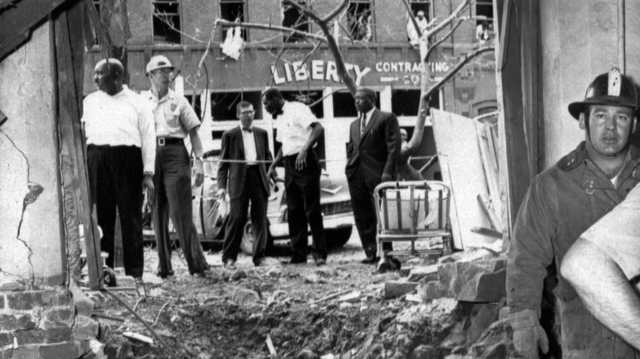
On Sunday morning September 15 a white man driving a white and turquoise Chevrolet was seen placing a boxunder the steps of the 16th Street Church.A bomb exploded as students were filing into
abasement roomfor Sunday school.The
bomb killed 11 year old Denise
McNair and Addie Mae Collins, Carole Robertson, and Cynthia Wesley, all 14 years old.
Surveying the bomb damage to the 16th Street Baptist Church.
Rev. King spoke at the funeral for
three of the girls. More than 8,000mourners, including 800 clergymen of all races, attended
the service. No city officials attended.
Outrage over the bombing and other atrocities paved the wayfor the
passage of the Civil Rights Actof 1964, which was signed into law by President Lyndon Johnson the following
summer.
Ku Klux Klan member Robert Chambliss
was later identified as the man who left the package.He was soon arrested and 122sticks
of dynamite were found in his home
matching theforensic patternof theexplosivesused in the bomb.Despite overwhelming
evidence, including an eyewitness, a local jury acquittedChambliss ofmurder and convicted him of a minor chargeofpossessing explosives.He was fined $100 and sentenced tosix monthsin local jail, where he was safely separatedfrom Black inmates and treated as ahero
by jailers.
Defiant Klansman Robert Chambliss who planted the bomb was confident and
defiant outside of the court house during his state trial for murder.
Despite overwhelming evidence an all white jury acquitted of that charge
and convicted him of a minor possession of explosives charge. He would
ultimately be brought to justice decades later and died in prison.
The verdict shocked and outraged the nation.But it was not until 1977 when young Alabama
Attorney General Bill Baxley reopened the case that anything
like justice began to be done.Baxley secured
a conviction of Chambliss despite not havingaccess to FBI fileswhich were denied him
because the agency feared that the extent of itsinfiltrationof the Klan—and possible advance
knowledge of the bombing plot—might be exposed.Chambliss
was sentenced tolife imprisonment. He died in an
Alabama prison on October 29, 1985.
In May of
2002 the FBI finallymade public its
files on the case and said that Klansmen Herman
Cash, Thomas Blanton, and Bobby Cherry had conspired with Chambliss on the bombing.Cash was dead.Blanton and Cherry were charged with murder
and eventually convicted in separate trials.Cherry was identified as the ring
leader and the man whose military
training made him familiar with
explosives.Cherry died in prison
in 2004.Blanton remains in prison.
Richard Fariña wrote Birmingham Sunday, a haunting balladrecorded by his sister in
law Joan Baez on her 1964
album Joan Baez/5 and was used as the theme song of the 1997 Spike Lee documentary about the bombing, 4
Little Girls.