Showing posts with label John L. Lewis. Show all posts

Sunday, August 28, 2022

It Was Bigger and Wider than Dr. King—The March for Jobs and Freedom Moved a Nation

Dr. Martin Luther King's ringing I Have a Dream speech was the highlight and climax of the 1963 March for Jobs and Freedom in Washington and helped change America, but the March itself was bigger than any one man.

Like a lot of people back in ’63 I was glued to the television for the beginning-to-end coverage provided by CBS News of the March for Jobs and Justice on August 28.  I was a 14 year old in Cheyenne, Wyoming at the time.  I was both thrilled and awestruck.  Listening to Dr. King’s I Have a Dream Speech literally changed my life.

The March was the brain child of labor and Civil Rights leader A. Phillip Randolph.

The march originally was the brainchild of an elder of both the labor and Civil Rights movements.  A. Philip Randolph, President of the Brotherhood of Sleeping Car Porters and of the Negro American Labor Council as well as a Vice President of the AFL-CIO modeled his call for a march on Washington on a similar event he had planned back in 1941 to force President Franklin D. Roosevelt to open employment in the burgeoning defense industry to Blacks.  Just the threat of thousands of Negros descending on the Capital had been enough to cause the President to establish the Committee on Fair Employment Practice and bar discriminatory hiring in the defense industry.  Randolph wanted to bring similar pressure on President John F. Kennedy and Congress to move on stalled Civil Rights legislation, but also to bring up new issues of jobs that had been overshadowed by the tumultuous battle for civil rights in the South

Randolph brought together the leaders of all of the largest national Civil Rights organizations including James Farmer, President of the Congress of Racial Equality (CORE); John Lewis, President of the Student Nonviolent Coordinating Committee (SNCC); Roy Wilkins, President of the National Association for the Advancement of Colored People (NAACP); Whitney Young, President of the National Urban League; and Dr. King, President of the Southern Christian Leadership Conference (SCLC) to form a coalition to sponsor the march.  It was no small feat because of turf wars, ideological differences, and egos.

Civil Rights Leaders and major speakers at the March for Jobs and Justice, standing left to right are Director of the National Catholic Conference for Interracial Justice Matthew Ahmann, Rabbi Joachim Prinz, Student Nonviolent Coordinating Committee (SNCC) leader John Lewis, Protestant minister Eugene Carson Blake, Congress of Racial Equality (CORE) leader Floyd McKissick, and UAW President Walter Reuther; sitting are National Urban League Executive Director Whitney Young, chairman of the Demonstration Committee Cleveland Robinson, Brotherhood of Sleeping Car Porters President A. Philip Randolph, Dr. Martin Luther King Jr. of the Southern Christian Leadership Conference (SCLC), and National Association for the Advancement of Colored People (NAACP) leader Roy Wilkins.

In addition, Randolph sought support from the Labor movement, most significantly from Walter Reuther, President of the United Auto Workers (UAW)The white dominated craft unions of the AFL, however, were notable for their absence

Bayard Rustin of the pacifist Fellowship of Reconciliation (FOR) and the organizer of the 1947 Journey of Reconciliation, an early forerunner of the Freedom Rides that was meant to test a Supreme Court ruling that banned racial discrimination in interstate travel, was tapped to coordinate volunteers and logistics, recruit marchers from across the country, and attend to all the other details of the march while Randolph pulled together political, labor and religious support for the march. 

Veteran pacifist and Civil Rights leader Bayard Rustin of the Fellowship of Reconciliation was the Deputy Director of the March and in charge of most of the planning and logistics.  As an openly Gay man his public profile was kept low.  Retail workers labor leader Cleveland Robinson was named Chairman of the Administrative Committee.

Other than being a star speaker that day King was not heavily involved in the planning or management of the event. He even left the details of mobilizing SCLC supporters to his aides.

As word spread, it became apparent that the march was going to turn into the largest event of its kind in history.  The media began to pay attention.  On the day of the march, buses poured into the city from sleepy Mississippi towns and from gritty industrial hubs like Detroit and Chicago.  Trains from Boston, New York, and Philadelphia were jammed.  Thousands of local Washington residents swelled the throng. 

Organizers put the crowd at more than 300,000.  The National Park Service, in charge because the speakers’ platform was erected at the Lincoln Memorial, said 200,000.  Whatever was the case, crowds filled the Mall far past the Washington Monument.  About 80% of the marchers were Black. Marchers included many celebrities including actors like Sidney Poitier, Harry Bellefonte, and Charlton Heston—yes that Charlton Heston. 

Charlton Heston, Harry Bellefonte, novelist James Baldwin, and Marlon Brando added star power to the March.

It was a Wednesday afternoon, but the three major broadcast networks broke away from their usual programming of afternoon soap operas to cover the swelling crowd and speeches live

Marian Anderson, who had sung on the same steps at the invitation of Eleanor Roosevelt after she was denied use of the Daughters of the American Revolution Constitution Hall in 1939, opened the program with the National Anthem.  Several other performers took to the stage over the course of the program, perhaps most notably Peter, Paul & Mary, Joan Baez, Bob Dylan, and Mahalia Jackson. 
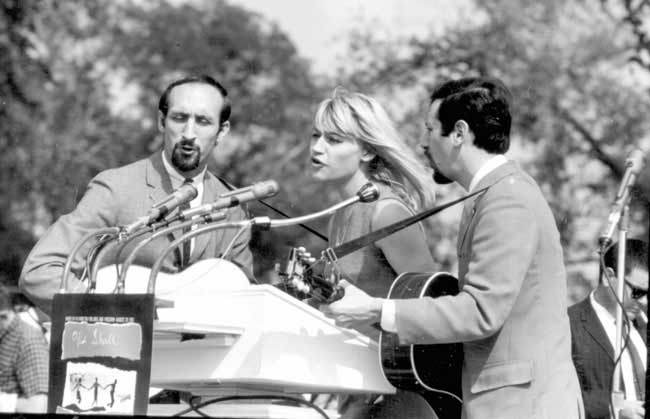
Peter Paul & Mary were among the notable entertainers who performed.  They led the crowd in Pete Seeger's anthem If I Had a Hammer.

The Catholic Archbishop of Washington, Patrick OBoyle led the invocation.  Other religious leaders on the program included Dr. Eugene Blake on behalf of the Protestant National Council of Churches and two leading Rabbis. 

After Randolph’s opening remarks each of the major civil rights leaders took the stage in turn. Floyd McKissick had to read the remarks of CORE’s James Farmer, who was in a Louisiana jail. The youngest leader, John Lewis of the militant SNCC, excoriated the Kennedy Administration for not acting to protect Civil Rights workers who were under regular and violent attack across the South.  Randolph and others who were trying to flatter and coax the President into action forced Lewis to strike the most inflammatory portions of his speech, but what was left was still plenty critical. 

Despite their notable contributions to the Civil Rights Movement key figures like Rosa Parks, and Dianne Nash were excluded from the speaker's list.  In the end the only woman to address the crowd was singer and dancer Josephine Baker who had spent most of the previous 30 years as an expatriate in Paris.  She wore her World War II uniform as a decorated member of the French Resistance.

Slain NAACP organizer Medgar Everss wife Myrlie was on the announced program to lead a Tribute to Negro Women but did not appear.  In fact, several prominent female figures in the Movement were either not invited or had their requests to be added to the program rejected by Randolph.  In the end the only woman to speak was jazz singer and dancer Josephine Baker who wore her World War II Free French uniform emblazoned with her medal of the Légion d’honneur

It all led up the last major address—the highly anticipated speech of Dr. King.  If civil rights veterans knew what to expect from the notoriously eloquent leader, millions of Americans viewing at home were in for an eye opening experience.  The speech, built to the thundering crescendo:

Let freedom ring. And when this happens, and when we allow freedom ring—when we let it ring from every village and every hamlet, from every state and every city, we will be able to speed up that day when all of God's children—black men and white men, Jews and Gentiles, Protestants and Catholics—will be able to join hands and sing in the words of the old Negro spiritual: “Free at last! Free at last! Thank God Almighty, we are free at last!”

The hundreds of thousands of ordinary folks who showed up for the March for Jobs and Justice were just as important as any of the movement heavies and celebrities.

The nation, or much of, it was awestruck and impressed.  That speech, along with the continued televised violence against Blacks struggling for equal access to public accommodations and the vote, helped set the stage for the major Civil Rights legislation enacted in the next three years.  


Saturday, February 20, 2021

The March for Jobs and Freedom Was Bigger than Dr. King— Focus on Black History Month 2021

Dr. Martin Luther King's ringing I Have a Dream speech was the highlight and climax of the 1963 March for Jobs and Freedom in Washington and helped change America, but the March itself was bigger than any one man.

Like a lot of people back in ’63 I was glued to the television for the beginning-to-end coverage provided by CBS News of the March for Jobs and Justice on August 28.  I was a 14 year old in Cheyenne, Wyoming at the time.  I was both thrilled and awestruck.  Listening to Dr. King’s I Have a Dream Speech literally changed my life.

The March was the brain child of labor and Civil Rights leader A. Phillip Randolph.

The march originally was the brainchild of an elder of both the labor and Civil Rights movements.  A. Philip Randolph, President of the Brotherhood of Sleeping Car Porters and of the Negro American Labor Council as well as a Vice President of the AFL-CIO modeled his call for a march on Washington on a similar event he had planned back in 1941 to force President Franklin D. Roosevelt to open up employment in the burgeoning defense industry to Blacks.  Just the threat of thousands of Negros descending on the Capital had been enough to cause the President to establish the Committee on Fair Employment Practice and bar discriminatory hiring in the defense industry.  Randolph wanted to bring similar pressure on President John F. Kennedy and Congress to move on stalled Civil Rights legislation, but also to bring up new issues of jobs that had been overshadowed by the tumultuous battle for civil rights in the South. 

Randolph brought together the leaders of all of the largest national Civil Rights organizations including James Farmer, President of the Congress of Racial Equality (CORE); John Lewis, President of the Student Nonviolent Coordinating Committee (SNCC); Roy Wilkins, President of the National Association for the Advancement of Colored People (NAACP); Whitney Young, President of the National Urban League; and Dr. King, President of the Southern Christian Leadership Conference (SCLC) to form a coalition to sponsor the march.  It was no small feat because of turf wars, ideological differences, and egos.

Civil Rights Leaders and major speakers at the March for Jobs and Justice, standing left to right are Director of the National Catholic Conference for Interracial Justice Matthew Ahmann, Rabbi Joachim Prinz, Student Nonviolent Coordinating Committee (SNCC) leader John Lewis, Protestant minister Eugene Carson Blake, Congress of Racial Equality (CORE) leader Floyd McKissick, and UAW President Walter Reuther; sitting are National Urban League Executive Director Whitney Young, chairman of the Demonstration Committee Cleveland Robinson, Brotherhood of Sleeping Car Porters President A. Philip Randolph, Dr. Reverend Martin Luther King Jr. of the Southern Christian Leadership Conference (SCLC), and National Association for the Advancement of Colored People (NAACP) leader Roy Wilkins.

In addition Randolph sought support from the Labor movement, most significantly from Walter Reuther, President of the United Auto Workers (UAW).  The White dominated craft unions of the AFL, however, were notable for their absence. 

Bayard Rustin of the pacifist Fellowship of Reconciliation (FOR) and the organizer of the 1947 Journey of Reconciliation, an early forerunner of the Freedom Rides that was meant to test a Supreme Court ruling that banned racial discrimination in interstate travel, was tapped to coordinate volunteers and logistics, recruit marchers from across the country, and attend to all of the other details of the march while Randolph pulled together political, labor and religious support for the march. 

Veteran pacifist and Civil Rights leader Beyard Rustin of the Fellowship of Reconciliation was the Deputy Director of the March and in charge of most of the planning and logistics.  As an openly Gay man his public profile was kept low.  Retail workers labor leader Cleveland Robinson was named Chairman of the Administrative Committee.

Other than being a star speaker that day King was not heavily involved in the planning or management of the event. He even left the details of mobilizing SCLC supporters to his aides.

As word spread, it became apparent that the march was going to turn into the largest event of its kind in history.  The media began to pay attention.  On the day of the march, buses poured into the city from sleepy Mississippi towns and from gritty industrial hubs like Detroit and Chicago.  Trains from Boston, New York, and Philadelphia were jammed.  Thousands of local Washington residents swelled the throng. 

Organizers put the crowd at more than 300,000.  The National Park Service, in charge because the speakers’ platform was erected at the Lincoln Memorial, said 200,000.  Whatever was the case, crowds filled the Mall far passed the Washington Monument.  About 80% of the marchers were Black. Marchers included many celebrities including actors like Sidney Poitier, Harry Bellefonte, and Charlton Heston—yes that Charlton Heston. 

Charlton Heston, Harry Bellefonte, novelist James Baldwin, and Marlon Brando added star power to the March.

It was a Wednesday afternoon but the three major broadcast networks broke away from their usual programming of afternoon soap operas to cover the swelling crowd and speeches live. 

Marian Anderson, who had sung on the same steps at the invitation of Eleanor Roosevelt after she was denied use of the Daughters of the American Revolution Constitution Hall in 1939, opened the program with the National Anthem.  Several other performers took to the stage over the course of the program, perhaps most notably Peter, Paul and Mary, Joan Baez, Bob Dylan, and Mahalia Jackson.

Peter Paul & Mary were among the notable entertainers who performed.  They led the crowd in Pete Seeger's anthem If I Had a Hammer. Seeger himself did not appear despite his close association with the Civil Rights Movement in he South because memories of his his former Communist Party membership and indictment for his First Amendment refusal to testify against others before the House Un-American Activities Committee.

The Catholic Archbishop of Washington, Patrick O’Boyle led the invocation.  Other religious leaders on the program included Dr. Eugene Blake on behalf of the Protestant National Council of Churches and two leading Rabbis. 

After Randolph’s opening remarks each of the major civil rights leaders took the stage in turn. Floyd McKissick had to read the remarks of CORE’s James Farmer, who was in a Louisiana jail. The youngest leader, John Lewis of the militant SNCC, excoriated the Kennedy Administration for not acting to protect Civil Rights workers who were under regular and violent attack across the South.  Randolph and others who were trying to flatter and coax the President into action forced Lewis to strike the most inflammatory portions of his speech, but what was left was still plenty critical. 

Despite their notable contributions to the Civil Rights Movement key figures like Rosa Parks, and Dianne Nash were excluded from the speaker's list.  In the end the only woman to address the crowd was singer and dancer Josephine Baker who had spent most of the previous 30 years as an expatriate in Paris.  She wore her World War II uniform as a decorated member of the French Resistance.

Slain NAACP organizer Medgar Evers’s wife Myrlie was on the announced program to lead a Tribute to Negro Women, but did not appear.  In fact several prominent female figures in the Movement were either not invited or had their requests to be added to the program rejected by Randolph.  In the end the only woman to speak was jazz singer and dancer Josephine Baker who wore her World War II Free French uniform emblazoned with her medal of the Légion d’honneur. 

It all led up the last major address—the highly anticipated speech of Dr. King.  If civil rights veterans knew what to expect from the notoriously eloquent leader, millions of Americans viewing at home were in for an eye opening experience.  The speech, built to the thundering crescendo:

Let freedom ring. And when this happens, and when we allow freedom ring—when we let it ring from every village and every hamlet, from every state and every city, we will be able to speed up that day when all of God's children—black men and white men, Jews and Gentiles, Protestants and Catholics—will be able to join hands and sing in the words of the old Negro spiritual: “Free at last! Free at last! Thank God Almighty, we are free at last!”

The hundreds of thousands of ordinary folks who showed up for the March for Jobs and Justice were just as important as any of the movement heavies and celebrities.

The nation, or much of, it was awestruck and impressed.  That speech, along with the continued televised violence against Blacks struggling for equal access to public accommodations and the vote, helped set the stage for the major Civil Rights legislation enacted in the next three years. 


Wednesday, August 28, 2019

Bigger than Dr. King—The March for Jobs and Freedom Moved a Nation

Dr. Martin Luther King's ringing I Have a Dream speech was the highlight and climax of the 1963 March for Jobs and Freedom in Washington and helped change America, but the March itself was bigger than any one man.
Like a lot of people back in ’63 I was glued to the television for the beginning-to-end coverage provided by CBS News of the March for Jobs and Justice on August 28.  I was a 14 year old in Cheyenne, Wyoming at the time.  I was both thrilled and awestruck.  Listening to Dr. King’s I Have a Dream Speech literally changed my life.

The March was the brain child of labor and Civil Rights leader A. Phillip Randolph.
The march originally was the brainchild of an elder of both the labor and Civil Rights movements.  A. Philip Randolph, President of the Brotherhood of Sleeping Car Porters and of the Negro American Labor Council as well as a Vice President of the AFL-CIO modeled his call for a march on Washington on a similar event he had planned back in 1941 to force President Franklin D. Roosevelt to open up employment in the burgeoning defense industry to Blacks.  Just the threat of thousands of Negros descending on the Capital had been enough to cause the President to establish the Committee on Fair Employment Practice and bar discriminatory hiring in the defense industry.  Randolph wanted to bring similar pressure on President John F. Kennedy and Congress to move on stalled Civil Rights legislation, but also to bring up new issues of jobs that had been overshadowed by the tumultuous battle for civil rights in the South. 
Randolph brought together the leaders of all of the largest national Civil Rights organizations including James Farmer, President of the Congress of Racial Equality (CORE); John Lewis, President of the Student Nonviolent Coordinating Committee (SNCC); Roy Wilkins, President of the National Association for the Advancement of Colored People (NAACP); Whitney Young, President of the National Urban League; and Dr. King, President of the Southern Christian Leadership Conference (SCLC) to form a coalition to sponsor the march.  It was no small feat because of turf wars, ideological differences, and egos.

Civil Rights Leaders and major speakers at the March for Jobs and Justice, standing left to right are Director of the National Catholic Conference for Interracial Justice Matthew Ahmann, Rabbi Joachim Prinz, Student Nonviolent Coordinating Committee (SNCC) leader John Lewis, Protestant minister Eugene Carson Blake, Congress of Racial Equality (CORE) leader Floyd McKissick, and UAW President Walter Reuther; sitting are National Urban League Executive Director Whitney Young, chairman of the Demonstration Committee Cleveland Robinson, Brotherhood of Sleeping Car Porters President A. Philip Randolph, Dr. Reverend Martin Luther King Jr. of the Southern Christian Leadership Conference (SCLC), and National Association for the Advancement of Colored People (NAACP) leader Roy Wilkins.
In addition Randolph sought support from the Labor movement, most significantly from Walter Reuther, President of the United Auto Workers (UAW).  The White dominated craft unions of the AFL, however, were notable for their absence. 
Bayard Rustin of the pacifist Fellowship of Reconciliation (FOR) and the organizer of the 1947 Journey of Reconciliation, an early forerunner of the Freedom Rides that was meant to test a Supreme Court ruling that banned racial discrimination in interstate travel, was tapped to coordinate volunteers and logistics, recruit marchers from across the country, and attend to all of the other details of the march while Randolph pulled together political, labor and religious support for the march.  
Veteran pacifist and Civil Rights leader Beyard Rustin of the Fellowship of Reconciliation was the Deputy Director of the March and in charge of most of the planning and logistics.  As an openly Gay man his public profile was kept low.  Retail workers labor leader Cleveland Robinson was named Chairman of the Administrative Committee.
Other than being a star speaker that day King was not heavily involved in the planning or management of the event. He even left the details of mobilizing SCLC supporters to his aides.
As word spread, it became apparent that the march was going to turn into the largest event of its kind in history.  The media began to pay attention.  On the day of the march, buses poured into the city from sleepy Mississippi towns and from gritty industrial hubs like Detroit and Chicago.  Trains from Boston, New York, and Philadelphia were jammed.  Thousands of local Washington residents swelled the throng. 
Organizers put the crowd at more than 300,000.  The National Park Service, in charge because the speakers’ platform was erected at the Lincoln Memorial, said 200,000.  Whatever was the case, crowds filled the Mall far passed the Washington Monument.  About 80% of the marchers were Black. Marchers included many celebrities including actors like Sidney Poitier, Harry Bellefonte, and Charlton Heston—yes that Charlton Heston.  

Charlton Heston, Harry Bellefonte, novelist James Baldwin, and Marlon Brando added star power to the March.
It was a Wednesday afternoon but the three major broadcast networks broke away from their usual programming of afternoon soap operas to cover the swelling crowd and speeches live. 
Marian Anderson, who had sung on the same steps at the invitation of Eleanor Roosevelt after she was denied use of the Daughters of the American Revolution Constitution Hall in 1939, opened the program with the National Anthem.  Several other performers took to the stage over the course of the program, perhaps most notably Peter, Paul and Mary, Joan Baez, Bob Dylan, and Mahalia Jackson.  

Peter Paul & Mary were among the notable entertainers who performed.  They led the crowd in Pete Seger's anthem If I Had a Hammer.
The Catholic Archbishop of Washington, Patrick O’Boyle led the invocation.  Other religious leaders on the program included Dr. Eugene Blake on behalf of the Protestant National Council of Churches and two leading Rabbis. 
After Randolph’s opening remarks each of the major civil rights leaders took the stage in turn. Floyd McKissick had to read the remarks of CORE’s James Farmer, who was in a Louisiana jail. The youngest leader, John Lewis of the militant SNCC, excoriated the Kennedy Administration for not acting to protect Civil Rights workers who were under regular and violent attack across the South.  Randolph and others who were trying to flatter and coax the President into action forced Lewis to strike the most inflammatory portions of his speech, but what was left was still plenty critical.  

Despite their notable contributions to the Civil Rights Movement key figures like Rosa Parks, and Dianne Nash were excluded from the speaker's list.  In the end the only woman to address the crowd was singer and dancer Josephine Baker who had spent most of the previous 30 years as an expatriate in Paris.  She wore her World War II uniform as a decorated member of the French Resistance.
Slain NAACP organizer Medgar Evers’s wife Myrlie was on the announced program to lead a Tribute to Negro Women, but did not appear.  In fact several prominent female figures in the Movement were either not invited or had their requests to be added to the program rejected by Randolph.  In the end the only woman to speak was jazz singer and dancer Josephine Baker who wore her World War II Free French uniform emblazoned with her medal of the Légion d’honneur. 
It all led up the last major address—the highly anticipated speech of Dr. King.  If civil rights veterans knew what to expect from the notoriously eloquent leader, millions of Americans viewing at home were in for an eye opening experience.  The speech, built to the thundering crescendo:
Let freedom ring. And when this happens, and when we allow freedom ring—when we let it ring from every village and every hamlet, from every state and every city, we will be able to speed up that day when all of God's children—black men and white men, Jews and Gentiles, Protestants and Catholics—will be able to join hands and sing in the words of the old Negro spiritual: “Free at last! Free at last! Thank God Almighty, we are free at last!”

The hundreds of thousands of ordinary folks who showed up for the March for Jobs and Justice were just as important as any of the movement heavies and celebrities.
The nation, or much of, it was awestruck and impressed.  That speech, along with the continued televised violence against Blacks struggling for equal access to public accommodations and the vote, helped set the stage for the major Civil Rights legislation enacted in the next three years. 

Saturday, December 30, 2017

A Brazen Act of Bold Defiance—The Flint Sit-Down Strike

United Auto Workers members at Fisher Body Plant #1 made themselves at home inside when they learned General Moters was trying to sneak critical dies out ot the plant in advance of a strike planned after the first of the year.


Eighty years ago today the Flint Sit-Down Strike of 1937, the great heroic event in the unionization of the American auto industry, broke out.  Previous attempts to organize by AFL craft unions and by the Industrial Workers of the World (IWW) had failed to make permanent inroads.  The new United Auto Workers (UAW), an industrial union organized on lines similar the IWW and backed by John L. Lewis’s Congress of Industrial Organizations (CIO), had built scattered locals but had yet made no real headway in organizing the industry.  Many thought the new union would fail.
The union decided to target General Motors for a major organizing drive by striking its two Fisher Body plants in Cleveland, Ohio and Flint, Michigan.  By cutting off the supply of auto bodies, they could quickly shut down all GM production.  Besides, the union had its strongest support at Fisher.  
Self-organized as the Women's Emergency Brigade, the wives, mothers, and sisters of strkers played a critical part in the struggle from bring food to be passed through plant windows to forming mass picket lines to confront company scabs and goons.
When the company got wind of plans to strike after New Year’s 1937, it started stripping essential stamping dies from the Flint plant to be sent to Cleveland.  On December 30 local leaders at the Flint #1 plant called a hasty lunch-hour meeting and decided to launch a sit-down strike, occupying the plant and preventing the dies from being moved.  The IWW had pioneered the sit-down strike at Briggs Auto and Murray Body in 1933, so the workers were aware of the tactic.
Workers set up cots, elected a “mayor” and council to run things, and got support from wives and family members who passed food through the plant windows.  The union governing committee ignored repeated injunctions to end the strike and repelled an attempt by police to re-take the factory by force on January 11 by turning fire hoses on them.  The strike spread to Chevrolet #4 and was attracting national attention.  

The virtually universal history of National Guard intervention in American labor struggles was as a heavy handed, and sometime lethal, reinforcements for company goons, posses, vigilantes, and local police in attacking workers.  New Deal Michiga Governor Frank Murphy called up the Guard with entirely different instructions--to protect strikers and their supporters from attacks by company goon squads.  They effectively prevented another attempt to take the plant by force after a January 11 assault was repelled by the workers. Here they stand by as food and milk is delivered to the strikers through a window..
Newly inaugurated Michigan Governor Frank Murphy, a New Deal Democrat elected with strong labor support, called up the National Guard not to attack the strikers, but to defend them from scabs and goon squads being organized by the company.
As production at all facilities ground to a halt, the company was forced to enter negotiations with John L. Lewis speaking for the UAW since the company refused to be in the same room with UAW leaders.  On February 11 the company signed a one-page agreement recognizing the UAW as the bargaining agent of its members for the next six months. 

Celebrating victory after almost a month and a half of occupying the plant.
On the strength of this victory the UAW signed up more than 100,000 more GM workers and enforced conditions by local grievance walkouts across the country.  Eventually other automakers, including highly resistant Ford, also recognized the union.