Showing posts with label June Carter. Show all posts

Friday, January 14, 2022

Folsom Prison—The Greatest Concert You Couldn’t Get a Ticket To

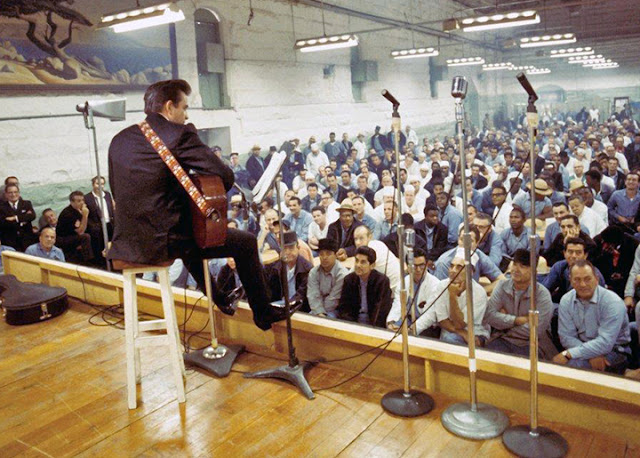
For much of the Folsom concert, Cash set on a stool at the front of the stage, his feet propped up on a rail, as close to his audience of cons as he could get.

Today is the anniversary of the two greatest concerts you could never buy a ticket to.  On January 14, 1968 Johnny Cash, the Tennessee Three, June Carter, Carl Perkins and The Statler Brothers played two shows at an unusual venueCalifornia’s Folsom Prison.

The shows were hastily arranged by Cash and executives at Columbia Records for the express purpose of making a live recording in front of an audience of inmates.  The idea was rooted in Cash’s 1955 Sun Records single Folsom Prison Blues

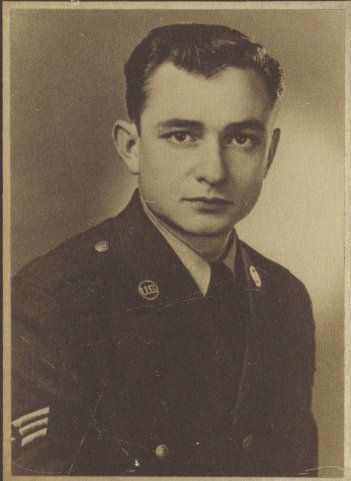
                        Johnny Cash as an Airman.

Cash was inspired to write the song while he was still in the Air Force in Germany.  His unit was shown the 1951 film Inside the Walls of Folsom Prison, a B-movie starring Steve Cochran, a dark haired actor who bore more than a passing resemblance to Cash himself.  Inspired, Cash wrote the song, borrowing much of the melody and some of the words from Gordon Jenkins’s Crescent City Blues on his long-form concept album Seven Dreams.  Jenkins’s contribution was unaccredited on the first single release but included in later issues.

The song was a minor hit for Cash but became part of his standard stage show.  It also gained a cult following among inmates, who frequently wrote to the star and asked for him to play at their institutions.  Cash made a point of replying—or making sure his staff replied—to all the prison inquiries and did begin doing occasional prison shows.  The first was at Huntsville State Prison in Alabama in 1957.

As Cash’s career progressed he began to cultivate a persona as an outsider, a rebel, a potentially dangerous man.  His songs and prison performances created a wide-spread impression that he had been in prison himself—a notion he did very little to discourage.  Indeed, like his identification with the struggle of Native Americans caused him to claim Cherokee blood, this image became so firmly rooted in his mind that he began to more than half believe it himself.

Cash's mug shot for his 1965 Mississippi arrest for picking flowers in a park.

In fact, Cash had spent about three nights in jail, all in drug related incidents.  One case was for trespassing to pick flowers in a Starksville, Mississippi park in 1965 while stoned. He would later sing about that on a recording made later at San Quentin.

In 1969 Cash had hit bottom in a long struggle with pillsamphetamines and downers—as well as alcohol that had damaged his career and caused the end of his first marriage.  After an epiphany deep in a Tennessee cave, he became determined to shake addiction.  With the help of his touring partner and love interest June Carter and her mother, the legendary Maybelle Carter, the singer went cold turkey on pills during an excruciating week.  He would stay sober for the next seven years but would suffer periodic relapses the rest of his life. 

To rejuvenate his career, Cash wanted to follow up his deeply personal Bitter Tears, his 1964 album of songs on the plight of Native Americans and his 1965 double LP Ballads of the True West, with a live recording at a prison.  Columbia executives, then down on Cash for diminished record sales and erratic behavior during the worst period of his addiction, flatly refused.  But when the country music division of the label underwent change, Cash’s new producer Bob Johnston was enthusiastic.  Phone calls were made offering shows to official at both Folsom and San Quentin.  Folsom agreed first and the concerts were hastily arranged.

Shows were presented to inmates at 9:30 am and again at 12:00 so that engineers would have two takes on most numbers.  The play lists also varied slightly to provide more song options for the planned album.  Carl Perkins opened the show with his Sun Records classic Blue Suede Shoes and the Statler Brothers did their huge hit Flowers on the Wall before Cash took the stage.

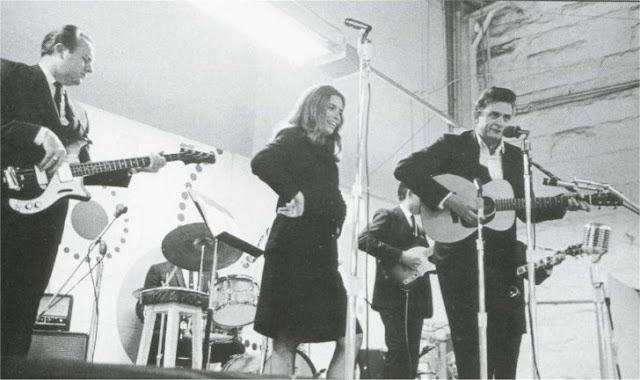
Carl Perkins, June Carter, Cash on stage at Folsom backed by the Tennessee Three.

An announcer instructed the prisoners not to cheer Cash until he got on stage and opened with his signature “Hello, I’m Johnny Cash.”  Both shows opened with Folsom Prison Blues and a set of prison related songs that included The Green, Green Grass of Home, and the comic execution song 25 Minutes to Go.  June Carter, to whom Cash would propose marriage on a stage of a London Ontario concert just a little over a month later, joined him on stage for duets.  Among the other songs that Cash performed at one or both of the shows were The Orange Blossom Special, Long Black Veil, I Still Miss Someone, Stripes, and Cocaine Blues.

It took for months of production to ready the resulting album Johnny Cash At Folsom Prison.  Of 16 cuts on the album, 14 came from the first show when the musicians were fresher.  The cheering heard on Folsom Prison Blues when the line “shot a man in Reno” was added in postproduction because the inmates were careful not to cheer mentions of lawbreaking for fear of reprisals from the guards

Columbia, which was trying to concentrate on its rock and pop catalogue did not heavily promote the record when it was released, but the album got a boost when the new version of Folsom Prison Blues quickly shot to the top of the Country music charts and was climbing the pop charts.  It suffered a setback when many radio stations pulled the song for its reference to murder in the wake of the assassination of Bobby Kennedy in April.

Johnny Cash at Folsom Prison is regarded by many critics as the greatest country music album of all time.

The album was greeted with unanimous rave reviews in both the country music and mainstream pressAl Aronowitz in Life summed of the sentiment of most critics that Cash sang like “someone who has grown up believing he is one of the people that these songs are about.”

The record was a #1 Country hit and rose to 13 on Billboard’s Pop Album chart in a year dominated by the Beatles and the emergence of American psychedelic rock.  It was certified as a Gold Record for half a million copies shipped by August.  On the strength of the record’s success and cross-over appeal, ABC Television gave Cash his own prime time variety show, destined to be a legendary showcase not only for the star but for a who’s who of rising folk, country, pop, and rock and roll acts.

The original album is generally regarded as the greatest country music record of all time.  Re-released as a CD in 1999 with three additional tracks from the concerts, it scored again, this time going Triple Platinum for sales of over three million copies.  In 2008, Columbia and Legacy Records re-issued At Folsom Prison as a two CD, one DVD set with both concerts uncut and remastered, including the performances by Perkins, the Statler Brothers, and June Carter.  The DVD contained both original footage and interviews with Cash, Carter and others involved in the project. 

Almost makes you wish that you were a California felon lucky enough to be in the original audience. 

Friday, April 10, 2020

The Old Rugged Cross—Murfin Home Confinement Music Festival 2020

The Old Rugged Cross sung by Johnny Cash and June Carter.

Good Friday is such a sad day for Christians that it is hard to be chipper especially when believers, do not even have the consolation of coming together for worship these days.  And it makes it hard to pick out an appropriate song for the Home Confinement Music Festival.  Then I remember millions of American Protestants have long taken comfort in the Hymn The Old Rugged Cross.

George Bennard, writer and composer of The Old Rugged Cross.
It was written in 1912 by  evangelist and song-leader George Bennard, 1873–1958, who was saved as a young man by the Salvation Army who became a Methodist camp meeting revivalist.  It was popularized when two of evangelist Billy Sunday’s musicians, Homer Rodeheaver, who bought the publishing rights to the song for a reported $50 or $500 and Virginia Asher.  Together as a duo they were the  record it in 1921.  It circulated as a revival campaign staple for decades and the sheet music  sold briskly for both church accompanists  and home parlor pianists especially in the South.
Music for The Old Rugged Cross.
But did not become more widely known until Ernest Tubb's 1953 album, The Old Rugged Cross.  After that it became a staple of the burgeoning sub-genre of country gospel music.  Many of country music’s biggest stars recorded it on the gospel albums including Al Green, Andy Griffith, Anne Murray, Brad Paisley, Chet Atkins, George Jones, Eddy Arnold, Jim Reeves, Merle Haggard, Patsy Cline, Loretta Lynn, Ray Price, Tennessee Ernie Ford, , Roy Rogers and Dale Evans, The Oak Ridge Boys, The Statler Brothers, Vince Gill, Willie Nelson, Alan Jackson, George Beverly Shea, and John Prine.  That’s a whole wing of the Country Music Hall of Fame right there.
The cover for a re-mastered version of Ernest Tubb's recording.

As a boy growing up in Cheyenne, Wyoming in the 1950’s the song was inescapable at Easter time.  Mom played her favorite,  Tennessee Ernie Ford, over and over at our house.
Black gospel singers including Mahalia Jackson and the Rev. Al Green also recorded it as did folk/rock superstar Bob Dylan.  The new genre of Christian Rock is all over it as well bringing it to the new Evangelical Mega Churches.

Johnny Cash Sings Precious Memories, 1975,
Today we will enjoy a live performance by Johnny Cash and June Carter before thousands in a sports arena.  The song was included on Cash’s 1975 album Johnny Cash Sings Precious Memories

Friday, March 27, 2020

May the Circle Be Unbroken—Murfin Home Confinement Music Festival

Can the Circle be Unbroken by the original Carter Family, 1927.

Those of us of a certain age recall the popular game of Six Degrees of Kevin Bacon.  The idea was that the busy actor could be connected to anyone else in Hollywood in less than six steps.  In fact it was shown that he was connected to most contemporary actors by two steps and even those from the dawn of motion pictures by three.  The idea that any two people in the world could be connected in six steps originated with Hungarian playwright Frigyes Karinthy in 1929 and was popularized in 1990 play Six Degrees Separation written by John Guare

Six degrees of Kevin Bacon.
The concept has been generalized to the average social distance in the global population calculable by a logarithm.  Several experiments to test that hypothesis have consistently produced results that hover around six.  In the largest test to date tracing internet connection through social media and messaging found that almost everyone could be connected in 6.6 steps.  Of course that was biased by computer access and the relative wealth and education levels that entails.  But many population experts believe that similar numbers could be produced if personal connections, extended families, ancestry, business relationships, and correspondence could be traced except for the most isolated and primitive societies like the uncontacted native tribes of the Amazon.
The point of all this is that by this point in the Coronavirus Pandemic each of us have become aware of connections of two or three steps to those who have been tested for and contracted virus and even those who have now died.  Some of will have a 0 degree of separation—meaning that they have personally been infected.  Putting aside celebrities who have been reported, we find links in our immediate and extended families, work associates, social groups, and communities.  We are indeed very connected.

Not to be morbid about it, but most of us have already or will lose someone close to them.  Which brings us to today’s song—Will the Circle Be Unbroken which is apt on at least two levels.  The song was written in 1907 by lyricist Ada R. Habershon and composer Charles H. Gabriel but has often been unattributed as it spread via parlor musicians and community dances over the next decades.
It was collected and adapted by A.P. Carter from isolated Mace Springs, Virginia.  It is not clear if at first he was aware of the original authorship or had seen any sheet music.  He probably took notes from front porch performances during one of his many song collecting tours of the Appalachian region.  He called his version Can the Circle Be Unbroken and there was some variation in lyrics from the original.  It was one of the songs that the Carter Family—A.P., his wife Sara, and Maybelle who was Sara’s cousin and A.P.’s sister-in-law—recorded in their Victor sessions in Bristol, Tennessee in 1927 and again in August of 1935.  Subsequent recordings of the song by Sara and Maybelle and by Maybelle with her daughters the Carter sisters June, Helen, and Anita reverted to the original title as did most of the many covers based on the Carter Family song.

The Carter Family in 1927--Maybelle, Sara, and A.P.
By the way, in case you are interested Kevin Bacon is only three degrees from Mother Maybelle via Tommy Lee Jones in JFK then Johnny Cash in The Hunted who was the husband of June Carter and appeared with Mother Maybelle in numerous TV shows.


Tuesday, January 14, 2014

The Classic Concert You Couldn’t Buy a Ticket to

For much of the Folsom concert, Cash set on a stool at the front of the stage, his feet propped up on a rail, as close to his audience of cons as he could get.


Today is the anniversary of the two greatest concerts you could never buy a ticket to.  On January 14, 1968 Johnny Cash, the Tennessee Three, June Carter, Carl Perkins and The Statler Brothers played two shows at an unusual venue—California’s Folsom Prison.

The shows were hastily arranged by Cash and executives at Columbia Records for the express purpose of making a live recording in front of an audience of inmates.  The idea was rooted in Cash’s 1955 Sun Records single Folsom Prison Blues.  Cash was inspired to write the song while he was still in the Air Force in Germany.  His unit was shown the 1951 film Inside Folsom Prison, a B-movie starting Steve Cochran, a dark haired actor who bore more than a passing resemblance to Cash himself.  Inspired, Cash wrote the song, borrowing much of the melody and some of the words from Gordon Jenkins’s Crescent City Blues from his long-form concept album Seven Dreams.  Jenkins’s contribution was unaccredited on the first single release, but included in later issues.
The song was a minor hit for Cash, but became part of his standard stage show.  It also gained a cult following among inmates, who frequently wrote to the star and asked for him to play at their institutions.  Cash made a point of replying—or making sure his staff replied—to all of the prison inquiries and did begin doing occasional prison shows.  The first was at Huntsville State Prison in Alabama in 1957.

As Cash’s career progressed he began to cultivate a persona as an outsider, a rebel, a potentially dangerous man.  His songs and prison performances created a wide-spread impression that he had been in prison himself—a notion he did very little to discourage.  Indeed, like his identification with the struggle of Native Americans caused him to claim Cherokee blood, this image became so firmly rooted in his mind that he began to more than half believe it himself.
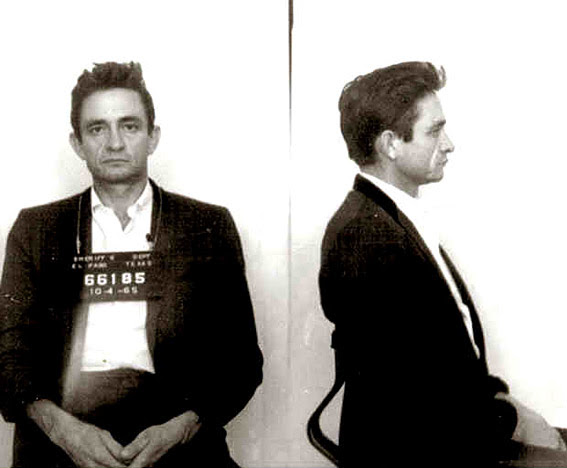
In fact, Cash had spent about three nights in jail, all in drug related incidents in his life.  One case was for trespassing for picking flowers in a Starksville, Mississippi park in 1965 while stoned. He would sing about that on a recording made later at San Quentin.

In 1969 Cash had hit bottom in a long struggle with pills—amphetamines and downers—as well as alcohol that had damaged his career and caused the end of his first marriage.  After an epiphany deep in a Tennessee cave, he became determined to shake addiction.  With the help of his touring partner and love interest June Carter and her mother, the legendary Maybelle Carter, the singer went cold turkey on pills during an excruciating week.  He would stay sober for the next seven years, but would suffer periodic relapses the rest of his life. 

To rejuvenate his career, Cash wanted to follow up his deeply personal LP Bitter Tears, his 1964 record of songs on the plight of Native Americans and his 1965 double record album Ballads of the True West, with a live recording at a prison.  Columbia executives, then down on Cash for diminished record sales and erratic behavior during the worst period of his addiction, flatly refused.  But when the country music division of the label underwent change, Cash’s new producer Bob Johnston was enthusiastic.  Phone calls were made offering shows to officials at both Folsom and San Quentin.  Folsom agreed first and the concerts were hastily arranged.

Shows were presented to inmates at 9:30 am and again at 12:00 so that engineers would have two takes on most numbers.  The play lists also varied slightly to provide more song options for the planned album.  Carl Perkins opened the show with his Sun Records classic Blue Suede Shoes and the Statler Brothers did their huge hit Flowers on the Wall before Cash took the stage.  An announcer instructed the prisoners not to cheer Cash until he got on stage and opened with his signature “Hello, I’m Johnny Cash.”  Both shows opened with Folsom Prison Blues and a set of prison related songs that included The Green, Green Grass of Home, and the comic execution song 25 Minutes to Go.  June Carter, to whom Cash would propose marriage on a stage of a London Ontario concert just a little over a month later, joined him on stage for duets.  Among the other songs that Cash performed at one or both of the shows were The Orange Blossom Special, Long Black Veil, I Still Miss Someone, Stripes, and Cocaine Blues.
It took for months of production to ready the resulting album Johnny Cash At Folsom Prison.  Of 16 cuts on the album, 14 came from the first show when the musicians were fresher.  The raucous cheering heard on Folsom Prison Blues when the line “shot a man in Reno” was added in post production because the inmates were careful not to cheer mentions of lawbreaking for fear of reprisals from the guards. 

Columbia Records, which was trying to concentrate on its rock and pop catalogue did not heavily promote the record when it was released, but the album got a boost when the new version of Folsom Prison Blues quickly shot to the top of the Country music charts and was climbing the pop charts.  It suffered a set back when many radio stations pulled the song for its reference to murder in the wake of the assassination of Bobby Kennedy in April.
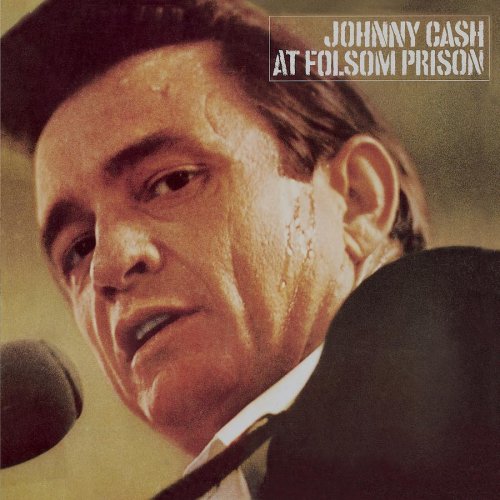
The album was greeted with unanimous rave reviews in both the country music and mainstream press.  Al Aronowitz in Life summed of the sentiment of most critics that Cash sang like “someone who has grown up believing he is one of the people that these songs are about.”

The record was a Number 1 Country hit and rose to 13 on Billboard’s Pop Album chart in a year dominated by the Beatles and the emergence of American psychedelic rock.  It was certified as a Gold Record for half a million copies shipped by August.  On the strength of the record’s success and cross-over appeal, ABC Television gave him his own prime time variety show, destined to be a legendary showcase not only for the star but for a who’s who of rising folk, country, pop, and rock and roll acts.

The original album is generally regarded as the greatest country music record of all time.  Re-released as a CD in 1999 with three additional tracks from the concerts, it scored again, this time going Triple Platinum for sales of over three million copies.  In 2008, Columbia and Legacy Records re-issued At Folsom Prison as a two CD, one DVD set with both concerts uncut and remastered, including the performances by Perkins, the Statler Brothers, and June Carter.  The DVD contained both original footage and interviews with Cash, Carter and others involved in the project. 

Almost makes you wish that you were a California felon lucky enough to be in the original audience.