Showing posts with label Métis. Show all posts

Friday, May 23, 2025

Canadian Mounties as a National Symbol are Ready to Face Off Against a Real U.S. Threat


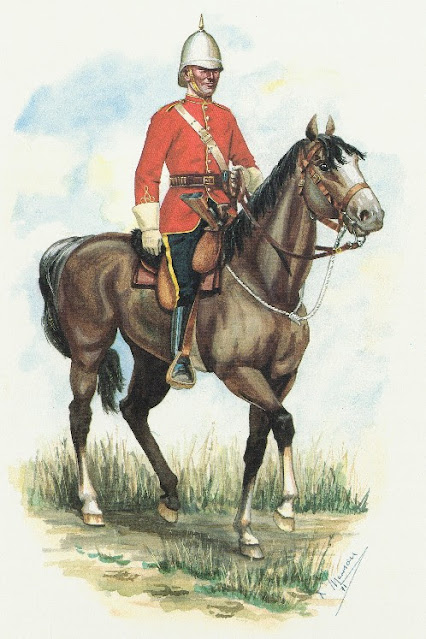
                                                         A Northwest Canadian Mounted Police Constable in 1876.

On May 23, 1873 acting on the advice of Canadian Prime Minister John A. Macdonald Queen Victoria gave her personal approval to the establishment of the North West Mounted Police.  Macdonald was keen on extending authority over the vast, lightly populated Northwest Territories, discouraging the ever expansionist United States from moving into the vacuum, and preventing the kind of full scale Indian warfare that characterized the American frontier.

The unit was originally conceived of as an army cavalry unit to be called the Northwest Rifles modeled after the Indian Army’s famed Khyber Rifles.  But Macdonald feared that the military form might antagonize the native peoples and the United States and possibly lead to conflict.  Instead, he decided to turn to the civilian, paramilitary police Royal Irish Constabulary as his model.  Rank and file members were designated as Constables.  But it was organized as a lancer cavalry unit and outfitted in standard Imperial red tunics and colonial white pith helmets. 

The first force under Commissioner Arthur French was trained and assembled at Fort Dufferin in Manitoba and was dispatched on its first deployment on July 8, 1874, the Long March  to Fort Whoop-Up  in what is now southern Alberta.  Fort Whoop-up was a trading post established by Americans operating from near-by Montana Territory.  Its trading staples included plenty of fire water and the purpose of the expedition of 22 officers and 287 constables and sub-constables was to stamp out the trade.  Of more real concern may have been reports that the traders were flying the American flag over the fort.  


Officers and Constables in garrison uniforms including the jaunty pillbox caps that they much preffered to pith helmets and often wore on patrol at Ft. March in 1878.

Word of the advancing force was enough to cause the Americans to abandon the fort and French established his first frontier post, Ft. MacLeod nearby.  The force clearly established Canada’s claim to the west and made possible a southern route for the trans-Canadian railway. 

The NWMP early duties include continued suppression of the whiskey trade, keeping peace among native tribes, and general law enforcement.  Each post commander was sworn in as a Justice of the Peace so that the force had judicial as well as police power and over vast areas was the only form of organized government.  Because the force gained a reputation for treating native people fairly, even in disputes with Whites, peace was generally kept.  When Sitting Bull and thousands of Sioux crossed the border in 1876 after the Battle of the Little Big Horn seeking the protection of the Great White Mother (Victoria), NWMP under James Morrow Walsh maintained order at the Sioux settlement at Wood Mountain and the presence of a large armed force dissuaded the American Cavalry from any cross border adventures.  


 The Mounted police engaged as soldiers in the Métis Rebellion alongside Army troops like the Middlands Regiment which made a bayonet charge at the Battle of Batoche in 1885.

In 1885 the NWMP saw their first, and only, widespread domestic use as a military force in suppressing the Métis (a distinct culture of mixed native and European, mostly French, dissent) under the leadership of Louis Riel.  Simultaneously there was an uprising of dissident Cree which the government tied to the Métis. After the rebels enjoyed some early successes, Riel was defeated in a bloody three day Battle of Batoche on May 9.  On June 9 the last significant band of Cree were routed and dispersed at Loon Lake.  Riel and the Cree chief Poundmaker surrendered in June.  Other leaders escaped into the United States.  Poundmaker and other Cree leaders were sentenced to prison while eight natives were hung for crimes.  Riel was hung, causing controversy and protests by French speaking Canadians who ever after regarded the NWMP as an instrument of Anglo domination.  The remaining Cree and other native allies were pacified with increased rations.  Peace was secured on the frontier and the Canadian Pacific spurred to completion. 

The NWMP began to enter international folklore with the Klondike Gold Rush of 1896.  With prospecting intensifying in the Yukon Territory and a growing presence of American miners and whiskey traders in the region—which always set off alarm sovereignty bells in Ottawa—NWMP authority was extended to the Yukon and an initial force of twenty officers were dispatched to the region to keep order and enforce customs duties on Americans pouring in over the border from Skagway, Alaska.  In fact a brief attempt was made to assert Canadian control over Skagway, but the force settled for a customs port at the top of the pass leading to Dawson and the heart of the mining district.  


Mounties like these at Dawson in the Yukon gold fields were already using broad brimmed Stetsons in 1899 five years before they were officially incorporated into the dress uniform of the Northwest Mounted Police.

The RCMP rigidly enforced minimum grubstake requirements to prevent starvation, which had occurred during the first season of the rush.  Miners without sufficient supplies were turned back.  And there were thousands because word of the Rush came in the midst of one of the worst of the periodic economic Panics in America sending many desperate men north to find their fortunes. 

The police also worked to keep out handguns, an American favorite, as a way to reduce crime and tried to control gambling and prostitution as well.  Known criminals were quickly deported.  The presence of the police in the gold field prevented the violence and claim jumping that was typical of most gold rush areas.  When observers retuned from the fields they unanimously remarked on the contrast between the mayhem and anarchy on the Alaskan side of the border and the relative peace kept by the force that earned a new nickname—the Mounties.  Soon they were heroes of dime novels, melodramas, and early silent pictures in the U.S. and Canada. 

In 1904 the NWMP adopted the flat brimmed Stetson hat with a high four-pinch crown as the official headgear of the unit, replacing the detested white pith helmets, which were entirely unsuited for use in the north.  Many units had unofficially been using the hats for years on patrol, wearing the helmets only on Parade or ceremonial occasions. 

The same year King Edward VII bestowed the title Royal to the name in recognition of service of Police members who volunteered in the Canadian Rifles and other regiments during the Boer War.  

Royal North West Mounted Police found their jurisdiction growing.  The Arctic and Yukon had already been added, and soon the newly organized provinces of Alberta, Saskatchewan, and Manitoba in the years leading to the First World War. 

The war brought a new role—“border patrols, surveillance of enemy aliens, and enforcement of national security regulations.”  This new national security role would lead the force in controversial new directions, including massive surveillance and monitoring of many labor unions, socialist organizations, ethnic associations, and of French Canadians who were constantly suspected of separatist intentions. 

In 1918 RNWMP was dispatched to help occupy the Russian port of Vladivostok as part of the Canadian Expeditionary Force sent to join the Allied effort aiding White forces in the Russian Civil War.  

Mounties charge workers during the Winnipeg General Strike of 1919.  The force was increasingly used against labor unions, Socialists, and Communists often abetting private strike breaking thugs.  To this day the Canadian labor movement regards the RCMP with suspicion and contempt.

The following year they were called in to quell the Winnipeg General Strike and opened fire on the strikers killing 4 and injuring 30.  They frequently intervened in labor disputes for the next thirty years and began to be considered strike breakers and scab herders by working people. 

In 1920 the Dominion Police were merged into the force under the new name Royal Canadian Mounted Police (RCMP) which was given expanded authority as a national police force with authority to enforce Federal Law in all Provinces and Territories and officially adding counterintelligence operations to its national security portfolio. Among regular targets of the RCMP were the Communist Party of Canada, the One Big Union (Canadian counterpart of the Industrial Workers of the World), and minority ethnic and cultural groups.  Ukrainians who were arriving in the Prairie Provinces in large numbers to escape the bloody civil war at home, were particularly targeted because they included both Red and White sympathizers.  Chinese were also targeted, and two percent of all Chinese immigrants were deported by the RCMP for alleged violation of the Opium laws.  Special squads were organized for strike breaking and a semi-secret Legion of Frontiersmen united sworn officers with right wing civilian vigilantes.  

 The official badge of the Royal Canadian Mounted Police since 1920.

During the ‘30s more duties were added as the RCMP absorbed the Preventative Services, National Revenue creating the new RCMP Marine Section, a naval arm with duties analogous the American Coast Guard.  The RCMP schooner St. Roch became the first ship to ever cross the Northwest Passage from west to east and later the first vessel to make the crossing in one season. 

With Canada’s entry into World War II with the rest of the British Commonwealth, security functions were reorganized as the RCMP Security Service. 

In 1949 Newfoundland became a full member of the Canadian Federation and the RCMP absorbed its former police unit, the Newfoundland Rangers. 

The Red Scare of the 1950’s was as intense north of the border as south and the RCMP was empowered to “screen out subversive elements from the public sector.”  The witch hunt of public servants was extensive and was soon broadened to include investigations of alleged homosexuals on the grounds that their “aberrant sexual behavior” made them susceptible to black mail and extortion.  The RCMP even devised a Fruit Machine meant to discover secret homosexuals by monitoring pupil dilation when viewing beefcake pictures.  Hundreds of civil servants lost their jobs before the program was finally discontinued. 

The rise of the separatist Parti Québécois in the 70’s resulted in widespread abuse by the RCMP and led to a special commission which finally recommended the RCMP be stripped of intelligence duties and a new Canadian Security Intelligence Service (CSIS) be created. 


On day-to-day duty Constables wear fairly standard police uniforms including protective vests.  Only the badge on their caps and the yellow stripe on their pants are distinctive.  

Beginning in 1974 women were included in the force.  Today the RCPM is a force of almost 19,000 sworn officers and another 9,700 unsworn support personnel.  It is the national police force and provides policing to all Provinces and Territories except Ontario and Quebec, which maintain their own provincial forces.  They also contract as local law enforcement in many small cities and towns.  They also provide border and customs services and maintain a security function, including expanded anti-terrorist authority. 

Mounties charge on their matching black horses as part of a performance of the Musical Ride. 

The familiar red tunics with Sam Browne belts, Stetson hats, blue jodhpurs with yellow stripe, and high boots remain the dress uniform and a nation symbol of Canada.  Daily uniforms are usually blue or grey, standard police style.  The RCMP fulfills many ceremonial guard functions at state occasions and maintains the famous Musical Ride, a mounted unit with matching black horses that performs elaborate drills, including a full charge with leveled lances, to musical accompaniment. 

During the Vancouver Winter Olympic Games of 2010, the RCMP was featured as a national symbol in both the opening and closing ceremonies including the whimsical and humorous closing program, but also in the formal raising and lowering of the Olympic Flag.  It seemed like the Mounties and the Maple Leaf Flag were the two things that Canadians wanted the world to remember about them.  


The opening ceremony at the Vancouver Winter Olympics in 2010 included giant Mountie pulled along on wheels and a Busby Berkley style dance number on a birthday cake.

Today with Trump’s bluster and blather about a 51st State, punishing tariffs, and open lust for Canadian national resources, the RCMP is hearkening back to it’s original mission of defending sovereignty and checking American overreach and expansionism.  As Canada rallies defiance, the Mounties are both a symbol of defiance and, along with  small but tough and highly trained Armed forces, an active deterrent to aggression.

The Mounties are watching you, Donald.  And you know what they say—They always get their man.


Thursday, May 2, 2024

The Hudson Bay Company was the Corporation that Ruled Half a Continent

This map shows the huge range of Hudson Bay Company operations and influence including its Factories and trading posts.

On May 2, 1670 King Charles II of England granted a Royal Charter to The Governor and Company of Adventurers of England trading into Hudson’s Bay.  Not only was it one of the first corporations, it was soon one of the richest and most powerful in the world.  Within decades it would control a fur trading empire including the vast Hudson’s Bay drainage, far flung outposts as far away as the Pacific, and extending deep into what would become U.S. territory trading exclusively with hundreds of indigenous tribes.  It owned outright fully 15% of all North American land excluding Spanish possessions and virtually controlled almost all of what is modern Canada excluding the Maritimes, Quebec, the southern portions of Ontario.  And this dominance extended well into the 19th Century.

All of that wealth and power would likely have remained in French hands had it not been for the extremely bad judgment of a colonial official. 

Pierre-Esprit Radisson and Médard des Groseilliers a/k/a Médard de Chouart, Sieur des Groseilliers, two traders working from established French fur trading posts near the Great Lakes, got wind of Cree stories of fabulous new fur county north of and beyond Lake Superior including rumors of a frozen sea to the north.  Believing that access to the sea from the north via a new trading post on Hudson Bay would save the cost of overland transportation to the St. Lawrence route to the Atlantic, they asked for permission to establish one.  Not only were they turned down, they were absolutely forbidden from trading north for fear that lucrative monopolies on the St. Lawrence would be disrupted.  The two pressed ahead anyway believing that arriving in Montreal laden with valuable furs would open eyes.  And indeed they returned from a1659-60 expedition to the upper regions with just such a fabulous hall.

Radisson & Groseillers Establish the Fur Trade in the Great North West, 1662, by Archibald Bruce Stapleton.

Instead of being hailed as heroes, however, the pair was arrested for trading without a license and their furs confiscated—to be sold a tidy profit on no investment by the very official who commandeered them.  Infuriated, upon release the pair made it to the main port of French rivals in North America—Boston.  The flinty-eyed merchants of Boston may have detested the Papist swine and feared French power, but they knew an opportunity when they saw one.  Boston investors helped the Frenchmen outfit a ship to sail into Hudson’s Bay, on which the English had shaky claims based on the final voyage of Henry Hudson back in 1610-11.  The 1663 voyage, however, failed when the Frenchmen’s ship became locked in sea-ice in the bay.

Still, the long-term prospects for the venture looked encouraging enough that one Boston backer sent the two to London to seek new financing.  The hapless pair arrived in England in 1665, at the height of the Great Plague when business of all sorts was at a virtual standstill.  They languished for years in fruitless search of a benefactor.  Finally they encountered Prince Rupert of The Rhine, a cousin and favorite of Charles II.  He agreed to be a sponsor and investor and introduced the pair to the King, who likewise was intrigued and invested for his private purse.  That attracted still more capital, secured by the valuable Royal Charter.

That outfitted two ships, The Nonsuch was commanded by Captain Zachariah Gillam, who was accompanied by Groseilliers, and The Eaglet was commanded by Captain William Stannard and accompanied by Radisson which sailed in June 1668.  While The Eaglet was forced to turn back after running into heavy seas off Ireland and sustaining heavy damage, The Nonsuch completed the dangerous sail to the southern rim of Hudson’s Bay.  A trading post, Charles Fort (later Rupert House), was established at the mouth of the river named for the expedition patron, Prince Rupert, on James Bay.  By next summer the ship set sail with a full load of furs traded from the natives.  In London the cargo was sold for £1,233, an enormous sum and more than enough to pay for the expedition and turn a tidy profit.

                        King Charles II presents the Hudson Bay Company Royal Charter in 1670.

On the basis of those kinds of results, Charles II issued his Royal Charter which granted the company a monopoly on all trade from Rupert’s Land--the region drained by all rivers and streams flowing into Hudson Bay.  A Royal Governor was appointed and English merchant adventurers became factors and agent’s overseeing a growing number of fort/trading posts—Rupert House, Moose Factory (1673, south) and Fort Albany, Ontario (1679, west) on James Bay and three  posts were established on the western shore of Hudson Bay proper, Fort Severn (1689), York Factory (1684) and Fort Churchill (1717).  York Factory became the most important and eventually headquarters for the Company.

The Factor employed mainly French and Métis—French/native “half breeds”—to go into the wilderness to trade with remote tribes, do some trapping on their own, and to encourage the tribes to visit the Factories to trade and barter. 

This system quickly cut into profits by the French, who organized raids on Hudson Bay posts.  During King William’s War 1688-97 several posts changed hand multiple times.  And during Queen Anne’s War 1702-17 the company lost all of its outposts except Fort Albany, but all were returned to the Company under the terms of the Treaty of Utrecht.  The wars disrupted Company operations and no dividends were paid to stock holders for twenty years.

With relative peace restored—further Anglo-French conflicts would be less disruptive to the fur trade—the Company was finally able to become the economic engine of the dawning Empire rivaling even the East India Company, in which the Hudson Bay Company became heavily invested. 

By the early 18th Century trade values were regularized around a standard trading unit known as the Made Beaver (MB)—a prime pelt ready for processing.  The value of other furs and hides were calculated in relation to the MB.  Trade goods such as knives, kettles, beads, needles, and the Hudson’s Bay point blankets were fixed to the MB, eliminating much of the haggling of the French trading system.  By the mid-1700’s point blankets made up 80% of the value of trading goods.  These heavy woven wool blankets had thick stripes.  In 1774, as tensions rose with the English Colonies on the Atlantic seaboard, the Company began establishing inland trading posts, the first being Cumberland House in what is now Saskatchewan.

                        Trapper/traders in coats made from Hudson Bay Company Point Blankets.

The American Revolution quickly became part of another Anglo/French world war.  French squadron under Jean-François de Galaup, comte de Lapérouse captured and demolished York Factory and Prince of Wales Fort, a strong, modern stone and masonry star fort at the mouth of the Churchill River.

That disruption, however, cost the Company fewer headaches than the creation of a new rival, North West Company (NWC) was founded in Montreal in 1779 and the first domestic joint stock corporation in North America.  Soon the NWC was operating its own string of trading posts and once again diverting trade from the Northerly route through the Bay to access to world markets through the St. Lawrence.  Fierce competition between the companies forced up prices for furs and cut deeply into profits.  In the field, competition was often violent with traders and native allies raiding each other’s camps and sometimes fighting pitched battles.

The British Government stepped in in 1824 and forcibly folded the NWC into the Hudson Bay Company.  Redundant and competitive posts were closed or consolidated.  The company was also extended trading rights to the vast new Northwest Territories and with the creation of the Columbia Department to the Pacific Ocean in the west.


Hudson Bay traders pushed deep into the untamed wilderness in search of beaver pelts and furs.

Through the 1830’s John Jacob Astor’s American Fur Company based in Astoria dominated the rich Pacific coast fur trade.  But with the establishment of Fort Vancouver on the Columbia River the company gained the upper hand.  While it sent expeditions deep into Northern California—dangerously claimed by both the Spanish and Russians, the Company did everything in its power to discourage American encroachment by both overland fur traders and land hungry immigrants.

Under terms of an 1818 agreement, no formal boundary had yet been established between US and British territory, but Oregon was supposed to be jointly administered by the two nations with trading rights to both.  At best it was a tense relationship.  As immigrants began pushing west, the Company established Ft. Boise astride one likely route and bought the American trading post at Fort Hall.  Traders at both posts did everything they could to keep immigrants from coming.  But in 1843 Marcus Whitman led the first successful immigrant train along the Oregon Trail to the Willamette Valley which was followed by a flood of immigrants and foretold the doom of the Oregon fur trade.  When the boundary was established at the 49th Parallel after much bluster and sabre rattling by the Americans, the company abandoned Oregon.

Through these years the Company was getting richer, and also more complex.  MBs might do as a trading standard in the wilderness, but for increasing operations in civilization, cash was required.  For more than thirty years the Company issued its own bank notes, denominated in Pound Sterling and printed in London.

The company’s insistence on enforcing its trading monopolies set the stage for one of the great crisis of Canadian history—the rebellion of the mixed race  Métis that had its roots in the trial of  Guillaume Sayer for illegal trading.  A large group of Métis led by Louis Riel, Sr. staged a noisy, armed demonstration outside the Company court house.  Sayer was convicted, but not fined de facto ending the monopoly.  The Red River Métis would form their own company and trade across the border into the United States.  Under the leadership of Louis Riel, son of the earlier leader, there would be two rebellions, the first resulting in the establishment of Manitoba, and the final North-West Rebellion of 1885 that was crushed by the new Dominion of Canada.

Meanwhile the British North American Exploring Expedition or Palliser Expedition explored and surveyed the open prairies and wilderness of western Canada from 1857 to 1860—all here-to-fore the domain of the Hudson Bay Company.  The Expedition was charged with finding a possible rail route to the Pacific.  But it also issued a report that while discouraging immediate settlement showed that much of the prairie was likely prime agricultural land.  The Company had always maintained that the west was entirely unsuitable to settlement to protect its fur trade.


The Hudson Bay Company coat of arms.  Simplified versions are still used by the company.

When the consortium of the International Financial Society became the majority stockholder in 1863, it began looking for new infusions of cash just as Canada was emerging as a quasi-independent Canadian Confederation.  In 1869 the company approved the return of Rupert’s Land to Britain which in turn gave it to Canada and loaned the new country the £300,000 required to compensate for its losses. The Deed of Surrender came into force the following year. The Northwest Territories was brought under Canadian jurisdiction under the terms of the Rupert’s Land Act 1868, by the Parliament of the United Kingdom. The Deed enabled the admission of the fifth province, Manitoba to the Confederation on 15 July 1870. 

Although fur trading remained a cornerstone of the business, the influx of settlers into the Prairie Provinces and British Columbia transformed trading posts into mercantile stores, selling directly to settlers for cash.  Over vast areas of rural Canada Hudson Bay Company operated virtually the only local stores.  The first such shop was established as early as 1857 at Fort Langley on the Frazier River.  Other stores soon followed.


Hudson Bay cash stores served immigrant farmers and tradesmen across the Prairie Provinces in the second half of the 19th Century.

In 1913 Hudson Bay entered the Department Store business with a grand new store in Calgary Alberta, quickly followed by more big stores in Edmonton, Vancouver, Victoria, Saskatoon, and Winnipeg.  After World War I the company expanded with stores in Ontario and Quebec.

As retail sales became an ever bigger part of the business, the Hudson Bay Company began retreating from the fur trade and diversifying into real estate holdings and Petroleum companies.  Hudson’s Bay Oil and Gas Company (HBOG) became a major Canadian oil producer in combination with other producers and consolidation and began exporting oil to US refineries by pipeline to Billings, Montana.  After a severe dip in international oil prices, the Company sold its controlling interest in HBOG and exited the energy business.


The Hudson Bay department store in Winnipeg in a tinted post card from the 1920's.

Shortly after, it ended its participation in the fur trade, which had become a public relations nightmare for the company over the annual baby seal hunts in the arctic.  It sold all of its remote Northern trading posts and fur business in 1987.

By that time the Hudson Bay Company had ceased to be a British corporation under Royal Charter.  Due to heavy taxation in Britain, the company dissolved it Royal Charter on its 300th anniversary in 1970, moved its headquarters to Winnipeg, and became a Canadian company.

The company aggressively moved into greater and greater retail operations, buying up one after another established chains including Morgan’s allowing it to expand into Montreal, Toronto, Hamilton, and Ottawa.  It re-branded all stores as The Bay.  More chains were acquired, including the Zellers discount store, Simpson’s.  Through a succession of majority owners, most notably billionaire Kenneth Thompson and his family from 1970-97, the Hudson Bay Company continued to gobble up competitors large and small including Tower Department Stores, Woodward’s, and K-Mart Canada.

The company is now owned by NRDC Equity Partners, an American equity trading corporation which already controlled Lord & Taylor luxury department stores.  It transferred management of Lord & Taylor to the Hudson Bay Company.  In 2013 it also purchased another flagship luxury chain, Sax Fifth Avenue.  

Like most major retailers Hudson Bay has suffered from losses to on-line shopping. In 2017 it separated management to the HBC and Sax chains, cut 7000 jobs, and has been closing some stores.  The coronavirus pandemic was another blow.

Today the company still operates hundreds of stores in the United States and Canada.  And it still sells those trade blankets at its Hudson Bay Stores—and gets a pretty penny for them, too.