Showing posts with label Oscars. Show all posts

Friday, May 16, 2025

A Hollywood Night Out—$5 Seats to the First Academy Awards


The Awards presentation at the Academy of Motion Pictures Arts and Sciences banquet at the Hollywood Roosevelt Hotel, May 16, 1929.

On May 16, 1929 the first Academy Awards were presented at a banquet at the Hollywood Roosevelt Hotel.  270 people plunked down $5 for tickets to the black tie event. 

In many ways it was indistinguishable from award dinners common to any industry.  The main event seemed to be the dinner.  The awards were presented in a brisk 15 minutes after the deserts were cleared and after speeches by founders of the Academy of Motion Picture Arts and Sciences, including producer Louis B. Mayer who was a prime mover in establishing the organization just two years before. 

The Academy’s first President, actor Douglas Fairbanks, shared hosting and presenting with his successor, director Cecil B. DeMille.  There we no surprises.  Award recipients had been announced weeks earlier. 

While many things would change about the annual ceremonies, one constant was the Award itself, a hefty gold statuette of a sleek man holding a sword point down with his hands clasp in front of him.  In 1931 Bette Davis would give it an enduring nick name by observing, “This looks just like my uncle Oscar.”  


The big commercial hit Wings starring Charles Buddy Rodgers, Clara Bow, and Gary Cooper walked away with one of two Best Picture Awards.

Recipients of the first awards were mostly for films released in 1927.  Many awards, including those for acting were given not for a single film, but for a body of work during the year.  There were two best picture awards, Outstanding Picture, Production for popular, mainstream hits, and Outstanding Picture, Unique and Artistic Production for what we would today call an art film.  The action-packed World War I flying adventure Wings starring Buddy Rodgers, Gary Cooper, and Clara Bow won the commercial award.  Sunrise: A Song of Two Humans, an allegorical film by German director F. W. Murnau staring George OBrien as The Husband and Janet Gaynor as The Wife won the art award.  The film included music and sound effects, but no dialog on a sound track using the Fox-Movietone Sound-on-Film system.  


                                                             Janet Gaynor collected her statuette for two films.  She would be a repeat winner in 1930.

It was a very good year for 22 year old Gaynor.  She won Best Actress in a Leading Role for her performance as the long suffering wife and for two films she made with director Frank Borzage and leading man Charles Farrell, Seventh Heaven, and Street Angel.  Borzage took home the trophy as Best Director, Dramatic Picture for the charming romance Seventh Heaven. 

That year there was also a separate award for Best Director, Comedy Picture which was won by Lewis Milestone for Two American Knights, produced by Howard Hughes and staring William Boyd—the future Hopalong Cassidy—and Mary Astor. 

Best Actor in Leading Roll went to German character actor Emil Jannings for work in two pictures, The Lost Command as an exiled Czarist general, and The Way of All Flesh as a businessman tempted and dishonored. 

There were three writing awards.  The former newspaper man Ben Hecht won Best Writing, Original Story for the early gangster flick Underworld.  Best Writing, Adapted Story went once again to Seventh Heaven for Benjamin Glazers screenplay.  Joseph Farnham won in the doomed category Best Writing, Title Cards for his whole body of work in 1927 which included Fair Co-Ed, Laugh, Clown, Laugh, and Telling the World.  
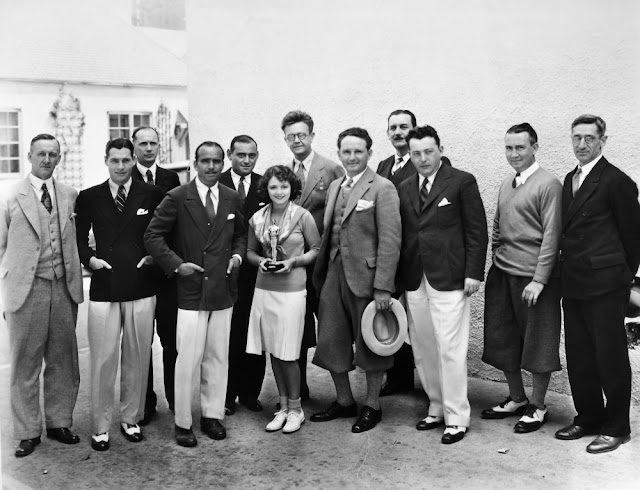
 

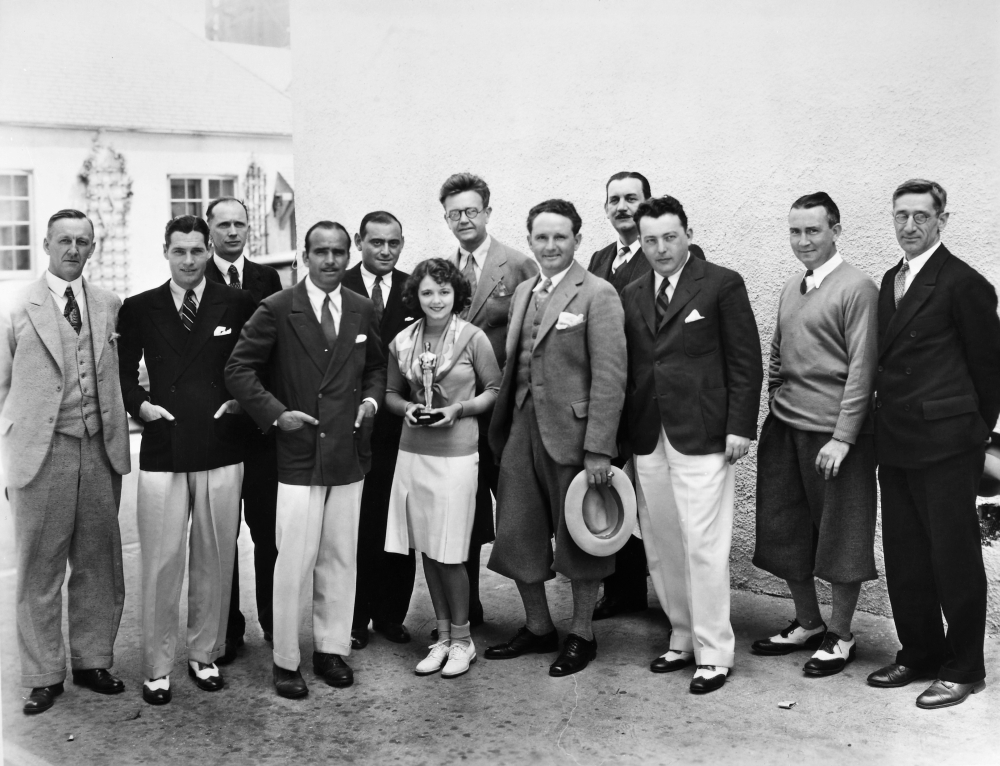
The day after the ceremony host Douglas Fairbanks and winner Janet Gaynor in less formal attire than the night before re-enacted the presentation for the press with director Frank Borzage in his golf knickers to Gaynor's left.

Awards were also given out for Best Cinematography (Sunrise), Best Engineering Effects (Wings), and Best Art Direction. 

Two Honorary awards were given.  The first was to Charles Chaplain, who had been withdrawn from consideration in several categories of regular award because he did, well, everything.  His citation read, “For versatility and genius in acting, writing, directing and producing The Circus.   The dawning of a new age was recognized in a special award to Warner Bros. “For producing The Jazz Singer, the pioneer outstanding talking picture, which has revolutionized the industry.”  


When Sunrise: A Tale of Two Humans which was drenched in heavy German Expressionist symbolism was first released it mystified audiences and flopped at the box office.  After winning the arty Best Picture category it was re-released and patrons flocked to movie houses to see what the fuss was about.  

Even the most optimistic boosters of the new awards did not foresee how popular—and powerful—they would become.  The eyes of Hollywood were opened when winning films were re-released to big audiences.  Sunrise, in particular, which had made hardly any money in its first release suddenly found an audience.  Thereafter the Awards—and the presentation showcases for them—would become a very big deal indeed in Tinsel Town.


Sunday, May 16, 2021

A Hollywood Night Out—The First Academy Awards for $5 Seat

The Awards presentation at the Academy of Motion Pictures Arts and Sciences banquet at the Hollywood Roosevelt Hotel, May 16, 1929.

On May 16, 1929 the first Academy Awards were presented at a banquet at the Hollywood Roosevelt Hotel.  270 people plunked down $5 for tickets to the black tie event. 

In many ways it was indistinguishable from award dinners common to any industry.  The main event seemed to be the dinner.  The awards were presented in a brisk 15 minutes after the deserts were cleared and after speeches by founders of the Academy of Motion Picture Arts and Sciences, including producer Louis B. Mayer who was a prime mover in establishing the organization just two years before. 

The Academy’s first President, actor Douglas Fairbanks, shared hosting and presenting with his successor, director Cecil B. DeMille.  There we no surprises.  Award recipients had been announced weeks earlier. 

While many things would change about the annual ceremonies, one constant was the Award itself, a hefty gold statuette of a sleek man holding a sword point down with his hands clasp in front of him.  In 1931 Bette Davis would give it an enduring nick name by observing, “This looks just like my uncle Oscar.” 

The big commercial hit Wings starring Charles Buddy Rodgers, Clara Bow, and Gary Cooper walked away with one of two Best Picture Awards.

Recipients of the first awards were mostly for films released in 1927.  Many awards, including those for acting were given not for a single film, but for a body of work during the year.  There were two best picture awards, Outstanding Picture, Production for popular, mainstream hits, and Outstanding Picture, Unique and Artistic Production for what we would today call an art film.  The action-packed World War I flying adventure Wings starting Buddy Rodgers, Gary Cooper, and Clara Bow won the commercial award.  Sunrise: A Song of Two Humans, an allegorical film by German director F. W. Murnau staring George O’Brien as The Husband and Janet Gaynor as The Wife won the art award.  The film included music and sound effects, but no dialog on a sound track using Fox-Movietone Sound-on-Film system. 

                                    Janet Gaynor collected her statuette for two films.  She would be a repeat winner in 1930.

It was a very good year for 22 year old Gaynor.  She won Best Actress in a Leading Role for her performance as the long suffering wife and for two films she made with director Frank Borzage and leading man Charles Farrell, Seventh Heaven, and Street Angel.  Borzage took home the trophy as Best Director, Dramatic Picture for the charming romance Seventh Heaven. 

That year there was also a separate award for Best Director, Comedy Picture which was won by Lewis Milestone for Two American Knights, produced by Howard Hughes and staring William Boyd—the future Hopalong Cassidy—and Mary Astor. 

Best Actor in Leading Roll went to German character actor Emil Jannings for work in two pictures, The Lost Command as an exiled Czarist general, and The Way of All Flesh as a businessman tempted and dishonored. 

There were three writing awards.  The former newspaper man Ben Hecht won Best Writing, Original Story for the early gangster flick Underworld.  Best Writing, Adapted Story went once again to Seventh Heaven for Benjamin Glazer’s screenplay.  Joseph Farnham won in the doomed category Best Writing, Title Cards for his whole body of work in 1927 which included Fair Co-Ed, Laugh, Clown, Laugh, and Telling the World. 

The day after the ceremony host Douglas Fairbanks and winner Janet Gaynor in less formal attire than the night before re-enacted the presentation for the press with director Frank Borzage in his golf knickers to Gaynor's left.

Awards were also given out for Best Cinematography (Sunrise), Best Engineering Effects (Wings), and Best Art Direction. 

Two Honorary awards were given.  The first was to Charles Chaplain, who had been withdrawn from consideration in several categories of regular award because he did, well, everything.  His citation read, “For versatility and genius in acting, writing, directing and producing The Circus.   The dawning of a new age was recognized in a special award to Warner Brothers “For producing The Jazz Singer, the pioneer outstanding talking picture, which has revolutionized the industry.” 

When Sunrise: A Tale of Two Humans which was drenched in heavy German Expressionist symbolism was first released it mystified audiences and flopped at the box office.  After winning the arty Best Picture category it was re-released and patrons flocked to movie houses to see what the fuss was about.  

Even the most optimistic boosters of the new awards did not foresee how popular—and powerful—they would become.  The eyes of Hollywood were opened when winning films were re-released to big audiences.  Sunrise, in particular, which had made hardly any money in its first release suddenly found an audience.  Thereafter the Awards—and the presentation showcases for them—would become a very big deal indeed in Tinsel Town.

Tuesday, April 27, 2021

Judas and the Black Messiah and Poems for and About Fred Hampton—National Poetry Month 2021


As expected the film Judas and the Black Messiah did pretty well at the Academy Awards on Sunday night.  It was the account of the life, betrayal, and murder of Illinois Black Panther Party Chairman Fred Hampton on December 4, 1969.  The movie  premiered at the 2021 Sundance Film Festival was lauded by critics and showered with honors,  British-Ugandan actor Daniel Kaluuya won Best Supporting Actor at the Golden Globes, Critics’ Choice Awards, Screen Actors Guild Awards, and BAFTA Awards for his portrayal of the charismatic Hampton. The film had six Oscar nominations, including Best Picture with Kaluuya again winning  Best Supporting Actor and Best Original SongFight for You.

Judas and the Black Messiah was released by Warner Bros. to nearly empty theaters in February due to the Coronavirus pandemic and simultaneously on HBO Max.  It was directed and produced by Shaka King, who wrote the screenplay with Will Berson, In addition to Kaluuya it starred Lakeith Stanfield as FBI informer William O’Neal, Dominique Fishback as Hampton’s girlfriend Deborah Johnson, Darrell Britt-Gibson as Chicago Panther co-founder Bobby Rush, and a cameo by Martin Sheen as FBI chief J. Edgar Hoover. 

Fred Hampton speaking.

Missing from the film was any depiction of Cook County State’s Attorney Edward Hanrahan who organized the fatal raid/ambush by a 14-man team of the state Special Prosecutions Unit (SAO).  Hanrahan boasted of his role and became a target for the outrage that erupted after Hampton was riddled with bullets fired through a window as he slept on a mattress.  But the infamous raid was really an outgrowth of Hoover’s COINTELPRO operation aimed at crushing the Panthers nationally, rising Black Nationalism, and especially at Hampton’s success in building his own rainbow coalition across racial divisions with the Puerto Rican Young Lords, Appalachian  White Young Patriots, and Chicano Brown Berets and Young Comancheros.

                                The Seed's Fred Hampton memorial cover.

Fred Hampton, his murder, and the aftermath were personal to me as a Chicago activist at the time and a member of the Chicago Seed staff collective.  Along with the self-described   revolutionary greaser paper Rising Up Angry covered the story closely.  We quickly broke the  COINTELPRO connection but did not know the identity of the FBI mole O’Neal until 1973. He committed suicide in 1990 after being interviewed for the PBS documentary series Eyes on the Prize. The experience had a dramatic effect on the Seed moving it from counter-cultural flower power hippie radicalism to a much more militant revolutionary stance.

Deborah Johnson and her son Fred Hampton Jr. a year after the assasination.

Hampton’s girlfriend, the pregnant Deborah Johnson was in the apartment during the raid and saw his bullet ridden body.  Weeks later Fred Hampton Jr. was born.  She remained a Black Panther activist. She changed her name to Akua Njeri and has remained an important Black nationalist and socialist leader.  Both Njeri and her son consulted with the production team on the film and were frequently on the set.  She advised Dominique Fishback, who played her in the film, and was adamant that Fishback not cry during the assassination scene. She had not done so in 1969 and felt it was an important show of strength for the character and for Black women.

Unfortunately I have not yet been able to see the film since I don’t subscribe to HBO Max, but I hope its Awards will bring it back to re-opened theaters in my area soon.

Actress Fishback wrote a poem that her character speaks to Hampton in the film.  Although she talked about that in several press interviews, I have not been able to find a transcript of the poem or a YouTube video clip of her speaking it in the movie.  Something to look forward to.

But the first of two poems written for  anniversaries of the assassination speaks directly to Akua Njeri.

                Deborah Paredez.

Deborah Paredez is a poet, ethnic studies scholar, and cultural critic She has published widely on topics including Black and Latinx performance, poetry of war and witness, feminist elegy, and the role of divas in American culture. Her poetry, essays, and commentary have appeared in The New York Times, Los Angeles Review of Books, National Public Radio, Boston Review, The Georgia Review, Feminist Studies, and elsewhere.

She was a Co-Founder and for a decade (2009-2019) served as Co-Director of CantoMundo, a national organization for Latinx poets. She is a founding member of the Poetry Coalition and currently serves as a board member of CLMP: Community of Literary Magazines and Presses, and LitNet: The Literary Network. She is a professor of creative writing and ethnic studies at Columbia University.  


Lightening

for Deborah Johnson (Akua Njeri)

—Composed on the 45th anniversary of Fred Hampton's murder, Chicago IL—


you didn’t look

down or back, spent

the fractured minutes

studying each crease

and curve of the law-

men’s faces

so later you could tell

            how it happened:

how you crossed over
           
            his body, how you kept

your hands up

how you didn't

reach for anything

not your opened robe—

nothing—how they said he's good

            and dead

how you crossed

over the threshold

how you lifted one

and then the other

slippered foot across the ice

            how you kept yourself

from falling—how

your bared belly bore

the revolver’s burrowing snout—

            how   
how   

—how when the baby starts

            to descend, it’s called

lightening though

it feels like a weight

you cannot bear—lightening

            is when you know

it won’t be

long before it’s over

—Deborah Paredez

Originally published in RHINO. Copyright © 2015 by Deborah Paredez.

Haki R. Mdhubuti.

Born Donald Luther Lee in Little Rock, Arkansas, the poet adopted the Swahili name Haki R. Madhubuti after traveling to Africa in 1974. Madhubuti received an MFA from the University of Iowa and served in the U.S. Army from 1960 to 1963. A member of the Black Arts Movement, he has published more than 20 books of poetry, nonfiction, and critical essays, and his work has been widely anthologized. Influenced by Gwendolyn Brooks, Madhubuti writes experimental, free-verse, politically charged poetry with a staccato rhythm. Over the span of his career, his poetry has shifted its focus from the personal to the political. Early work with the Student Non-Violent Coordinating Committee (SNCC), the Congress of Racial Equality (CORE), and the Southern Christian Leadership Conference (SCLC) informs his activist poetics.

Madhubuti has won an American Book Award, the Kuumba Workshop Black Liberation Award, the Broadside Press Outstanding Poet’s Award, and fellowships from the National Endowment for the Arts (in both 1969 and 1982) and the National Endowment for the Humanities.

He wrote this for the 50th anniversary of Hampton’s death.

He Never Saw the Bullets Coming

I.     born in a time of war

there is little memory of
denmark vesey and those who betrayed him,
nat turner’s revolt centuries before the turner diaries,
harriet tubman and the fear her name evoked,
sojourner truth and people running from her words,
frederick douglass refusing to accept whiplash,
marcus garvey daring to organize millions of Black people
without the permission of whites, w.e.b. du bois
committed to thinking outside the box, circle
and lies of white conquerors. ida b. wells
challenging the real fake news. elijah muhammad’s
confirmation of Black as integral to self-definition
and giving malcolm x a voice.
fred hampton daring to tell the people the truth
about their lives decades before black lives
mattered, in a time, as today, where white lives
mattered more as anti-democracy movements entrenched themselves.

II.     betrayal of one’s own kind

it is the wisdom of children that is missing
from the blue notes of Black musicians who were
always ahead, not knowing it themselves,
as we revolutionaries pushed, shoved, made up new languages
that closely approximated our overneeded call for meaningful
resolution, light quest, love, honor and yeses from our creator
by conditions forced into our singular lives within the watchful eyes
of the enemies, the enemies of art, drum making and almond milk.

the night before the hunt and kill — they laughed.
the negro officers renewed their nigger cards,
the white officers dipped their bullets in pig oil, and
tore up the constitution, bill of rights and
proclaimed that god is white-white, and we go
before first light with orders from washington,
chicago’s kill squad and fbi’s COINTELPRO.
reporters who really wanted to be poets
confronted their contradictory truths, which ate
their eyes and minds and burned their fingernails off
while they choked on their lying tongues.

it was murder.
& we meet to hear the speeches/ the same, the duplicators.
they say that which is expected of them.
to be instructive or constructive is to be unpopular (like: the
          leaders only
sleep when there is a watching eye)
but they say the right things at the right time, it’s like a
          stage show:
only the entertainers have changed.
we remember bobby hutton. the same, the duplicators.

the seeing eye should always see.
the night doesn’t stop the stars
& our enemies scope the ways of blackness in three bad
          shifts a day.
in the AM their music becomes deadlier.
this is a game of dirt.

only Blackpeople play it fair.

—Haki R. Madhubuti