
It’s
a little old fashioned but you have probably heard or used
the phrase “the best thing since sliced
bread.” It was an idiom originally meant to convey a sense of wonder and appreciation for
some new gadget or development. Later it took
on something of a sarcastic connotation. After all, sliced bread had become so commonplace that is
seemed damning with faint praise. To
understand why sliced bread was such a wonder, we have to look back on those dark, dark days before you could pick up a
loaf of neatly sliced and wrapped bread anywhere basic food is peddled.
It
was on July 7, 1928 when the Chillicothe
Baking Company of Chillicothe, Missouri, a small commercial bakery first used the bread slicing machine developed by Otto Frederick Rohwedder on bread for sale. They called their new product Kleen Maid Sliced Bread and it was a resounding success from
the moment it hit the shelves.

Not at all shy of promoting its sensational new product, the Chillicothe
Baking Co. took out a full page ad in the local newspaper. Missourians
beat a steady path to their door.
Think about that date for a moment. By 1928 railroads, the telephone, and electric lights were already in use for generations. Automobiles and trucks had virtually replaced horse drawn carriages and wagons on American streets. The Wright
Brothers had long since first flown and mail and even passengers were regularly winging between cities. Commercial radio was taking off and
handsome cabinet receivers were becoming center pieces in middle class parlors. There were movie palaces in the downtowns of every city and theaters in every neighborhood and small town. Just the
previous October Al Jolson sang Mammy
in the Jazz Singer and many of those cinemas were already
scrambling to install the equipment for the popular new talkies. Just about every element of modern life was already
in place.

Even into the early 20th Century other than some improvements to ovens,
bread was still produced as it had been for ages--in small hand crafted
lots and offered for sale daily by small bakeries which served their
immediate neighborhoods.
But
before that fateful July day, Americans bought their bread fresh daily from local bakeries. At home if they wanted
bread on the dinner table with butter, to make sandwiches for work or school lunches, or have toast
with breakfast it required a super sharp knife and a deft hand. Otherwise it was easy to shred the loaf or mangle and squash it while getting a firm
grip on it. America’s favorite white bread needed to
be crusty and firm enough to withstand the surgery. Even if neatly sliced, it was difficult to
get slices of consistent thickness. Slices
tended to be thick and only a few could be cut from the
loaf.
Toast
was replacing biscuits for breakfast since the introduction
of electronic toasters, but
those toasters could typically burn only one slice at a time, had to be
carefully watched, and then turned by hand
to be crisp on both sides. With the
introduction of thinner, uniform bread slices made revolutionary the Toastmaster
Model A-1-A, first offered for sale in 1925, and
other quickly introduced pop-up
toasters fixtures on kitchen
counters everywhere.

The newfangled Toastmaster pop-up toaster and sliced bread--a match made in heaven that revolutionized the American breakfast.
Otto
Frederick Rohwedder was born to German immigrant parents
on July 7, 1880. He had a degree in optics from the Northern Illinois College of Ophthalmology and Otology in Chicago. But he had also apprenticed as a jeweler. He returned to that trade and also showed he
was a shrewd businessman who was
able to open a small chain of
three jewelry stores.
Like
many jeweler/watch repairmen he
found that his skill with fine
intricate machinery could be applied to other projects. With his shops successful
enough to allow him time to dedicate to tinkering and experimentation. He began obsessively working on a machine to
slice bread, a project whose complex
requirements and multiple blades had defeated other would-be developers. As
he got closer to a practical design,
Rohwedder sold his stores to finance
finishing the work and going into production.

The Edison of the bakery--Otto Rohwedder.
By 1917 he had developed a prototype and had opened a small machine shop to go into production. But then disaster struck. A fire
destroyed the prototype, all of
his drawings and notes,
and all the machines and tools
he had assembled. Without insurance he was unable to immediately resume his work.
It took ten years while Rohwedder scrimped, saved, and rounded up small investors while he worked on improving his first
design. In 1927 he obtained a patent on an improved machine
that not only sliced the bread but wrapped
it. He got enough money together two build two new prototypes. He sold one to his friend Frank Bench, who installed it at the
Chillicothe bakery. By coincidence Bench
went into production with the machine on Rohwedder’s 48th birthday.
At about the same time the second machine was sold
to a bakery in Battle Creek, Michigan. That city has disputed Chillicothe’s claim to being the home to the
first commercial use. But since no
documentation can be found on the exact date that the machine was first used in
Michigan, most historians of
invention and production have stood by the Iowa town’s boast.
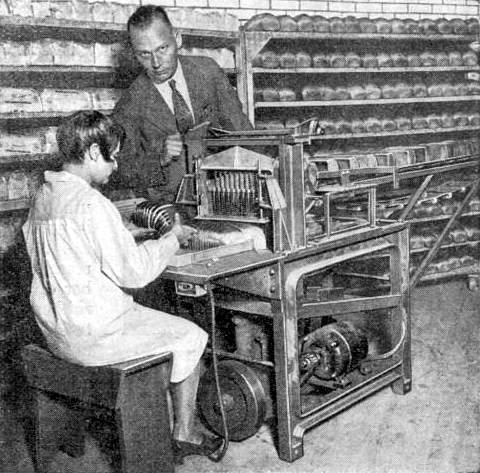
A slicer/wrapper in operation in a St. Louis bakery in 1930.
Both bakers reported the quick success of their
products and they popularity with customers.
Orders for more machines started pouring in. So did improvements.
The machines were used by a single seated
operator who hand inserted one loaf at a time. It was a somewhat laborious
process and the slices had a
tendency to separate and fall before the wrapping was completed. Within months a St. Louis baker, Gustav Papendick, invented an improved wrapping process using cardboard
trays to hold the loaves together.
Rohwedder himself and other inventors continued to file patents for
further improvements. Within a few years
the machine was adapted for use on a semi-automated
production line allowing for
the production of bread on an industrial,
rather than handcraft scale.

An improved version of Rohwatter's slicer incorporating a conveyor system made industrial-scale production of bread possible.
W.E. Long, who licensed his Holsum Bread brand to local bakeries around the country, began
promoting the Rohwedder machine to the bakeries so that there would be a consistent
product in late 1928. Two years later Wonder Bread, which had introduced
its super soft loaves in 1927, adopted the improved
equipment for its brand, produced in large
regional commercial bakeries which rapidly spread over the Eastern
United States.
The public literally ate up the products as fast as production could be ramped up. It was Depression
proof. Bread was a relatively inexpensive commodity and the price per-loaf of the
improved product was actually coming down due to economies of
scale. Everybody bought bread even
if they could hardly afford to buy much else in the way of food. Consumption
of bread also soared, attributed to the convenience of use and the thinner
machine slices adapting well to toast and sandwich making. Waxed
paper wrapped sandwiches with
a single slice of bologna or cheese, or even just mustard or a thin layer of peanut
butter became Depression staples.
By 1933 more than half of all bread sold in the U.S. was sliced and the
percentage leaped ahead every year.
The
bread slicers/wrappers also encouraged
development of related technologies—Scotch Tape, for instance, was first commercially applied to sealing the wax paper wrap of loaves coming off the conveyor.
Commercial
sliced bread also greatly contributed to how Americans shopped. Previously almost all bread was either home baked or purchased at small local bakeries. The small shops struggled to afford the
expensive slicing machine. Bread began
to show up on grocery store shelves along with bags of commodities like flour, sugar, and coffee, canned goods, and refrigerated dairy
products. It contributed to the transition from grocery clerks fetching products from behind the counter shelves to the new self-service stores like the growing Piggly-Wiggley and A&P chains. By
the mid-30’s chains like Ralph’s
and Safeway on the West Coast and Kroger’s in the Midwest were opening large stores “On the Super Plan” which added fresh produce, meats,
and the newly developed frozen foods to the non-perishable staples and
bread offered by the old groceries. Big
commercial bakeries had no trouble keeping the shelves stocked with plenty of
their brightly wrapped product.

Introduced
in 1930 super-soft Wonder Bread came wrapped in an improved
sealed wax paper package to preserve freshness. It was mass-produced in
centralized baking factories and stocked on shelves of new self-service
groceries driving local bread bakers out of business.
Of
course, thousands of local bakeries were forced out of business in the
process. Those which survived either provided
European specialty breads in immigrant city
neighborhoods or become specialists in cakes, cookies, and pastries.
A sign of how dependent American consumers had become on
sliced bread came in the debacle that occurred when bureaucrats of the war time Food Distribution Administration moved
on January 13, 1943 to ban the sale of sliced bread nationally as a food conservation measure. Patriotic
housewives who had stoically endured food rationing and coupons, meatless and sugarless days and other deprivations openly
revolted flooding the agency,
politicians, and newspapers with anguished complaints. A
letter in the New York Times just days after the ban went into effect was
typical:
I should like to
let you know how important sliced bread is to the morale and saneness of a
household. My husband and four children are all in a rush during and after
breakfast. Without ready-sliced bread I must do the slicing for toast—two
pieces for each one—that’s ten. For their lunches I must cut by hand at least
twenty slices, for two sandwiches apiece. Afterward I make my own toast.
Twenty-two slices of bread to be cut in a hurry!
The
agency was able to shut down production by the big commercial bakeries, but
smaller independent shops and delicatessens continued to use their machines to
satisfy the demands of their customers.
Officials issued threats of draconian
measures against
offenders.
At
first they doubled down defiantly
on their position but were soon taking
heat from Congress and other branches of the Administration. On
March 8, less than two months after issuing the order the Food Distribution
Administration ran up the white flag and rescinded it. They
covered their asses with a statement that the savings in commodity flour had not been as great as
projected. Plenty of sliced bread, which was still
rationed, was back on the shelf in no time.

Sliced bread typically fills an aisle of a modern supermarket.
As
for inventor Rohwedder, he made out pretty
well himself, if not spectacularly. In
1930 he sold his patent rights to the Micro-Westco Company of Bettendorf,
Iowa. He became vice-president and sales manager of its Rohwedder
Bakery Machine Division. He retired in 1951 at the age of 71. Despite is revolutionary contribution to the American way of eating he never became a household name and
remained personally obscure outside of the baking industry. He didn’t seem to mind.
He
died on November 6, 1969 at the age of 80 in Michigan.


