Showing posts with label Peter Stuyvesant. Show all posts

Monday, March 29, 2021

A Familiar Dutchman and Sweden’s Claim to an American Colony

Peter Minuit, Former Governor of New Amsterdam, famous for purchasing Manhattan Island from the natives, led the Swedish colonization project after being ousted by his Dutch bosses.  

Ok, quickly now, students, go to a map and show me the location of the colony of New Sweden.  What?  You say you’ve never heard of such a thing?  Well on March 29, 1638 two ships carrying Swedish and FinnishFinland was at the time part of Swedenimmigrants sailed up Delaware River and landed near modern day Wilmington.  They claimed the river and its drainage for the New Sweden Company. 

In command was a veteran of North American colonization, Peter Minuit.  Minuit is familiar to school children as the Dutch Governor of New Netherland who supposedly swindled Native Americans out of the island of Manhattan for $24 in beads and trinkets.  Like most such arch-typical tales, the story was only half right.  Minuit did purchase the island—and near-by Staten Island—for about 60 Guilders—a significant sum in those days—in trade goods including steel ax heads, needles, hoes, drilling awls pots, and trade wampum.  A historian described it as a significant “high-end technology transfer, handing over equipment of enormous usefulness.”  Both parties to the deal were happy and neither felt cheated. 

Minuit served as governor from 1626 to 1631 when he was suspended by the Dutch West Indies Company because the fur trade with Native Americans, which was supposed to finance the colony, was less remunerative than anticipated and because Minuit was suspected of skimming for his personal purse. 

Queen Christiana was the early teenage daughter of Gustavus Adolphus when Stuyvesant sailed up the Delaware River.  She was called the most learned woman in Europe but created a scandal by refusing to marry or produce an heir and by famously cross dressing.  When she abandoned Sweden's Lutheran state church and converted to Catholicism she abdicated her throne at age 28 in 1654.  She was memorably portrayed by Greta Garbo in a famous 1933 MGM biopic that wrote in a love story with a Spanish Catholic diplomat as a cover for the real Queen's lesbianism.

Outraged Minuit turned to the Swedes, who were going about the business of entering the competition for New World riches.  They were glad to have him.  Sweden, at the time, was at its height of its influence as a world power.  It ruled over much of Scandinavia including Finland, and most of Norway, portions of Russia, all of modern Estonia, Latvia, and most of Lithuania, parts of Poland, Germany, and Denmark.  The Baltic Sea was a virtual Swedish lake.  The Swedes felt more than ready to join the mercantile powers in America.  

Minuit established Fort Christina, in honor of Sweden’s twelve year old Queen.  But as Minuit well knew, the drainage of the Delaware River was claimed by the Dutch.  After establishing his colony, Minuit decided to return to Sweden for more colonists and make a dash down to the Caribbean to pick up a load of tobacco to make the trip profitable.  Unfortunately, he was killed in a hurricane off of St. Christopher. 

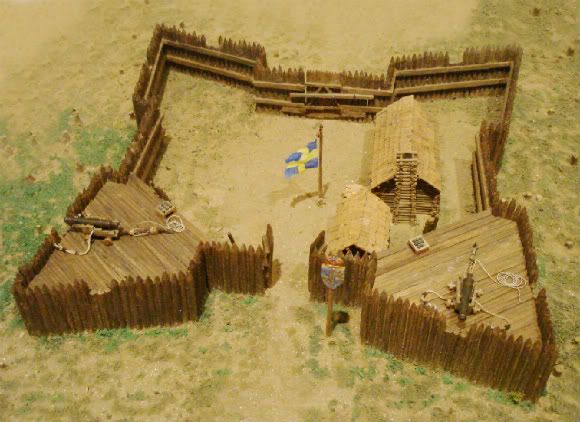
A museum model of Fort Christina 

Over the next dozen years 12 groups of settlers totaling more than 600 reached New Sweden and established settlements on both sides of the river.  The settlers were mostly small farmers.  They introduced a form of shelter never seen before in the new world—the log cabin—which would become the standard pioneer abode for the next two hundred years. 

A tapestry hanging in the American Swedish Museum in Philadelphia depicts the Swede's most enduring cultural legacy in the New World--the log cabin.

They had excellent relations with the local tribes and lived comfortably with the near-by Dutch until a new governor arrived in 1654 and seized the Dutch post of Fort Casamir, modern day New Castle.  The notoriously bellicose Dutch governor in New Amsterdam, Peter Stuyvesant, dispatched five armed ships and 317 professional soldiers to retake the post.  They then proceeded up the river and forced the surrender of Ft. Christina.  That ended Swedish sovereignty over the area. 

The wrath of peg-legged Dutch governor Peter Stuyvesant upon learning that the Swedes had captured Fort Casamir was depicted in this painting.

But the Dutch made no attempt to expel the existing settlers.  In fact they granted them extraordinary rights to retain their lands, practice their Lutheran religion, and govern themselves as a quasi-independent “Swedish Nation.”

But the Dutch themselves were not long to retain their American possessions.  After a series of wars, they were gone for good by 1674 and New Netherland became New York. 

In 1681 William Penn was granted his charter for Pennsylvania, which included the “Three Lower Counties” which make up today’s Delaware.  The Swedes, with no reinforcements coming from the mother country for decades, were quickly subsumed by the British.

Hundreds of years later an Irish American from Pennsylvania would settle in Delaware and put the small often ignored state back on the map of American consciousness.  But damned few of Joe Biden’s Senate constituents were decedents of those old Swede settlers.   

Thursday, August 20, 2020

Standing Night Watch in Nieuw-Amsterdam Earned the First Jew in the Colonies a Home

A Dutch view of New Amsterdam nine years after it was conquored by the English and renamed New York> note the militia drilling.

On August 22, 1654 Jacob Barsimson became the first known Jew to take up residence in what is now the United States.  Barsimson disembarked a ship from The Netherlands that day in Nieuw-Amsterdam (New Amsterdam), the capital of the colony of New Netherlands.  The city was still a raw frontier trading post huddled next to the protective parapets of a fort for protection from both the local natives and the voracious English. 
Barsimson, an Ashkenazi, was sent as an emissary by wealthy Dutch Jews to check out the suitability of the North American colony for settlement by Jews being persecuted in earlier attempts to establish New World footholds in Brazil and the West Indies. 
A map shows early Jewish migration routes and settlements in the New World including Sephardi Portuguese Jews from The Netherlands at Recife, Brazil and Dutch Caribbean Islands like Curauo.
The Dutch Republic had become a place of refuge for all sorts of religious dissenters and outcasts once it had finally thrown out the Hapsburgs and with them the Inquisition.  During the same years the Netherlands was harboring Unitarian refugees from Poland and other persecuted minorities.  Of course, no one in Europe was more persecuted than the Jews.
A sizable community, mostly from Portugal where the Inquisition was still going strong, had established itself in Amsterdam and was prospering.  But Jews had prospered here and there in Europe before and had the tides of prejudice rose against them time and time again.  The merchants of Amsterdam were looking for escape routes for themselves, as much as for their cousins in Brazil.
Despite being less than welcomed by Governor Peter Stuyvesant, Barsimson saw promise in the new city.  On October 22 he was on hand to welcome the first group of 23 settlers from Recife, Brazil.  Together they started the first Jewish community in North America, four years before the founding of another enclave at Newport, Rhode Island.
Others joined them along with some from the Dutch sugar islands in the Caribbean.  Stuyvesant became increasingly alarmed by the influx and imposed harsh restrictions on their occupations and trade opportunities.

Barsimson frequently got the best of his nemesis Governor Peter Stuyvesant  by going over his head to the Governors of the Dutch West India Company.
Barsimson, the acknowledged leader of the community, found himself in an ongoing game with the governor to secure rights and privileges for his people.  Jews were barred from most trades, shop keeping, public office, conducting religious services, and participation in the militia.  When Stuyvesant turned down a simple request to allow Jewish burials on the grounds that it was “premature”—no Jews had yet died—Barsimson appealed over his head to the directors of the West India Company which controlled New Amsterdam and in which several wealthy Jews were large investors.  The company ordered their governor to reverse his decision.
It was a pattern Barsimson would repeat.  He shrewdly observed that among the many restrictions placed on Jews was service in the militia and taking their turns at arms guarding the walls for the fort.  He understood that the rights of citizenship were tied to the responsibility to defend the colony.  Despite the continued threat of Indian attack and the growing menace from the English and from a new Swedish colony established in what is now Delaware by former New Amsterdam governor Peter Minuet, Stuyvesant refused the appeal for Barsimson and another Jew, Asser Levy for the right to take their turn at guard duty.  Once again an appeal was made to the Company and once again the Governor was overruled.

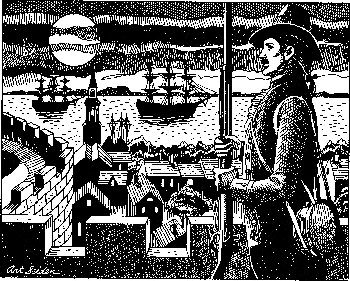
A 20th Century illustration of Barsimson on night watch on the walls of New Amsterdam.
Barsimson and other Jews proudly took their turns on the walls and in Militia musters, thus securing the rights of citizenship in 1655.
In 1658 the Governor drew charges against Barsimson and had him summoned to court.  The Jewish leader refused to attend because he had been summoned on the Sabbath.  The court, in a curt slap in the face to the Governor ruled that, “though defendant is absent, yet no default is entered against him, as he was summoned on his Sabbath.”  It was the earliest court case in any colony establishing any level of religious acceptance for Jews.


Asser Levy was Barsimson’s close friend and associate and with him won the right to stand guard.  He would go on to purchase an estate near Albany and become the first Jew to own land in the colony.  He was Barsimson’s frequent partner in law suits to secure and expand Jewish rights.

When New Amsterdam fell to the British in 1664, the thriving community of Ashkenazi and Sephardic Jews retained full citizenship in the newly named colony of New York.

Saturday, March 29, 2014

Ex-Dutch Governor Leads Sweden’s Bid for an American Colony

The European colonizers on the Eastern seaboard of heavily forested North America—French, English, Dutch—and Native tribes all built  fortifications of palisaded logs like Peter Minuit’s Fort Christiana.  But only the Swedes built their dwellings, like the building seen within the walls, out of interlocking horizontal logs instead of laboriously hand sawn planks, stone, or mud and wattle.  Log cabins were sturdy, well insulated for harsh winters, and provided protection in the event of Indian raids.  After New Sweden was conquered by the Dutch and then became part of William Penn’s Grant, this style of construction was rapidly adopted by settlers as they pushed the margins of the frontier ever westward.  Log cabins were the most enduring cultural legacy of New Sweden’s short lived tenure as a colony.


Ok, quickly now, students, go to a map and show me the location of the colony of New Sweden. What?  You say you’ve never heard of such a thing?  Well on March 29, 1638 two ships carrying Swedish and FinnishFinland was at the time part of Sweden—emigrants sailed up Delaware River and landed near modern day Wilmington.  They claimed the river and its drainage for the New Sweden Company. 
In command was a veteran of North American colonization, Peter Minuit.  Minuit is familiar to school children as the Dutch Governor of New Netherlands who supposedly swindled Native Americans out of the island of Manhattan for $24 in beads and trinkets.  Like most such arch-typical tales, the story was only half right.  Minuit did purchase the island—and near-by Staten Island—for about 60 Guilders—a significant sum in those days—in trade goods including steel ax heads, needles, hoes, and drilling awls pots and trade wampum.  A historian described it as a significant “high-end technology transfer, handing over equipment of enormous usefulness.”  Both parties to the deal were happy and neither felt cheated. 
Minuit served as governor from 1626 to 1631 when he was suspended by the Dutch West Indies Company because the fur trade with Native Americans, which was supposed to finance the colony, was less remunerative than anticipated and because Minuit was suspected of skimming for his personal purse. 
Outraged Minuit turned to the Swedes, who were going about the business of entering the competition for New World riches.  They were glad to have him.  Sweden, at the time, was at its height of its influence as a world power.  It ruled over much on Scandinavia including Finland, and most of Norway, portions of Russia, all of modern Estonia, Latvia, and most of Lithuania, parts of Poland, Germany, and Denmark.  The Baltic Sea was a virtual Swedish lake.  The Swedes felt more than ready to join the mercantile powers in America.  
Minuit established Fort Christiana, in honor of Sweden’s twelve year old Queen.  But as Minuit well knew, the drainage of the Delaware River was claimed by the Dutch.  After establishing his colony, Minuit decided to return to Sweden for more colonists and make a dash down to the Caribbean to pick up a load of tobacco to make the trip profitable.  Unfortunately, he was killed in a hurricane off of St. Christopher. 
Over the next dozen years 12 groups of settlers totaling more than 600 reached New Sweden and established settlements on both sides of the river.  The settlers were mostly small farmers.  They introduced a form of shelter never seen before in the new world—the log cabin—which would become the standard pioneer abode for the next two hundred years. 
They had excellent relations with the local tribes and lived comfortably with the near-by Dutch until a new governor arrived in 1654 and seized the Dutch post of Fort Casamir, modern day New Castle.  The notoriously bellicose Dutch governor in New Amsterdam, Peter Stuyvesant, dispatch five armed ships and 317 professional soldiers to retake the post.  They then proceeded up the river and forced the surrender of Ft. Christiana.  That ended Swedish sovereignty over the area. 
But the Dutch made no attempt to expel the existing settlers.  In fact they granted them extraordinary rights to retain their lands, practice their Lutheran religion, and govern themselves as a quasi-independent “Swedish Nation.”
But the Dutch thems elves were not long to retain their American possessions.  After a series of wars, they were gone for good by 1674 and New Netherlands became New York. 
In 1681 William Penn was granted his charter for Pennsylvania, which included the “Three Lower Counties” which make up today’s Delaware.  The Swedes, with no reinforcements coming from the mother country for decades, were quickly subsumed by the British.

Wednesday, August 22, 2012

First Jew in New Amsterdam Had to Fight to Stand Guard

A modern illustration imagines Jacob Barsimson taking his turn at guard on the walls of New Amsterdam.

On August 22, 1654 Jacob Barsimson became the first known Jew to take up residence in what is now the United States.  Barsimson disembarked a ship from The Netherlands that day in Nieuw-Amsterdam (New Amsterdam), the capital of the colony of New Netherlands.  The city was still more of a raw frontier trading post huddled next to the protective parapets of a fort for protection from both the local natives and the voracious English. 
Barsimson, an Ashkenazi, was sent as an emissary by wealthy Dutch Jews to check out the suitability of the North American colony for settlement by Jews being persecuted in earlier attempts to establish new world foothold in Brazil and the West Indies. 
The Dutch Republic had become a place of refuge for all sorts of religious dissenters and outcasts once it had finally thrown out the Hapsburgs and with them the Inquisition.  During the same years the Netherlands was harboring Unitarian refugees from Poland and other persecuted minorities.  Of course, no one in Europe was more persecuted than the Jews.
A sizable community, mostly from Portugal where the Inquisition was still going strong, had established itself in Amsterdam and was prospering.  But Jews had prospered here and there in Europe before and had the tides of prejudice rose against them time and time again.  The merchants of Amsterdam were looking for escape routes for themselves, as much as for their cousins in Brazil.   

Despite being less than welcomed by Governor Peter Stuyvesant, Barsimson saw promise in the new city.  On October 22 he was on hand to welcome the first group of 23 settlers from Recife, Brazil.  Together they started the first Jewish community in North America, four years before the founding of another enclave at Newport, Rhode Island.
Others joined them along with some from the Dutch sugar islands in the Caribbean.  Stuyvesant became increasingly alarmed by the influx and imposed harsh restrictions on their occupations and trade opportunities.
Barsimson, the acknowledged leader of the community, found himself in an ongoing game with the governor to secure rights and privileges for his people.  Jews were barred from most trades, shop keeping, public office, conducting religious services, and participation in the militia.  When Stuyvesant turned down a simple request to allow Jewish burials on the grounds that it was “premature”—no Jews had yet died—Barsimson appealed over his head to the directors of the West India Company which controlled New Amsterdam and in which several wealthy Jews were large investors.  The company ordered their governor to reverse his decision.
It was a pattern Barsimson would repeat.  He shrewdly observed that among the many restrictions placed on Jews was service in the militia and taking their turns at arms guarding the walls for the fort.  He understood that the rights of citizenship were tied to the responsibility to defend the colony.  Despite the continued threat of Indian attack and the growing menace from the English and from a new Swedish colony established in what is now Delaware by former New Amsterdam governor Peter Minuet, Stuyvesant refused the appeal for Barsimson and another Jew, Asser Levy for the right to take their turn at guard duty.  Once again an appeal was made to the Company and once again the Governor was over ruled.
Barsimson and other Jews proudly took their turns on the walls and in Militia musters, thus securing the rights of citizenship in 1655.
In 1658 the Governor drew charges against Barsimson and had him summoned to court.  The Jewish leader refused to attend because he had been summoned on the Sabbath.  The court, in a curt slap in the face to the Governor ruled that, “though defendant is absent, yet no default is entered against him, as he was summoned on his Sabbath.”  It was the earliest court case in any colony establishing any level of religious acceptance for Jews.
When New Amsterdam fell to the British in 1664, the thriving community of Ashkenazi and Sephardic Jews retained full citizenship in the newly named colony of New York.