Showing posts with label Presidential primaries. Show all posts

Friday, March 29, 2013

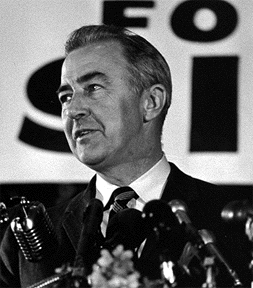
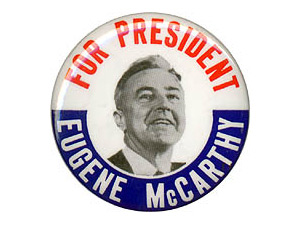
The Quixotic Eugene McCarthy


The gentleman scholar of American politics Eugene McCarthy was born March 29, 1916 in Watkins, Minnesota.  His father was an Irish cattle buyer and local Postmaster—a political appointment—known for his humor and storytelling.  His mother was from German stock and intensely religious.  He was raised in a devoutly Catholic home and educated in the local parochial school before going to St. John’s College Prep in Collegeville, Minnesota
The school was operated by the Benedictine Monks of St. Johns Abby, who deeply influenced the young man.  They encouraged his natural scholarly bent.  He entered the Abby as a novice following graduation in 1931.  After nine months he reluctantly concluded that he did not have the vocation and left.  But he so impressed his fellow novices that one observed sadly that his departure was “like losing a twenty game winner.”
McCarthy didn’t go far.  He enrolled in St. John’s University in Collegeville under the same leadership. 
After graduating with distinction in 1935, he became a public school teacher serving rural schools in South Dakota and Minnesota.  He also pursued advanced education at the University of Minnesota where he earned a master’s degree in 1939.  He took his new degree back to his beloved St. John’s where he was professor of economics and education from 1940 to ’43.
McCarthy left academia to participate in the war effort as a civilian technical assistant in the Military Intelligence Division of the War Department.
In June 1945 he married Abigail Quigley, another academic.  Together they briefly returned to Watkins were they lived on a farming commune for Catholic couples before each resumed their careers.  Together they would have four children.
McCarthy resumed teaching as a professor of sociology at the College of St. Thomas in St. Paul.  He also became active in the Minnesota Democratic-Farmer-Labor Party.  In 1948 the Party tapped him for its nomination to Congress from the 4th District.  That was the same year fellow Minnesotan Minneapolis Mayor Hubert Humphrey rose to national prominence with a speech at the Democratic National Convention demanding a Platform Plank condemning segregation—the speech which caused the Dixiecrat Party split that year.  The two leading liberal’s careers would be intertwined ever after.
He entered the House of Representatives in 1949 just in time to see another McCarthy, Wisconsin Senator “Tail Gunner Joe” to rise to national prominence and launch the McCarthy Era hysterics. 
He was a hard working and respected Congressman noted for his liberalism, his professorial demeanor, and his interest in foreign policy.  Popular at home, he easily won re-election five times but was little known outside of his home state.
In 1958 he moved up to the Senate where he earned a seat on the Foreign Relations Committee.  McCarthy attracted national attention at the Democratic National Convention of 1960 when at the urging of Eleanor Roosevelt he gave an impassioned speech in defense of  Adlai Stevenson and rallied liberals to his standard.  Both he and Mrs. Roosevelt fully understood the powerful symbolism of a leading Catholic politician standing against the nomination of John F. Kennedy.  It was the beginning of a long and contentious relationship with the Kennedy family and their supporters.
By 1960 McCarthy began to be noticed for a series of serious political and policy books including Frontiers in American Democracy, Dictionary of American Politics, and A Liberal Answer to the Conservative Challenge.  He became an acknowledged egg head liberal leader of the Democratic Party.
In 1964 Lyndon B. Johnson, in need of a northern liberal running mate not tied to the Kennedys considered him for the nod, but opted for his fellow Minnesota senator Hubert Humphrey whose ebullient personality was considered better for the campaign than the sometimes dry McCarthy.
It was probably just as well for Johnson, because McCarthy was becoming increasingly disenchanted not only with the escalating War in Vietnam, but with the foreign policy assumptions that made such military interventions possible.   He laid those objections out in speeches on the Senate floor, in appearances on the Sunday morning news panel shows, and in a widely read book published in 1967 The Limits of Power: America's Role in the World.  Suddenly McCarthy was the leading and most coherent anti-war voice in Congress.
He was recruited by supporters of Oregon Senator Wayne Morse, one of only two Senators who voted against the Gulf of Tonkin Resolution, to enter the 1968 Presidential Primaries against Johnson.  McCarthy somewhat reluctantly agreed expecting only to be able to bring the issue of the war to the fore and perhaps influence Johnson to change course.
McCarthy was as surprised as anyone when an army of college students and young people descended on the first primary state, New Hampshire to canvas the state door to door on his behalf.  Many came Clean for Gene, cutting long hair, shaving beards and adopting sport coats and ties and prim dresses.  McCarthy shocked the nation—and the White House—by placing second in the contest with 42% of the vote against Johnson 49%.  Perhaps more importantly, because the President had not bothered to slate delegates to the state convention which would in turn select delegates to the Democratic National Convention, McCarthy supporters won 20 of 24 spots and thus controlled the delegation.
The win spurred other actors to action.  Four days after the primary Senator Robert Kennedy, who despite despising Johnson had not believed he was vulnerable, announced his entry into the race, perhaps hoping that McCarthy would drop out in his favor.  On March 31 Johnson announced that he “would not seek and will not serve” a second term.
In the following primaries some of McCarthy’s early supporter did jump ship to Kennedy, who quickly put together a well oiled campaign.  But McCarthy and many of his loyal, idealistic followers steadfastly remained in the race. 
Vice President Humphrey, with impeccable liberal credentials but tied to Johnson’s war policy, entered the race too late to get in the primaries but with the support of almost the entire party establishment.  He began reaping delegates in the many states which still relied exclusively on state conventions and on elected officials at all levels who were automatic delegates.
Kennedy and McCarthy slugged it out an increasingly bitter race.  Kennedy won the crucial, delegate rich California primary but was assassinated following his acceptance speech.  Most of Kennedy’s supporters, instead of throwing their grieving support to McCarthy, backed South Dakota Senator George McGovern instead.  
McCarthy arrived at the Democratic National Convention in Chicago with more delegates from primary elections than any candidate, but that was only 20 % of the total.  The fight for the nomination on the convention floor was overshadowed by the demonstrations and massive police violence on the streets.  Many McCarthy supporters and delegates were swept up in the melees and in the early morning hours after the famous Battle of Michigan Avenue, police actually stormed McCarthy Conrad Hilton headquarters and beat staffers and demonstrators who were being sheltered there.

McCarthy declined to endorse Humphrey, but in October said he would personally vote for him over Richard Nixon and George Wallace.  Many of his idealistic supporters were radicalized by the experience.  McCarthy was embittered.
The senator declined to run for re-election in 1970 and even seemed to retreat from a high profile role in the chamber in his remaining two years.
But the presidential bug, once caught, is not easy to shake.  McCarthy tried once more to win the Democratic Party nomination in 1972. He fell far short and had to drop out well before the convention. 
While remaining a committed social liberal, he had also become increasingly distressed by the growing power of the Federal government over individual lives and had assumed libertarian positions on many issues. 
Despite this apparent turn to the right, his anti-imperialist foreign policy still had support from many on the left.  He abandoned the Democrats to run as an independent or under various state party titles in 1976.  He gained ballot access in 30 states and was a recognized write-in in two more.  In the end he garnered 740,460 popular votes—just under 1% of the total—finishing third in the election.
In his remaining years McCarthy was an increasingly isolated figure given to quixotic crusades that sometimes baffled former supporters.  He considered Jimmie Carter the worst President in history.  After flirting with the Libertarian Party, he endorsed Ronald Reagan in November 1980.  He was also a party to a Federal law suit with William F. Buckley, the Libertarians, and the American Civil Liberties Union, that struck down most existing limits on Federal campaign contributions as an abridgement of free speech.
McCarthy’s personal life was also disrupted in the ‘70’s.  He separated from his wife in 1970 but because of their strong mutual Catholic faith neither sought a divorce.  Now living in the Virginia countryside, he was rumored to be having a long term secret affair with a high level woman journalist.  Many suspected that it was columnist Shana Alexander.  But a recent biography revealed that his lover was CBS News correspondent Marya McLaughlin.  The affair continued until her death in 1998.
In 1992 McCarthy returned to the Democratic Party and campaigned once again in New Hampshire.  But NBC News anchor Tom Brokaw acting as moderator of a televised debate refused to allow him to participate because “he wasn’t a serious candidate,” conferring him to the margins with such figures at Billy Jack star Tom Laughlin.  It was a humiliating rejection and McCarthy subsequently withdrew from the race.
McCarthy died at the age of 89 of Parkinson’s disease in a Georgetown retirement home on December 10, 2005.
In one final, ironic insult, he was supposed to be memorialized with other prominent Democrats at the 1996 Democratic Convention.  But his photo in the montage displayed to delegates and TV viewers was identified as “Senator Joseph McCarthy.”—the name of the infamous Republican anti-communist.  In the end the Democrats could hardly remember who he was.

Wednesday, October 24, 2012

The Year of George McGovern—A Political Memoir of Sorts

The 1972 Democratic Candidate was in the bulls eye of the well oiled Nixon machine.


The death of former Senator George McGovern touched a deep emotional response to many of my generation.  At least among my friends.  Despite losing the presidency in the largest Electoral College massacre in history in 1972 a lot of the people I know had some sort of connection to him or his campaign.  Some were youthful volunteers at surprisingly high levels of a national campaign.  Others just pinned their hopes and dreams on the South Dakota maverick.
My story was a little more complicated.
It must have been late winter. Maybe February.  A dark, soggy late night.  I had been out with friends, probably hitting the $2 pitchers at Johnny Weise’s saloon on Lincoln Avenue in Chicago.  Probably closed the joint.  We usually did.  The rest split, but I ended up at my friend Mitch Lieber’s apartment.  Probably wanted to round out the buzz with a little weed.  But not too much, because we were still in a talkative mood.
The topic was politics.   Not surprising for a couple of certified young radicals.  But we weren’t talking about taking it to the man in the streets, we were talking electoral politics.  Democratic Party politics.  Not a fashionable topic in our circles.
We were trying to divine who would get the nomination of the shattered and fractured Democrats for the honor sacrificing himself to Dick Nixon in the fall.  The party was deeply divided between liberal and conservative wings, peaceniks and old fashion Cold War hawks.  With the primary season just getting underway, there were a surprising number of volunteers for the suicide mission, most of them Senators.
Among those with their hats in or near the ring at that early stage were ’68 retread Hubert Humphrey trying desperately to reclaim his liberal credentials and distance himself from the War in Vietnam and the long, unpopular shadow of Lyndon Johnson; Alabama Governor George Wallace, still in the party but on his way to following Strom Thurman’s 1948 Dixiecrat path; Senator Edmund Muskie of Maine, the favorite of conventional wisdom and the pundocracy; Senator Eugene McCarthy, still the hero of a now older cadre of anti-war ideologues and the devil blamed for splitting the party and dooming Humphrey in ’68 by party pros;  Henry “Scoop” Jackson a/k/a the Senator from Boeing was the fair haired boy un-reconstructed cold warriors;  North Carolina Governor Terry Sanford, the “I’m not as racist as you think” standard bearer for the New South;  Oklahoma Senator Fred Harris, a folk hero to old fashion Populist/progressives; and George McGovern of South Dakota, a reliable liberal in the Senate but not as well known as his competitors, short on money and seemingly with no base of his own outside his home state. 
And that list did not include other, longer shots, favorite sons and symbolic candidates like House Ways and Means Committee Chair Wilber Mills, former liberal Republican Mayor of New York John Lindsey, Indiana Senator Vance Hartke, Representative Shirley Chisholm of New York, Representative Patsy Mink of Hawaii, and Walter Fauntroy, the non-voting Representative from the District of Columbia.
I know, it still gives me a headache.  But that night we tried to sort them out.  Who would be forced out for lack of money or backing?  Who could get votes in what primaries?  Who could perform in caucus states, and where state conventions were still tightly controlled by party bosses?  Most importantly, who was the second or even third choice of the supporters and delegates of candidates winnowed out by the process?
Getting my wind and extemporizing as I went along, I began to make a case for a Dark Horse at the convention—George McGovern!  For the Humphrey people he was both not Gene McCarthy and a fellow farmer/labor style prairie liberal.  For the McCarthy people and peace folks, he was a strong anti-war voice in the Senate.  Kennedy loyalists, who tended to support Muskie, would recall that McGovern was the symbolic choice of bereaved fans of Bobby Kennedy at the ’68 convention.  As a senator from South Dakota he could appeal to the prairie populists and farm state voters.  He had strong labor support and connections and, importantly, big city bosses didn’t hate the mention of his name.  To top it all off his anti-war stance was balanced by his credentials as a certified World War II hero as an Army Air Force bomber pilot.
It was a boozy, brava performance that impressed me, if not Mitch.  I stumbled into the night with a new interest in the race, which I would follow closely the rest of the year.
But I couldn’t talk much about it.  Having recently done a turn as General Secretary Treasurer of the Industrial Workers of the World (IWW), I was officially imbued with traditional Wobbly disdain for electoral politics.  I was also formally embracing an anarcho-syndicalist ideology and had joined the Solidarity Bookstore collective that managed the anarchist book store on Armitage Avenue across from Waller High School. 
Moreover, I was on the staff collective of The Seed, Chicago’s underground newspaper of record.  The staff was divided between lifestyle hippies, serious Marxist-Leninists, more libertarian (as we used the word then, not in its current right wing connotation) street freak movement sorts all loosely united in a Wobbly shop.  There had also recently been an infusion of radical feminist women into what had previously been largely a boys club.  None of these factions, often at loggerheads with each other, had any interest in electoral politics and the Democratic Party in particular.
In other words, my peers presented a united front of pressure not to give a rat’s ass for politics and to disdain even voting as “collaborating in your own oppression.” 
But I harbored a dark secret.  Since growing up a boy in Cheyenne, Wyoming and inoculated at an early age with the cockeyed idealism of old Frank Capra movies, the Cowboy Code, and other propaganda, I had harbored a secret devotion to democracy and a reverence for voting.  I knew I should be ashamed, but I could not help myself.  I was a registered voter.  In fact, I had never missed an election—national, state, local, primary or general since turning 21.  I still got a thrill from stepping into the voting booth like I had watched my father do.  And although it was complicated by my disdain   for Mayor Daly’s Chicago political machine, I voted Democratic in state and national elections and for insurgent or reform Democrats in Cook County when I could find them.  It wasn’t because I didn’t believe in or seek more revolutionary change, it was that I was willing to take what I could get in the mean time.
Few of my friends were let in on this dreadful secret. 
I had at least one close friend who supported electoral action.  Fred W. Thompson, my main mentor in the IWW was as devoted to the Socialist Party as he was to the Wobblies.  He knew it was unpopular and took care to keep his two organizational passions as separate as possible.  A wise man, he was willing to put up with the influx of energetic anarchists who were re-energizing his beloved union.  Privately Fred would have loved for me to consider embarrassing the party of Eugene V. Debs.  But he was circumspect about it, although I am sure it was through him that I had been approached in 1970 to run for alderman on the SP ticket—a request that both astonished and alarmed me.  I turned them down and in the end the party abandoned attempts to slate candidates in local races for the first time in decades.
So I followed the Democratic race closely, if covertly in the newspapers—I read at least three every day—the Tribune, Sun-Times, and Daily News.  If I was downtown I would pick up the Defender, the city’s Black daily.  I didn’t have a TV in those days, but radio news was still a great resource.  And I knew a saloon or three where politics was talked, with gusto.
On the Seed, I advocated for some election coverage besides the usual not-a-dime’s-worth of difference rants.  Without revealing my hand I got my fellow workers somewhat reluctantly to let me do an article on third party and minor candidates.  It was something and I threw myself into it with some enthusiasm.  I tried to arrange interviews with as many as possible, or at least with party spokespersons. 
To Fred Thompson’s dismay, I couldn’t interview a Socialist Party candidate because the party had fractured and the majority had become the Social Democrats, USA which opted out of electoral politics in favor of becoming, essentially, a left faction of the Democrats.  Illinois, Wisconsin and other state Parties, bolted and formed a new Socialist Party the following year, but not in time for this election.
Of all of the left parties, only the Trotskyite Socialist Worker’s Party was actually on the ballot in Illinois.  I interviewed their vice presidential candidate Andrew Pulley who was from Illinois.  Gus Hall, the Communist Party boss who was making the first of several runs, would not speak to me.  But I knew Ted Pearson, a reporter for the Daily Worker from covering various events and press conferences and he arranged with me to speak with someone in the campaign.  I even dug up an actual candidate from the moribund Socialist Labor Party, a very nice elderly man with a little goatee whose name escapes me and was astonished to be paid attention to.  I suspect I was the only media interview of his “campaign.”  Pacifist Benjamin Spock assembled the remnants of 1972’s Peace and Freedom Party for a run on the People’s Party ticket.  I found someone from his campaign, too, although despite his fame he would run behind the SWP candidate in the popular vote.
I didn’t bother with who turned out to be the biggest vote getter among the minor parties, John Schmitz of the new right wing American Independent Party, which would later become the party of George Wallace.  I also completely overlooked John Hospers, the first standard bearer of the brand new Libertarian Party who managed to get only 8,000 nationally but become the only minor party candidate to get an Electoral College vote when a “faithless elector” abandoned Richard Nixon for him.
Despite working hard on the article, it was buried deep inside the Seed, probably next to the crab cure ad and attracted no notice.
Meanwhile as the campaign unfolded it looked like my McGovern prediction was a good pick.  Only it wasn’t playing out like I thought.  It was not going to be decided at the convention after multiple ballots.  George was doing just fine out on the hustings in the primaries.
I probably should have noted that the Senator himself redesigned the Democratic Party’s process of selecting a candidate.  As the chair of the McGovern Commission he drew up the new party rules after the 1968 debacle which emphasized the importance of the primaries.  Several states joined the relative handful of primary states.  No one understood the significance better.  McGovern knew what primaries to enter, and which ones to contest.  He also was able to mobilize a huge number of enthusiastic youthful volunteers to flood those states with door-to-door canvassing.   He drew from anti-war activists, students, and former McCarthy and Kennedy troops. 
Frankly, he caught more traditional campaigns with their pants down.  From the beginning he was nipping at the heels of the presumed front runner Muskie in the Iowa Caucuses and the first primary in Muskie’s back yard, New Hampshire.  But Muskie was only able to barely squeak by in the Live Free or Die state after a document purporting that he had slurred French Canadians, a sizable ethnic minority in northern New England.  Another article attacked his wife for supposedly cursing and drinking on the campaign trail.  Muskie went to the door step of the hyper conservative Manchester Union Leader to emotionally refute the charges.  The press reported that he broke into tears.   He was tagged as too weak and emotional to be president.
It turned out later that both of the news stories were manufactured and planted by Nixon’s Dirty Tricks operation aimed at derailing what the White House conceived as its toughest competition.  So were the exaggerated stories of Muskie’s tears.
By late April Muskie’s campaign was derailed and McGovern swept to a convincing victory in Massachusetts.  Two days after that win conservative columnist Robert Novak picked up another line fed to him by Nixon operatives, “The people don’t know McGovern is for amnesty, abortion and legalization of pot.”  While Humphrey forces tried to use this line of attack, it did not stop McGovern from rolling to victory in Wisconsin, New York, and Virginia as well as almost all of the Plains and Western States.  Hawk Jackson took his home state of Washington as well as Missouri, Colorado and Oklahoma, states with substantial defense industries.
Humphrey was only able to win his home state at the tier of blue collar, rust belt states of Pennsylvania, Ohio, and Indiana. 
Wallace predictably did well in the Southern states—although he only won Florida, Alabama, Tennessee, and North Carolina outright.  But before his campaign as stopped by a would-be assassin’s bullet, Wallace shocked everyone by wining Michigan and Maryland on the basis of a strong showing by resentful working class whites.
Although Humphrey did have a slight lead in total voters cast in the primary, McGovern creamed him in the delegate harvest.  In fact weeks before the Convention, it was apparent that McGovern would be the nominee—and that significant factions of the party were unhappy with the outcome.
I followed it all in excruciating detail.
Around mid-summer I quit the SEED staff.  I had been at logger heads with some of the staff over things like their insistence on spelling Amerikkka and a general mocking and condescending attitude to white working people that was bound to alienate them and not to help bring them into a multi-ethnic and multi-racial coalition for revolutionary change.  I was also fed up with what would become known as political correctness.  The final straw was when the serious Marxists tried to bowdlerize short stories in a special Fiction Supplement that I edited.
I continue to work on the staff of the IWW’s Industrial Worker, which paid almost no attention to the elections.  I got a job on the second shift at a Schwinn Bicycle framing plant on the West Side.
I missed most of the Convention due to work.  McGovern won on the first round.  But he decided to let the convention pick his running mate, a move meant to be an olive branch to his most bitter opponents.  It did not work out well.  70 individuals were put into nomination and balloting stretched into the wee hours of the morning before McGovern’s personal choice, youthful Senator Tomas Eagleton was finally selected. 
I was shocked when I got home and turned on the radio.  McGovern had to deliver the most important address of any Presidential campaign, the acceptance speech which traditionally introduced the candidate to the America public, after 3 a.m. Central Time.  Essentially no one but confirmed political junkies ever heard it. 
Far from uniting the Party at the Convention, many traditional Democrats and major donors sat out the race and some even endorsed Nixon.
And things went downhill from there.  Days after the convention it was reported that Eagleton had been received electric shock treatment for major depression and had never revealed it to McGovern or Party leaders.  Initially pledging to stand by his running mate, after three days of pounding in the press McGovern dumped him making him look both weak and indecisive.  Then six leading Democrats, including some of his primary foes, flatly turned down offers to join the ticket.
In the end Sargent Shriver, brother-in-law of John, Bobby, and Teddy Kennedy agreed to run.  Hopeful that a little Kennedy magic would rub off, McGovern turned to campaigning in earnest.
In one of the most ill advised plans put forth by any campaign, McGovern was convinced to endorse an income re-distribution scheme that proposed to send every tax payer or everyone who filed an income tax form whether they owed taxes or not, a check for $1000 regardless of income, millionaires was well as paupers.  The idea was to inject a huge amount of disposable income into the economy which would spur purchases and the sluggish economy.  It was a sitting duck for ridicule.
McGovern was hammered as a radical and socialist and layered on the existing “amnesty, abortion and acid” tag.  Nixon’s dirty trick operatives were working over time against McGovern.  And Nixon himself executed his famous Southern Strategy to woo Wallace supporters and finally once and for all break the Democratic hold on the old Solid South.
Still, McGovern and his legions of devoted young volunteers soldiered on hoping that America would come to it senses, hoping for a miracle.
I was hoping for one, too.  But not hopeful.  In November I cast my ballot at DePaul University’s Alumni Hall gymnasium, which was right across the street from the four story apartment house where I lived with my girl friend Cecelia Joseph.   I voted in the morning and then headed to work.
When I got home I was not shocked that Nixon had won.   But I was stunned by the ferocious breadth of McGovern’s defeat.  He had only managed to carry one state, Massachusetts.  The Electoral College land slide was even greater than the popular margin.  The final tally was 520 votes for Nixon, 17 for McGovern, and one for that obscure Libertarian.
It was the most lop sided victory since George Washington was elected unanimously.
McGovern returned to the Senate for a long and useful career.  He was shunned by later conventions as the Party strove to erase him from the popular memory.  Many of his discouraged volunteers gave up on politics.  A handful however launched careers and would later help rebuild the Party.
For better or worse, the Democratic Party was made over into a new kind of party, anti-war by instinct, embracing minority voters to make up for the hemorrhage of Southern Whites, and socially liberal.
As for me, I did not have much time to nurse my private wounds.  Soon after the election I got my orders to report for induction.  But that, as they say, is another story.


Tuesday, April 17, 2012

National Poetry Month—Eugene McCarthy "Mai Li Conversation"


Sometimes people famous for other things turn out to be very good poets indeed.  Not always—various celebrities have taken advantage of their notoriety and foisted on the public verse that would have best been left out of one of those vanity press anthologies for suckers.  Eugene McCarthy, best remembered as the 1968 Democratic peace candidate who caused Lyndon B. Johnson to fold his tents, tuned out to be very good indeed.  With characteristic wry and self depreciating humor he wrote, “If any of you are secret poets, the best way to break into print is to run for the presidency.”

McCarthy was born March 29, 1916 in Watkins, Minnesota.  His father was an Irish cattle buyer and local Postmaster—a political appointment—known for his humor and storytelling.  His mother was from German stock and intensely religious.  He was raised in a devoutly Catholic home and educated in the local parochial school before going to St. John’s College Prep in Collegeville, Minnesota
 
The school was operated by the Benedictine Monks of St. Johns Abby, who deeply influenced the young man.  They encouraged his natural scholarly bent.  He entered the Abby as a novice following graduation in 1931.  After nine months he reluctantly concluded that he did not have the vocation and left.  But he so impressed his fellow novices that one observed sadly that his departure was “like losing a twenty game winner.”

McCarthy didn’t go far.  He enrolled in St. John’s University in Collegeville under the same leadership. 

After graduating with distinction in 1935, he became a public school teacher serving rural schools in South Dakota and Minnesota.  He also pursued advanced education at the University of Minnesota where he earned a master’s degree in 1939.  He took his new degree back to his beloved St. John’s where he was professor of economics and education from 1940 to ’43.

McCarthy left academia to participate in the war effort as a civilian technical assistant in the Military Intelligence Division of the War Department.

In June 1945 he married Abigail Quigley, another academic.  Together they briefly returned to Watkins were they lived on a farming commune for Catholic couples before each resumed their careers.  Together they would have four children.

McCarthy resumed teaching as a professor of sociology at the College of St. Thomas in St. Paul.  He also became active in the Minnesota Democratic-Farmer-Labor Party.  In 1948 the Party tapped him for its nomination to Congress from the 4th District.  That was the same year fellow Minnesotan Minneapolis Mayor Hubert Humphrey rose to national prominence with a speech at the Democratic National Convention demanding a Platform Plank condemning segregation—the speech which caused the Dixiecrat Party split that year.  The two leading liberals careers would be intertwined ever after.

McCarthy entered the House of Representatives in 1949 just in time for the McCarthy Era hysterics.  He was a hard working and respected Congressman noted for his liberalism, his professorial demeanor, and his interest in foreign policy.  Popular at home, he easily won re-election five times but was little known outside of his home state.

In 1958 he moved up to the Senate where he earned a seat on the Foreign Relations Committee.  McCarthy attracted national attention at the Democratic National Convention of 1960 when at the urging of Eleanor Roosevelt he gave an impassioned speech in defense of  Adlai Stevenson and rallied liberals to his standard.  Both he and Mrs. Roosevelt, however, understood the powerful symbolism of a leading Catholic politician standing against the nomination of John F. Kennedy.

By 1960 McCarthy began to be noticed for a series of serious political and policy books including Frontiers in American Democracy, Dictionary of American Politics, and A Liberal Answer to the Conservative Challenge.  He was an acknowledged liberal leader of the Democratic Party.

In 1964 Lyndon B. Johnson, in need of a northern liberal running mate not tied to the Kennedys considered him for the nod, but opted for his fellow Minnesota senator Hubert Humphrey whose eubulant personality was considered better for the campaign than the sometimes dour McCarthy.

It was probably just as well for Johnson, because McCarthy was becoming increasingly disenchanted not only with the escalating War in Vietnam, but with the foreign policy assumptions that made such military interventions possible.   He laid those objections out in speeches on the Senate floor, in appearances on the Sunday morning news panel shows, and in a widely read book published in 1967 The Limits of Power: America's Role in the World.  Suddenly McCarthy was the leading and most coherent anti-war voice in Congress.

He was recruited by supporters of Oregon Senator Wayne Morse, one of only two Senators who voted against the Gulf of Tonkin Resolution, to enter the 1968 Presidential Primaries against Johnson.  McCarthy somewhat reluctantly agreed expecting only to be able to bring the issue of the war to the fore and perhaps influence Johnson to change course.

McCarthy was as surprised as anyone when an army of college students and young people descended on the first primary state, New Hampshire to canvas the state door to door on his behalf.  Many “Came clean for Gene,” cutting long hair, shaving beards and adopting sport coats and ties and prim dresses.  McCarthy shocked the nation—and the White House—by placing second in the contest with 42% of the vote against Johnson 49%.  Perhaps more importantly, because the President had not bothered to slate delegates to the state convention which would in turn select delegates to the Democratic National Convention, McCarthy supporters won 20 of 24 spots and thus controlled the delegation.

The win spurred other actors to action.  Four days after the primary Senator Robert Kennedy, who despite despising Johnson had not believed he was vulnerable, announced his entry into the race, perhaps hoping that McCarthy would drop out in his favor.  On March 31 Johnson announced that he “would not seek and will not serve” a second term.

In the following primaries some of McCarthy’s early supporter did jump ship to Kennedy, who quickly put together a well oiled campaign.  But McCarthy and many of his loyal, idealistic followers steadfastly remained in the race.  Vice President Humphrey, with impeccable liberal credentials but tied to Johnson’s war policy, entered the race too late to enter the primaries but with the support of almost the entire party establishment.  He began reaping delegates in the many states which still relied exclusively on state conventions and on elected officials at all levels who were automatic delegates.

Kennedy and McCarthy slugged it out an increasingly bitter race.  Kennedy won the crucial, delegate rich California primary but was assassinated following his acceptance speech.  Most of Kennedy’s supporters, instead of throwing their grieving support to McCarthy, backed South Dakota Senator George McGovern instead.  

McCarthy arrived at the Democratic National Convention in Chicago with more delegates from primary elections than any candidate, but that was only 20 % of the total.  The fight for the nomination on the convention floor was overshadowed by the demonstrations and massive police violence on the streets.  Many McCarthy supporters and delegates were swept up in the melees and in the early morning hours after the famous Battle of Michigan Avenue, police actually stormed McCarthy Conrad Hilton headquarters and beat staffers and demonstrators who were being sheltered there.

McCarthy reluctantly threw his support to Humphrey, but McGovern won the nomination.  Many of his idealistic supporters were radicalized by the experience.  McCarthy was embittered.

The senator declined to run for re-election in 1970 and even seemed to retreat from a high profile role in the chamber in his remaining two years.

But the presidential bug, once caught, is not easy to shake.  McCarthy tried once more to win the Democratic Party nomination in 1972. He fell far short and had to drop out well before the convention. 

While remaining a committed social liberal, he had also become increasingly distressed by the growing power of the Federal government over individual lives and had assumed libertarian positions on many issues. 

Despite this apparent turn to the right, his anti-imperialist foreign policy still had support from many on the left.  He abandoned the Democrats to run as an independent or under various state party titles in 1976.  He gained ballot access in 30 states and was a recognized write-in in two more.  In the end he garnered 740,460 popular votes—just under 1% of the total—finishing third in the election.

In his remaining years McCarthy was an increasingly isolated figure given to quixotic crusades that sometimes baffled former supporters.  He considered Jimmie Carter the worst President in history.  After flirting with the Libertarian Party, he endorsed Ronald Reagan in November 1980.  He was also a party to a Federal law suit with William F. Buckley, the Libertarians, and the American Civil Liberties Union, that struck down most existing limits on Federal campaign contributions as an abridgement of free speech.

McCarthy’s personal life was also disrupted in the ‘70’s.  He separated from his wife in 1970 but because of their strong mutual Catholic faith neither sought a divorce.  Now living in the Virginia countryside, he was rumored to be having a long term secret affair with a high level woman journalist.  Many suspected that it was columnist Shana Alexander.  But a recent biography revealed that his lover was CBS News correspondent Marya McLaughlin.  The affair continued until her death in 1998.

In 1992 McCarthy returned to the Democratic Party and campaigned once again in New Hampshire.  But NBC News anchor Tom Brokaw acting as moderator of a televised debate refused to allow him to participate because “he wasn’t a serious candidate,” conferring him to the margins with such figures at Billy Jack star Tom Laughlin.  It was a humiliating rejection and McCarthy subsequently withdrew from the race.

McCarthy died at the age of 89 of Parkinson’s disease in a Georgetown retirement home on December 10, 2005.

In one final, ironic insult, he was supposed to be memorialized with other prominent Democrats at the 1996 Democratic Convention.  But his photo in the montage displayed to delegates and TV viewers was identified as “Senator Joseph McCarthy.”—the name of the infamous Republican anti-communist.  In the end the Democrats could hardly remember who he was.

Today’s poem was included in McCarthy’s first book of poetry, Cool Reflections: Poetry For The Who, What, When, Where and Especially Why of It All, published during the 1968 campaign.

Mai Li Conversation

How old are you, small Vietnamese boy?
Six fingers. Six years.
Why did you carry water to the wounded soldier, now dead?
Your father.
Your father was enemy of free world.
You also now are enemy of free world.
Who told you to carry water to your father?
Your mother!
Your mother is also enemy of free world.
You go into ditch with your mother.
American politician has said,
"It is better to kill you as a boy in the elephant grass of Vietnam
Than to have to kill you as a man in the rye grass in the USA."
You understand.
It is easier to die
Where you know the names of the birds, the trees, and the grass
Than in a stranger country.
You will be number 128 in the body count for today.
High body count will make the Commander-in-Chief of free world much encouraged.
Good-bye, small six-year-old Vietnamese boy, enemy of free world.

—Eugene McCarthy