Showing posts with label Protestants. Show all posts

Monday, November 28, 2022

Cheyenne Winter Song—The Murfin Winter Holiday Music Festival 2022-23

                                                        A Cheyenne Winter Song with art.

It is still Native American Heritage Month, so it is appropriate for us to turn to the seasonal music of Native American and First Nations peoples.  Many, of course, are ChristianRoman Catholic from lands claimed by the French and Spanish as well as converts from U.S. missionaries like the Salish and Kootenai Tribes  (Flat Heads) in western MontanaProtestants like the Lenape (Delaware) converted by the Moravians and others and many Cherokee and related tribes originating in the South East;  pockets converted by other denominations during the Reservation Era;  some Russian Orthodox in Alaska and Congregationalists in Hawaii

A Protestant altar set up for a Native American Christmas service.

Native singers, flutists, drum circles, and original composers have recorded a wide selection of adapted carols and holiday songs as well as new material in pop, folk, and country western styles.

But many aboriginal people reject Christianity as an alien and hostile religion of conquerors and settler colonists.  In recent years the move away from Christianity has been accelerated by the cultural renaissance fostered by American Indian movements of the 1960s and ‘70s and more recently by rage over the forced separation of families and brutal boarding schools run by churches in Canada and the U.S. resulting in wide-spread abuse, neglect, and sexual exploitation.

Armed Royal Canadian Mounted Police officers abet the forced abduction of First Nations children by Catholics to state sanctioned boarding schools where hundreds of thousands died and many more were abused and scarred for life.  Similar scenes were acted out by troopers in blue coats in the U.S.  Outrage over the practice has driven many indigenous peoples in both countries from Christianity.

Some have tried to synthesize Christian and traditional worship, most notably the Native American Church which uses psychedelic peyote as a sacrament.  It is now the most widespread indigenous organized religion among Native Americans in the U.S., Canada, and Mexico with an estimated 300,000 adherents.

The logo of the Native American Church which synthesizes Christianity and aboriginal traditions with the use of  peyote as a sacrament. 

Others, however, have turned increasingly to traditional tribal rituals, mythologies, and customs often having to resurrect them from the lore of elders and reviving nearly lost languages.  Some like the Hopi, Zuni, and Navaho of the American Southwest were powerful enough to maintain the religion and culture. 

There are many icons depicting Native American Christ figures.  This one by Father John Giuliani represents a Lakota Jesus.

Although Anglo New Agers have tried to promote Native American Spirituality as a homogeneous and touchy-feely ecological mysticism, the many nations and tribes had diverse rituals and belief systems, each due respect and honor.

Many traditions from the Woodland tribes of the Northeast and Great Lakes to the high plains horse cultures and the distinct worship of Pacific Northwest and Alaskan peoples had their own winter songs which acknowledged time of darkness, cold, and often starvation while thanking their spirit guides, for support and guidance and looking forward to a time of rebirth.

A Northern Cheyenne winter original Indian Art by Native American artist Gary Wingo.

Today we sample a Winter Song of the Northern Cheyenne chanted by a drum circle over an organ drone.


Thursday, June 10, 2021

Canadian Protestants Unite to Form a National Church

The inaugural worship service of he new United Church of Canada held on June 10, 1925 in the Mutual Street Arena in Toronto attracted thousands and lasted for hours.

On June 10, 1925 member congregations in the Toronto area held their first worship service as part of the new United Church of Canada.  The denomination was an amalgam of Canadian Congregationalist, Methodist, most Presbyterian, and Prairie Provinces churches which had already federated locally and were loosely formed as the Association of Local Union Churches.  The United Church instantly became, behind the Roman Catholics, the second largest Christian church body in Canada and despite recent declines in membership mirroring similar trends for mainline Protestants in the United States remains so to this day.

Although the name of the new denomination seems to imply official status as a State Church, that is not the case.  Anglican Church of Canada, of which Queen Elizabeth is titular head as Defender of the Faith, and is the third largest denomination in the country has special status but is also not a State Church.  In Francophone Quebec the Roman Catholic Church likewise has special status.

The emblem of the United Church of Canada in stained glass.  The red cross is reminiscent of the Cross of St. George but is in the shape of the Cross of St. Andrew thus representing the national symbols of the United Kingdom.  It separates symbols of the founding denominations--Methodists, Congregationalists, and Presbyterians.

The Canadians accomplished what American Protestants had often claimed they yearned for but never did.  Instead, American Protestantism remained mired in sectarianism and the tendency of church bodies to schizmatize over doctrinal, ritual, political, and sectional differences.  The Congregationalists tried valiantly to do the same, but were rebuffed by most of the largest potential allies, notably the Presbyterians with whom they shared nearly identical theological roots.  Of course they also spurned potential allies like the Universalists and their cousin Unitarians over doctrinal differences.  In the end the Congregationalists could join only with a faction of the [Dutch] Reform Church and a few small sects to form the United Church of Christ in the 1950’s.  Hope that the creation of the UCC would spur others to join proved fruitless.

The impetus for the amalgamation actually came from the Provinces outside the Protestant motherland of Ontario.  Many small towns had churches from all three of the founding denominations but had trouble finding and keeping highly educated clergy willing to work in the “wilds” for little pay.  They also struggled to maintain separate buildings.  It became common for a minister of one denomination to provide pastoral care for the others when they had no settled ministry.  This led to preaching from their pulpits on occasion and eventually to the creation of local Union churches serving adherents of all groups.  By the turn of the 20th Century the situation was becoming so common that the Association of Local Union Churches was formed to provide some moderate level of support and coordination.

This former Methodist church built in 1899 was typical of the small and struggling churches in the Prairie Provinces.  It shared its space with a Presbyterian congregation for some time before forming a Union Church and becoming part of the movement that led to the creation of the United Church of Canada.

This encouraged talks among the parent organizations.  Talks dragged on for years before an agreement was made between the governing bodies of each church.  Then it had to be ratified by votes of member congregations.  The Methodists, largest of the groups, and Congregationalists voted overwhelmingly to participate.  But there was a split among Presbyterians.  302 out of 4,509 Presbyterian congregations, mostly concentrated it the Scots heartland of southern Ontario, voted against affiliation.  Under a freedom of association clause, they were allowed to go their own way and set up their own new Presbyterian Church in Canada.

The next step was untangling the various property issues resulting from different polities.  That required an Act of Parliament which was passed in June, 1924 to go into effect a year later.

On Sunday, June 10, 1924 thousands jammed Mutual Street Arena in Toronto for a gala opening worship.  It must have been quite an event.  Worshipers were handed a 38-page order of service containing the full text of the liturgy, prayers, hymns, and music.  The program aimed to be inclusive and respectful of all traditions so hymns and prayers from all were included.  Clergy from all joined in leading prayers, offering greetings, and in the sermon.

The Rev. George C. Pidgeon, former Moderator of the Presbyterian Church, was elected first Moderator of the United Church of Canada.

The first General Council, the governing body of the new denomination, selected the Rev. George C. Pidgeon, last Moderator of the Presbyterian Church as he first Moderator of the United Church.  The leader of the Methodists, who had been expected to take the position, withdrew in hope that Pidgeon could convince the recalcitrant Presbyterians to join the fold.

Structurally, the Methodists gave up their Episcopal structure.  What became of unemployed Bishops is not clear.  The church was organized around localized Presbyteries, but local congregations had much more autonomy than under the classic Presbyterian model, a nod to the Congregationalists.  85 or so Presbyteries were organized in 18 Conferences which elected members of the General Council which meets every three years.

Theologically the United Church has always been liberal and has grown more so.  It offers open communion in memory of the Last Supper.   There is infant baptism, but adults have to be confirmed as members after making a public confession of faith to the congregation.  Originally that confession was expected to reflect basic Christian tenets, but most congregations now admit wide personal statements and admit non-traditional Christians, theists, agnostics, and in some cases even atheists.  Adults entering the church are baptized. 

Not all attending United Church worship are members.  In fact the United Church now claims about 300,000 members but over a million “adherents.”  Many of these are regular church goers and participate fully in congregational life but choose for one reason or another not to formally join—most because of the baptism and profession of faith requirements.  Adherents can’t vote for officers or on ministerial calls, but on all other congregational issues are typically included by a motion at the beginning of annual congregational meetings to allow voting by, “all who are present.”

The United Church and the Anglican Church have been in discussions for decades and in 1943 signed a statement permitting mutual ministry, but the Episcopal structure of Anglicanism and the status of their ministers as priests has prevented formal merger. 

Always promoting ecumenicalism, the United Church helped found the Canadian Council of Churches in 1944 and the World Council of Churches in 1946.

The United Church of Canada was one of the first Protestant bodies in the world to affirm complete equality in the pews and pulpit for "all persons regardless of sexual orientation" in 1988,  Although some congregations were lost and individual members withdrew, the Church remains a bastion of equality.

In 1988 the General Council voted to allowall persons, regardless of sexual orientation, who profess their faith in Jesus Christ are welcome to be or become members of The United Church of Canada” and that “all members…are eligible to be considered for ordered ministry.”  This created a minor schism.  Membership fell nearly 75,000 over the next four years and a number of congregations left.  Despite this, the United Church has continued its commitment, which is now widely supported in the pews.

The church has also had to deal with the heritage of operating government sanctioned native residential schools that were designed to assimilate native children into Canadian culture.   These had been inherited from the founding denominations.  By the late 40’s the United Church began to close the schools as assimilation was recognized as destructive to First Nations peoples and culture.  But the hangover has lingered for decades, spurred in recent years of accounts of sexual exploitation at some of the schools.  The United Church has dealt with it repeatedly.  It elected a Cree, the Reverend Stan McKay as Moderator in 1992 and two years later it set up a “Healing Fund” and later issued a formal apology to the First Nations.  In 2006 the church signed the Indian Residential Schools Settlement Agreement, a part of a formal pact between the Government and the First Nations which had the support of the Church.


First Nations residential schools managed by the United Church like this one on Chiniki Reseerve in Morely, Alberta in the 1930's, remain a troubling legacy for the church.

The United Church now struggles now with declining membership, like mainline U.S. Protestants, but still stands at the forefront of social justice in Canada. 

Here’s wishing them a happy birthday!

Saturday, June 10, 2017

Canadian Protestants United in a National Church

The inaugural worship service of he new United Church of Canada held on June 10, 1925 in the Mutual Street Arena in Toronto attracted thousands and lasted for hours.


On June 10, 1925 member congregations in the Toronto area held their first worship service as part of the new United Church of Canada.  The denomination was an amalgam of Canadian Congregationalist, Methodist, most Presbyterians, and Prairie Provinces churches which had already federated locally and were loosely formed as the Association of Local Union Churches.  The United Church instantly became, behind the Roman Catholics, the second largest Christian church body in Canada and despite recent declines in membership mirroring similar trends for mainline Protestants in the United States remains so to this day.
Although the name of the new denomination seems to imply official status as a State Church, that is not the case.  Anglican Church of Canada, of which Queen Elizabeth is titular head as Defender of the Faith,  and is the third largest denomination in the country has special status but is also not a State Church.  In Francophone Quebec the Roman Catholic Church likewise has special status.
The emblem of the United Church of Canada in stained glass.  The red cross is reminiscent of the Cross of St. George but is in the shape of the Cross of St. Andrew thus representing the national symbols of the United Kingdom.  It separates symbols of the founding denominations--Methodists, Congregationalists, and Presbyterians.
The Canadians accomplished what American Protestants had often claimed they yearned to do but never did.  Instead, American Protestantism remained mired in sectarianism and the tendency of church bodies to schizmatize over doctrinal, ritual, political, and sectional differences.  The Congregationalists tried valiantly to do the same, but were rebuffed by most of the largest potential allies, notably the Presbyterians with whom they shared nearly identical theological roots.  Of course they also spurned potential allies like the Universalists and their cousin Unitarians over doctrinal differences.  In the end the Congregationalists could join only with a faction of the [Dutch] Reform Church and a few small sects to form the United Church of Christ in the 1950’s.  Hope that the creation of the UCC would spur other to join proved fruitless.
The impetus for the amalgamation actually came from the Provinces outside the Protestant motherland of Ontario.  Many small towns had churches from all three of the founding denominations but had trouble finding and keeping highly educated clergy willing to work in the “wilds” for little pay.  They also struggled to maintain separate buildings.  It became common for a minister of one denomination to provide pastoral care for the others when they had no settled ministry.  This led to preaching from their pulpits on occasion and eventually to the creation of local Union churches serving adherents of all groups.  By the turn of the 20th Century the situation was becoming so common that the Association of Local Union Churches was formed to provide some moderate level of support and coordination.

This former Methodist church built in 1899 was typical of the small and struggling churches in the Prairie Provinces.  It shared its space with a Presbyterian congregation for some time before forming a Union Church and becoming part of the movement that led to the creation of the United Church of Canada.
This encouraged talks among the parent organizations.  Talks dragged on for years before an agreement was made between the governing bodies of each church.  Then it had to be ratified by votes of member congregations.  The Methodists, largest of the groups, and Congregationalists voted overwhelmingly to participate.  But there was a split among Presbyterians.  302 out of 4,509 Presbyterian congregations, mostly concentrated it the Scots heartland of southern Ontario, voted against affiliation.  Under a freedom of association clause, they were allowed to go their own way and set up their own new Presbyterian Church in Canada.
The next step was untangling the various property issues resulting from different polities.  That required an act of Parliament which was passed in June, 1924 to go into effect a year later.
On Sunday, June 10, 1924 thousands jammed Mutual Street Arena in Toronto for a gala opening worship.  It must have been quite an event.  Worshipers were handed a 38-page order of service containing the full text of the liturgy, prayers, hymns, and music.  The program aimed to be inclusive and respectful of all traditions so hymns and prayers from all were included.  Clergy from all joined in leading prayers, offering greetings, and in the sermon.

The Rev. George C. Pidgeon, former Moderator of the Presbyterian Church was elected first Moderator of the United Church of Canada.
The first General Council, the governing body of the new denomination, selected the Rev. George C. Pidgeon, last Moderator of the Presbyterian Church as he first Moderator of the United Church.  The leader of the Methodists, who had been expected to take the position, withdrew in hope that Pidgeon could convince the recalcitrant Presbyterians to join the fold.
Structurally, the Methodists gave up their Episcopal structure.  What became of unemployed Bishops is not clear.  The church was organized around localized Presbyteries, but local congregations had much more autonomy than under the classic Presbyterian model, a nod to the Congregationalists.  85 or so Presbyteries were organized in 18 Conferences which elected members of the General Council which meets every three years.
Theologically the United Church has always been liberal and has grown more so.  It offers open communion in memory of the Last Supper.   There is infant baptism, but adults have to be confirmed as members after making a public confession of faith to the congregation.  Originally that confession was expected to reflect basic Christian tenets, but most congregations now admit wide personal statements and admit non-traditional Christians, theists, agnostics, and in some cases even atheists.  Adults entering the church are baptized. 
Not all attending United Church worship are members.  In fact the United Church now claims about 300,000 members but over a million “adherents.”  Many of these are regular church goers and participate fully in congregational life but choose for one reason or another not to formally join—most because of the baptism and profession of faith requirements.  Adherents can’t vote for officers or on ministerial calls, but on all other congregational issues are typically included by a motion at the beginning of annual congregational meetings to allow voting by, “all who are present.”
The United Church and the Anglican Church have been in discussions for decades and in 1943 signed a statement permitting mutual ministry, but the Episcopal structure of Anglicanism and the status of their ministers as priests has prevented formal merger. 
Always promoting ecumenicism, the United Church helped found the Canadian Council of Churches in 1944 and the World Council of Churches in 1946.

The United Church of Canada was one of the first Protestant bodies in the world to affirm complete equality in the pews and pulpit for "all persons regardless of sexual orientation" in 1988,  Although some congregations were lost and individual members withdrew, the Church remains a bastion of equality.
In 1988 the General Council voted to allowall persons, regardless of sexual orientation, who profess their faith in Jesus Christ are welcome to be or become members of The United Church of Canada” and that “all members…are eligible to be considered for ordered ministry.”  This created a minor schism.  Membership fell nearly 75,000 over the next four years and a number of congregations left.  Despite this, the United Church has continued its commitment, which is now widely supported in the pews.
The church has also had to deal with the heritage of operating government sanctioned native residential schools that were designed to assimilate native children into Canadian culture.   These had been inherited from the founding denominations.  By the late 40’s the United Church began to close the schools as assimilation was recognized as destructive to First Nations peoples and culture.  But the hangover has lingered for decades, spurred in recent years of accounts of sexual exploitation at some of the schools.  The United Church has dealt with it repeatedly.  It elected a Cree, the Reverend Stan McKay as Moderator in 1992 and two years it set up a “Healing Fund” and later issued a formal apology to the First Nations.  In 2006 the church signed the Indian Residential Schools Settlement Agreement, a part of a formal pact between the Government and the First Nations which had the support of the Church.

First Nations residential schools managed by the United Church like this one on Chiniki Reseerve in Morely, Alberta in the 1930's, remain a troubling legacy for the church.
The United Church now struggles now with declining membership, like mainline U.S. Protestants, but still stands at the forefront of social justice in Canada. 
Here’s wishing them a happy birthday!

Saturday, June 11, 2016

Riot on Broad Street—The Irish in Boston

Generic 19th Century depiction of rioting/street brawl represents the kind of melee that erupted on Boston's Broad Street in  1837.


It began as, so many unpleasant things do, with a traffic jam of sorts.  It was June 11, 1837 and the place was Boston a/k/a the Hub of the Universe.  After fighting a fire in neighboring Roxbury the volunteer firefighters of Fire Engine Company 20 had stopped at a saloon to wash the smoke out of their throats.  After refreshing themselves they departed to make their way back to the station.  They found their way blocked by a passing Irish funeral parade.  An outraged fireman, named George Fey began cursing at the mourners then took a shove at one of them.  Instantly a melee erupted and quickly escalated as paving stones were hurled and all manner of makeshift weapons, including the brigade’s fire axes, were deployed.
Fire Captain W. W. Miller ordered his men to make a run for the firehouse.  When they got there Miller sounded an alarm that called out all of the city’s fire brigades.  Those heroes rushed to the scene and along with Company 20 to the scene of the initial fight.  By that time the funeral procession had passed but the commotion had attracted a crowd which the firefighters immediately attacked.
It was called the Broad Street Riot, and became the greatest street disturbance in the city’s history.  About 1000 people on both sides engaged in a furious street battle.  Fire fighters chased their foes inside some homes which were then systematically smashed up.  Although no one was known to be killed outright, fighting went on for hours.
Unitarian Mayor Samuel Atkins Eliot.


It was broken up when Mayor Samuel Atkins EliotUnitarians will recognize the name as a member of that faith’s most distinguished family—who had been on the scene of the original fire, arrived with 10 companies of militia he had hastily called out.  The violence was quelled, but not the simmering rage boiling between the immigrant Catholic Irish and Boston’s working class Protestants.  The fine lads of the fire brigades, you see, were all recruited among the city’s Protestant laborers, apprentices, and shop clerksNo Irish need apply.
Boston, founded by Puritans, had a tradition of rabid anti-Catholicism stretching back well before the American Revolution.  It was then the custom for gangs of apprentices and laborers to gather every year on Guy Fawkes Day—called locally Pope Day—for parades bearing effigies of the Pope to be burned.  Gangs from the North and South sides would customarily run into each other and engage in a semi-ritualistic gang brawl between them.  All of this in a city virtually bereft of any actual Catholics, except whatever seamen might be lounging around the port. It took a shrewd organizer, Samuel Adams, to transform these street hooligans into the muscle of the Sons of Liberty.

Volunteer fire brigades like this one required a lot of manpower to pull the engine through the streets, handle hoses and bucket brigades, and tear down burning walls.  The men in Boston were recruited among Protestant apprentices, laborers, and street toughs and were idolized in their community.
After the Revolution when Boston’s municipal volunteer fire companies were organized, they were drawn from the same pool.
Boston had recovered as a major port and trading center.  By the turn of the 19th Century it was beginning to attract immigrants, especially from Ireland, seeking work.  Most of them were Catholics.  There was plenty of work and whatever resentment the locals might have was kept in check by prosperity.  But President Thomas Jefferson’s embargo on trade with warring European powers and the War of 1812 all but destroyed Boston’s commerce and led to a regional depression.  Tensions mounted between Yankees and Micks.  Street brawls became common.
The first ever public Catholic Mass in Boston was not held until 1788.  In 1803 the Catholics were numerous and prosperous enough to open Holy Cross Church, designed by the same architectCharles Bulfinch—who was building the city’s impressive churches for the Standing Order.   By 1808 there were enough Catholics—the vast majority of the Irish—to establish the Diocese of Boston. The first Bishop was Jean Cheverus, a refugee from the French Revolution
After the War of 1812, commerce resumed, and so did prosperity.  New waves of immigrants arrived.  Catholics began building not only churches but other institutions—a convent and schools.  This rapid rise of Catholics in their midst inflamed the Protestant Clergy as much as job competition inflamed the working class.  Denouncing insidious Popery in thundering terms became common on Sunday mornings and the city’s several religious publications could be relied on for more.
No matter how theologically liberal the Boston clergy were—and most of them were very liberal religiously and would soon formally break from the Calvinist Standing Order and become openly Unitarian—few of its members could resist the siren call of anti-PoperyRhetoric heated up which seemed to give a sanction to anti-Catholic street violence.
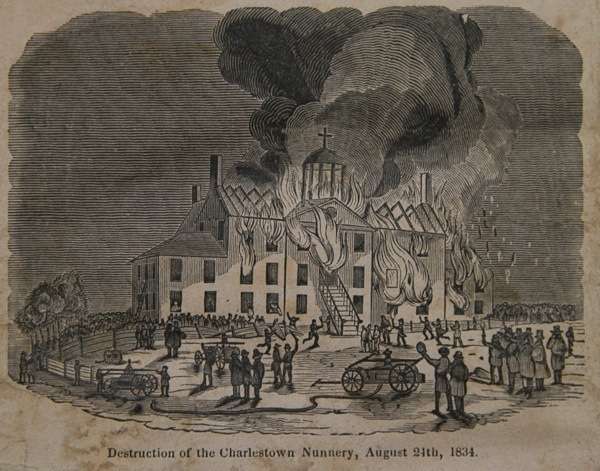
As fire brigades stood by a Protestant mob burned the Ursuline Convent and Girl's Academy.
Things really blew up in 1834 in Charleston—now the Somerville neighborhood of Boston—home to a large population of working class Protestants.  It was also the site of a Convent of Ursuline Nuns, and the academy for girls that they operated.  Since no equivalently high quality education was available to girls in Boston, many of the city’s Unitarian elite had enrolled their daughters there, regardless of warnings from their ministers.  In 1834 the school had 47 students, only six of whom were Catholic.  The neighboring Protestants resented both Catholics and the haughty Bostonian elite.
Rumors circulated of Protestant girls being “sold” to the convent.  Then in August word began to circulate about a nun who possibly wanted to leave the convent, but was prevented from doing so.  Inflamed by a circular calling on the citizenry to intervene to free the mysterious woman, a mob gathered on the evening of August 11.  Early the next morning they rushed the convent with torches and burning tar barrels.  The nuns and students barely had time to escape and hide in the garden while the building was vandalized then set on fire.  Responding fire brigades not only refused to extinguish the flames, but they joined the rioters.  The building burned to the ground in two hours.
The following morning Mayor Theodore Lyman convened a meeting at Faneuil Hall to try to calm the situation and instigate an investigation into the arsonBishop Benedict Fenwick called another meeting about the same time at Holy Cross, now officially a cathedral at which he tried to keep the outraged Irish from pouring into the streets to seek revenge.  He was largely successful.
But a new Protestant mob assembled and marched first to Faneuil Hall with the intent of breaking up the Mayor’s meting and then on to the Cathedral.  They were foiled at both points by a Militia guard.  After failing to procure arms from the guarded arsenal they proceeded on to the Convent.  In a frenzy as the Convent itself still smoldered the mob destroyed the gardens and orchards, set bonfires, and pulled down fences before exhausting their fury.
The city’s clergy were divided by the convent riot.  Orthodox ministers including Lyman Beecher, soon to rise to fame as a leading abolitionist either openly cheered the rioters or found excuses for their actions in supposed Catholic immorality and exploitation of pure womanhood.  The city’s Unitarian divines generally decried the violence but refrained from any action or speech which could be considered coming to the defense of Catholics.  The only sympathy came from Bishop Fenwick’s personal friend, the Universalist Hosea Ballou, himself an outcast from the local religious establishment.
The self-confessed ring leader of the riot, John R. Buzzell and a dozen others were charged and brought to trial, but Buzzell boasted:
The testimony against me was point blank and sufficient to have convicted twenty men, but somehow I proved an alibi, and the jury brought in a victory of not guilty, after having been out for twenty-one hours.
In the end only one defendant, a 16 year old boy seen burning a book after the main arson, was convicted.  The boy had no attorney and not a friend in the world, because he was sentenced to life in prison.  That sentence was so manifestly unjust and out of line that Bishop Fenwick and Mother Superior Sister Mary St. George joined 5,000 local citizens petitioning for a commutation of sentence for the boy.  He was eventually released.
Catholic demands for restitution for the failure of authorities to protect their property kept the memory of the Convent Riot alive in both communities as the Boston City Council, Charleston Town Meeting, the County of Middlesex, and the Massachusetts legislature all considered and rejected claims year after year.
 

Anti-Catholic cartoons like this kept Protestant workers inflamed.

Tensions between Catholics and Protestants remained high.  Then in January of 1836 Awful Disclosures of Maria Monk, or, The Hidden Secrets of a Nun’s Life in a Convent Exposed was published and became an instant best seller.  In fact it was said to be the mostly widely read American book between Parson’s Weems’s spurious biography of George Washington and Harriet Beecher Stowe’s Uncle Tom’s Cabin.  The book was a pot boiler novel supposedly written by Maria Monk, a young woman who had escaped from a convent.  It told a hair-raising story of sexual exploitation.  The book, since proven to be almost total fabrication, fueled new waves of anti-Catholicism and led directly to the emergence of the Know Nothings, a rabidly anti-Catholic and anti-immigrant secret society and political party.
Given this kind of history, the Broad Street Riot comes clearly into focusFourteen Irish and four Protestants were brought to trial.  Like the earlier Convent Riot, no Protestants were convicted.  The four Irish were all sentenced to terms in the work house.
The riot did cause Mayor Eliot to institute two reforms.  First, he established a paid Fire Department under the authority of the Mayor and Council.  The volunteer brigades were abolished, although almost all of the members of the new professional Department were drawn from their ranks.  Second, he established a Day Police to supplement the existing Night Watch. The two were soon merged into the Boston Police Department.  Recruitment into the new department came mostly from the Irish community.  The two departments remained largely segregated for decades before the Irish and other Catholics began to be hired by the Fire Department.
Two versions of the riot were told and kept alive in their communities.  The popular version among working class Protestants was that the fire brigade was rushing to a fire when blocked by arrogant Irish mourners who would not let them pass.  In some versions children or whole families perished in the flames.  It was manifestly not true
That did not stop it from being believed and the story is retold to this day. The Mighty Mighty Bosstones, a popular Ska and proto-punk band in the 1990’s sang:
The Boston fire-fighting volunteers
 On their way to fight a fire somewhere
Met with a funeral procession
Proceeding way too slow
A brownstone burns out of control
We need to lay to rest this soul
Loggerheads on Broad Street Eye to eye and toe to toe
Broad Street’s just not broad enough
And you just don’t love God enough…
A new wave of immigrants arrived in the 1840’s spurred by the Irish Potato Famine, and the flood gates of Europe opened up after the Civil War.  Catholics gained a majority in the city population and led by Irish politicians seized the City government, a move as bitterly resented by the class Unitarian Brahmins who were used to running things as by the still large Protestant working class.
Meanwhile the enthusiasm for reform among the intellectual elite of Boston, tended to grow in direct proportion to the growing Irish Catholic populationEarly support for moderation in alcohol use was transformed into a temperance movement aimed squarely at the taverns of the scary, rowdy Irish.  Free public education was supported as a counter to the Catholic’s system of parochial schoolsCompulsory public schooling was at first meant to close the Catholic schools and place children into public schools where they would be inoculated with Protestant valuesCrusades for decency and morality in entertainment were aimed at popular amusements.  What Do-gooders saw as reform, the working class Irish recognized as a cultural attack upon them.
Late 19th Century resentments resulted the persistence of the No Irish Need Apply signs still frequently seen in shops and factories.  The politics of Boston and those signs would be bitterly remembered by Joseph P. Kennedy when he became a fabulously rich man married to a daughter of the former Boston Mayor John Francis “Honey Fitz” Fitzgerald.  He would inoculate his sons, and by extension their children with a resentment of the WASP elite, and a determination to prove themselves better than any of them.

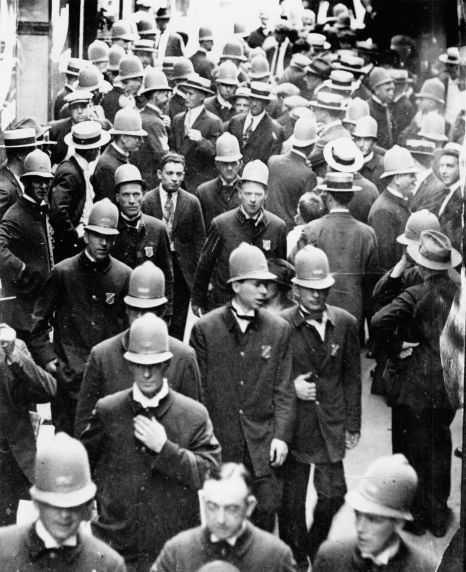
Members of the almost all Irish Boston Police Department leave a 1919 strike meeting.  WASP governor Calvin Coolidge crushed the strike with National Guard troops and banned the strikers for life from any public employment souring still strong resentments in Boston's Irish Southie community that have lingered to this day.
While Protestant/Catholic relations improved across much of the nation, and as Irish Americans established themselves in politics and the professions, the old strains eased in most places.  But not in Boston.  The Irish found themselves “put in their place” when Governor Calvin Coolidge, a quintessential WASP, crushed the strike by the virtually all Irish Boston Police in 1919, banning every man for life from public service.  Many of those men, unable to find work, would make their close knit South Boston neighborhood —Southie—a bastion of bank robbers, cartage thieves, and gangsters to this day.
If the Irish in Boston hold resentments to this day, the Protestants have not been shining examples of brotherhood.  The Unitarian’s Beacon Press continued to publish virulent anti-Catholic screeds well into the 1950’s.  Unitarian Universalist ministers generally supported Boston school desegregation in the ‘60’s and ‘70’s including forced bussing which was voraciously—and occasionally violently—opposed by the Irish of Southie and were often harsh in characterizing the opposition as racist.
More recently conflicts over abortion rights, LBGT rights, and marriage equality, along with the continue scandals about clergy sex abuse in the Church, has led to revival of anti-Catholic rhetoric.
Today in most parts of the country with heavily Catholic populations, large proportions—often majorities—of local Unitarian Universalist congregations—are made up of former Catholics.  But not so much in Boston, and especially not among the Boston Irish.  Disgruntled liberal former Catholics would generally go anywhere to worship before they would set foot in a congregation of those they see as their ancient tribal enemies.
It seems some street brawls never really end.