Showing posts with label Random House. Show all posts

Friday, April 19, 2024

The Great American Poem by Billy Collins—National Poetry Month 2024


Billy Collins reading in 2008.

Billy Collins is probably the most accessible and popular working poet in the U.S. and yet still gets respect by serious critics, cultural guardians, and awards panels.   His work is transparent, straight forward, conversational, personal, and often wry.

He was the U.S. Poet Laureate from 2001 to 2003, and is the author of many collections of verse, including Questions About Angels from Pittsburgh in1999 and Aimless Love form Random House in 2013. His many honors include fellowships from the National Endowment for the Arts and the Guggenheim Foundation and the Poetry Foundation’s Mark Twain Award for Humor in Poetry.


The Great American Poem

If this were a novel,

it would begin with a character,

a man alone on a southbound train

or a young girl on a swing by a farmhouse.


And as the pages turned, you would be told

that it was morning or the dead of night,

and I, the narrator, would describe

for you the miscellaneous clouds over the farmhouse


and what the man was wearing on the train

right down to his red tartan scarf,

and the hat he tossed onto the rack above his head,

as well as the cows sliding past his window.


Eventually—one can only read so fast—

you would learn either that the train was bearing

the man back to the place of his birth

or that he was headed into the vast unknown,


and you might just tolerate all of this

as you waited patiently for shots to ring out

in a ravine where the man was hiding

or for a tall, raven-haired woman to appear in a doorway.


But this is a poem, not a novel,

and the only characters here are you and I,

alone in an imaginary room

which will disappear after a few more lines,


leaving us no time to point guns at one another

or toss all our clothes into a roaring fireplace.

I ask you: who needs the man on the train

and who cares what his black valise contains?


We have something better than all this turbulence

lurching toward some ruinous conclusion.

I mean the sound that we will hear

as soon as I stop writing and put down this pen.


I once heard someone compare it

to the sound of crickets in a field of wheat

or, more faintly, just the wind

over that field stirring things that we will never see.


Billy Collins


Sunday, April 2, 2023

Billy Collins Has an Excellent Point—National Poetry Month 2023

Billy Collins reading in 2008.  His performances are always packed.

Billy Collins is a contemporary American poet best known for his easy accessibility and actually being able to sell his popular collections.  Dubbed “the most popular poet in America” by Bruce Weber in the New York Times, he served two terms as the U.S. Poet Laureate, from 2001-2003.  Poetry and poets are often themes of his verse.  This particular effort is perfect for National Poetry Month and echoes some of my own feelings.

The Effort

Would anyone care to join me
in flicking a few pebbles in the direction
of teachers who are fond of asking the question:
“What is the poet trying to say?”

as if Thomas Hardy and Emily Dickinson
had struggled but ultimately failed in their efforts—
inarticulate wretches that they were,
biting their pens and staring out the window for a clue.

Yes, it seems that Whitman, Amy Lowell
and the rest could only try and fail
but we in Mrs. Parker’s third-period English class
here at Springfield High will succeed

with the help of these study questions
in saying what the poor poet could not,
and we will get all this done before
that orgy of egg salad and tuna fish known as lunch.

Tonight, however, I am the one trying
to say what it is this absence means,
the two of us sleeping and waking under different roofs.
The image of this vase of cut flowers,

not from our garden, is no help.
And the same goes for the single plate,
the solitary lamp, and the weather that presses its face
against these new windows—the drizzle and the
morning frost.

So I will leave it up to Mrs. Parker,
who is tapping a piece of chalk against the blackboard,
and her students—a few with their hands up,
others slouching with their caps on backwards—

to figure out what it is I am trying to say
about this place where I find myself
and to do it before the noon bell rings
and that whirlwind of meatloaf is unleashed.

Billy Collins

The Effort from Ballistics. © Random House 2008.


Saturday, October 1, 2022

Almost too Good to be True—Little Golden Books the Cheep and Durable Books that Children Love

A well used copy of The Poky Little Puppy, the best selling of the 12 original Little Golden Books.

Today’s responsible parents are required by law to provide educationalpsychologically vetted, and age appropriate books for their tykes, preferably penned by a celebrity and sensitively illustrated by a renowned artist.   

The book must be an over-sized hard cover festooned with award medallions and must be purchased at specialized childrens book boutique for at least $22.95 plus tax.  The parents will read this book to the designated tot 1.2 times before it is carefully placed on colorful shelves with scores of other books in a display meant to impress other parents and visiting in-laws with the depth of their commitment to their children’s betterment.   

Sometime between the kid’s eighth and twelfth birthdays all the books will be boxed up and sold in a garage sale for .25 cents each.

Generations earlier, grim faced relatives shoved thick little books dense with type and uplifting moral lessons at children who were expected to be able to recite long passages from them by rote in the parlor after Sunday dinner.

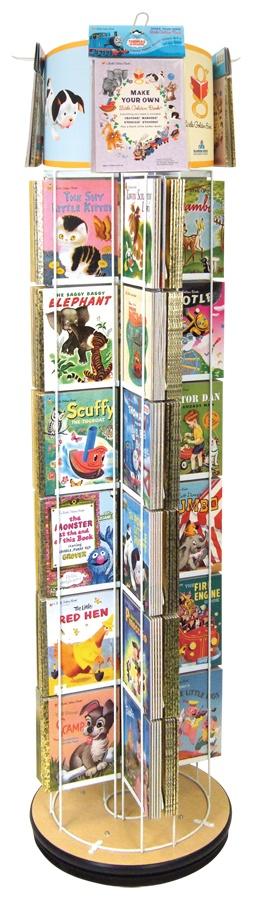
In between there were Little Golden Books.  The first twelve titles in this durable series were published on October 1, 1942.  They featured simple stories and rhymes illustrated on every page with bright lithographsbound between thick, sturdy hard cardboard covers with a glittering gold stripe down the spine.  Each book sold for .25 cents, not just in bookstores, but in the kind of places families visited almost all the time—department storesdrug stores, dime storesgrocery stores

Among those first twelve books were some that have not been out of print a day since:  Three Little KittensThe Little Red HenThe Poky Little Puppyand The Animals of Farmer Jones.  The Poky Little Puppy alone may be the bestselling children’s book of all time with more than 15 million sold as of 2005.


As a child of the 1950s, I can attest to the magnetic appeal of these books.  Staring at the rack of Little Golden Books in the grocery store kept me out of mischief while my mother did the weekly shopping.  If I had been good and Mom, always a thrifty shopper, kept the bill low, I might be allowed to take home a new book. 

By that time besides the cheerful little kiddy books, there were also exciting adventures of Hopalong Cassidy and Roy Rodgers, and books from Walt Disney cartoons.  These books were kept in the bedroom and read over and over.  By the time I was in the second grade and ready to graduate to real or chapter books, both my reading skills and my affection for books made me eager and able.

Maureen's all time favorite book.

Thirty years later Little Golden Books were still captivating my youngest daughter Maureen who especially treasured Martha’s House by Edith Kunhardt which took us on a tour of a little girls family cottage, irresistibly more charming than our slapdash and chaotic abode.  When she was four years old she had me read her that book every single day until we almost accomplished the impossible, wearing it out.  Another thirty-five years on, Maureen still recalls and speaks fondly of the book and of our daily ritual.

Little Golden Books were the brainchild of Georges Duplaix, a French born children’s book author and the head of The Writers and Authors Guild, Inc., an agency that sought to find publishers for its members.  Duplaix sold Simon and Schuster on the idea of an inexpensive line of colorful basic childrens books.  He helped select Dr. Mary Reed, a professor at the Teachers College of Columbia University, as the initial editor of the series.  Western Printing and Lithographing Company of Racine, Wisconsin was brought in as a partner in the enterprise and did the actual printing and binding.

Georges Dupaix not only recruited authors and illustrators, but penned several Little Golden Book titles including some like this on that he translated himself from their original French editions.

Despite World War II paper shortages, the books were a success beyond everyone’s wildest expectations.  Within five months the 12 original titles had gone through three printings and sold more than 1.2 million copies.

Duplaix went to work for Western Publishing, for whom he recruited many writers and artists for the series and other Western imprints.  In 1958 Western bought out Simon and Schuster’s interest in the series.  The Golden Books imprint, now including several other formats in addition to the classic cardboard bound books, has been sold several times.  In 2001, Random House paid an estimated $85 million to acquire Golden Books.

Several noted authors and illustrators have contributed to Little Golden Books, probably most notably Richard Scarry.  Margaret Wise Brown, best known as the author of Goodnight Moon, collaborated with illustrator Garth Williams, who also did Charlotte’s Web and the Little House Books, on several early Golden Book titles.

Little Golden Books now features inspiring biographies for early readers.

Today, you can still find Little Golden Books, including many classic titles but also new ones featuring the likes of Sponge BobI Am a Clone Trooper (Star Wars), Encanto, and girl empowerment bios of Lucile Ball and Betty White.  They now cost $5.99.  Given inflation, which is not much more expensive than the first books in 1942.