
The Charge of the Light Brigade by Richard Caton Woodville, Jr.
Alfred, Lord Tennyson, then the Poet Laureate of England got it exactly and succinctly right when he wrote “Not tho’ the soldier knew, someone had blunder’d... Charging an army, while all the world wonder’d.” He dashed off what would become the recital piece of every English schoolboy within moments of laying down the Times with a correspondent’s account of a disastrous vainglorious charge by the British Light Cavalry into the teeth of Russian artillery that commanded a long, narrow valley from the heights on both sides as well as the head of the vale. The poem, The Charge of the Light Brigade was rushed to press and published on December 9, 1854, less than six full weeks after the debacle of October 25 that year.
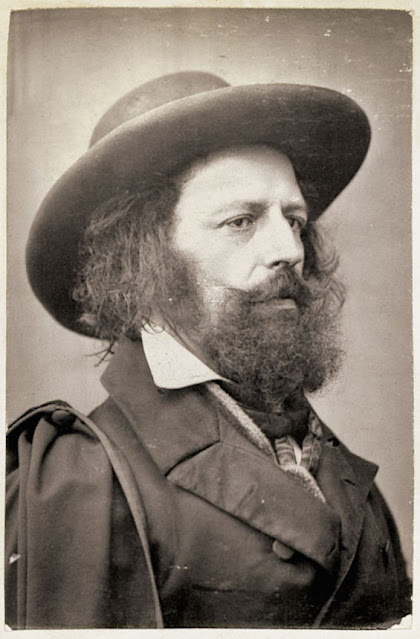
Alfred, Lord Tennyson's poem fixed the story of the Light Brigade in the public imagination.
One could easily argue that not only was the charge itself an inexcusable blunder, but so was the whole Crimean War, of which it became the most celebrated moment of a wretched waste of lives and treasure. For arcane motives involving international imperial rivalries particularly involving the Great Game of Russian dreams of a deep-water port on the Indian Ocean as the threat to British India and to support ambitions in Afghanistan, former enemies Britain and France came to the defense of the Ottoman Empire over Russians demands for protection of Orthodox minorities in the Balkans.
Both the new allies had large armies uniformed, armed, and drilled for a Napoleonic Era war of massed formations and open country maneuver. Although the English had some experience with colonial warfare, both main armies were more than rusty after 35 years of European peace and the English were commanded by inexperienced and largely incompetent noblemen and wealthy gentry capable of buying commissions.
Moreover, the nature of modern warfare had changed and no one was less prepared than the Western powers. Principle innovations were vastly improved heavy and field artillery mounted in unprecedented numbers, rifled muskets that increased the accuracy of infantry fire, and especially the use of railroads to supply and reinforce Russian forces through interior lines while the British and French had a long and unreliable sea connection.
After inconclusive early action in the Balkans, the British and French decided to attack the bastion Russian control of the Black Sea, Sevastopol on the Crimean Peninsula. The Western armies were rushed to the theater with only summer campaign uniforms, inadequate tents and bedding, on short rations of barely edible bully beef. Moreover, many were weakened by sickness contracted on crowded troop transports and once ashore were stricken by dysentery and infectious diseases.
Despite this, the British and French had early success against the ill-trained Russians after landing unopposed on the Peninsula north of Sevastopol. But the Russians quickly fortified the city and erected complex earthwork defenses which concentrated artillery fire against possible attack. The war quickly settled into a siege and the allies were forced into miserable, water filled trenches opposite Russian defenses. Staggering losses were soon felt from Russian artillery pounding but especially from disease, exposure, and malnutrition.

A topographical map shows British held Balaclava and the valley between the Causeway Hills and the Fedukhin Heights into which the Light Brigade charged.
To break the situation open, the British launched a flanking amphibious maneuver, landing a substantial force east of Sevastopol at Balaklava. It should have been a masterful, war ending operation. Instead, a large Russian Army began a counterattack on the English toehold beginning on October 23, 1853 which quickly routed Ottoman forces occupying outer defenses on the highlands around the port while capturing substantial Turkish artillery and turning it against the English. Although the English rallied in their defensive interior trenches, the problem soon became how to re-capture or neutralize the former Ottoman guns.

Lord
Lucan, commander of the Cavalry Division at Balakava, sent the Light
Brigade up the Valley and kept the Heavy Brigade under his personal
command in reserve. He never committed the Heavy Brigade in support of
the shattered Light Brigade.
The British cavalry, which had missed earlier fighting as it was delayed at sea had arrived. It consisted of two divisions under the command of Lieutenant General George Bingham, 3rd Earl of Lucan, who was under the overall orders of Field Marshal FitzRoy Somerset, 9th Earl of Raglin.
The Heavy Brigade was mounted on chargers, wore silver helmets and armored breast plates, and were armed with heavy cavalry sabers. These men consisting of the 4th Royal Irish Dragoon Guards, the 5th Dragoon Guards, the 6th Inniskilling Dragoons, and the Scots Greys were intended as shock troops especially trained for frontal assaults of artillery positions and capable of overwhelming them.

Surviving officers and men of the 13th Light Dragoons at Balakava by James Fenton--one of the earliest war theater photographs.
The Light Brigade included the 4th and 13th Light Dragoons, 17th Lancers, and the 8th and 11th Hussars, under the command of Major General James Brudenell, 7th Earl of Cardigan. Lucan and Cardigan were brothers-in-law but also bitter service rivals who personally detested each other. This enmity would have fateful consequences.

Lord
Cardigan in all of his splendor led the Light Brigade into the "jaws of
Death." He escaped most of the blame for the disaster and was hailed a
hero. He is also remembered for the name-sake buttoned sweaters he
wore around camp.
Raglin recognized that the key to the upcoming campaign was re-capturing the Turkish guns, mostly heavy naval rifles, on the heights. He intended for the fast-moving Light Brigade to sweep around Russian flanks and attack the guns before the Russians could evacuate them and hopefully send the gunners into a panicked flight in which they could be hacked to pieces. It was exactly the kind of work the light cavalry was designed for.
Raglin’s written order to Lucan, drafted by Brigadier Richard Airey read “Lord Raglan wishes the cavalry to advance rapidly to the front, follow the enemy, and try to prevent the enemy carrying away the guns. Troop horse artillery may accompany. French cavalry is on your left. Immediate.” This hasty and somewhat cryptic order was carried to Lucan by Raglan’s favorite, dashing young Captain Louis Edward Nolan. Nolan was widely regarded as the most outstanding and capable young officer in the Cavalry with a great career and high command in his future.
Nolan rode hard to find Lucan and excitedly handed the commander his orders. Lucan was somewhat mystified by the orders and asked Nolan, “What guns does he mean?” Nolan replied with a casual sweep of his hand, not just the hills, but the concentration of artillery at the head of the Valley. Lucan assumed that he meant an assault on those guns was the primary objective.
Despite the fact that such a charge was the purpose of the Heavy Cavalry under Major General James Yorke Scarlett, Lucan believed the order was intended for Cardigan’s Light Brigade.
When Cardigan received his orders to attack up the valley “without delay” he recognized that his units would be riding into an unwinnable trap. He assumed his brother-in-law had issued the order out of personal spite. But to uphold his honor he decided to attack immediately without delaying for clarification of the orders from Raglan.

A
panoramic and fairly accurate depiction of the Light Brigade charge up
the valley into the Russian guns from a popular late 19th Century print.
With Cardigan in the van, the 669 men of Light Brigade set off at a trot up the long valley between Fedyukhin Heights and the Causeway Heights. As a staff officer Nolan observed the maneuver and expected Cardigan to quickly split his forces to the left and right to attack the heights. When instead they picked up the pace to a full charge, a horrified Nolan rode around the troops and across their entire front gesturing wildly and shouting “There’s been a mistake!” until he was shot out of the saddle and killed.
The Heavy Brigade, now under Lucan’s direct command, was held in reserve and was meant to follow the Light Brigade when it breached the guns at valley’s head.
The Russian forces commanded by Pavel Liprandi included approximately 20 battalions of infantry supported by over 50 artillery pieces deployed on both sides and at the opposite end of the valley. Enfilading fire soon ripped the ranks of the troopers from the heights while the front was shredded by level fire heavy with grape.
Despite the heavy carnage, troopers reached the guns and sent the Russian artillerymen into flight. But they were not able to hold on. Lucan, observing the disaster, never launched his secondary attack with the Heavy Cavalry. The Light Brigade was put to flight and the Russian crews returned to their guns to pour moved devastating volleys into their backs.
The Light Brigade suffered horrendous losses of officers and men—110 killed outright, 161 wounded, 60 captured and 335 horses killed in action, or were put down after because of their wounds.
The French light cavalry, the Chasseurs d’Afrique under Armand-Octave-Marie d’Allonville, did manage to clear the Fedyukhin Heights of two half batteries of guns, two infantry battalions, and Cossacks and provided cover for the remaining elements of the Light Brigade as they withdrew. The French Marshal Pierre Bosquet, famously observed of the Light Brigade sacrifice, “It is magnificent, but it is not war, it is Madness!”
In the end the soon to be world famous battle had no immediate tactical or long-term strategic significance. The disorganized Russians, who had been handed a gift beyond their expectations were unable to take advantage of it and dislodge the British from Balaklava. The Siege of Sevastopol settled into a long, nightmarish endurance contest that was a preview of the trench warfare on the Western Front during World War I.
The yearlong siege of Sevastopol killed and wounded 170,000 men, on both sides not including the tens of thousands the British and French lost to disease and ended when the Russians pulled off a near-miraculous evacuation of their battered remaining forces over a pontoon bridge. It signaled an ultimate Russian defeat but was delayed by some minor, face saving victories by the Tsar’s troops in the Balkans. An Austrian ultimatum to Russia brought the parties to the negotiating table where the British and French were ready to grant none-to-terrible terms to end the whole bloody affair in March of 1856 with the Treaty of Paris.
No one got much out of the bloodbath except the Ottomans. The famously ailing Sick Man of Europe was able to limp along as the edges of its Empire were nibbled away in rebellions and small local wars until their involvement in the Great War brought down the ancient Sultanate.
When word of the disaster reached London in November, public reaction mirrored Tennyson’s, if not so elegantly expressed. The troops were lauded—even idolized—as gallant heroes whose devotion to duty and country against impossible odds were inspiring and unquestionable. The Army and government did everything in their power to encourage and spread this sentiment. It was their armor against public outrage at the criminal incompetence that led to the slaughter.

London gets the news from Raglin's report to the Secretary of State for War.
The first report of the battle was printed in the The London Gazette in an “Extraordinary Edition” on November 12 and contained the official dispatches of senior officers as addressed to the Secretary of State for War and the Colonies Henry Pelham-Clinton, 5th Duke of Newcastle. Raglin put the blame almost completely on Lucan:
…from some misconception of the order to advance, the Lieutenant-General (Lucan) considered that he was bound to attack at all hazards, and he accordingly ordered Major-General the Earl of Cardigan to move forward with the Light Brigade.
Raglin essentially claimed that whatever the orders he received, Lucan on the ground should have exercised his discretion.
When he learned that the official reports had been publicly exposed, Lucan wrote a furious reply saying that Raglin had bound him strictly to absolute obedience to every order as issued. The War Ministry blocked publication as a breach of public decorum and disrespect to a senior officer. Lucan was recalled from duty and arrived in England in March 1854. But word of his objections became public knowledge, if not the exact text of his defense. It was the beginning of round-after-round of finger pointing and blame shifting.
Meanwhile William Russell of the Times, the man who practically invented the roll of a professional war correspondent and would later notably cover major campaigns in the American Civil War, published his two lengthy accounts in December—the reports that inspired Tennyson’s poem. None of the senior commanders escaped his blame except for Cardigan who dutifully and valiantly executed his fateful orders and did not receive the promised support of the Heavy Brigade. Cardigan was able to return home a hero and was elevated over his superiors to Inspector General of the Cavalry.
When Lucan arrived in London in March he immediately launched what would today be called a public relations offensive. He began with an exchange of letters the Times he reiterated his criticism of Raglin but also turned his sights on Captain Nolan for delivering a garbled message with unseemly, agitated excitement. Nolan was the perfect target. He may have been a promising officer, but he was a junior one without as yet a wide web of kin and supporters at the upper levels of the Army and government. He was an Irishman with no aristocratic connections. Best yet, he was dead and unable to mount a defense.
Lucan repeated his defense in a speech to a friendly House of Lords. It worked like a charm. Lucan escaped further investigation or any formal charges against him. Although he never returned to active command, he was awarded the prestigious Order of the Bath that summer, made a full General in 1865 and a superannuated Field Marshal in 1887, the year before his death at age 88.

Lord Raglin, the one-armed old soldier in over-all command in the Crimea died of dysentery and depression before he could come home.
As for Raglin, he remained in command in the Crimea overseeing the fruitless stalemate. A botched piecemeal allied assault on Sevastopol on June 18, 1855 was a complete failure. The accounts of Florence Nightingale and others held him responsible for the wretched condition of his troops and their suffering. His own health declined rapidly, accelerated by what is now recognized as clinical depression. He died, like so many of his men, of dysentery, just ten days after his final blunder. His body was returned to England to a solemn welcome and suitably grand funeral.
When the survivors of the Light Brigade finally arrived home with the rest of the battered Crimean army, their ranks further thinned by subsequent actions and mostly by disease and exposure, they were lionized. There were a number of reunions over the years, most notably one in In October 1875 at the Alexandra Palace in London to celebrate its 21st anniversary of the battle. It was the largest event of its kind. The elderly Lucan, probably unsure of his welcome, declined to attend but dined the same night with some of his former officers.
In 1890 Rudyard Kipling wrote his own piece about the Light Brigade portraying an apocryphal visit to Tennyson by the “twenty last survivors” begging him to write a new poem to shame the British public into offering financial assistance to the elderly and neglected veterans.
Some observers credit the glory bestowed on the Light Brigade for the mindset of sacrificial devotion to duty the led a generation of young Britons to their doom in fruitless over-the-top bayonet charges into No Man’s Land in the teeth of German machine guns and artillery in the Great War. And as in the Crimea, incompetent but aristocratic commanders usually escaped blame for the slaughter.
The American Civil War helped popularize Tennyson’s poem in this country as an ode to battlefield gallantry. It was popular with troops on both sides, but especially cherished by the plumed knights of J.E.B. Stuart’s Confederate Cavalry. In the post-war years it became nearly as popular a school recital piece here as it did in Britain.

The Warner Bros.1936 version of the tale was mostly romantic fantasy showcasing their photogenic popular leads, Errol Flynn and Olivia DeHavilland,
Most Americans are only familiar with the battle through fragmentary memories of the poem or from the highly inaccurate 1936 Warner Bros. historical romance, The Charge of the Light Brigade starring Errol Flynn and Olivia de Havilland. The movie portrayed the charge as revenge for a massacre of Lancers at the hands of a Russian influenced religious fanatic on the Northwest Frontier of India. In the film Flynn and his Indian Army troops are miraculously posted to the Light Brigade and the villainous Surat Khan and his men are manning the Russian guns. Flynn thus portrayed heroic figures in two of the most famous military disasters of the 19th Century including They Died With Their Boots On about George Armstrong Custer in 1941.

The death of Captain Nolan, David Hemming, in the 1968 British film.
Tony Richardson’s 1968 British film, The Charge of the Light Brigade, a savage indictment of the stupidity of war and the British class system made at the height of the Vietnam War era, was epic in scale, but contained elements of bitter satire. It got the facts of the debacle mostly straight. Little seen in the U.S. it had a stellar cast of British film and theater notables including John Gielgud as Lord Raglin, Harry Andrews as Lord Lucan, Trevor Howard as Lord Cardigan, and Richardson’s wife, Vanessa Redgrave. David Hemming played Captain Nolan as both a sympathetic naïve young man and a vainglorious twit, the perfect scapegoat for the disaster. It was the most expensive British film at the time it was shot but was a box office failure when Richardson refused to screen the film for critics and went out of his way to insult and alienate them. In retrospect the neglected film has been listed as one of the 100 Best War Films of All Time in a 2004 British public opinion poll.
It has been 57 years since that last film. Many futile wars later, perhaps a new version is in order. Too bad it would probably be too expensive to make and historical epics are out of fashion.


