Showing posts with label Scandinavia. Show all posts

Thursday, June 11, 2020

Fun With Flags—Denmark’s Nordic Cross Set a Trend

The Danish national flag featuring the Nordic Cross--the koffadiflaget.

With a big tip-o’-the-hat to Dr. Sheldon Cooper and his popular cabal access show Fun With Flags, today we share the story of the Nordic Cross and how it got on the flags of all of those folks with blond hair, social democracy, great health care, better sex lives than you or me, and generally the happiest people in the world.  Hey, if the Cross on the flag helps, I’m willing to donate at least the field in the Stars and Stripes.
The Nordic Cross symbolized Christianity, of course, and particularly the Lutheranism that became the state religion of the Nordic Nations.  It has a long horizontal cross bar and the upright was “shifted to the hoist”—the mast or flag pole—leaving the two inner fields as squares and the two outer fields one and half times the width of the inner ones.  Trust me, the design is not as complicated as the written description.  In fact it is simplicity itself as the national flags using it are unadorned by bars, shields,  or other devices.
Blame it all on Denmark which on June 10, 1748 adopted the Koffardiflaget as a civil ensign for use by its merchant ships.  As was the case with other national flags, as opposed to the personal banners of sovereigns, the flag identifying merchant or naval vessels quickly became internationally recognized and a de facto national flag before ultimately being adopted as an official emblem.
The Danish design was simplicity itself—an off-center white cross with narrow arms and upright on a crimson field.

A recreation of the personal banner of William the Conqueror.  Some dispute the early use of the Nordic Cross.
Of course, the Nordic Cross was far older than any national flag.  The personal banner of William the Conqueror, decedent of Vikings, featured the cross on a red field with arms of two lions in the upper left field on a swallow tail pennant.  It also appeared on the arms and banners of various nobles and local rulers not only in Scandinavia, but in the low countries, northern Germany and the Baltic region.  The Teutonic Knights used a black cross on a white background when they held sway from Northern Germany, through Poland and up into Lithuania.
The Scandinavian nations had a complicated history with various parts uniting voluntarily, being forced to unite, sometimes sharing a monarch but not national identity, and at war with one another until the modern independent nations were established when Norway Sweden gained its independence from Sweden in 1905 and Finland split from Russia after the 1917 Revolution.    But with the exception of Finland with its own unique ethnicity and Uralic language, the Scandinavian nations mostly shared a common ethnicNorse—identity, customs, pre-Christian and Christian religious traditions, and related languages.

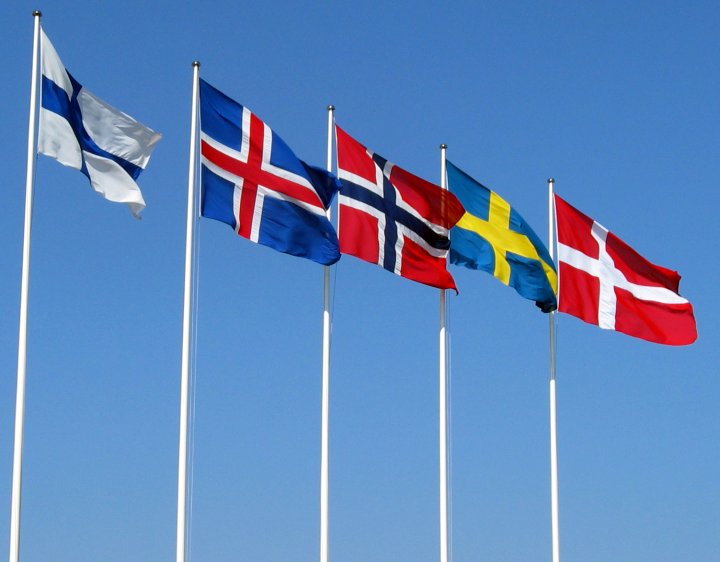
Nordic flags, from left to right: the flags of Finland, Iceland, Norway, Sweden, and Denmark. 
One by one each of the nations adopted national flags featuring the Nordic Cross.
·         Norway in 1821 featuring a blue field with a red cross superimposed over a larger white cross.
·         Sweden in 1906 featuring a light blue field and a gold cross.
·         Iceland although loosely ruled by Norway until 1814 and tied to the Danish Crown from 1380-1945 adopted its flag in 1915 with a red-on-white cross on a blue field.
·         Finland in 1918 featuring blue cross on a white field.

The Inuit majority of Greenland rejected the Norse Cross but maintained the colors of the Danish flag.
The only nation not using the Norse cross is Greenland which gained home rule from Denmark in 1975 and virtual national autonomy in 2009.  It earlier flags were based on the Danish banner.  Unlike the other nations of the region, the ethnic Norse are a minority in Greenland.  The indigenous Inuit  are the majority.  When Virtual independence was achieved a flag with a white cross on a light green background was proposed, an acknowledgement of still being part of the Danish Realm.  But the Inuit preferred a distinctive national banner and a proposal designed by  Thue Christiansen was adopted in 1985.  It features two equal horizontal bands of white (top) and red with a large disk slightly to the hoist side with the top half red, the bottom half white. The red and white colors recall the Koffardiflaget.
Many local flags around the world incorporate the Norse Cross.  In the United Kingdom the Orkney and Shetland Islands in the North Sea off of Scotland both of which were once Norse fifes use the cross on their flag, as does Yorkshire West Riding, once a part of the historic Danelaw.  In the Balkans flags proposed or considered as national banners for Estonia and Latvia incorporated the Cross.

The Nordic Cross was nearly overwhelmed on the War Ensign of Nazi Germany.
Nazi Germany, which often looked at Norse mythology for inspiration incorporated the Cross in its War Ensign, which is now forbidden to be displayed.  A black Iron Cross was displayed in the upper inside field and a large swastika medallion  covered the intersection of the Norse Cross which was black on white on a red field.  Leave it to the Germans to over engineer a simple concept.
For some reason the Nordic Cross shows up, sometimes highly stylized in the flags of several Brazilian states and municipalities despite it being a Portuguese speaking nation and heavily Catholic.  Why is anybody’s guess.

Sunday, June 11, 2017

Denmark Starts Trend for Nordic Cross National Flags

The Danish national flag featuring the Nordic Cross--the koffadiflaget.


With a big tip-o’-the-hat to Dr. Sheldon Cooper and his popular cable access show Fun With Flags, today we share the story of the Nordic Cross and how it got on the flags of all of those folks with blond hair, social democracy, great health care, better sex lives than you or me,  and generally the happiest people in the world.  Hey, if the Cross on the flag helps, I’m willing to donate at least the field in the current Stars and Stripes.
The Nordic Cross symbolized Christianity, of course, and particularly the Lutheranism that became the state religion of the Nordic Nations.  It has a long horizontal cross bar and the upright was “shifted to the hoist”—the mast or flag pole—leaving the two inner fields as squares and the two outer fields one and half times the width of the inner ones.  Trust me, the design is not as complicated as the written description.  In fact it is simplicity itself as the national flags using it are unadorned by bars, shields,  or other devices.
Blame it all on Denmark which on June 10, 1748 adopted the Koffardiflaget as a civil ensign for use by its merchant ships.  As was the case with other national flags, as opposed to the personal banners of sovereigns, the flag identifying merchant or naval vessels quickly became internationally recognized and a de facto national flag before ultimately being adopted as an official emblem.
The Danish design was simplicity itself—an off-center white cross with narrow arms and upright on a crimson field.

A recreation of the personal banner of William the Conqueror.  Some dispute the early use of the Nordic Cross.
Of course, the Nordic Cross was far older than any national flag.  The personal banner of William the Conqueror, decedent of Vikings, featured the cross on a red field with arms of two lions in the upper left field on a swallow tail pennant.  It also appeared on the arms and banners of various nobles and local rulers not only in Scandinavia, but in the low countries, northern Germany and the Baltic region.  The Teutonic Knights used a black cross on a white background when they held sway from Northern Germany, through Poland and up into Lithuania.
The Scandinavian nations had a complicated history with various parts uniting voluntarily, being forced to unite, sometimes sharing a monarch but not national identity, and at war with one another until the modern independent nations were established when Sweden gained its independence from Norway in 1905 and Finland split from Russia after the 1917 Revolution.    But with the exception of Finland with its own unique ethnicity and Uralic language, the Scandinavian nations mostly shared a common ethnicNorse—identity, customs, pre-Christian and Christian religious traditions, and related languages.

Nordic flags, from left to right: the flags of Finland, Iceland, Norway, Sweden, and Denmark.
One by one each of the nations adopted national flags featuring the Nordic Cross.
·       Norway in 1821 featuring a blue field with a red cross superimposed over a larger white cross.
·       Sweden in 1906 featuring a light blue field and a gold cross.
·       Iceland although loosely ruled by Norway until 1814 and tied to the Danish Crown from 1380-1945 adopted its flag in 1915 with a red-on-white cross on a blue field.
·       Finland in 1918 featuring blue cross on a white field.

The Inuit majority of Greenland rejected the Norse Cross but maintained the colors of the Danish flag.
The only nation not using the Norse cross is Greenland which gained home rule from Denmark in 1975 a virtual national autonomy in 2009.  It earlier flags were based on the Danish banner.  Unlike the other nations of the region, the ethnic Norse are a minority in Greenland.  The indigenous Inuit  are the majority.  When Virtual independence was achieved a flag with a white cross on a light green background was proposed, an acknowledgement of still being part of the Danish Realm.  But the Inuit preferred a distinctive national banner and a proposal designed by  Thue Christiansen was adopted in 1985.  It features two equal horizontal bands of white (top) and red with a large disk slightly to the hoist side with the top half red, the bottom half white. The red and white colors recall the Koffardiflaget.
The Nordic cross can be found in many local flags around the incorporate the Norse Cross.  In the United Kingdom the Orkney and Shetland Islands in the North Sea off of Scotland both of which were once Norse fifes use the cross on their flag, as does Yorkshire West Riding, once a part of the historic Danelaw.  In the Balkans flags proposed or considered as national banners for Estonia and Latvia incorporated the Cross.

The Nordic Cross was nearly overwhelmed on the War Ensign of Nazi Germany.
Nazi Germany, which often looked at Norse mythology for inspiration incorporated the Cross in its War Ensign, which is now forbidden to be displayed.  A black Iron Cross was displayed in the upper inside field and a large swastika medallion  covered the intersection of the Norse Cross which was black on white on a red field.  Leave it to the Germans to over engineer a simple concept.
For some reason the Nordic Cross shows up, sometimes highly stylized in the flags of several Brazilian states and municipalities despite it being a Portuguese speaking nation and heavily Catholic.  Why is anybody’s guess.

Saturday, December 13, 2014

Ancient Sicilian Saint and Blond Babes With Fire on Their Heads

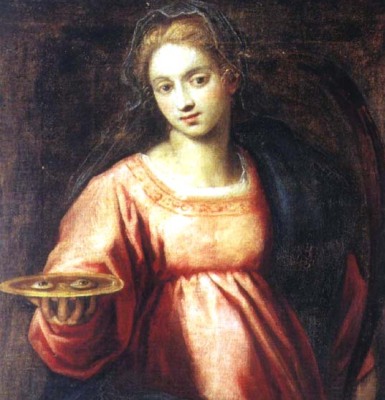
A Renaissance painting of St. Lucy displaying her eyes on a tray.  In some versions of her story she plucks her own eyes out of her head when a suitor admires them and sends them to him on a tray.  Miraculously, God gives her new eyes.  For this sacrifice she is patroness of the blind.


How did a Sicilian virgin martyr become the center of a Scandinavian winter festivalparticularly one rife with such obvious pagan symbolism?  In point of fact, no one is exactly sure, but the Feast of St. Lucy—Santa Lucia—observed annually on December 13, is ancient on one hand and surprisingly recent in its Norse guise.
Almost nothing is known about St. Lucy.  She was reported to be the daughter of a wealthy and/or noble family from Syracuse in Sicily in the early Fourth Century.  Syracuse was a sophisticated city originally founded as a Greek city state.  Lucy may have been descendent of the Greek aristocracy, more recent Roman rulers, or both.   
Historically she has been pictured as a blonde, which suggests a Greek origin, although no one knows what she looked like.
Lucy—he name in Latin meant light—was evidently a devout Christian during a time when members of the Church were still being persecuted by the Roman Empire.  The traditional story has it that her pagan mother arranged a marriage to a rich and powerful pagan man.  Lucy protested and vowed to save herself for Christ.  After she prayed for a miracle that saved her mother’s life, her mother relented.  But the jilted suitor was enraged. 
Here the story breaks down into many versions.  Either the swain tortured and killed Lucy, or he ratted her out as a Christian to local authorities.  Those authorities, or the far-off Emperor Diocletian himself, ordered her execution and/or torture.  Depending on the tale her eyes were first plucked out—a story that would later make her the patron saint of the bind—then she was stabbed in the throat with sword while she was proclaiming her love of Christ.  Or she was burned alive, but the fire would not consume her and she continued to testify.  In the end, no matter the details, she was a martyr to her faith and virginity.
Within a century she was the center of a cult venerating her as a saint, centered in Rome.  Veneration of her spread throughout the Empire, which by then was officially Christian.  Her feast day became one of the most important on the calendar.  Many legends sprang up about her and the miracles she performed.
One might assume that the Scandinavian veneration of her feast day dated to the era when the Norse countries were still Catholic.  But although her feast was undoubtedly on the liturgical calendar, there is no evidence of special celebrations during that time, at least by the Church.
Some historians believe that stories of St. Lucy may have entered the folk culture of the north after the Viking Normans conquered the island and established the Kingdom of Sicily in 1160.  As a matter of fact, there is historic evidence of the Normans introducing those stories and elevating the status of St. Lucy’s feast in Britain, where her feast day was thought to coincide with the shortest day of the year, which was pretty close under the old Julian calendar.  Unfortunately, there is no hard evidence that this was communicated to the Normans’ stay-at-home cousins in Scandinavia.
The Feast of Santa Lucia in its current form did not seem to be celebrated until after both Norway, in 1537, and Sweden, in 1597 adopted Lutheranism as the state religion.  But Lutherans do not typically venerate saints.
One line of conjecture has it that in response to Luther’s ban on St. Nicholas as a winter holiday gift giver, replacing him with Kindchen Jesus, or Christkind, a German Lutheran cousin.  This theory conjectures that in Sweden young women or girls were robed in white to portray the Christ child and that somehow, over centuries, this morphed into a portrayal of the Sicilian Saint.  On the face of it this seems ludicrous, but stranger things have happened, I suppose.
Most likely veneration of St. Lucy surrounding the coincidence of her Feast Day with the Solstice in the old Julian Calendar was introduced by sailors visiting Swedish ports—or in some accounts rescued from ship wrecks.  Others attribute it to Swedish mercenary soldiers returning from southern wars.  Take your pick.

Enter the eldest daughter.

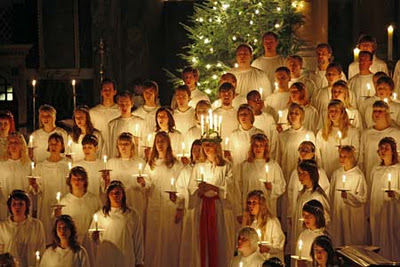
As developed and practiced in Sweden by the early 19th Century Santa Lucia arrives at a home in the dark with a donkey laden with delicacies and small presents.  It was the custom was for the eldest daughter of a family in a white robe for purity, a red sash for martyrdom, and a crown of glowing candles would enter the master bedroom of a home at dawn leading a procession of other women and girls of the family each carrying a candle.  The flaming crown was said to represent the return of light to darkness of the longest day of the year—an idea fraught with pre-Christian, pagan symbolism.  Or, to take a more Christian interpretation, it is meant to symbolize the fire that could not consume St. Lucy in some versions of the tale.
The leading girl with her crown comes bearing gifts of sweets, coffee, and cakes.  She and the others in the procession sing a song about the saint.  In more recent times it is the Neapolitan song Santa Lucia with lyrics adapted locally.  After the gifts are presented to the parents in their bed the girls would go on to sing other songs, usually Christmas carols.
This form of celebration evidently originated in the area around Lake Vänern in the late 18th century and spread slowly to other parts of the country and eventually to Norway, Finland, Denmark, and areas around the Baltic.  Each region adopted variations to the tradition.
This festival was then a home observance and not part of either church or public ritual
Public observations in Sweden did not begin until a Stockholm newspaper promoted one in 1927.  Now most cities and many schools, elect a Santa Lucia each year for popular public processionals.  The eve of the festival has become a popular party night, particularly with young people and university students.
In Norway, where the tradition never took as deep a root, the private celebrations of Santa Lucia had nearly faded away in all but isolated and remote rural areas.  But during the Nazi occupation of World War II, the custom was revised as statement of cultural pride.  The symbolism of bringing light into the darkness obviously had political implications.  The collaborationist Quisling government tried to outlaw the practice. Which, of course, only made it more popular.
 
Public celebrations like this are now common in both Skandinavia and in American communities with strong ethnic identities.
After liberation, public Santa Lucia processionals became popular and the home custom has nearly faded to extinction.

The Scandinavian countries, despite still having official Lutheran state churches, are today among the most thoroughly secular in the world.  Santa Lucia Day, never an official holiday, has been stripped of virtually all religious meaning and is celebrated as a joyous ethnic festival.  In fact, the neo-pagan symbolism of the occasion has probably only made it more popular than ever.
Scandinavian emigrants brought the custom to the United States in the late 19th and early 20th Centuries where it took particular hold in rural areas with large, supportive immigrant populations especially in the cold states of the Upper Midwest—Wisconsin, Minnesota, and the Dakotas.  In big cities, even ones with large immigrant communities, the custom tended to fade by the second generation as it assimilated into the general population.
Today some heavily Swedish and/or Norwegian small towns celebrate with the yearly selection of a comely Santa Lucia and a public ritual and in those Lutheran liberal arts colleges of Scandinavian origin with an abundance of blond co-eds and a well-developed choral singing tradition.