Showing posts with label Second Bank of the United States. Show all posts

Saturday, January 29, 2022

Too Mean to Die—Old Hickory’s Defiant Brush With Assassination

Mad Brit Richard Lawrence's pistol misfired when he took point blank aim at Andrew Jackson on the steps of the Capitol. 

You have to feel a little sorry for Richard Lawrence.  He was in the right place at the right time, skulking around the steps of the U.S. Capitol Building on January 30, 1835.  A funeral service for a member of Congress was breaking up.  All the dignitaries of the government including the Chief Executive himself were in attendance and would have to pass within feet of him.  He carried in each side pocket of his coat one cocked and loaded single shot derringer flintlock pistol.  He had a plan.  What could possibly go wrong?

Lawrence was a 35 year old Englishman who had been hearing voices in his head for a very long time.  Some believe he may have been the victim of lead in the paint he used in his work. Back home those voices had told him that he was the son and the heir of Richard III and that somehow the American President had kept him from the Throne.  He believed what those voices told him with such certainty that he decided to cross the ocean and come to the United States to have his revenge.  Along the way he decided he was also King of the U.S. and that Andrew Jackson was a usurper.

Suddenly the doors of the Capitol flew open and the mourners, led by the President himself emerged.  Lawrence hid himself behind a pillar.  As Jackson neared, he drew his pistol and stepped in front of the President firing at his chest at point blank range.
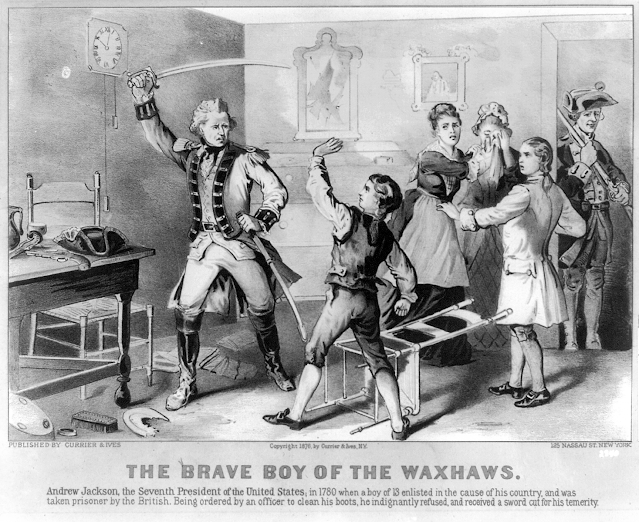
Jackson's larger than life image began with his Revolutionary War capture by the British as a boy and the saber slash across his cheek for defying an officer's demand that he clean his boots.

We interrupt the narrative at this point to review a little bit about the victim of the assault.  Andrew Jackson was no stranger to violence. During the American Revolution acting as a courier for irregular troops in North Carolina at the age of 13 or 14, Jackson was captured by the Red Coats.  When he defiantly refused the order of a British officer to shine his boots, his cheek was slashed open by a saber.

As a young man he took leave of his widowed mother keeping in mind a single piece of advice which he would follow to the letter the rest of his life, “Never sue for libel in a Court of Law.”  By that she meant that in affairs of honor the manly thing was confronting the offender personally and if possible, kill him.

In the raw new territory of Tennessee Jackson read and began practicing law.  He also developed a reputation of being quick to anger and as a common tavern brawler.  As he rose in the society of Nashville, he assumed the manners and character of a gentleman.  Which meant he abandoned wrestling in the mud, eye gouging, and trying to bite his enemy’s ear off.  Instead, he subscribed to the Code Duello.  Over the years he was in several affairs of honor and was both shot and did the shooting.
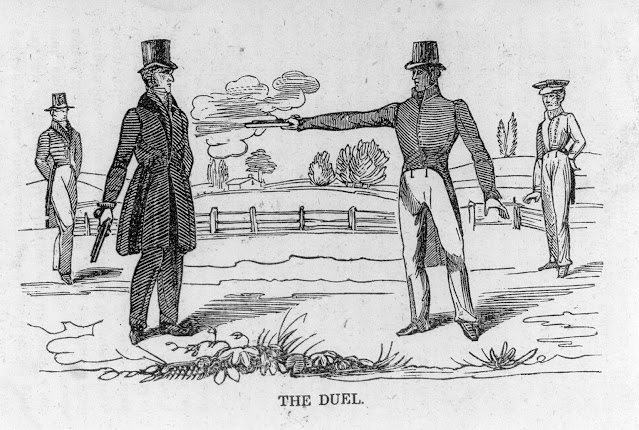
Jackson shot and killed Charles Dickenson in an 1806 duel after his opponent wasted his shot.  Dickenson had accused Jackson's wife Rachel of bigamy.

In one case he challenged a man who publicly asserted—truthfully—that his beloved wife Rachel was at least an inadvertent bigamist for marrying him before a divorce to her first husband was final.  On the field of honor his enemy purposefully wasted his shot.  In most cases the other party would do the same and both could leave the field with honor.  But Jackson took slow and steady aim at the defenseless man and shot him dead through the heart.

In 1813 a feud between Jackson, by then General of the Tennessee Militia and a former friend and subordinate officer Col. Thomas Hart Benton and his brother Jesse erupted into a wild street fight.  As Jackson closed to kill Thomas with a brace of pistols, Jesse snuck up behind him and shot him at point blank range in the side.  A ruckus between partisans of both sides ensued.  The Benton brothers fled town and Tennessee, although Thomas would later reconcile with the old General and become a political ally as a Senator from Missouri.  Jackson nearly bled to death and lost partial use of his left arm.  Jesse’s ball remained lodged in his body and caused him almost constant pain for the rest of his life.
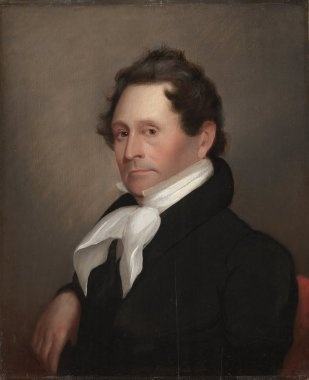
Jackson suffered a near fatal wound in a wild street brawl with Thomas Hart Benton and his brother Jesse.  Thomas latter reconciled with the General, became a staunch political supporter, and was a powerful Senator from Missouri.

Then, of course, there was Jackson’s well documented heroics and adventures as an officer against Native American tribes in the Red Stick War against the Creeks, at the legendary defense of New Orleans against the British, and finally marching through Florida in defiance of orders putting the nation at risk of a new war with Spain.

Back at the Capitol steps, when Lawrence fired a loud pop was heard and a cloud of black powder smoke briefly engulfed the two men.  But for some reason it was just a misfire, and the ball never left the barrel.

As the smoke cleared the enraged 67 year old President lurched for Lawrence and began beating him with his heavy gold-headed cane.  Lawrence stumbled.  He had trouble getting his second pistol out of his pocket while fending off blows.  When he did get it out, the second gun also misfired.  Jackson continued raining blows on the now prostrate man until witnesses physically dragged him away.

Jackson was unscathed, although he didn’t realize he had not actually been shot until he got back to the Executive Mansion and discovered nothing more than powder burns on his clothing.

Lawrence was taken to jail unconscious.  When he recovered he was examined by a doctor who declared that he was suffering from “morbid delusions.”

Later that spring Lawrence was put on trial.  The prosecutor was Francis Scott Key, better known as the writer of the Star Spangled Banner. Lawrence was found not guilty by reason of insanity, one of the first such verdicts in American history.  He lived his life out in various mental institutions until his death in 1861.
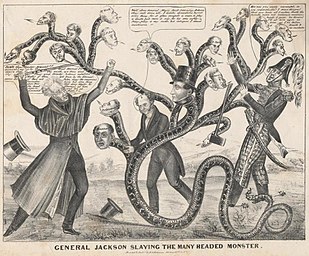
Jackson suspected that his bitter enemies over blocking the renewal of the Second Bank of the United States Charter were behind the assassination attempt.

Jackson didn’t believe it for a second.  He was sure that Lawrence was a hireling of his political enemies in the emerging Whig Party or perhaps of the bankers irate over his blocking the renewal of the Charter of the Second Bank of the United States.  Vice President Martin Van Buren agreed.  Ever after he carried a brace of pistols to the Capitol to fulfill his Constitutional duties of President of the Senate.

Many historians have examined the matter, and none have found any connection between Lawrence and Jackson’s many enemies.  That did not prevent the spread of the first of the conspiracy theories which seem to arise naturally from all assassinations and attempts.
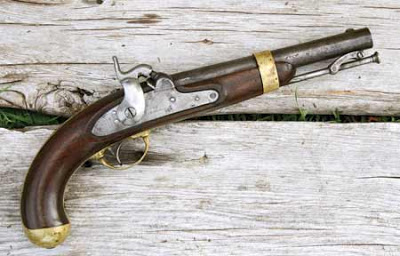
The Smithsonian Institution tested both of Lawrence's flintlock derringer pistols similar to this one, and both fired perfectly.

Lawrence’s pistols ended up in the Smithsonian Institution.  Around the centennial of the attack, researchers there tested both guns to try to find out why they had misfired.  Both fired perfectly on the first attempt to shoot them.  The scientists placed the odds of both functional pistols misfiring at 1 in 250,000.  Jackson was a lucky man.

Even luckier that he did not live in the 21st Century when his assailant might have a Glock with an extended clip.  No gold headed cane would protect him from that.

Wednesday, January 30, 2019

Old Hickory’s Defiant Brush With Assassination

Mad Brit Richard Lawrence's pistol misfired when he took point blank aim at Andrew Jackson on the steps of the Capitol.

Note—By calendar serendipity we have back-to-back entries about Andrew Jackson.
You have to feel a little sorry for Richard Lawrence.  He was in the right place at the right time, skulking around the steps of the U.S. Capitol Building on January 30, 1835.  A funeral service for a member of Congress was breaking up.  All of the dignitaries of the government including the Chief Executive himself were in attendance and would have to pass within feet of him.  He carried in each side pocket of his coat one cocked and loaded single shot derringer flintlock pistol.  He had a plan.  What could possibly go wrong?
Lawrence was a 35 year old Englishman who had been hearing voices in his head for a very long time.  Some believe he may have been the victim of lead in the paint he used in his work. Back home those voices had told him that he was the son and the heir of Richard III and that somehow the American President had kept him from the Throne.  He believed what those voices told him with such certainty that he decided to cross the ocean and come to the United States to have his revenge.  Along the way he decided he was also King of the U.S. and that Andrew Jackson was a usurper.
Suddenly the doors of the Capitol flew open and the mourners, led by the President himself emerged.  Lawrence hid himself behind a pillar.  As Jackson neared, he drew his pistol and stepped in front of the President firing at his chest at point blank range

Jackson's larger than life image began with his Revolutionary War capture by the British as a boy and the saber slash across his cheek for defying an officer's demand that he clean his boots.
We interrupt the narrative at this point to review a little bit about the victim of the assault.  Andrew Jackson was no stranger to violence. During the American Revolution acting as a courier for irregular troops in North Carolina at the age of 13 or 14, Jackson was captured by the Red Coats.  When he defiantly refused the order of a British officer to shine his boots, his cheek was slashed open by a saber.
As a young man he took leave of his widowed mother keeping in mind a single piece of advice which he would follow to the letter the rest of his life, “Never sue for libel in a Court of Law.”  By that she meant that in affairs of honor the manly thing was confronting the offender personally and if possible, kill him.
In the raw new territory of Tennessee Jackson read and began practicing law.  He also developed a reputation of being quick to anger and as a common tavern brawler.  As he rose in the society of Nashville, he assumed the manners and character of a gentleman.  Which meant he abandoned wrestling in the mud, eye gouging, and trying to bite your enemy’s ear off.  Instead he subscribed to the Code Duello.  Over the years he was in several affairs of honor and was both shot and did the shooting. 

Jackson shot and killed Charles Dickenson in an 1806 duel after his opponent wasted his shot.  Dickenson had accused Jackson's wife Rachel of bigamy.
In one case he challenged a man who publicly asserted—truthfully—that his beloved wife Rachel was at least an inadvertent bigamist for marrying him before a divorce to her first husband was final.  On the field of honor his enemy purposefully wasted his shot.  In most cases the other party would do the same and both could leave the field with honor.  But Jackson took slow and steady aim at the defenseless man and shot him dead through the heart.
In 1813 a feud between Jackson, by then General of the Tennessee Militia and a former friend and subordinate officer Col. Thomas Hart Benton and his brother Jesse erupted into a wild street fight.  As Jackson closed to kill Thomas with a brace of pistols, Jesse snuck up behind him and shot him at point blank range in the side.  A ruckus between partisans of both sides ensued.  The Benton brothers fled town and Tennessee, although Tomas would later reconcile with the old General and become a political ally as a Senator from Missouri.  Jackson nearly bled to death and lost partial use of his left arm.  Jesse’s ball remained lodged in his body and caused him almost constant pain for the rest of his life.

Jackson suffered a near fatal wound in a wild street brawl with Thomas Hart Benton and his brother Jesse.  Thomas latter reconciled with the General, became a staunch political supporter, and was a powerful Senator from Missouri.
Then, of course, there was Jackson’s well documented heroics and adventures as an officer against Native American tribes in the Red Stick War against the Creeks, at the legendary defense of New Orleans against the British, and finally marching through Florida in defiance of orders putting the nation at risk of a new war with Spain.
Back at the Capitol steps, when Lawrence fired a loud pop was heard and a cloud of black powder smoke briefly engulfed the two men.  But for some reason it was just a misfire and the ball never left the barrel.
As the smoke cleared the enraged 67 year old President lurched for Lawrence and began beating him with his heavy gold-headed cane.  Lawrence stumbled.  He had trouble getting his second pistol out of his pocket while fending off blows.  When he did get it out, the second gun also misfired.  Jackson continued raining blows on the now prostrate man until witnesses physically dragged him away.
Jackson was unscathed, although he didn’t realize he had not actually been shot until he got back to the Executive Mansion and discovered nothing more than powder burns on his clothing.
Lawrence was taken to jail unconscious.  When he recovered he was examined by a doctor who declared that he was suffering from “morbid delusions.”
Later that spring Lawrence was put on trial.  The prosecutor was Francis Scott Key, better known as the writer of the Star Spangled Banner. Lawrence was found not guilty by reason of insanity, one of the first such verdicts in American history.  He lived his life out in various mental institutions until his death in 1861. 

Jackson suspected that his bitter enemies for blocking the renewal of the Second Bank of the United States Charter were behind the assasination attempt.
Jackson didn’t believe it for a second.  He was sure that Lawrence was a hireling of his political enemies in the emerging Whig Party or perhaps of the bankers irate over his blocking the renewal of the Charter of the Second Bank of the United States.  Vice President Martin Van Buren agreed.  Ever after he carried a brace of pistols to the Capitol to fulfill his Constitutional duties of President of the Senate.
Many historians have examined the matter and none have found any connection between Lawrence and Jackson’s many enemies.  That did not prevent the spread of the first of the conspiracy theories which seem to arise naturally from all assassinations and attempts.

The Smithsonian Instituion tested both of Lawrence's flintlock derringer pistols similar to this one, and both fired perfectly.
Lawrence’s pistols ended up in the Smithsonian Institution.  Around the centennial of the attack, researchers there tested both guns to try to find out why they had misfired.  Both fired perfectly on the first attempt to shoot them.  The scientists placed the odds of both functional pistols misfiring at 1 in 250,000.  Jackson was a lucky man.
Even luckier that he did not live in the 21st Century when his assailant might have a Glock with an extended clip.  No gold headed cane would protect him from that.

Thursday, August 16, 2018

Pop Quiz—Who Rioted at the White House?

What may be the earliest photograph of the White House--an 1846 daguerreotype taken five years after the riot on the grounds of the mansion. 

The White House a/k/a The President’s Palace and Executive Mansion has seen its share of turmoil.

There was the time the British arrived uninvited and Dolly Madison had to abandon dinner and make a getaway with Washington’s Portrait rolled up in a rug.  The Redcoats burned the place requiring a fresh coat of white wash and earning the place a new name.

The Red Coats burning the Executive Mansion was a no-good-terrible-very-bad-day but it wasn't a riot.

It got pretty boisterous when Andrew Jackson was inaugurated and he invited the “plain people” over to the house.  Things got out of hand when thousands showed up, apparently very hungry.  They climbed through windows and broke furniture to get to the Enormous Cheese sent down from Vermont for the occasion.  But despite shocking the sensibilities of respectable folks, it was a friendly, if inebriated, crowd.

Then there was the day when Abraham Lincoln looked out the window and saw his Army running in a panic for their lives after being whipped at the First Battle of Bull Run.

Harry Truman was living across the street at Blair House while the old place was getting fixed up when Puerto Rican Nationalists tried to break in and shoot him.  They failed, but a White House Police Officer was killed.

This blog has covered all of those exciting events.

But today is the anniversary of the first, and as far as I can tell, only full scale riot on the White House grounds.  Can you guess who rioted and why?  Betcha can’t.

First let’s eliminate some possible candidates.

  • Coxey’s Army—The first greatmarch on Washington” by the unemployed in 1894 during one of the nation’s recurring financial Panics.  It dispersed peacefully at the Capital and never targeted the White House.
  • Suffrage ProtestsPicketing of Woodrow Wilson’s White House during World War I was a first for public demonstrations there, but was entirely orderly.  Irked, Wilson ordered the arrest of the women, many of whom were sent to jail where they went on a hunger strike and were force fed by hoses shoved down their throats.  But no riot.
  • The Bonus MarchWorld War I Veterans demanding early payment of a promised bonus in 1932 marching up Pennsylvania Avenue to the Capital was dispersed by General Douglas MacArthur’s tanks and cavalry and chased across the river where he burned their shanty town.  Herbert Hoover, however, and the White House were never in any danger.
Since these events there have been many huge demonstrations in Washington for civil rights, for and against abortion rights, against several wars, and for numerous other causes.  The current Resident has drawn regular protests large, small, and creative.  But no riots at the White House.

Picketing now occurs almost daily for one cause or another and symbolic but peaceful civil disobedience there is so routine that it hardly merits any press attention.  The occasional loon tries to scale the fence or somehow gets on the grounds, but is always nabbed.

Give up?

On August 16, 1841 a mob of Whig Party members, likely fueled by generous supplies of alcohol by their backers, rioted on the grounds of the White House, pelting the building with stones and bricks breaking windows, fired guns into the air, and burned the President in effigy.  They never breached the doors, but John Tyler undoubtedly had some very anxious moments.

What were they so mad about?  Tyler had just, for the second time , vetoed a bill re-chartering the Second Bank of the United States.  This was a riot by business interests who had solidly backed the Whig’s against the firm Anti-bank policy of both Thomas Jefferson’s old Democratic Republicans and Andrew Jackson’s rebuilt Democratic Party.

Tyler was sitting in the White House, albeit accidently, as a Whig, so his opposition to the Bank was even more infuriating.

Tyler was a Virginia aristocrat and self-described “Old Republican”—a conservative opposed to creeping nationalism and an advocate of strict construction of the Constitution.  After a successful political career as a U.S. Representative, Governor, and Senator, like many southern politicians of his class, he broke with Andrew Jackson and the Democratic Party when Jackson backed a controversial Tariff and threatened to send Federal troops to South Carolina when it threatened to nullify the law.
Henry Clay of Kentucky--perhaps the most powerful of the Whig's three great national leaders including old Federalist Daniel Webster and pro-slavery firebrand John C. Calhoun.  Each represented faction of the party at war with each other from the beginning.

He was left with little other option than to join with other Jackson haters in the Whig Party.  The Whigs were a new party made up of the fragmentary remnants of the old Federalists in New England led by Daniel Webster and the western Nationalists and advocates of internal improvements led by Henry Clay.  Disgruntled southern aristocrats like Tyler added to the mix and were generally led by firebrand former Vice President John C. Calhoun. 

The Whigs were an inherently unstable alliance with the first two groups backing Northern business interests, strong central government, and Federal spending on infrastructure.  The old Federalists were generally opposed to slavery, or at least its expansion, while the Westerners were eager to add new states, slave or free.  The agrarian Southerners fought New England business interests tooth and nail, opposed spending on infrastructure as unconstitutional and likely to lead to Federal taxation, and were passionate advocates of slavery and its expansion.

An 1840 Whig ticket poster.

 Desperate to win the Presidency for the first time after failing to dislodge them under Martin Van Buren in 1836, the Whigs passed over their big three  leaders to run a military hero and “Man of the People” in the mold of Jackson in 1840.  They tapped William Henry Harrison, the vanquisher of Tecumseh and his federation of the tribes, hero of  the War of 1812 and former Governor of Indiana Territory.  The old general, although born a Virginia aristocrat, was portrayed as a simple frontiersman content to sit on his log cabin front porch with a jug of cider.  He was expected to be compliant to the wishes of Party leaders, especially Henry Clay.  Tyler was added to the ticket for balance and to attract votes in the South, where Democrats were the strongest.  The ticket prevailed under the banner of Tippecanoe and Tyler Too!

Tyler was expected to sink into honorable obscurity as Vice President.  But the old Indian fighter came down with pneumonia after giving the longest inaugural address in history in freezing rain and died just a few weeks later.  Tyler became the first accidental president.  He beat back attempts to characterize him as “The Vice President acting in lieu of the President” or as “Acting President” and insisted on assuming the full powers and title of the office.  He moved into the Executive Mansion and inherited Harrison’s Whig Cabinet.

The romance between the new president and his party was short lived.  Tyler remained ever an Old Republican at heart.  When Senator Henry Clay of Kentucky, as leader of Congressional Whigs, tried to move key elements of the party platform, he found himself stymied again and again by Tyler, who vetoed cherished internal improvement projects.  But the number one objective of the Party was re-chartering the Second National Bank of the United States which Jackson had killed in his first term with the strong support at that time from Senator Tyler of Virginia.

The bank was seen by commercial and industrial interests as key to stabilizing the chaotic currency system, becoming a repository for Federal funds, and having enough capital to invest in both infrastructure and private industry.  Tyler, in the tradition of Jefferson and Jackson, hated banks as usurers and deeply distrusted the power of a central bank to subvert republican virtues.  He vetoed the first attempt at a re-charter and sent Congress a list of his objections.

Clay re-crafted the charter incorporating many of Tyler’s objections and expected that he would sign it.  Tyler vetoed it for a second time.

John Tyler--a much un-loved President without a party.

 It was that veto that set off the riot on the White House lawn.  It was not the only outlet for Whig rage.  On September 11, Tyler’s entire Cabinet with the exception of Secretary of State Daniel Webster resigned in mass at the urging of Clay.  Webster refused to resign citing on-going treaty negotiations with Britain over establishing an agreed upon northern boundary and probably to tweak his party rival Clay.  The resignations were expected to force Tyler himself to resign.  He did not.  Days later he was officially expelled from the Whigs by the Congressional caucuses.

Tyler was now despised equally by most Whigs and Democrats who viewed him as a turn coat.  He managed to survive an attempted impeachment promoted in the House of Representatives by John Quincy Adams.  But government was essentially in stalemate.  Congress rejected 11 of his appointments to the Cabinet until he was able to attract Southern Democrats to back his choice of Calhoun for Secretary of State.

Tyler lost two members of the Cabinet he did manage to put together—and nearly his own life—when a cannon exploded on the deck of the U.S. Princeton in February 1844.  Many regretted that the President was not among the dead.

Tyler’s major accomplishment was the Treaty of Annexation of Texas.  Tyler, who was usually lukewarm to western expansion, was eager to add a slave state.  Northern Whigs were adamantly opposed and even the usually pro-expansion Clay was worried about upsetting the delicate balance of power between slave and non-slave states.  The Senate at first rejected the treaty.

Meanwhile, Tyler, a man without a party, attempted to create one around himself for a run for the Presidency on his own.  He patched together a party of sorts from the few loyalists he had in Congress, conservative southern Whigs, and officeholders who he had appointed.  They even held a convention and nominated Tyler.

The Whigs put up Clay, who was opposed to the treaty, but the Democrats abandoned early favorite Van Buren, also a treaty opponent, for Speaker of the House James Knox Polk of Tennessee, an ardent expansionist and supporter of Texas.  Tyler withdrew from the race and threw his support to Polk.  Polk won the election and pro-Texas Democrats picked up seats in Congress.

Although his treaty could not get through the Senate, the new Congress, with the support of the President, voted to accept Texas into the union by resolution.  Tyler signed the act three days before leaving office.

Rejected and unloved by anyone but his brand new bride, Julia Gardiner, the daughter of a New York Congressman also killed on the Princeton, Tyler returned to his Virginia plantation expecting to live out his days in obscurity.  He surely would have succeeded in this aim had he not sided with the Confederacy and been elected to the Rebel Congress from Virginia.  He died shortly after taking office in January of 1861.

Considered a traitor to the country he once led, he was the only former president not to be memorialized in Washington upon his death.

A frequent denizen of worst president lists, John Tyler, top row center, and all of the rest have new competition.

 Most historians place Tyler close to the top of any list of worst presidents.  He is certainly among the most obscure.  History relegates him to a virtual footnote.
 
But once upon a time he stirred enough passions to earn the only riot ever at the White House.  That ought to count for something.
 
And, by the way, the riot had one other lasting effect. It led Congress to form the Auxiliary Guard, the predecessor to today’s Metropolitan Police Department of the District of Columbia.  Prior to that the only law enforcement in Washington was the single U.S. Marshall for the District.