
Admiral Zheng Ho's great Ming Dynasty fleet sets sail for the first tim on a voyage of discovery, trade, and conquest in 1405.
The Doctrine of Discovery is the notion, originating in agreements between maritime powers Portugal and Spain and enshrined with the theological
approval of the Pope, that “new” lands and the indigenous people living in them became the rightful property of their European “discoverers.” By extension it could also be called a doctrine of conquest.
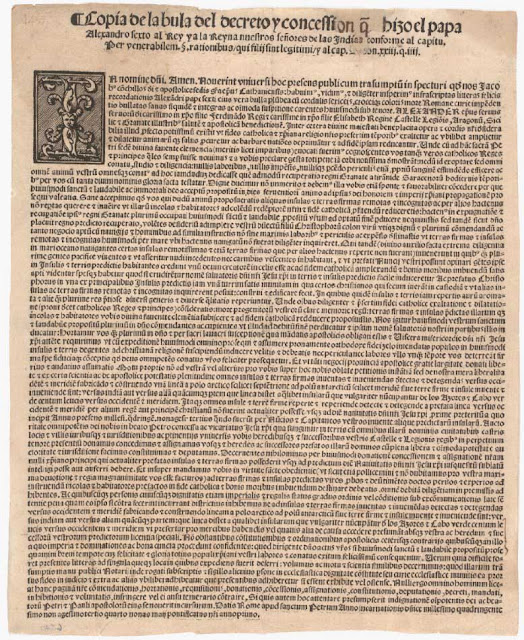
Pope Alexander VI's Demarcation Bull of 1493 is still cited as the legal basis for the Doctrine of Discovery.
Indigenous people around the world regard the
Doctrine as the root of their displacement and exploitation. And by
extension, it affects not
just those peoples, but modern issues
of borders and immigration as evidenced between the United
States and Mexico.
Most Americans and Europeans,
even those sympathetic to the plight of native peoples, take the Doctrine for granted as if it
was the natural order of things. It is so wrapped up in our history and culture, even still in our legal system, that it is difficult, almost impossible, to intellectually extricate ourselves from it and its implications.

The first to fall victim to the Doctrine of Discovery were the once
numerous Arawak or Tortino tribe which once inhabited most of the
islands of the Caribbean . Between 1492 and 1518 the Spanish virtually
wiped out the tribe by mass murder, torture, starvation, disease, and
forced hard labor in slavery. The subsequent history of European
"discovery" and conquest would more or less repeat the process over the
next 400 years and even into the 20th Century.
But let’s for a minute play a game of historical “what
if.” What if the shoe was on the other foot and Asians “discovered” Europe?
Would that give them legitimate claim on Spain, or France, or
even England? Farfetched you
say? Not as much as you might think. Indeed it almost happened. Here’s how.

Admiral Zheng He in a contemporary heroic Chinese portrait. The Chinese
government now celebrates his exploits as an example of Chinese power
while down-playing his Muslim identity and role in spreading Islam to
the archipelagos of of the Southern Pacific and the Malay peninsula.
On July 11, 1405 Chinese Admiral Zheng
He (Cheng Ho in earlier English transliterations)
set sail from Suzhou a city near modern Shanghai with a fleet of 317 ships with crews totaling almost 28,000 men. His mission from the Yongle Emperor of the Ming Dynasty was to establish a Chinese presence, impose
imperial control over trade, impress
foreign peoples in the Indian
Ocean basin, and extend the empire’s tributary system.
He may also have been on a hunt for the deposed Jianwen Emperor believed to hiding somewhere in the region.
For that reason, this voyage has been called the “largest manhunt in
history.”
Zheng didn’t find the erstwhile emperor, but he did visit Champa, Java, Palembang,
Malacca, Aru, Samudera, Lambri,
Ceylon, Kollam, Cochin, and Calicut.
Over the next 28 years Zheng and
large fleets would make six more
voyages extending his contacts to the Straits of Hormuz, the Arabian
Peninsula and the coast of East
Africa. On these voyages he traded, engaged in diplomatic exchanges with local rulers—he brought back dozens of princes and ambassadors to the Ming
court on one expedition—and made
war on pirates and recalcitrant local princes. His fleets of treasure ships brought untold wealth
back to China and Zheng was showered with honors.

The known and confirmed routes of Zheng He's several voyages. There is
evidence that at least some of his ships pushed further south on the
east coast of Africa and may have even rounded the Cape of Good Hope
into the Atlantic.
The routes he first sailed were not totally unknown. Chinese merchants had been trading sporadically along many of these
routes to Ceylon, India and the Arabian Peninsula since the Han Dynasty nearly 1000 years
earlier. But these voyages cemented
virtual Chinese command of South Asia and the Indian Ocean.
But on Zheng’s 6th and penultimate voyage
in 1420 and ‘21, he did explore new
routes, following the east coast
of Africa south. At least some of his ships may have rounded the Cape of Good Hope. One European source, the Venetian
monk and cartographer Fra Mauro in
a 1457 map, reported the sighting of a huge “Junk
from India” 2,000 miles into the
Atlantic Ocean in 1420. If
that report is accurate, the
ship could only have come from Zheng’s fleet.
After that voyage a new Emperor suspended Zheng’s explorations. He resumed sailing one more
time in 1430 when another Empower ascended the throne. His intentions may have
been to consolidate the trade routes already established, but some historians
believe he may have planned to sail around the Cape. But the great
Admiral died and was buried at sea in 1433 before he could make that journey. If he had
lived, or if the Chinese had followed
up on his voyages, it is entirely
possible that the huge, seaworthy Junks that Zheng sailed could have reversed the course of the Portuguese
explorers north along the coast of West Africa, perhaps ultimately to Europe itself.

One of Zheng He's main trading and war junks, called Treasure Ships compared to Christopher Columbus's Santa Maria,
typical of the of trading and naval caravels then sailed by the Spanish
and Portuguese. Had Chinese fleets ever made it to Europe they would
have overwhelmed the puny tubs sailed by the continental powers.
Had he done so, his fleet would have
been more than a match for the tiny tubs being sailed by Europeans. How would the
Portuguese, Spaniards, or the Pope feel if he laid claim on their lands and lives?
But it never happened. For unknown reasons the Ming never again sent out a fleet.
Indeed, China almost completely ceased to be a naval power except
along its own coast. The Empire began
its long retreat into itself and isolation.
As for Zheng himself, he was an
example of the astonishing diversity of the Chinese Empire. He was born as Ma He in a wealthy Muslim family in 1371 in Yunnan, the large province
just north of the Himalayas bordering modern Tibet and Nepal. He was
the descendent of a Persian general who came into the service of the Mongol Empire. His family was devout and both his
great grandfather and grandfather carried honorific titles indicating that they
had made the Hajj (pilgrimage) to Mecca.
From childhood he was undoubtedly literate in both Chinese characters
and in the Arabic of the Quran.
It is likely he also knew some Persian
and Indian dialects.
Unfortunately, his father fought on the side of a Mongol loyalist when the Mings
invaded Yunnan. Eleven year old Ma He was captured by Muslim generals in the
Ming service and was sent to the
Emperor’s court as a slave.
There he was made a eunuch.
As painful as that might have been, it opened up opportunities for the very bright and capable boy.
Imperial eunuchs were often elevated to the top ranks of civil and military service. So it was for
the renamed Zheng. He became a trusted
adviser to the Prince of
Yan and an officer in the Prince’s army of rebellion against his nephew,
the Jianwen Emperor. When the Prince ascended the throne as the
Yongle Emperor, Zheng was elevated to
the highest possible post, Eunuch Grand Director. It was
likely Zheng himself who cooked up the scheme for a mighty armada and the Emperor was pleased to put his most trusted adviser in charge with the diplomatic
title of Chief Envoy, and the
de facto rank of admiral.
In keeping with the traditions of religious toleration that helped keep the multi-ethnic empire together, Zheng was always allowed to practice his Muslim faith
and surround himself with other Islamic officers.

Indonesia, with the largest Muslim population in the world, owes its
Islamic identity to Zheng He who introduced and fostered the faith
there. Like several other Muslim or Muslim majority nations, Indonesia
has honored him with postage stamps.
In fact, Zheng’s most lasting contribution to the world
might well be religious.
Islamic scholar Hamka wrote in 1961:
“The development of Islam in Indonesia
and Malaya is intimately related to
a Chinese Muslim, Admiral Zheng He.” Another scholar has written “Zheng
He built Chinese Muslim communities first in Palembang, then in San Fa…subsequently
he founded similar communities along the shores of Java, the Malay Peninsula
and the Philippines. They preached
Islam according to the Hanafi school of thought and in Chinese language.”
Fairly large settlements of Chinese
Muslims in Java assimilated into the local culture and eventually lost contact with increasingly
isolated China. But their religion
persisted. Today the largest Muslim population in the world is in Indonesia, and there are large Muslim populations in Malaysia, the Philippines, and other island
states.
All thanks to a Ming sailor.


