
On Palm Sunday 1939 Puerto Rican Nationalist Cadets line up in their spiffy uniforms for a protest march in the city of Ponce. Ahead is a small detachment of police. They may have been unaware of units behind them and on side streets as they stepped off.
Note—This is the sort of already obscured history Trump wants to ban by anti-DEI fiat. Just reading this spits in they eye of the tyrant.
It started with a lovely Palm Sunday morning for a stroll through Ponce, Puerto Rico. It ended with 19 dead and over 200 badly injured when the Insular Police acting on the direct and explicit orders of the Governor, General Blanton C. Winship opened fire on a peaceful parade led by Cadets of the Puerto Rican Nationalist Party. The police surrounded the marchers and fired from all sides using machine guns, Thompson sub-machine guns, rifles, pistols, and tear gas grenades. They fired not only on marchers, but directly into the bystanders who were watching the parade. After the initial fusillade, firing continued for 15 minutes as police chased down survivors, executing some of the wounded as they lay on the ground, beating others.
Puerto Ricans would ever after remember March 21, 1937 as the Ponce Massacre.
General Nelson A. Miles, the veteran Indian fighter, led a nearly bloodless invasion of Puerto Rico during the Spanish American War. Because of the press stirred up hoo-ha in support of Cuban Revolutionaries, that island had to be granted independence after the war, albeit with heavy strings attached. Not so the other fruit plucked from feeble Spain—the Philippines, Guam, and Puerto Rico. Those the United States had every intention to keep as part of a new, un-declared empire.
In the Philippines the Army quickly turned on its erstwhile allies in a local independence movement and crushed a rebellion by them and then fought an extended guerilla campaign against Islamic Moro rebels on the southern islands.
In Puerto Rico, there was no armed opposition. But there was resentment as the first American Governor, Charles Herbert Allen, looted the island’s treasury, funneled money to American contractors, railroad operators, and sugar planters while refusing to build roads, schools, or infrastructure for the people. American interests gobbled up agricultural land for sugar plantations, and the population sank deeper into poverty and deprivation than they ever had under Spanish rule.
After looting the territory and setting up a network of plantations, Allen resigned to return to the U.S. where he became fabulously wealthy as the founder of largest sugar-refining company in the world, the American Sugar Refining Company, now known as Domino Sugar.
By 1914 the nearly powerless Puerto Rican House of Delegates voted unanimously for independence from the United States. Their action was ignored. But in 1917 the U.S. Congress acted unilaterally to make Puerto Ricans U.S. citizens. Islanders noted that the first “benefit” of citizenship was the imposition of draft boards to funnel troops to World War I.
Nationalists first began organizing in 1917 in protest to the citizenship move. The earliest meetings were held in Ponce forming the Asociación Nacionalista de Ponce (Ponce Nationalist Association) and founding the newspaper El Nacionalista. Other nationalist or pro-independence groups sprang up elsewhere on the island. By 1924 these merged into the Puerto Rican Nationalist Party.

The Party’s early years were marked by dissension, schism, and other difficulties. By 1930 Dr. Pedro Albizu Campos, a militant leader, emerged as party President.
The Great Depression hit Puerto Rico even harder than the continental United States. Unemployment soared, but little New Deal relief reached the population and what aid did come was often skimmed by corrupt American administrators and local politicians. Strikes rattled the sugar industry. The Nationalist Party, however, was not able to translate popular discontent to electoral victories. It remained a minority party in the House of Delegates. Campos suspected the honesty of elections.
Campos organized the Cadets, a youth branch somewhat similar to Scouts, and the Hijas de la Libertad (Daughters of Freedom), the women’s branch, both of which played leading rolls in increasing street demonstrations.
By 1934 President Franklin D. Roosevelt, responding to complaints by plantation owners and the sugar interests, was alarmed by what they described as near social anarchy. He appointed a new Governor with vague instructions to get things under control. His choice, General Winship could not have been more disastrous.
Winship was a Georgia native born in 1869 when the memories of the Civil War were still raw. He was practicing law when the Spanish American War broke out and immediately enlisted in a Georgia Volunteer regiment. He liked his taste of military life and joined the Regular Army serving in the Judge Advocate General’s Corps as a lawyer. But the sound of trumpets lured him from his law books. He served on active field duty with General John J. Pershing in the campaign against Poncho Villa in Mexico and then in France with the American Expeditionary Force (AEF). There he commanded troops under fire and was awarded the Distinguished Service Cross and the Silver Star.

Governor Blanton C. Winship ordered the attack.
In peace time he served as Calvin Coolidge’s military aid and then capped off his career as Judge Advocate General from 1931 to his retirement in 1933.
Despite what must have looked like an impressive resume, Winship was a poor choice for the delicate assignment handed him on several counts. He was by nature a martinet and autocrat. He had, for a lawyer, contempt for civilian leadership. And as a Southerner he disdained the brown skinned, Catholic people he was sent to govern. He considered them little better than savages and incapable of self-government.
Winship arrived in Puerto Rico with Colonel Francis Riggs to act as his chief of police, a tip off to the repression to come. Riggs had already been an advisor to Nicaraguan dictator Anastasio Somoza. He went about organizing the Insular Police, a militia under the Governor’s direct command and control as a heavily armed paramilitary force. He armed them with new weapons including sub machine guns and both .30 caliber and .50 caliber machine guns in addition to Army issue 1903 Springfield rifles and Colt .45 automatic pistols. Then they were turned loose to harass strikers and street demonstrators.
Things rapidly came to a head in 1935 when Insular Police shot and killed four Nationalist Party students and a bystander at the University of Puerto Rico in Río Piedras. Reports were that some of the victims were executed by shots to the head at close range. The incident became known as the Río Piedras Massacre.
For Campos, it was the last straw. He declared that his party would no longer compete in “U.S. controlled elections” and called for armed struggle to expel the Americans.
In retaliation for the killings on February 23, 1936 two members of the Cadets, Hiram Rosado and Elías Beauchamp, assassinated Col. Riggs in San Juan as he returned home from church. Both were quickly apprehended and executed without trial at police headquarters.
Gov. Winship ordered the leadership of the Nationalist Party rounded up. Campos and several others were charged with sedition and conspiracy to overthrow the government. They were taken to Boston, the Federal District Court with jurisdiction over Puerto Rico and tried before a jury impaneled on the island. The trial ended in a hung jury as little evidence was presented linking Campos and the others to the assassination. A second jury, consisting only of Anglo residents of Puerto Rico, convicted all but one defendant and sentenced the rest to ten years in prison.
Back on the island, Winship ordered the suppression of any protests to the sentences.
Despite this the Cadets who planned the Palm Sunday March in 1937 had reason to be hopeful of a peaceful protest.
Ponce was generally friendly to the Nationalists. They requested, and were quickly granted a parade permit by Mayor José Tormos Diego. The request was considered a courtesy since a 1927 court decision had ruled that streets and plazas were open and free to political and social gatherings.
When Winship heard that the permit had been issued, he exploded. He called in his new Chief of Police, Colonel Enrique de Orbeta, and gave him orders to proceed at once to Ponce with a strong force to prevent any demonstration, “by all means necessary.”
Oberta considered those orders a carte blanch to use overwhelming lethal force. He arrived in town with heavily armed police units drawn from around the island. He would not trust local officers with this duty.
The Cadets and their followers, as well as a crowd of bystanders, assembled with no knowledge that their permit had been rescinded. The police chief of the municipality, Juan Diaz, was positioned in front of the assembling marchers with 14 men, another local chief and a sergeant led nine men with Thompson sub machine guns at the rear. Chief of Police Antonio Bernardi, heading 11 policemen armed with machine guns, stood on the east and another group of 12 police, armed with rifles, was placed to the west. Scores of additional police, perhaps totally 200, were in reserve.
Cadet leader Tomás López de Victoria could see the line of police ahead of him. It is unclear if he was aware of the more heavily armed police to his flanks and rear. At the appointed hour he determined to step off following the singing of the patriotic song La Borinqueña following the flag bearer. They had hardly taken a step when police opened fire with a murderous volley. The flag bearer was killed instantly. Seventeen year old Carmen Fernández took up the banner and was shot and gravely injured.
Police continued to pour fire into the crowd from all sides as people scrambled for their lives.

Police turned their fire on bystanders stitching the facades of the
buildings with bullet holes from Thompson sub-machine guns and rifle
fire.
They also turned automatic fire directly into the bystanders along the building walls of the street, riddling the facades with bullet holes and leaving victims in heaps in front of them. After the sustained vollies, firing became sporadic as police chased down those trying to flee or executed some of the scores of wounded littering the ground in the confined area. It took nearly a quarter of an hour before the last shot was fired. 150 uninjured or lightly injured demonstrators and bystanders were arrested but ultimately released on bail.
In the wild cross fire it was no surprise that two police were killed and several injured. These deaths and injuries would be used in Winship’s report to his superiors at the Department of the Interior to claim that they were victims of shots fired by marchers precipitating the gunfight. This story was quickly picked up by the American press which painted the Governor as a hero for suppressing a “bloody insurrection.”

But that story began to unravel almost immediately. No weapons were found on or near any of the victims. All had been unarmed. Many had been shot in the back. Survivors and witnesses from nearby buildings who were not involved quickly discounted the official version.
The local District Attorney opened an investigation into the killings but came under intense direct pressure from Winship who ordered the prosecutor’s office to charge more Nationalists and Cadets and issued a direct order that no police officer be charged. The prosecutor resigned in protest.
An official Puerto Rican government investigation was launched, but naturally under the control of Winship made no conclusions.

Puerto Rican Senator Luis Muñoz Marin, a leading political figure and Nationalist opponent, went to Ponce to personally investigate the shootings. There he was shown unpublished photographs taken by journalist Carlos Torres Morales of El Imparcill from the window of a building overlooking the scene which clearly showed police firing directly into the crowds of bystanders. These two photographs had not been seen by either of the two previous investigations.
Those photos helped convince the United States Commission on Civil Rights to launch its own investigation spearheaded by Arthur Garfield Hayes of the American Civil Liberties Union assisted by a panel of distinguished Puerto Ricans.
The Hayes commission concluded that the police had behaved as a mob and committed a massacre.
The report created an uproar in Congress which began its own investigation. There were cries for the police on the scene, Chief Orbeta, and Winship to be indicted. But Winship also had friends in Congress.
Before any charges could be brought against him, new legislation was passed exempting government officials from prosecution for crimes committed in the line of their official duties.
In the end neither Winship nor any police were ever charged.
On July 25, 1938 Winship decided to mark the 40th anniversary of the American landings in Puerto Rico not, as was customary, with low key observations in the capital of San Juan, but in Ponce to show that he had smashed the Nationalists and now “owned the town.” Shots were fired at the reviewing stand from which he was watching the parade. The governor survived the assassination attempt but in the wild shootout that followed two people, including a police officer, were killed and 36 others wounded.
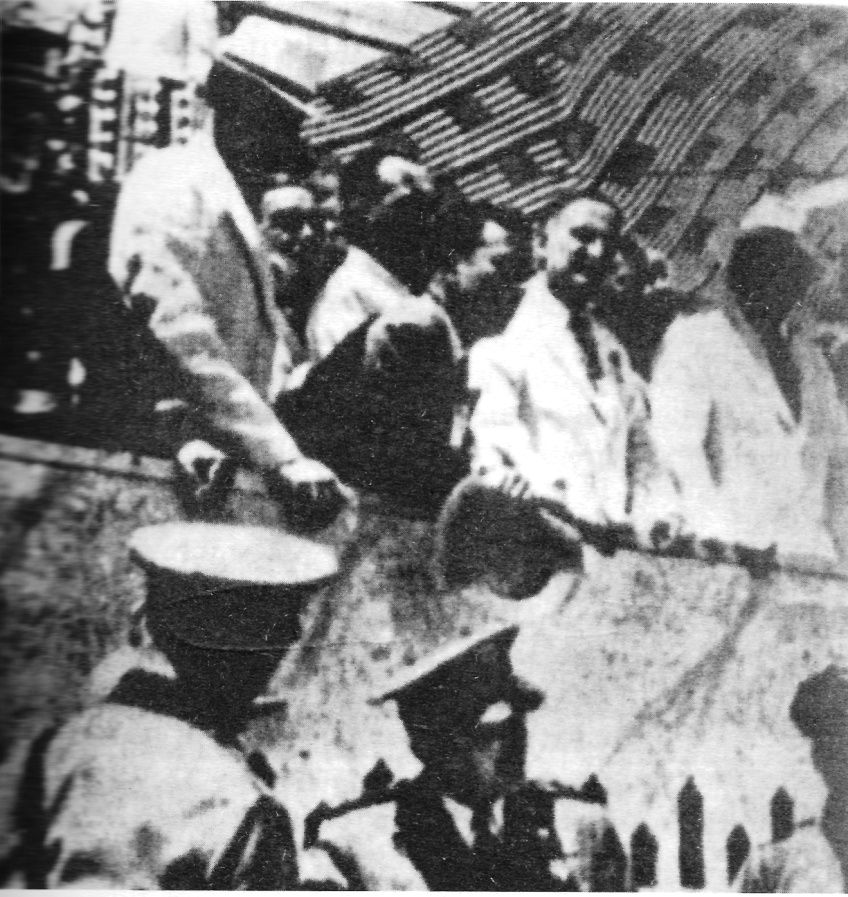
In July 1938 Gov. Winship, second from right, survived bullets fired at
the reviewing stand of a military parade in Ponce to commemorate the
40th anniversary of of the American landing on the island in the Spanish
American War.
The following year, responding to complaints of dictatorial rule from islanders and increasing pressure from Congress, President Roosevelt summarily removed Winship from his post.
It was not, however, the end of his career. When World War II broke out Winship returned to active duty in the Army and was placed in charge of prosecution of suspected Nazi saboteurs on the Home Front. In 1944 at the age of 72 and the oldest active duty soldier in the Army, he retired as a Major General.
Rex Tugwell, one of FDR’s right hand men in the New Deal, was appointed as Governor in an attempt to restore good relations between the people and the U.S. Tugwell issued several pardons to long time nationalist leaders. In cooperation with Luis Muñoz Marin, who had founded a new, pro-US political party, the Partido Popular Democratico (Popular Democratic Party of Puerto Rico), he pursued a policy of reform and during World War II instituted many New Deal-like social programs and infrastructure improvements.
Marin and his PPD became the dominant political party in Puerto Rico.
The Nationalists did not fare so well. They really had been crippled by Winship’s repression and by the rising popularity of Marin’s party.
After the war, however, Nationalists, still committed to Campos’s call for armed struggle for independence, stepped up their activity. In 1948 as Senate leader Marin ushered in the draconian Law 53 or Ley de la Mordaza (gag law.) Under this law it became a crime “to own or display a Puerto Rican flag anywhere, even in one’s own home; to speak against the U.S. government; to speak in favor of Puerto Rican independence; to print, publish, sell, or exhibit any material intended to paralyze or destroy the insular government; or to organize any society, group, or assembly of people with a similar destructive intent.” Those accused of violations could be sentenced to ten years in prison, a fine of $10,000, or both.
Marin and his party would use this law ruthlessly not only against armed Nationalist militants, but sympathizers, dissidents of any kind, and even those who did not vote for the PPD.
Meanwhile Marin had wrung from Congress a law allowing the direct election of the next governor by the people. Marin knew that he would be elected. And he was. He officially took office on January 2, 1949 and served sixteen years—four terms as Governor.
In 1950 Nationalists at Campo’s order initiated an armed uprising beginning with an attack on the Governor’s Palace on October 30. Attacks occurred across the island, but Marin quickly suppressed the uprising. Campos and the Nationalist leadership were soon rounded up, but under Law 53 so were thousands who were peripherally sympathetic.

Would-be Truman assassin Oscar Collazo lies dead at the steps to Blair House in Washington in 1950.
As part of the uprising On November 1, 1950, Griselio Torresola and Óscar Collazo unsuccessfully attempted to assassinate President Harry S. Truman, who was staying at the Blair House in Washington, D.C.
In 1952 Puerto Rican voters overwhelmingly approved a new status the Estado Libre Associado (Free State Association), commonly called Commonwealth Status, with a high degree of self-rule while remaining in association with the U.S. and the people retaining U.S. citizenship.
In 1954 four nationalists opened fire on Congress while in session, wounding six, one critically. It was one of the last major hurrahs of the old Nationalist party.
The party split in 1955 with a majority faction rejecting armed struggle. Most pro-independence advocates now belong to other groups, not the mere shadow of the Nationalist Party.
For his part Campos spent most of the rest of his life in prison, his health deteriorating. He may have been among the Puerto Rican prison hospital inmates who were subjected to massive overdoses of radiation in a secret research project in the ‘50s and ‘60s.
On November 15, 1964, on the brink of death, Campos was pardoned by Governor Marin. He died on April 21, 1965 in San Juan. Hundreds of thousands attended his funeral.
Ideological followers of Campos continued activity and were blamed for a rash of pipe bombings in Chicago and elsewhere into the 1970’s.
Today, support for independence has dwindled. Recent elections have brought to power a party that, in theory at least, supports statehood. In a 2012 referendum voters rejected the continuance of commonwealth status overwhelmingly and a majority favored statehood. Legislation was signed by President Obama in 2014 for a final, binding referendum on a future status. The was vote was held during the November 3, 2020 General Elections.
The ballot asked one question: “Should Puerto Rico be admitted immediately into the Union as a State?” The results showed that 52 percent of Puerto Rico voters answered yes.
Plans were complicated by Puerto Rico’s debt crisis which threatened to bankrupt the island unless some sort of aid and permission for debt restructuring passed a hostile Republican led Congress. And then a devastating earthquake and multiple hurricanes ravaged the island. Donald Trump famously held up approved emergency aid for the island in retribution for criticism of him by San Juan Mayor Carmen Yulín Cruz. Years after the disasters President Joe Biden ordered the long delayed aid paid.
In the US the Republican Party was long an advocate for Puerto Rican statehood. But the realization that statehood would probably result in the election of two Senators and several Representatives who would caucus and vote with the Democrats has cooled their ardor. Statehood was again on the table in Congress where Democrats needed more Senate votes to shore up their narrow majority. Many expected action on it along with statehood for the District of Columbia.
Trumpista Republicans are now unanimously opposed to statehood and some have even suggested that independence which would strip American citizenship from Puerto Ricans would be preferable. They would also like to prevent continued migration to the mainland from the island. From xenophobe Trump’s perspective it is an open door, when coupled with an end to birthright citizenship, to potentially detaining and deporting millions.


