 |
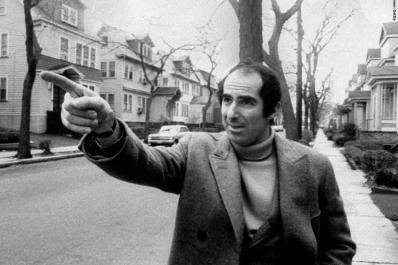
| Philip Roth in Newark--ever an inspiration and obsession. |
Word
has come that Philip Roth died on
Tuesday in New York City at the age
of 85. He was widely considered the last of the Great American Novelists of
the late 20th Century the peer of heavy hitters John Updike and Saul
Bellow. Roth himself believed that
the novel, which had ruled for a century
as the supreme and exalted American literary form, is doomed
to becoming a cult niche in the Age of the Internet for a diminishing educated elite, “I think always people will be reading
them but it will be a small group of people. Maybe more people than now read
Latin poetry, but somewhere in that range…” Ever a realist, Roth was sanguine with
the prospect.
Roth
was far more prolific than either of
the novelists he was frequently lumped with—29 full length novels and a dazzling
debut novella over nearly 50
years. His output was also more diverse
in style and topic than either of the other while reaping critical praise, armloads
of awards, and commercial success. Yet at the core of his varied output were common
threads—a Jewish identity with
which he was not always comfortable
but could not deny, a sense of being
profoundly American— “if I am not
American what am I”—a, a sex drive
that was often creepily compulsive, and
the world observed by fictional
doppelgangers for the author, or sometimes the author himself as a fictional character.
Today
the lengthy obituaries are all laudatory. Tomorrow or the next day I can safely predict that the backlash will begin with harshly critical essays. Leading the way will be Feminists critics who will denounce the
whole cabal of elite white men as the custodians
of the literary cannon. More pointedly they will charge Roth with
toxic masculinity and misogyny and will come loaded for bear with plenty of quotes from his work. They will also have the example and testimony of his two
ex-wives, both of whom showed up thinly
disguised in his novels—a Margaret Martinson in When She Was Good and actress Clare Bloom in I
Married a Communist. Bloom
penned her own bitter exposé of
their 14-year-long relationship and four year marriage in he memoir Leaving
the Doll’s House.
Not
far behind will be some Jewish critics who always found Roth’s portraits embarrassing for their relentless sexuality and discomfort with aspects of the culture that were at odds with his
identity as an American. Others were
angered at his voraciously espoused atheism—“I’m exactly the opposite of
religious, I’m anti-religious. I find religious people hideous. I hate the
religious lies. It’s all a big lie.”
Some Jewish critics hounded him from the beginning of his career. Rabbi
Gershom Scholem, the great kabbalah
scholar, said Portnoy’s Complaint was more harmful to Jews than The
Protocols of the Elders of Zion.
And Roth was heckled and booed at an early appearance at Yeshiva University which stunned and shocked the author.
 |
| Irving Howe, the Jewish intellectual who attacked Roth and was savaged by the author in return. |
Roth
fought back skewering one of his harshest critics, Irving Howe who he cast as supercilious
Milton Appel in 1983’s The Anatomy Lesson with a typically
uproarious rant:
“The comedy is
that the real haters of the bourgeois Jews, with the real contempt for their
everyday lives, are these complex intellectual giants,” Zuckerman snorts. “They
loathe them, and don’t particularly care for the smell of the Jewish
proletariat either. All of them full of sympathy suddenly for the ghetto world
of their traditional fathers now that the traditional fathers are filed for
safekeeping in Beth Moses Memorial Park. When they were alive they wanted to strangle
the immigrant bastards to death because they dared to think they could actually
be of consequence without ever having read Proust past Swann’s Way. And the
ghetto—what the ghetto saw of these guys was their heels: out, out, screaming
for air, to write about great Jews like Ralph Waldo Emerson and William Dean
Howells. But now that the Weathermen are around, and me and my friends Jerry
Rubin and Herbert Marcuse and H. Rap Brown, it’s where oh where’s the inspired
orderliness of those good old Hebrew school days? Where’s the linoleum? Where’s
Aunt Rose? Where is all the wonderful inflexible patriarchal authority into
which they wanted to stick a knife?”
Howe
never got up off the floor after that screed.
On
the other hand, many other Jews found much
to admire in Roth’s work which mirrored
a broader struggle with assimilation
and the retention of a cultural identity
distinct from a religious one.
Whatever
the criticisms that arise, it is hard to
deny Roth’s gifts as a writer—humor, insight, more than a dollop
of droll understanding of the very foibles his critics ravish him for, and a fluid, evolving, writing style.
Moreover,
the ascendancy of Donald Trump revived interest in Roth’s
2004 alternate universe novel The
Plot Against America in which Charles
Lindbergh, a shallow celebrity,
defeats Franklin D. Roosevelt as an America First candidate for President in the election of 1940,
strikes a hands-off-Europe deal with Adolph
Hitler, and launches his own campaign of anti-Semitism sweeping up
the not-so-fictional Roth family of Newark, New Jersey. Roth recognized
the parallels and told The New Yorker in an interview on the eve his inauguration that
Trump was “just a con man… ignorant of government, of history, of science, of
philosophy, of art, incapable of expressing or recognizing subtlety or nuance…destitute
of all decency… A
massive fraud, the evil sum of his deficiencies, devoid of everything but the
hollow ideology of a megalomaniac.”
Don’t
expect flowers from the Resident at
Roth’s memorial service. On the other hand, a nasty, semi-literate tweet is not
out of the question.
 |
| Philip Roth with his mother at the beach, 1935. |
Roth
was born on March 19, 1933 in Newark. His parents, Herman and Bess were second generation Eastern European Jews
who had largely assimilated. The family, which included an older brother, lived in a comfortable five room apartment in the middle class Weequahic
neighborhood. His father was an insurance broker and executive for Metropolitan Life who was resentful that his advancement in the
company was blocked by WASP top
management. Yet he made a
comfortable living and the family was relatively untouched by the Great Depression which scarred the childhood of others of
Philip’s generation. In his autobiography Roth described his
father, “His repertoire has never been large: family, family, family, Newark,
Newark, Newark, Jew, Jew, Jew. Somewhat like mine.”

Despite
strains with his father as he was pulled into an evermore “American” life
experience, Roth looked on his childhood and youth in Weequahic as in
many ways nearly idyllic. He enjoyed a robust childhood and was poplar
in high school where he was a bright
student but not quite diligent enough
in his studies to win a prized full
scholarship to Rutgers where he
wanted to study law. Years later he would specifically name Weequahic High School and his Newark
haunts in his breakthrough novel Portnoy’s Complaint. Both the author and his fictional
creation graduated in 1950. Both had also missed the direct horrors of
the Second World War and instead
came of age during the optimistic post-war
boom that was ominously shaded by
Red Scare witch hunts which seemed
to find a hell of a lot of Jewish
witches.
Less
prestigious Bucknell University in Pennsylvania was Roth’s fallback school. There he abandoned his vague dreams
of becoming a lawyer for the underdog
and turned his attention to writing. He did very well indeed graduating suma
cum laude in English with a Phi Beta Kapa key. He became one of the generation of post-war writers to pursue his literary career in tandem with post-graduate education and the life of academia. He missed the hard
knocks and hustling work as a journalist or freelancer that was typical of the
generation of heavy weights that came of age during and after World War I.
It
was on to the University of Chicago for
graduate work. It was a yeasty environment for a young writer. Saul
Bellow was a contemporary and with some what similar backgrounds and
interests they could not avoid being
rivals. There was also a lively left
political scene and the emergence of new and unconventional art forms. In the year that Roth earned his MA, 1955, the
Compass Players, forerunner of Second City launched their improvisational comedy reviews. Roth, a natural comic himself, absorbed it all.
 |
| One of Roth's earliest appearances in print was a short story in this local Chicago magazine. He didn't even make a cover mention. |
Roth
enlisted in the Army that year to avoid being drafted
and assigned to unpleasant duty
like the infantry. The Cold
War Army was said to be a democratizing
experience bringing together young
men of different backgrounds for the
first time in their lives. If so,
Roth was not enthralled with the
experience. He injured his back during Basic
Training and ultimately was given a medical
discharge.
The
experience became fodder for an early short story, Defender of the Faith, about a tough Jewish Drill Sergeant faced
with goldbricking recruits from the Tribe.
Implicit was the suggestion that he himself was one of the malingerers and that perhaps the back
injury which was his escape ticket
may have been exaggerated. It was this story in particular that drew the
early wrath of his Jewish critics.
 |
| Roth as a young writer and academic. |
Back
in Chicago in 1956 he resumed studies for a doctorate while teaching
writing to undergrads. During that year he met a lovely shiksa waitress Margaret Martinson, a single
woman with a small child. He was smitten. An intense, but
often troubled relationship ensued. At the end of the year he dropped out of the U of C and headed to the University of Iowa to teach in its creative writing program, then emerging as a national flagship for academic instruction of promising young writers.
None the less, Roth was not happy there, perhaps because the semi-rural Midwesterness of Ames was alien to him. After a while
with Martinson in tow he moved on to
a similar position at Princeton, another
WASP bastion but one with even more prestige. Everyone who knew him recognized Roth as
a comer.
During
these years he polished his early short stories and finished his first novella while publishing fiction and reviews
in publications including The New Republic. In 1959 he finally married Martinson,
although he would later claim to
have been emotionally blackmailed
into the wedding. The same year Goodbye, Columbus and Five Short
Stories was published to critical
acclaim. It won the National Book Award for 1960, a notable
achievement for a freshman outing
and one that put Roth on the literary map.

The
novella and all of the stories dealt in some way with the struggles of second
and third generation Jews with assimilation, class bias within the Jewish
community, and various crises of
identity. All would be themes that
Roth would continue to engage throughout his career.
He
followed up in fairly rapid succession
with two novels, Letting Go in 1962, set in the academic world he knew well at U
of C and Iowa and When She Was Good in 1967.
Both novels feature characters inspired by Martinson. The couple separated acrimoniously in 1963 and she subsequently refused to divorce Roth. They seemed to have continued to mutually torment each other even over disentrances. When
She Was Good was the only time Roth employed
a female main character and the only time the main character was a Goy.
While generally well received, neither of these books were initially commercially
successful.
 |
| An extremely rare photo of Roth first wife Margaret Martinson. A mutually tormented relationship. |
Martinson
died in a car wreck in 1968,
emotionally devastating Roth who was both grief
stricken and mortified that an initial reaction was one of relief.
Taken
together Roth considered these three books to be apprentice efforts. Although
artfully executed and dealing in the themes that would engage Roth throughout his
life, they were the product of his years as a student and academic. However, daring in subject, they remained
shackled to the ideals of the novel that he both learned and taught—especially the
restrictions of a so-called objective narrator. His next novel, Portnoy’s Complaint would
defiantly smash convention and plunge into an earthy froth of libido, and language
as liberated and challenging as the
shockingly unconventional coming of age
tale it told. It also became an instant commercial success, a pop icon, and turned the academic
writer into a ‘60’s superstar.
To
meet an insatiable public demand,
Roth’s earlier work was rushed into print in popular paperback formats and became hits themselves, especially to
college students and counter cultural youth who stuffed them
into their back jeans pockets.
Goodbye Columbus was made into a successful film starring Richard Benjamin and Ali McGraw in 1969. Three years later Portnoy’s Complaint made it to the screen again with Benjamin but
was a failure due to both a ham handed script and the inability of a commercial film to “go there.” In some ways the true film heir to Roth’s
book was the raunchy 1999 teen comedy American Pie.
Tomorrow—Portnoy
and after.


