Showing posts with label Utah. Show all posts

Friday, August 18, 2023

Philo T. Farnsworth—Primary Suspect in a DNA Test for Father of Television

                        Young Philo T. Farnsworth in Utah.

Inventor Philo T. Farnsworth was born in a log cabin on his grandfathers remote ranch in southwest Utah on August 19, 1906.  His family was of early settler Mormon stock.  Despite the classic 19th Century pioneer circumstances of his birth, Farnsworth would help reshape the modern world with his inventions.

By 1918 the family was ranching on its own in southern Idaho.  The new homestead had its own small generator and was primitively wired for lighting and some farm equipment.  Young Philo, a tinkerer in the great tradition and a devotee of Popular Mechanics was soon busy adapting other gadgets and appliances to being run by electricity.

Farnsworth's high school science teacher Justin Tomlin saved his sketch of an electron tube which eventually proved the inventor's priority over competitors.

He proved to be a whiz in high school in Rigby, Idaho at advanced math, chemistry, and physics. But he stunned Justin Tolman, his high school science teacher, with sketches for electron tubes.  He demonstrated how pictures might be transmitted and received wirelessly over a distance by filling several chalkboards with equations for his awestruck teacher.  That teacher’s memory of these early events later became key testimony in Farnsworth’s epic patent battles with the Radio Corporation of America (RCA).

After graduating from high school early, Farnsworth worked for the railroad to raise money for tuition to Brigham Young University.  In 1923 he joined his family, which had moved to Provo, Utah.  But when his father died less than a year later, 16 year old Philo was forced to quit school to support his family.

But his dreams never died.  He seized another opportunity to get a quality education when he tested number 2 in the nation and was recruited to the U.S. Naval Academy.  But when he discovered that the Navy would own any patents he developed during his continuing research, he resigned and returned to Utah.

An unsuccessful business venture brought him to Salt Lake City, where he took classes at the University of Utah.  He also caught the eye of George Everson, a professional fund raiser and philanthropist to work with local Community Chest.  Philo’s project so excited him that he agreed to pay for him to move to Los Angeles where he would be provided housing and a small laboratory space.  


Pem Farnsworth, the inventor's wife, has been called the first TV star because he broadcast her photo in his public press presentation.

Farnsworth leapt at the opportunity.  He married his sweetheart, Elma Pem Gardner, the sister of an associate of Everson.

After a period in L.A., the Farnsworth’s moved to San Francisco to be closer to Everson.  Despite Everson’s support, it was difficult to keep up the research and support the family.  Farnsworth worked mostly alone and the strange looking apparatus that were brought into his apartment/laboratory aroused suspicion and the place was raided by local police suspecting he was running a distillery.

After only a few months in California, however, Farnsworth was far enough along in his work to file patents.  Others were developing television systems, based on mechanical scanning devices.  Farnsworth proposed an entirely electronic system to produce images that could be received on another device.  These early patent applications gave him a lead over others who were experimenting with electronic systems.


 Farnsworth displays his television receptor for the press.

In September, 1927 Farnsworth transmitted his first image in his San Francisco lab, a simple line inscribed on a black plate back illuminated by a powerful arc lamp to a receiving device which reproduced the image by an electronic scan.  He demonstrated his device to the press a year later.

In 1930 Farnsworth’s patents were approved.  He was also visited by Vladimir Zworykin, who had been developing his own television system in Pittsburg for Westinghouse for some years.  Although his system was promising, it never functioned well enough.  Impressed, he made copies of Farnsworth’s Image Dissector for his own use.  He would eventually abandon that technique because of the extremely bright lighting required and turn his attention to developing the Iconoscope.


 Farnsworth's nemesis David Sarnoff of RCA.  The two fought bitterly over patent rights in a series of law suits that lasted years and nearly ruined Farnsworth despite winning them.

Meanwhile Farnsworth turned down an offer by David Sarnoff of RCA to buy his patents and work for them.  Again the inventor balked at having his patents held by others.  Instead, he moved to Philadelphia where he found what he hoped would be a congenial home at Philco.

RCA acquired Zworykin’s patents, which Zworykin had already used to challenge Farnsworth’s.   The company renewed the objections, but in 1934, based on evidence from that high school teacher and others, the Patent Office ruled that Farnsworth established priority for electronic television with his Image Dissector.  In the meantime, Farnsworth applied for additional patents, including one for color transmission and reproduction.

Despite the Patent Office decision, litigation between Farnsworth and RCA dragged on for years, greatly distressing the inventor.  Finally in 1939 RCA agreed to settle the dispute by licensing Farnsworth’s patents for a million dollars.  That led directly to the famous public demonstration of the RCA television system, based on several different patents, including Farnsworth’s at the New York World Fair on April 20, 1939.

But before that Farnsworth had struggled.  He parted ways with Philco in 1933 and then went to England in hopes of raising money for his expensive litigation with RCA.  There he met John Logie Baird, a Scottish inventor who had given the world first public demonstration of a working television system in London in 1926 using a mechanical rotating disc device.  The two joined forces and Baird’s company began to market a system to the BBC in competition with EMI, which used Zworkink’s patents.  Eventually the BBC opted for the EMI system.  

Farnsworth also demonstrated his system in Germany, where it was used for experimental broadcasts of the 1936 Olympics.


                Farnsworth showing off components for his television system including the critical cathode ray tube.

Back in America, Farnsworth continued his experimentation and filed several patents both for the improvement of television and in new areas, including  a ray for airplanes and ships to penetrate fog.  During World War II in combination with other patents on an improved cathode ray tube to be used as an image receptor, it led to radar.

He founded his own company, Farnsworth Television and Radio Corporation based in Fort Wayne, Indiana in 1936.  The company took on numerous defense contracts during the World War II, including the development of radar and improvements to sonar.  But the small, undercapitalized company struggled to make deliveries on time.

In 1951 International Telephone and Telegraph (ITT) bought his company and kept Farnsworth on a chief researcher working from a small basement laboratory known as The Cave.  His improvements to the radar circular sweep screen made possible modern air traffic control systems.

ITT agreed to modestly fund Farnsworth’s basic research into a new area, nuclear fusion.  He developed a specialized set of fusion reaction tubes called fusors.  Although he was able to produce micro scale fusion reactions in the lab, he could not figure out how to create large enough reactions to become a potential power source.  ITT soured on the expense of the project and cancelled its support, causing Farnsworth to leave the company in 1966.


Farnsworth was never a household name like other inventors.  He stumped the panel on I've Got a Secret on the medium he pioneered.

Disillusioned and drinking heavily, Farnsworth transferred his research back to Utah where he worked in a laboratory provided by Brigham Young University.  He started a new, small firm, Philo T. Farnsworth and Associates, and lured some former colleagues from ITT to join him in Utah.  He secured a contract with NASA, but his bank called in its loans, which Farnsworth had secured with his home and pension.  The company collapsed and the Internal Revenue Service padlocked his lab for failure to pay back taxes

Despite the failure of his fusion system to be commercially viable, it has become an invaluable tool in basic research and fusors are used to produce particles for use in cyclotrons and for other basic particle physics research.

With his family reduced to poverty despite fathering one of the great industries of the century, Farnsworth fell into deep depression and drank heavily, destroying his always fragile health.  He died of pneumonia on March 11, 1971, largely in obscurity.  His widow Pem campaigned relentlessly after his death to promote his place in the birth of television.


Fame is fleeting.  A statue of Farnsworth represented Utah in Statuary Hall in the U.S. Capital since 2010.  He joined Mormon patriarch Brigham Young in what has been called a national hall of fame.  But in 2019 the Utah legislature voted to remove the statue in 2020 and replace it with one of Martha Hughes Cannon,  a suffrage pioneer and first woman elected to a state legislature.  Copies of the Farnsworth statue are on still display in his home town and in an upper gallery of the Utah capitol building.

Farnsworth was not THE inventor of television.  Many inventors contributed to what would ultimately be the operating system that became practical and which after World War II exploded changing society and culture in ways Farnsworth could never have imagined when he began sketching ideas for tubes as a 14 year old in an Idaho science class.

Friday, November 18, 2022

The Man Who Never Died—Joe Hill

                    Joe Hill in a photo taken in prison awaiting his execution.

One hundred and seven years ago on November 19, 1915 Utah authorities took Joe Hill from his prison cell, tied him to a straight back chair, blindfolded him and pinned a paper heart on his chest.  Then, in accordance with the local custom a firing squad of five men, four of them with live rounds in their rifles and one with a blank, perforated that paper valentine.

No one was better at setting words to popular or sacred songs for use in educating and rousing up workers than Joseph Hillstrom, a Swedish immigrant who drifted into the migratory labor life of the American West shortly after the dawn of the 20th Century. He was born as Joel Hägglund in Gävle, Sweden and immigrated to the U.S. under the name Hillstrom in 1902 learning English in New York and staying for a while in Cleveland, Ohio before drifting West. 

He joined the Industrial Workers of the World (IWW) in 1910 and was soon sending songs to IWW newspapers, including his most famous composition, The Preacher and the Slave, meant to be sung to the music of the Salvation Army bands who were frequently sent to street corners to drown out Wobbly soapbox orators.

As a footloose Wobbly Hill was likely to blow into any Western town where there was a strike or free speech fight.  He was a big part of any Little Red Songbook from 1913 on with such contributions as The Tramp, There is Power in the Union, Casey Jones the Union Scab, Scissor Bill, Mr. Block, and Where the River Frasier FlowsHe also began to compose original music as well, the most famous of which was The Rebel Girl which he dedicated to the teen-age organizer of Eastern mill girls, Elizabeth Gurley Flynn

This oil portrait of Joe Hill hung in a succession of IWW General Headquarters offices.  When I worked late into the night as General Secretary Treasurer in the early 1970's I seemed to feel those intense eyes looking over me.  I wondered if I was living up to his legacy.

Hill also dispatched caustic, if crude, cartoons to Industrial Solidarity, the union’s newspaper, some of which ended up on silent agitatorsstickers meant to slapped up in mess halls, in lumber camps, in city flops and beaneries, and even on the factory floor

Joe Hill was often the first fellow worker ready to take the stump at a free speech fight and the first arrested.  He was loved by his fellow working stiffs and feared as an enormous pain in the side of Western bosses.

Hill came to Salt Lake City where the local copper barons feared he might bring their miners out on strike.  The small IWW miner’s local there was a target of police harassment.  But Hill apparently had no specific plans and was just booming around looking for work and possibly a place to winter over with sympathetic local Swedes

After he showed up at a doctor’s office with a bullet wound, he was arrested and charged with the robbery and murder of a grocer, a former policeman named Morrison—and his son the night before.  He told police that a woman’s honor was involved and would say no more.  He was tried, convicted, and executed by firing squad in 1915.  He was just 36 years old.

Most scholars agree that it was physically impossible for him to have been involved in the robbery or to be shot by the grocer.  But questions always lingered about the bullet wound and that vague alibi

                                            William M. Adler apparently solved many of the mysteries surrounding Joe Hills life and death.

Finally in 2013 writer William M. Adler did remarkable spade work and an exhaustive investigation of Hill time in Salt Lake in his book The Man Who Never Died, The Life, Times, and Legacy of Joe Hill, American Labor Icon.  Adler identified the likely real murder of grocery store owner and his son as Magnus Olson, a career criminal with a long record who was known to be in the area and who had beef with the former policeman.  The police had even picked him up as a possible suspect but he talked his way out of it and hid his identity under a welter of aliases.  Olson also matched the physical description of the assailant given by Morrison’s surviving son, which Hill did not.

Then Adler identified the mysterious woman—20 year old Hilda Ericson, the daughter of the family which ran the rooming house in suburban Murray where he was staying.  She had been engaged to Hill’s friend, fellow Swede, and Fellow Worker Otto Applequist who also boarded at the house.  Joe won the girl’s heart and she threw over Applequist for the Wobbly bard.  An upset Applequist shot Hill in a fit of jealousy, but immediately regretted it and was the man who took Joe to the doctor for treatment.  After taking Hill back to the rooming house he packed his bag and left at 2 am with the excuse he had gone looking for work.  Hill refused to name Applequist out of loyalty to his friend, and refused to identify the girl to spare her public humiliation—or perhaps to spare her and her family the risk of persecution from the police for providing an alibi.   And despite all that it cost him, Hill refused to say more.

The judgment of history is that Joe Hill was framed.  He became a martyr to labor in no small measure because of his Last Words, a letter to IWW General Secretary Treasurer William D. “Big Bill” Haywood,

Goodbye Bill. I die like a true blue rebel. Don’t waste any time in mourning. Organize... Could you arrange to have my body hauled to the state line to be buried? I don’t want to be found dead in Utah.

That has been shortened as a union motto to “Don’t Mourn Organize.

He also composed a memorable Last Will:

My will is easy to decide,
For there is nothing to divide.
My kin don’t need to fuss and moan,
“Moss does not cling to a rolling stone.”

My body? Oh, if I could choose
I would to ashes it reduce,
And let the merry breezes blow,
My dust to where some flowers grow.

Perhaps some fading flower then
Would come to life and bloom again.
This is my Last and final Will.
Good Luck to All of you,
Joe Hill.

In keeping with Hill’s wishes his body was shipped by rail to Chicago, home of the IWW’s General Headquarters where it was cremated.   His funeral was attended by thousands at the Westside Auditorium on Thanksgiving Day where Haywood, spoke along with tributes in several other languages and performances of Hill’s songs.  The funeral possession was reportedly one of the largest ever held in Chicago up to that time.  It took Hill’s remains to Waldheim Cemetery—now known as Forest Home Cemetery—where the bulk of his ashes were scattered around the Haymarket Martyrs Memorial.

One of the packets of Joe Hill's ashes distributed around the world and to every state but Utah.

The rest of his ashes were divided into small manila envelopes which were sent to IWW locals or delegates in all 48 states except Utah as well as to Sweden, and other countries. 

Over the years some packets of Hill’s ashes have surfaced—some that were seized by the Federal Government in its 1917 nationwide raids on IWW halls and offices were returned to the union by the National Archives in 1988.  The packets have been disposed of in various ways, some ceremonial, some not.  British labor singer Billy Bragg reportedly ate some.  West coast Wobbly singer Mark Ross has some inside his guitar.  Former Industrial Worker editor Carlos Cortez scattered ashes at the dedication of a monument to the six striking coal miners killed by Colorado State Police machine gun fire in the 1927 Columbine Mine Massacre.   An urn kept at General Headquarters in Chicago contains his last known ashes.  

Hill entered American culture as a folk hero along with the likes of John Henry and Casey Jones largely thanks to the memorable 1936 song I Dreamed I Saw Joe Hill Last Night with lyrics by Alfred Hayes and music by Earl Robinson.  As performed and recorded by the great African-American actor, activist, and singer Paul Robeson it became an anthem of the labor movement and eventually more famous than Hill’s own songs.  More than three decades later Joan Baez introduced it to a new generation of radicals and activists when she sang it at the Woodstock Festival in 1989. 

Phil Ochs, one of the heirs of Hill’s protest bard legacy also wrote and recorded his own Ballad of Joe Hill complete with a detailed account of his fate. 

The 1980 Swedish postage stamp commemorating Joe Hill.

Hill is also a revered figure in his native Sweden where he has been commemorated on postage stamps and where his childhood home is reverently preserved as a museum.  In 1971 director Bo Widerberg came to the States to film his Joe Hill.  Despite his reputation as the lyrical auteur of the internationally acclaimed Elvira Madigan, Widerberg botched the job by sacrificing much of the gritty class war content for a sappy and unbelievable romance.  The film sank like a stone when released in English in the U.S. 

IWW artist Carlos Cortez produced several versions of large format linocut hand printed posters of Joe Hill.

But even a bad movie could not erode Hill’s fame.  He has appeared in fiction, poetry, and plays and has inspired several works of art, perhaps most notably in linocut posters hand produced by Wobbly artist, poet, and editor Carlos Cortez.

For the centennial of Hill’s execution events were held around the country and the world all year, including a series of Joe Hill Road Show tours featuring contemporary IWW musicians and other performers of peoples music.

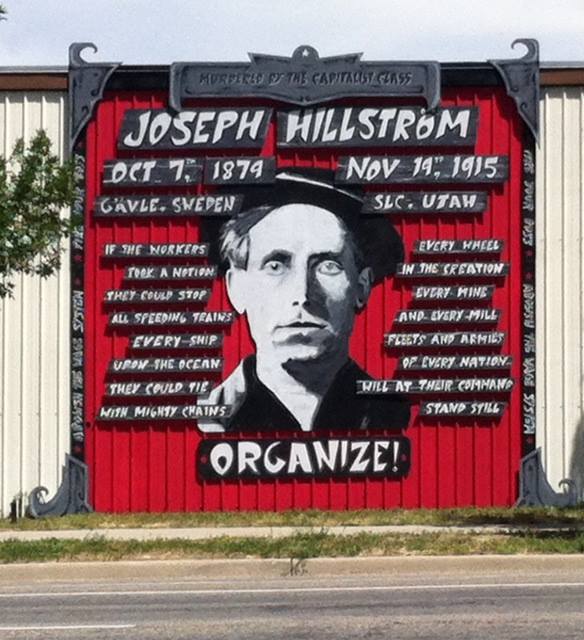
Truly, Joe Hill is the Man Who Never Died.

A centennial mural dedicated in Salt Lake City in 2015.