Before Earth Day, Arbor Day was the primary environmental celebration and a semi-holiday in the United States. And for a while it was a very big deal
with tens of thousands of volunteers across the country planting and tending trees. The
results were breath taking. Arbor Day is
often credited with re-foresting
American cities and towns.
Old 19th Century photographs reveal that many were barren urban wastelands long denuded of foliage
with buildings jammed together and coming right up to streets and crude sidewalks. In Chicago, for instance, Daniel Burnham’s famous network of
grand boulevards which radiated from
the downtown core piercing the neighborhoods with trees was influenced
by the Arbor Day movement. Later the
smaller boulevards—the local name for the strip of ground between
the sidewalk and the street—were planted with trees, many by the CCC during the Great Depression. Not
only did all of those trees greatly improve the look of the city, but they also
helped dramatically clean the air and provided much needed shade that helped cool city
folk through sweltering summers. Some sociologists
even noted reduction in crime in
neighborhoods with trees.
Tree planting festivals have
been traced by to the Spanish village of
Villanueva de la Sierra in 1805
where a local Priest organized a three day fiesta around planting
hundreds of trees. The custom spread to
neighboring villages and towns.
School Children plant a tree in 1909 in Nebraska, the state where Arbor Day originated.
In America
Arbor Day was founded in 1872 by Democratic politician and later Secretary
of Agriculture Julius Sterling Morton at Nebraska City, Nebraska. That first year 10,000 trees were planted in
and around the community.
Anyone who has ever visited Nebraska can attest to the crying need for
trees on its vast High Plains.
Morton’s son, Joy Morton,
the founder of the Morton Salt Company
in Chicago, shared his father’s enthusiasm and founded the Morton Arboretum in suburban Lyle
centered on the grounds of his estate.
The first observance drew national attention and soon other towns were emulating it. By 1883 the American Forestry Association officially
endorsed Arbor Day and named Birdseye Northrop
of Connecticut as Chairman of
a committee to make the day an official national celebration. Birdseye,
who liked to travel, also introduced the idea to Japan, Australia, Canada, and back to Europe.
The Post Office celebrated the 50th anniversary of Arbor Day.
In 1907 President Theodore Roosevelt issued an Arbor Day Proclamation to
the School Children of the United
States. It became an annual
tradition. Eventually Congress designated the final Friday of April for the
observance and several states made
it a holiday.
In the early years the Boy Scouts troupes were heavily
mobilized for tree planting and many still continue that tradition. As observed the CCC and the WPA in conjunction with National Forest Service were employed
during the Depression.
Tree plantings continue, but the spotlight
seldom shines on Arbor Day anymore.
But we can celebrate with poetry, naturally. Poets probably have been versifying about trees since the first bard plucked his lyre. Yet most of us can only recall Joyce Kilmer’s Trees. With apologies to
Kilmer who was killed in the trenches
of World War I just as his hymn
to trees was becoming famous, it is a pretty bad poem filled with mixed and
conflicting metaphors. We can do
better.
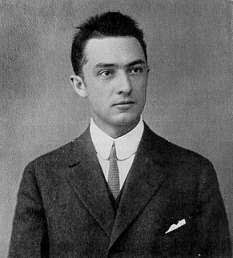
A Young William Carlos Williams.
Take Dr. Williams, for instance. The great poetic innovator of Patterson,
New Jersey paused to take in the
barren trees of winter. Ever creative
note his charming coining of a word in the third line.
Winter Trees
All the
complicated details
of the
attiring and
the
disattiring are completed!
A liquid
moon
moves gently
among
the long
branches.
Thus having
prepared their buds
against a
sure winter
the wise
trees
stand
sleeping in the cold
—William Carlos Williams
H.D.--Hilda Doolittle.
Hilda
Doolittle was an American poet from Bethlehem, Pennsylvania who
moved to England in 1911 when she
was 25 years old. Writing as simply H.D.
she became a close associate of Ezra
Pound and a central figure in the avant garde imagist movement that
revolutionized 20th Century poetry. After being nearly forgotten, she was
rediscovered by the women’s
studies movement in academia.
Pear Tree
Silver
dust
lifted from
the earth,
higher than
my arms reach,
you have
mounted.
O silver,
higher than
my arms reach
you front us
with great mass;
no flower
ever opened
so staunch a
white leaf,
no flower
ever parted silver
from such
rare silver;
O white
pear,
your
flower-tufts,
thick on the
branch,
bring summer
and ripe fruits
in their
purple hearts.
—H.D.
Wendell Berry.
O.K, show of hands. Who is surprised that farmer/activist/poet Wendell Berry, appreciates trees?
Woods
I part the
out thrusting branches
and come in beneath
the blessed and the blessing trees.
Though I am silent
there is singing around me.
Though I am dark
there is vision around me.
Though I am heavy
there is flight around me.
—Wendell Berry
The tree planting janitor of Briargate School, 2004
For twenty years this poet was a school custodian in McHenry County, Illinois. Among his many duties was occasionally
planting trees on the grounds. At least once the job got inside his
head. The result, this poem from the
2004 Skinner House collection We Build Temples in the Heart.
The
Janitor’s Epiphany
In the mist
of a late, cool spring,
a common workman’s callused boot
impelled the spade
which sliced the velvet lawn
and turned the Black Forest cake
earth.
And in time
he filled the hole casually,
as if it were any other job,
with a young tree yanked rudely
from its old place and flung down
here
before the school.
Satisfied
and ready to turn away,
he stopped short and looked again—
this is a
Great Thing, he thought,
and cries to
heaven for ceremony,
for some
note that life has happened here.
Yet civic virtue stilled his lips,
lest his sectarian
prayer rend a fragile peace,
and his own reason
mocked an active ear
waiting on the
supplicant’s plea
to do something,
anything.
But the rhythms of the season echoed
here,
the shade of generations
turned
with the spade and loam—
a Great
Thing has happened
and cries
out to heaven for ceremony,
for some
note that life has happened here.
—Patrick Murfin
We will end with that counter cultural
mystic Richard Brautigan who decades
ago had this vision. Richard Brautigan.
All
Watched Over By Machines Of Loving Grace
I like to think (and
the sooner the better!)
of a cybernetic meadow
where mammals and computers
live together in mutually
programming harmony
like pure water
touching clear sky.
I like to think
(right now, please!)
of a cybernetic forest
filled with pines and electronics
where deer stroll peacefully
past computers
as if they were flowers
with spinning blossoms.
I like to think
(it has to be!)
of a cybernetic ecology
where we are free of our labors
and joined back to nature,
returned to our mammal
brothers and sisters,
and all watched over
by machines of loving grace.
—Richard Brautigan