Showing posts with label Women's March on Washington. Show all posts

Friday, March 3, 2023

Bold New Militancy Launched Washington Woman Suffrage Procession of 1913


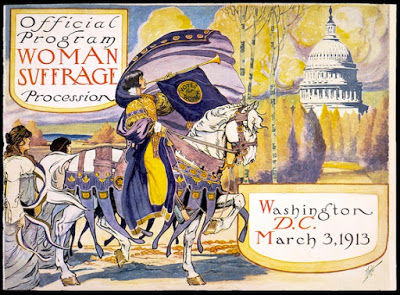
The stunning program cover for the 1913 Woman Suffrage Procession in Washington.

The giant Women’s March on Washington and sister marches across the country that greeted Donald Trump’s inauguration in January 2017 and they-said-it-couldn’t-be-done even larger marches a year later were seismic events that brought a broad, united, new intersessional feminism to the forefront of American social and political life after years on the defense as hard-fought gains once thought secure were under attack at every level.

Mass demonstrations no matter how large, critics maintained, had lost their power as the media lost interest in them and the public became bored.  Huge anti-war demonstrations that broke all records were barely covered by the press and had no discernable effect on curtailing a vastly unpopular war in Congress or in the Bush administration and only moderately moved the needle during the Obama years when painfully slow withdrawals of boots on the ground in Iraq and Afghanistan were matched by a brutal escalation of bombing and drone attacks not only in those two countries but across the region.

The Women's March on Washington was a rough welcome to Trump and a game changer for the feminist movement.

Instead, the media became fixated with a shiny new object—the tiny but colorful Tea Party movement.  Events drawing a few dozen in silly hats waving Don’t Tread on Me flags, and toting misspelled homemade signs received lead coverage night after night on network and cable TV news. Part of it was the sheer novelty of a right wing “grassroots” movement.  Traditional conservatives were at first dismissive and doubtful, but a hand-full of deep pocket millionaires saw potential pumped unlimited money into the movement, created faux grassroots national organizations to “lead it,” and soon used it to capture the Republican Party for their oligarchical aims.  Within what seemed like a blink of an eye they were in control of dozens of state governments, Congress, and the Presidency and seemed capable of completely remaking America with no effective opposition.

But there were signs of restiveness and resistance—the Occupy Movement that spread like wildfire, the up-from-the-streets youth-led Black Lives Matter movement, the May Day Immigration Rights marches and the rise of the Dreamers, the new Civil Rights movement represented by Moral Mondays.  But it was the Women’s Marches, perhaps because they included so many middle class white women, that finally recaptured the media and nation’s attention

To its credit the Women’s March movement has, not always smoothly, taken pains to broaden its leadership and representation and to stand for an intersessional struggle that includes not just traditional feminist objectives like preserving abortion rights, removing obstacles to social and professional advancement, the Equal Rights Amendment, and election of women, but support for Women of Color, immigrants and refugees, Muslims and other minority religions, the LBGTQ communities, Native Americans, the disabled, the labor movement, and environmentalists.  It has not been a perfect process and serious divisions remain over issues like electoral politics, particularly endorsement of Democrats, and levels of street militancy, but it has been a game changer.

One 110 years ago today, another march of women in Washington, in some ways quite different, marked a radical turning point in the long struggle for women’s suffrage and became a spiritual ancestor of today’s movements.

Alice Paul was inspired by the militant campaigns of the British Suffragettes led by Emmeline Pankhurst seen under arrest in the right foreground and her daughter Christabel in custody behind her.

Alice Paul and Lucy Burns were uppity women.  Worse they were angry, uppity women.  They were more youthful than the dowagers whose decades’ long drive for women’s suffrage had been noble, but fruitless.  Paul had been in England and was impressed with how Christabel Pankhurst and her mother Emmeline, leaders of a new militant suffrage movement which was making a sensation by using direct action tactics such as publicly heckling politicians, window smashing, and rock throwing raising the profile of the cause there.

When Paul returned to the United States in 1910 she joined the National American Women’s Suffrage Association (NAWSA) and soon advanced to a leadership role.  Although the national organization was committed to a state-by-state strategy as its top priority, Paul was made Chair of the Congressional Committee with the responsibility of lobbying for Federal action.  Carrie Chapman Catt, formidable leader of the NAWSA, did not have much faith in Paul or her project, but was probably glad to have the gadfly out her hair in New York where she was carefully planning an elaborate political effort to win state approval of the Vote by referendum.

Carrie Chapman Catt of New York was the formidable head of the National American Women's Suffrage Association.  She would split with Alice Paul over strategy and style and the two were sometimes bitter rivals.  Their two pronged suffrage campaign, moderate and radical, actually complimented each other and help rapidly move to the goal.  But when the 19th Amendment was ratified, it was the moderate Catt, not the bur-under-the-saddle Paul who was invited to the Wilson White House.

By 1912 Paul and Burns set up shop in the Capitol as a semi-autonomous affiliate of the NAWSA called the Congressional Union. 

In the Presidential election that year, Catt had broken ranks with many older suffragists who were traditionally Republican, and endorsed Woodrow Wilson, a distinguished academic and supposedly a new breed of progressive Democrat, in the hopes that he would swing his party behind suffrage.

Paul, however, did not want to wait for a painfully slow lobbing process to nudge the new Chief Executive in the right direction.  She declared her intention to “hold his feet to the fire” from the very beginning with a huge Suffrage demonstration on the eve of his inaugural.

Don’t imagine a modern march on Washington with mobs of somewhat disorganized marchers in pink pussy caps carrying banners, signs, and puppets in a mass throng on the Capitol’s wide avenues.  Paul’s Woman Suffrage Procession was planned out with military precision, the thousands of women marchers were arrayed in designated units, marching abreast.  Most units wore white, the symbol of purity and adopted color of the suffrage movement.   The procession would be led by equestrians and floats with women as various allegorical figures broke up the ranks of marchers.  An elaborate program was printed for onlookers and a proper parade permit had been obtained from local authorities.

Wilson arrived by train from his New Jersey home on Monday, March 3, 1913, the day before his inauguration.  As the first Democrat since Grover Cleveland to break the grip of Republican dominance and as a man of known Southern roots and sympathies, he likely expected a whoopsie-do reception in the culturally Southern city.  Instead, only a handful of dignitaries, politicians, and the press were at hand.  Everybody else in town seems to have been lining Pennsylvania Avenue.

Inez Milholland on her white steed was a dramatic and compelling lead to the Woman Suffrage Processional.

No wonder, for Paul had put on a dazzling show led by the beautiful blonde lawyer and activist Inez Milholland astride a white horse in flowing Greek robes.  Behind her, Paul and her friends, also on horseback, led 8,000 marchers, almost all women, and on parade. 

An estimated half a million viewers crowded the route including cheering supporters, the idly curious, a lot of very, very angry men.

The procession was quickly attacked by mobs of men along the route, throwing rocks and battering participants with clubs and fists as the police stood by without intervening.  Retaining as much courage and dignity as they could muster, the marchers continued on their route while running a virtual gauntlet.  Before the rear of the march reached its destination some hastily mobilized troops from Fort Myer arrived to provide some protection.  Over 800 marchers, almost all women, were injured in the attacks.

Mobs of men swarm and menace an ambulance trying to transport injured marchers as police stood by.  It took Army troops to restore order and allow the parade to finish.  Despite the violence, maybe because of it, Paul knew the Procession was a triumph.

Reaction to the parade and the attacks threatened to overwhelm news of the Presidential inauguration the next day, much to the annoyance of Wilson.  And to the delight of Paul who regarded the operation as successful in every way. She was sure that public outrage would lead to greater support for the cause.

A subsequent investigation held the police derelict in their duty for failing to protect the lawful demonstration and the District of Columbia Police Chief was fired.

In New York Catt was less than thrilled and feared the bold confrontation would alienate male supporters critical for her state-by-state campaign.  None-the-less Catt staged her own giant parade down Fifth Avenue in May as the kick-off for her ballot initiative plan.  A fifth the marchers in her parade were men.

                                                         Alice Paul and her Federal strategy was big news in the New York Times.

The breach over militancy and confrontation between Catt and Paul became irreparable in 1914 and Paul’s group severed ties with the national organization.  Two years later they reorganized as the National Women’s Party (NWP.) 

They continued to press Wilson for action with daily picketing at the White House.  When the picketing continued even after the country entered the Great War in Europe, Wilson had Paul and dozens of her associates and supporters arrested, jailed, and force-fed during hunger strikes.  When word got out about the abuse, Wilson was embarrassed yet again. Exasperated, Wilson finally declared support of a Federal Constitutional Amendment for women’s suffrage as a “war measure” and in recognition of the contribution of women to the effort.  He made no mention of Paul or the NWP, but no one doubted that their stubborn militancy had forced his hand.

Alice Paul raises a grape juice toast to the banner that she and members of the National Women's Party sewed by hand to hang on their Washington, D.C. headquarters building in celebration of the ratification of the 19th Amendment just over 7 years after the Suffrage Procession--a remarkably swift victory.

Both houses of Congress passed the 19th Amendment in 1919.  Then the battle moved to ratification by state legislatures and the state-by-state struggle advocated by Catt was back on.  The NAWSA and NWP played a kind of “good cop/bad cop tag team on state legislatures with Catt’s group wooing them with compliments and charm, and Paul threatening disruption and defiance. 

It proceeded, all things considered, with astonishing speed. On August 19, 1920 Tennessee passed the Amendment by one vote in the legislature, securing the necessary support to become a part of the Constitution.  When the Secretary of State certified the adoption on August 26, Paul and her cohorts proudly unfolded a banner on the NWP headquarters building in Washington and toasted the event—with grape juice, of course.


Thursday, March 3, 2022

Bold New Militancy Launched Washington Woman Suffrage Procession of 1913

The stunning program cover for the 1913 Woman Suffrage Procession in Washington.

The giant Women’s March on Washington and sister marches across the country that greeted Donald Trump’s inauguration in January 2017 and they-said-it-couldn’t-be-done even larger marches a year later were seismic events that brought a broad, united, new intersessional feminism to the forefront of American social and political life after years on the defense as hard-fought gains once thought secure were under attack at every level.

Mass demonstrations no matter how large, critics maintained, had lost their power as the media lost interest in them and the public became bored.  Huge anti-war demonstrations that broke all records were barely covered by the press and had no discernable effect on curtailing a vastly unpopular war in Congress or in the Bush administration and only moderately moved the needle during the Obama years when painfully slow withdrawals of boots on the ground in Iraq and Afghanistan were matched by a brutal escalation of bombing and drone attacks not only in those two countries but across the region.

The Women's March on Washington was a rough welcome to Trump and a game changer for the feminist movement.

Instead, the media became fixated with a shiny new object—the tiny but colorful Tea Party movement.  Events drawing a few dozen in silly hats waving Don’t Tread on Me flags, and toting misspelled homemade signs received lead coverage night after night on network and cable TV news. Part of it was the sheer novelty of a right wing “grassroots” movement.  Traditional conservatives were at first dismissive and doubtful, but a hand-full of deep pocket millionaires saw potential pumped unlimited money into the movement, created faux grassroots national organizations to “lead it,” and soon used it to capture the Republican Party for their oligarchical aims.  Within what seemed like a blink of an eye they were in control of dozens of state governments, Congress, and the Presidency and seemed capable of completely remaking America with no effective opposition.

But there were signs of restiveness and resistance—the Occupy Movement that spread like wildfire, the up-from-the-streets youth-led Black Lives Matter movement, the May Day Immigration Rights marches and the rise of the Dreamers, the new Civil Rights movement represented by Moral Mondays.  But it was the Women’s Marches, perhaps because they included so many middle class white women, that finally recaptured the media and nation’s attention

To its credit the Women’s March movement has, not always smoothly, taken pains to broaden its leadership and representation and to stand for an intersessional struggle that includes not just traditional feminist objectives like preserving abortion rights, removing obstacles to social and professional advancement, the Equal Rights Amendment, and election of women, but support for Women of Color, immigrants and refugees, Muslims and other minority religions, the LBGTQ communities, Native Americans, the disabled, the labor movement, and environmentalists.  It has not been a perfect process and serious divisions remain over issues like electoral politics, particularly endorsement of Democrats, and levels of street militancy, but it has been a game changer.

One 109 years ago today, another march of women in Washington, in some ways quite different, marked a radical turning point in the long struggle for women’s suffrage and became a spiritual ancestor of today’s movements.

Alice Paul was inspired by the militant campaigns of the British Suffragettes led by Emmeline Pankhurst seen under arrest in the right foreground and her daughter Christabel in custody behind her.

Alice Paul and Lucy Burns were uppity women.  Worse they were angry, uppity women.  They were more youthful than the dowagers whose decades’ long drive for women’s suffrage had been noble, but fruitless.  Paul had been in England and was impressed with how Christabel Pankhurst and her mother Emmeline, leaders of a new militant suffrage movement which was making a sensation by using direct action tactics such as publicly heckling politicians, window smashing, and rock throwing raising the profile of the cause there.

When Paul returned to the United States in 1910 she joined the National American Women’s Suffrage Association (NAWSA) and soon advanced to a leadership role.  Although the national organization was committed to a state-by-state strategy as its top priority, Paul was made Chair of the Congressional Committee with the responsibility of lobbying for Federal actionCarrie Chapman Catt, formidable leader of the NAWSA, did not have much faith in Paul or her project, but was probably glad to have the gadfly out her hair in New York where she was carefully planning an elaborate political effort to win state approval of the Vote by referendum.

By 1912 Paul and Burns set up shop in the Capitol as the as a semi-autonomous affiliate of the NAWSA called the Congressional Union. 

Carrie Chapman Catt of New York was the formidable head of the National American Women's Suffrage Association.  She would split with Alice Paul over strategy and style and the two were sometimes bitter rivals.  Their two pronged suffrage campaign, moderate and radical, actually complimented each other and help rapidly move to the goal.  But when the 19th Amendment was ratified, it was the moderate Catt, not the bur-under-the-saddle Paul who was invited to the Wilson White House.

In the Presidential election that year, Catt had broken ranks with many older suffragists who were traditionally Republican, and endorsed Woodrow Wilson, a distinguished academic and supposedly a new breed of progressive Democrat, in the hopes that he would swing his party behind suffrage.

Paul, however, did not want to wait for a painfully slow lobbing process to nudge the new Chief Executive in the right direction.  She declared her intention to “hold his feet to the fire” from the very beginning with a huge Suffrage demonstration on the eve of his inaugural.

Don’t imagine a modern march on Washington with mobs of somewhat disorganized marchers in pink pussy caps carrying banners, signs, and puppets in a mass throng on the Capitol’s wide avenues.  Paul’s Woman Suffrage Procession was planned out with military precision, the thousands of women marchers were arrayed in designated units, marching abreast.  Most units wore white, the symbol of purity and adopted color of the suffrage movement.   The procession would be led by equestrians and floats with women as various allegorical figures broke up the ranks of marchers.  An elaborate program was printed for onlookers and a proper parade permit had been obtained from local authorities.

Wilson arrived by train from his New Jersey home on Monday, March 3, 1913, the day before his inauguration.  As the first Democrat since Grover Cleveland to break the grip of Republican dominance and as a man of known Southern roots and sympathies, he likely expected a whoopsie-do reception in the culturally Southern city.  Instead, only a handful of dignitaries, politicians, and the press were at handEverybody else in town seems to have been lining Pennsylvania Avenue.

Inez Milholland on her white steed was a dramatic and compelling lead to the Woman Suffrage Processional.

No wonder, for Paul had put on a dazzling show led by the beautiful blonde lawyer and activist Inez Milholland astride a white horse in flowing Greek robes.  Behind her, Paul and her friends, also on horseback, led 8,000 marchers, almost all women, and on parade. 

An estimated half a million viewers crowded the route including cheering supporters, the idly curious, a lot of very, very angry men.

The procession was quickly attacked by mobs of men along the route, throwing rocks and battering participants with clubs and fists as the police stood by without intervening.  Retaining as much courage and dignity as they could muster, the marchers continued on their route while running a virtual gauntlet.  Before the rear of the march reached its destination some hastily mobilized troops from Fort Myer arrived to provide some protection.  Over 800 marchers, almost all women, were injured in the attacks.

Mobs of men swarm and menace an ambulance trying to transport injured marchers as police stood by.  It took Army troops to restore order and allow the parade to finish.  Despite the violence, maybe because of it, Paul knew the Procession was a triumph.

Reaction to the parade and the attacks threatened to overwhelm news of the Presidential inauguration the next day, much to the annoyance of Wilson.  And to the delight of Paul who regarded the operation as successful in every way. She was sure that public outrage would lead to greater support of the cause.

A subsequent investigation held the police derelict in their duty for failing to protect the lawful demonstration and the District of Columbia Police Chief was fired.

In New York Catt was less than thrilled and feared the bold confrontation would alienate male supporters critical for her state-by-state campaign.  None-the-less Catt staged her own giant parade down Fifth Avenue in May as the kick-off for her ballot initiative plan.  A fifth the marchers in her parade were men.


                                                Alice Paul and her Federal strategy was big news in the New York Times.

The breach over militancy and confrontation between Catt and Paul became irreparable in 1914 and Paul’s group severed ties with the national organization.  Two years later they reorganized as the National Women’s Party (NWP.) 

They continued to press Wilson for action with daily picketing at the White House.  When the picketing continued even after the country entered the Great War in Europe, Wilson had Paul and dozens of her associates and supporters arrested, jailed, and force-fed during hunger strikes.  When word got out about the abuse, Wilson was embarrassed yet again. Exasperated, Wilson finally declared support of a Federal Constitutional Amendment for women’s suffrage as a “war measure” and in recognition of the contribution of women to the effort.  He made no mention of Paul or the NWP, but no one doubted that their stubborn militancy had forced his hand.

Alice Paul raises a grape juice toast to the banner that she and members of the National Women's Party sewed by hand to hang on their Washington, D.C. headquarters building in celebration of the ratification of the 19th Amendment just over 7 years after the Suffrage Procession--a remarkably swift victory.

Both houses of Congress passed the 19th Amendment in 1919.  Then the battle moved to ratification by state legislatures and the state-by-state struggle advocated by Catt was back on.  The NAWSA and NWP played a kind of “good cop/bad cop tag team on state legislatures with Catt’s group wooing them with compliments and charm, and Paul threatening disruption and defiance

It proceeded, all things considered, with astonishing speed. On August 19, 1920 Tennessee passed the Amendment by one vote in the legislature, securing the necessary support to become a part of the Constitution.  When the Secretary of State certified the adoption on August 26, Paul and her cohorts proudly unfolded a banner on the NWP headquarters building in Washington and toasted the event—with grape juice, of course.


Friday, January 21, 2022

Five Years Later Women March On

The Women's March on Washington, January 19, 2017--a model of Resistance.

Five years ago, on the eve of the instillation of a slimy fraud, serial rapist and abuser, and would-be fascist strongman when much of the country was paralyzed by dread and despair the Women’s March on Washington filled the National Mall in defiance.  Their numbers dwarfed the inauguration crowds of the Orange Menace the next day.  It was the opening shot of an energized and spreading Resistance that four years later would oust the Resident.  What made it even more remarkable is that it was organized on-line in just a few weeks not by charismatic leaders or media celebrities but by ordinary women, many of them entirely new to activism.  It represented a genuine from the bottom up peoples movement that spread across the country sparking hundreds of sister marches.

From the beginning the March was characterized by devotion to what would become known as intersectionality defined by the Oxford English Dictionary as the “interconnected nature of social categorizations such as race, class, and gender as they apply to a given individual or group, regarded as creating overlapping and interdependent systems of discrimination or disadvantage.”  Representatives of other oppressed and threatened groups and movements including Black Lives Matter; immigrants facing deportation, detention, and family separation; Muslims and other endangered religious minorities; Native American Water Protectors; the LGBTQ community; youth; the differently abled; and others were recognized as essential mutual allies, represented at the rally; and included in leadership.

The Women's March Chicago 2018 with part of the Tree of Life UU contingent including Terry Kappel and Judy Stettner.  Photo by Linda Di.

The March was defiantly feminist but not separatistMen were welcome to attend and lend support to the agenda laid out by women.  In some of the Sister Marches as many as 25% of participants were male, some even wearing the knit pink pussy caps that became a symbol of the March.

In the years since the Women’s March has endured despite enormous challenges and no little controversy and internal dissent.  Major marches were staged again January of 2018 and 19.  Special March on the Vote events were held in the fall of 2018 before the mid-term elections that recaptured the House of Representatives.  In 2021 and again this year the March faced the challenges of the raging Coronavirus pandemic that disrupted and discouraged mass street events

Besides the pandemic challenges have included controversy over electoral politics particularly how closely to identify with Democrats, generational strains between older second wave feminists and younger women, leadership turmoil over allegations of antisemitism by Linda Sarsour, a Palestinian-American activist and Tamika Mallory, an African-American gun control activist who had voiced support for Louis Farrakhan and the Nation of Islam; a split between National leadership and organizers of many sister marches; and how much and what kind of corporate sponsorship to accept.


Despite it all today kicks off Women’s March Global 2022 events and activities which will run through March 8.  They write:

This January 21st, let’s unite again in solidarity to begin a new phase of activism. January 21st’s march will show our solidarity and strength once again. Even though we come from different places and we have different struggles, we all have the same overarching goal for equality and justice. As Audre Lorde said, “I am not free while any woman is unfree, even when her shackles are very different from my own” and so, this January 21st, show up and fight, not only for yourself but also for your sisters.  Follow us and be one of the first to know how you can take part – either on the streets or in the comfort of your home on Twitter at #WeWontBackDown or at https://fb.me/e/1OFzPllFV.


The March also outlined an ambitious agenda for 2022 in an email to supporters yesterday.  It includes: 

·         Growing our Women2Women Circles so we can wield our feminist power at the local level and drive change in our communities.

·         Recruiting volunteers to text & make phone calls to voters leading up to the 2022 midterm elections.

·         Providing trainings through our Feminist Fundamentals Short Course so that Women’s Marchers can gain the basic foundation you need to organize, activate and mobilize your community.

·         Scaling our Digital Defenders program so we can continue combating misinformation online and make sure everyone has access to the information they need to survive this pandemic.

·         Resisting against every attack the anti-abortion movement has planned this year and building pressure on Congress to pass the Women’s Health Protection Act.

·         Putting pressure on our politicians to support the feminist policies we need passed in Congress to survive the current crises we face.

·         Holding corporations accountable for the political campaigns they’ve financially supported and calling for corporate social responsibility.

·         Planning safe and Covid-conscious mass mobilizations so we can demonstrate our collective power as we resist attacks on our feminist values. 

Wednesday, March 3, 2021

Washington Women’s Suffrage Procession of 1913 Boded New Militancy

The stunning program cover for the 1913 Woman Suffrage Procession in Washington.

The giant Women’s March on Washington and sister marches across the country that greeted Donald Trump’s inauguration in January 2017 and the they-said-it-couldn’t-be-done even larger marches a year later were seismic events that brought a broad, united, new intersessional feminism to the forefront of American social and political life after years on the defense as hard-fought gains once thought secure were under attack at every level.

Mass demonstrations no matter how large, critics maintained, had lost their power as the media lost interest in them and the public became bored.  Huge anti-war demonstrations that broke all records for participation were barely covered by the press and had no discernable effect on curtailing a vastly unpopular war in Congress or in the Bush administration and only moderately moved the needle during the Obama years when painfully slow withdrawals of boots on the ground in Iraq and Afghanistan were matched by a brutal escalation of bombing and drone attacks not only in those two countries but across the region.

The Women's March on Washington was a rough welcome to Trump and a game changer for the feminist movement.

Instead, the media became fixated with a shiny new object—the tiny but colorful Tea Party movement.  Events drawing a few dozen in silly hats waving Don’t Tread on Me flags, and toting misspelled homemade signs received lead coverage night after night on network and cable TV news. Part of it was the sheer novelty of a right wing “grassroots” movement.  Traditional conservatives were at first dismissive and doubtful, but a hand-full of deep pocket millionaires saw potential pumped unlimited money into the movement, created faux grassroots national organizations to “lead it,” and soon used it to capture the Republican Party for their oligarchical aims.  Within what seemed like a blink of an eye they were in control of dozens of state governments, Congress, and the Presidency and seemed capable of completely remaking America with no effective opposition.

But there were signs of restiveness and resistance—the Occupy Movement that spread like wildfire, the up-from-the-streets youth led Black Lives Matter movement, the May Day Immigration Rights marches and the rise of the Dreamers, the new Civil Rights movement represented by Moral Mondays.  But it was the Women’s Marches, perhaps because they included so many middle class white women, that finally recaptured the media and nation’s attention. 

To its credit the Women’s March movement has, not always smoothly, taken pains to broaden its leadership and representation and to stand for an intersessional struggle that includes not just traditional feminist objectives like preserving abortion rights, removing obstacles to social and professional advancement, the Equal Rights Movement, and election of women, but support for Women of Color, immigrants and refugees, Muslims and other minority religions, the LBGTQ communities, Native Americans, the disabled, the labor movement, and environmentalists.  It has not been a perfect process and serious divisions remain over issues like electoral politics, particularly endorsement of Democrats, and levels of street militancy, but it has been a game changer.

One 108 years ago today, another march of women in Washington, in some ways quite different, marked a radical turning point in the long struggle for women’s suffrage and became a spiritual ancestor of today’s movements.

Alice Paul was inspired by the militant campaigns of the British Suffragettes led by Emmeline Pankhurst seen under arrest in the right foreground and her daughter Christabel in custody behind her.

Alice Paul and Lucy Burns were uppity women.  Worse they were angry, uppity women.  They were more youthful than the dowagers whose decades’ long drive for women’s suffrage had been noble, but fruitless.  Paul had been in England and was impressed with how Christabel Pankhurst and her mother Emmeline, leaders of a new militant suffrage movement which was making a sensation by using direct action tactics such as publicly heckling politicians, window smashing, and rock throwing raising the profile of the cause there.

When Paul returned to the United States in 1910 she joined the National American Women’s Suffrage Association (NAWSA) and soon advanced to a leadership role.  Although the national organization was committed to a state-by-state strategy as its top priority, Paul was made Chair of the Congressional Committee with the responsibility of lobbying for Federal actionCarrie Chapman Catt, formidable leader of the NAWSA, did not have much faith in Paul or her project, but was probably glad to have the gadfly out her hair in New York where she was carefully planning an elaborate political effort to win state approval of the Vote by referendum.

By 1912 Paul and Burns had set up shop in the Capitol as the as a semi-autonomous affiliate of the NAWSA called the Congressional Union. 

Carrie Chapman Catt of New York was the formidable head of the National American Women's Suffrage Association.  She would split with Alice Paul over strategy and style and the two were sometimes bitter rivals.  Their two pronged suffrage campaign, moderate and radical, actually complimented each other and help rapidly move to the goal.  But when the 19th Amendment was ratified, it was the moderate Catt, not the bur-under-the-saddle Paul who was invited to the Wilson White House.

In the Presidential election that year, Catt had broken ranks with many older suffragists who were traditionally Republican, and endorsed Woodrow Wilson, a distinguished academic and supposedly one of a new breed of progressive Democrats, in the hopes that he would swing his party behind suffrage.

Paul, however, did not want to wait for a painfully slow lobbing process to nudge the new Chief Executive in the right direction.  She declared her intention to “hold his feet to the fire” from the very beginning with a huge Suffrage demonstration on the eve of his inaugural.

Don’t imagine a modern march on Washington with mobs of somewhat disorganized marchers in pink pussy caps carrying banners, signs, and puppets in a mass throng on the Capitol’s wide avenues.  Paul’s Woman Suffrage Procession was planned out with military precision, the thousands of women marchers were arrayed in designated units, marching abreast.  Most units wore white, the symbol of purity and adopted color of the suffrage movement.   The procession would be led by equestrians and floats with women as various allegorical figures broke up the ranks of marchers.  An elaborate program was printed for onlookers and a proper parade permit had been obtained from local authorities.

Wilson arrived by train from his New Jersey home on Monday, March 3, 1913, the day before his inauguration.  As the first Democrat since Grover Cleveland to break the grip of Republican dominance and as a man of known Southern roots and sympathies, he likely expected a whoopsie-do reception in the culturally Southern city.  Instead only a handful of dignitaries, politicians, and the press were at hand.  Everybody else in town seems to have been lining Pennsylvania Avenue.

Inez Milholland on her white steed was a dramatic and compelling lead to the Woman Suffrage Processional.

No wonder, for Paul had put on a dazzling show led by the beautiful blonde lawyer and activist Inez Milholland astride a white horse in flowing Greek robes.  Behind her, Paul and her friends, also on horseback, led 8,000 marchers, almost all women, and on parade. 

An estimated half a million viewers crowded the route including cheering supporters, the idly curious, a lot of very, very angry men.

The procession was quickly attacked by mobs of men along the route, throwing rocks and battering participants with clubs and fists as the police stood by without interveningRetaining as much courage and dignity as they could muster, the marchers continued on their route while running a virtual gauntlet.  Before the rear of the march reached its destination some hastily mobilized troops from Fort Myer arrived to provide some protection.  Over 800 marchers, almost all women, were injured in the attacks.

Mobs of men swarm and menace an ambulance trying to transport injured marchers as police stood by.  It took Army troops to restore order and allow the parade to finish.  Despite the violence, maybe because of it, Paul knew the Procession was a triumph.

Reaction to the parade and the attacks threatened to overwhelm news of the Presidential inauguration the next day, much to the annoyance of Wilson.  And to the delight of Paul who regarded the operation as successful in every way. She was sure that public outrage would lead to greater support of the cause.

A subsequent investigation held the police derelict in their duty for failing to protect the lawful demonstration and the District of Columbia Police Chief was fired.

In New York Catt was less than thrilled and feared the bold confrontation would alienate male supporters critical for her state-by-state campaign.  None-the-less Catt staged her own giant parade down Fifth Avenue in May as the kick off for her ballot initiative plan.  A fifth the marchers in her parade were men.

                                                Alice Paul and her Federal strategy was big news in the New York Times.

The breach over militancy and confrontation between Catt and Paul became irreparable in 1914 and Paul’s group severed ties with the national organization.  Two years later they reorganized as the National Women’s Party (NWP.) 

They continued to press Wilson for action with daily picketing at the White House.  When the picketing continued even after the country entered the Great War in Europe, Wilson had Paul and dozens of her associates and supporters arrested, jailed, and force fed during hunger strikes.  When word got out about the abuse, Wilson was embarrassed yet again. Exasperated, Wilson finally declared his support of a Federal Constitutional Amendment for women’s suffrage as a “war measure” and in recognition of the contribution of women to the effort.  He made no mention of Paul or the NWP, but no one doubted that their stubborn militancy had forced his hand.

Both houses of Congress passed the 19th Amendment in 1919.  Then the battle moved to ratification by state legislatures and the state-by-state struggle advocated by Catt was back on.  The NAWSA and NWP played a kind of “good cop/bad cop” tag team on state legislatures with Catt’s group wooing them with compliments and charm, and Paul threatening disruption and defiance

Alice Paul raises a grape juice toast to the banner that she and members of the National Women's Party sewed by hand to hang on their Washington, D.C. headquarters building in celebration of the ratification of the 19th Amendment just over 7 years after the Suffrage Procession--a remarkably swift victory.

It proceeded, all things considered, with astonishing speed. On August 19, 1920 Tennessee passed the Amendment by one vote in the legislature, securing the necessary support to become a part of the Constitution.  When the Secretary of State certified the adoption on August 26, Paul and her cohorts proudly unfolded a banner on the NWP headquarters building in Washington and toasted the event—with grape juice, of course.