Showing posts with label astronomy. Show all posts

Saturday, August 1, 2026

Maria Mitchell Broke Taboos When She Reached for the Stars


                                   Astronomer Maria Mitchell from an 1851 portrait by H. Dassell. 

Today is the birthday of the woman who many consider the first professional female scientist in the world. Maria Mitchell was born on August 1, 1818 in Nantucket, Massachusetts. All of you with dirty minds can compose your own limerick now.

She was raised as one of 10 children in a Quaker family and was a distant cousin of Benjamin Franklin. Her father William was an amateur astronomer who believed that observation of natural phenomena revealed the glory of Gods plan. Alone among her siblings young Maria was captivated by her father’s enthusiasm. At an early age she began reading his books and recording his observations. Her father was her best teacher.

Maria got what formal education was then available to young women at Unitarian minister Cyrus Peirces School for Young Ladies, where she impressed the schoolmaster with her diligence so much that he kept her on as an assistant after she completed her course work. In 1835-38 she operated her own school.

The following year she was hired by the Nantucket Atheneum as a librarian. She pursued a self-directed program of education from the volumes in her charge. She worked there for 18 years. Meanwhile, she continued to assist her father. Together they made observations of stars for use in celestial navigation and surveyed the coastline of Nantucket Island, both of which were very useful for local mariners.

                   
                               Mitchell as a young woman.

Shortly after beginning her career at the Atheneum, Mitchell was expelled from her local Friends Society for expressing doubts and misgivings. She had little use for religious dispute. Like her father, she found her God in nature. She shifted her attendance to the Unitarian congregation but did not become a member.

The Atheneum provided intellectual and even spiritual nourishment itself.  It hosted lectures by the leading lights of the day, including key figures in Transcendentalism, anti-slavery, and early feminist causes such as Bronson Alcott, Henry David Thoreau, William Agassiz, Ralph Waldo Emerson, Lucy Stone, William Ellery Channing, Horace Greeley, and Theodore Parker. Many were guests in the Mitchell home and Emerson, among others, was invited to view the heavens through Maria’s telescope.

Mitchell’s life changed in the autumn of 1847. One night she observed an unusual blurry object in the night sky through her telescope. She noted its precise location. The following night she discovered it had moved, confirming her suspicion that the object was a comet. The discovery of Comet Mitchell (C1847 VI), or Miss Mitchells Comet, as it came to be popularly known, made her an instant celebrity. She was awarded a gold medal by King Fredrick VII of Denmark for being the first person ever to discover a comet that could not be observed with the naked eye.

                      
                              Mitchell's certificate of election to the American Academy of Arts and Sciences.

She also received honors at home. In 1848 Mitchell was elected as the first female member of the American Academy of Arts and Sciences and in 1850 to the new American Association for the Advancement of Science. The latter organization’s leading figure, Matthew Fontaine Maury, Superintendent of the United States Naval Observatory, helped her secure a commission from the U.S. Nautical Almanac Office calculating tables of positions of Venus.

Mitchell also used her fame to lend support to the causes of women and abolitionism. She was a friend and supporter of Elizabeth Cady Stanton, Susan B. Anthony, and Lucy Stone. Later in life, in 1873 she was a founder and early president of the American Association for the Advancement of Women. To show that she would not support slavery, she refused to wear any cotton garments tainted by the misery of enslaved persons.

In 1857 Mitchell gave up her position at the Atheneum. She accepted the invitation of Chicago banker General H. K. Swift to become a traveling companion to his daughter Prudence. It was Mitchell’s first real chance to travel beyond Massachusetts. She first toured the American West and South, where firsthand exposure to slavery encouraged her increasing abolitionist fervor. 

                                 
                                                Mitchell in middle age.

Then she accompanied Prudence and author Nathaniel Hawthorne and his family on the Grand Tour of Europe. She found herself a greater celebrity on the continent than at home. She was introduced to many of the leading scientists and given personal tours of observatories in Greenwich and Cambridge. After some difficulty she was even given admittance to the Vatican Observatory. She latter commented, “I did not know that my heretic feet must not enter the sanctuary, that my woman’s robe must not brush the seats of learning.”

Upon her return to the States Matthew Vassar asked her to join the faculty of his new college, the first to offer women “the same education, with the same standards, as that offered in men's colleges.” Despite the founder’s support the Board of Trustees resisted the appointment of women to the faculty for several years. Mitchell finally became the first female professor in 1865. She remained on the faculty until 1888.

For the most part, her association with Vassar College for Women was a happy one. She oversaw the construction of a modern observatory of which she was named Director so that she could continue her own observations and research in addition to her teaching duties. But there were challenges. When she discovered that she was being paid less than new male instructors just beginning their careers, she demanded equal pay. After a struggle she got it. Baptist members of the Board of Trustees also tried to have her dismissed for being “a rank Theodore Parker Unitarian.” She beat back that challenge, too.

Meanwhile Mitchell continued to reap honors. In 1869 she became one of the first three women elected to the prestigious American Philosophical Society, founded by her cousin Ben Franklin. In 1887 Columbia College in New York City awarded her an honorary Doctorate in Science and Philosophy.

Mitchell retired from Vassar after the 1888 school year. The following June she died in Lynn, Massachusetts at the age of 70. She was buried next to her father on her beloved Nantucket.


An early souvenir post card of the Maria Mitchell Memorial and Observatory on Nantucket Island.

In 1908 the Maria Mitchell Society opened the then state of the art Maria Mitchell Observatory on the island. The institution continues to keep her legacy alive and provides science education opportunities to generations of young people, many of the young women.

Tuesday, August 1, 2023

Maria Mitchell Reached for the Stars Broke Taboos

                   Astronomer Maria Mitchell from an 1851 portrait by H. Dassell. 

Today the birthday of the woman who many consider the first professional female scientist in the world. Maria Mitchell was born on August 1, 1818 in Nantucket, Massachusetts. All of you with dirty minds can compose your own limerick now.

She was raised as one of 10 children in a Quaker family and was a distant cousin of Benjamin Franklin. Her father William was an amateur astronomer who believed that observation of natural phenomena revealed the glory of Gods plan. Alone among her siblings young Maria was captivated by her father’s enthusiasm. At an early age she began reading his books and recording his observations. Her father was her best teacher.

Maria got what formal education was then available to young women at Unitarian minister Cyrus Peirces School for Young Ladies, where she impressed the schoolmaster with her diligence so much that he kept her on as an assistant after she completed her course work. In 1835-38 she operated her own school.

The following year she was hired by the Nantucket Atheneum as a librarian. She pursued a self-directed program of education from the volumes in her charge. She worked there for 18 years. Meanwhile, she continued to assist her father. Together they made observations of stars for use in celestial navigation and surveyed the coastline of Nantucket Island, both of which were very useful for local mariners.

                      Mitchell as a young woman.

Shortly after beginning her career at the Atheneum, Mitchell was expelled from her local Friends Society for expressing doubts and misgivings. She had little use for religious dispute. Like her father, she found her God in nature. She shifted her attendance to the Unitarian congregation, but did not become a member.

The Atheneum provided intellectual and even spiritual nourishment itself.  It hosted lectures by the leading lights of the day, including key figures in Transcendentalism, anti-slavery, and early feminist causes such as Bronson Alcott, Henry David Thoreau, William Agassiz, Ralph Waldo Emerson, Lucy Stone, William Ellery Channing, Horace Greeley, and Theodore Parker. Many were guests in the Mitchell home and Emerson, among others, was invited to view the heavens through Maria’s telescope.

Mitchell’s life changed in the autumn of 1847. One night she observed an unusual blurry object in the night sky through her telescope. She noted its precise location. The following night she discovered it had moved, confirming her suspicion that the object was a comet. The discovery of Comet Mitchell (C1847 VI), or Miss Mitchells Comet, as it came to be popularly known, made her an instant celebrity. She was awarded a gold medal by King Fredrick VII of Denmark for being the first person ever to discover a comet that could not be observed with the naked eye.

                        Mitchell's certificate of election to the American Academy of Arts and Sciences.

She also received honors at home. In 1848 Mitchell was elected as the first female member of the American Academy of Arts and Sciences and in 1850 to the new American Association for the Advancement of Science. The latter organization’s leading figure, Matthew Fontaine Maury, Superintendent of the United States Naval Observatory, helped her secure  a commission from the U.S. Nautical Almanac Office calculating tables of positions of Venus.

Mitchell also used her fame to lend support to the causes of women and abolitionism. She was a friend and supporter of Elizabeth Cady Stanton, Susan B. Anthony, and Lucy Stone. Later in life, in 1873 she was a founder and early president of the American Association for the Advancement of Women. To show that she would not support slavery, she refused to wear any cotton garments tainted by the misery of enslaved persons.

In 1857 Mitchell gave up her position at the Atheneum. She accepted the invitation of Chicago banker General H. K. Swift to become a traveling companion to his daughter Prudence. It was Mitchell’s first real chance to travel beyond Massachusetts. She first toured the American West and South, where firsthand exposure to slavery encouraged her increasing abolitionist fervor. 

                                 Mitchell in middle age.

Then she accompanied Prudence and author Nathaniel Hawthorne and his family on the Grand Tour of Europe. She found herself a greater celebrity on the continent than at home. She was introduced to many of the leading scientists and given personal tours of observatories in Greenwich and Cambridge. After some difficulty she was even given admittance to the Vatican Observatory. She latter commented, “I did not know that my heretic feet must not enter the sanctuary, that my woman’s robe must not brush the seats of learning.”

Upon her return to the States Matthew Vassar asked her to join the faculty of his new college, the first to offer women “the same education, with the same standards, as that offered in men's colleges.” Despite the founder’s support the Board of Trustees resisted the appointment of women to the faculty for several years. Mitchell finally became the first female professor in 1865. She remained on the faculty until 1888.

For the most part, her association with Vassar College for Women was a happy one. She oversaw the construction of a modern observatory of which she was named Director so that she could continue her own observations and research in addition to her teaching duties. But there were challenges. When she discovered that she was being paid less than new male instructors just beginning their careers, she demanded equal pay. After a struggle she got it. Baptist members of the Board of Trustees also tried to have her dismissed for being “a rank Theodore Parker Unitarian.” She beat back that challenge, too.

Meanwhile Mitchell continued to reap honors. In 1869 she became one of the first three women elected to the prestigious American Philosophical Society, founded by her cousin Ben Franklin. In 1887 Columbia College in New York City awarded her an honorary Doctorate in Science and Philosophy.

Mitchell retired from Vassar after the 1888 school year. The following June she died in Lynn, Massachusetts at the age of 70. She was buried next to her father on her beloved Nantucket.

An early souvenir post card of the Maria Mitchell Memorial and Observatory on  Nantucket Island.

In 1908 the Maria Mitchell Society opened the then state of the art Maria Mitchell Observatory on the island. The institution continues to keep her legacy alive and provides science education opportunities to generations of young people, many of the young women.


Saturday, August 1, 2020

Maria Mitchell—Reaching for the Stars

Astronomer Maria Mitchell from an 1851 portrait by H. Dassell. 

Today the birthday of the woman who many consider the first professional female scientist in the world. Maria Mitchell was born on August 1, 1818 in Nantucket, Massachusetts. All of you with dirty minds can compose your own limerick now.
She was raised as one of 10 children in a Quaker family and was a distant cousin of Benjamin Franklin. Her father William was an amateur astronomer who believed that observation of natural phenomena revealed the glory of God’s plan. Alone among her siblings young Maria was captivated by her father’s enthusiasm. At an early age she began reading his books and recording his observations. Her father was her best teacher.
Maria got what formal education was then available to young women at Unitarian minister Cyrus Peirce's School for Young Ladies, where she impressed the school master with her diligence so much that he kept her on as an assistant after she completed her course work. In 1835-38 she operated her own school.
The following year she was hired by the Nantucket Anatheum as a librarian. She pursued a self-directed program of education from the volumes in her charge. She worked there for 18 years. Meanwhile she continued to assist her father. Together they made observations of stars for use in celestial navigation and surveyed the coast line of Nantucket Island, both of which were very useful for local mariners.

Mitchell as a young woman.
Shortly after beginning her career at the Anatheum, Mitchell was expelled from her local Quaker Society for expressing doubts and misgivings. She had little use for religious dispute. Like her father, she found her God in nature. She shifted her attendance to the Unitarian congregation, but did not become a member.
The Anatheum provided intellectual and even spiritual nourishment itself. It hosted lectures by the leading lights of the day, including key figures in Transcendentalism, anti-slavery, and early feminist causes including Bronson Alcott, Henry David Thoreau, William Agassiz, Ralph Waldo Emerson, Lucy Stone, William Ellery Channing, Horace Greeley, and Theodore Parker. Many were guests in the Mitchell home and Emerson, among others, was invited to view the heavens trough Maria’s telescope.
Mitchell’s life changed in the autumn of 1847. One night she observed an unusual blurry object in the night sky through her telescope. She noted its precise location. The following night she discovered it had moved, confirming her suspicion that the object was a comet. The discovery of Comet Mitchell (C1847 VI), or Miss Mitchell’s Comet, as it came to be popularly known, made her an instant celebrity. She was awarded a gold medal by King Fredrick VII of Denmark for being the first person ever to discover a comet that could not be observed with the naked eye.

Mitchell's certificate of election to the Aerican Academy of Arts and Sciences.
She also received honors at home. In 1848 Mitchell was elected as the first female member of the American Academy of Arts and Sciences and in 1850 to the new American Association for the Advancement of Science. The latter organization’s leading figure, Matthew Fontaine Maury, Superintendent of the United States Naval Observatory, helped her secure  a commission to the U.S. Nautical Almanac Office, calculating tables of positions of Venus.
Mitchell also used her fame to lend support to the causes of women and abolitionism. She was a friend and supporter of Elizabeth Cady Stanton, Susan B. Anthony, and Lucy Stone . Later in life, in 1873 she was a founder and early president of the American Association for the Advancement of Women. To show that she would not support slavery, she refused to wear any cotton garments tainted by the misery of slaves.
In 1857 Mitchell gave up her position at the Anatheum. She accepted the invitation of Chicago banker General H. K. Swift to become a traveling companion to his daughter Prudence. It was Mitchell’s first real chance to travel beyond Massachusetts. She first toured the American West and South, where first hand exposure to slavery encouraged her increasing abolitionist fervor.

Mitchell in middle age.
Then she accompanied Prudence and author Nathaniel Hawthorne and his family on the Grand Tour of Europe. She found herself a greater celebrity on the continent than at home. She was introduced to many of the leading scientists and given a personal tour of observatories in Greenwich and Cambridge. After some difficulty she was even given admittance to the Vatican Observatory. She latter commented, “I did not know that my heretic feet must not enter the sanctuary, that my woman's robe must not brush the seats of learning.”
Upon her return to the States Matthew Vassar asked her to join the faculty of his new college, the first to offer women “the same education, with the same standards, as that offered in men's colleges.” Despite the founder’s support the Board of Trustees resisted the appointment of women to the faculty for several years. Mitchell finally became the first female professor in 1865. She remained on the faculty until 1888.

Mitchell with her Vassar students in 1878.
For the most part, her association with Vassar College for Women was a happy one. She oversaw the construction of a modern observatory of which she was named Director so that she could continue her own observations and research in addition to her teaching duties. But there were challenges. When she discovered that she was being paid less than new male instructors just beginning their careers, she demanded equal pay. After a struggle she got it. Baptist members of the Board of Trustees also tried to have her dismissed for being “a rank Theodore Parker Unitarian.” She beat back that challenge, too.
Meanwhile Mitchell continued to reap honors. In 1869 she became one of the first three women elected to the prestigious American Philosophical Society, founded by her cousin Ben Franklin. In 1887 Columbia College in New York City awarded her an honorary Doctorate in Science and Philosophy.
Mitchell retired from Vassar after the 1888 school year. The following June she died in Lynn, Massachusetts at the age of 70. She was buried next to her father in her beloved Nantucket.

An early souvenir post card ot the Maria Mitchell Memorial and Observatory on  Nantucket Island.
In 1908 the Maria Mitchell Society opened the then state of the art Maria Mitchell Observatory on the island. The institution continues to keep her legacy alive and provides science education opportunities to generations of young people, many of the young women.

Saturday, January 23, 2016

Winter Night Sky Will Stir Forgotten Awe

Beginning this morning five planets align in the pre-dawn sky.


A lot of star gazers are excited by a relatively rare display that will be put on by our Solar System neighbors in the dark pre-dawn sky.  Beginning this morning and continuing through the first week of February the five brightest planets will roughly line up in the night sky diagonally from the highest, Jupiter down to the smallest, Mercury, just above the horizon.  In between in descending order will be Mars, Saturn, and the brightest of them all “morning star” Venus.  It will take a sharp eye, cloudless skies, and a horizon clear of obstructions to spot Mercury, which will rise late in the east after the other planets have arranged themselves and after a few minutes will be obscured by the pre-glow of the dawn.  But with luck and persistence, early risers can catch all five in the sky at once with the naked eye.
To add to the interest the wandering and waning Moon will seem to play tag amid the planets, shifting position night by night until on February 6, a sliver of a crescent moon will pair with brilliant Venus and Mercury low in the southeast at just at dawn.
This is the first time since 2005 that the planets have thus aligned and it will not happen again until July of 2020.
Of course a lot of people, probably most, won’t ever see what the excitement is all about.  After all during those early hours hovering after 5 am, most folks are still snug in their beds or groggily pouring the first cup of coffee.  Even if they were inclined to step outside, odds are against getting a good view.  Cloud cover is more common this time of year than clear skies, except on the coldest of nights.  Winter storms are frequent.  This morning and for the rest of this weekend, for instance, the American East Coast is being buried in an epic Nor’easter which will prevent viewing.
More critically, most people now live in urban and suburban setting where light pollution all but obscures celestial bodies even on the clearest nights.  Most people only spy the Moon and a planet or two when they are highest in the sky.  Many have given up entirely and live their lives as if under a tent. 
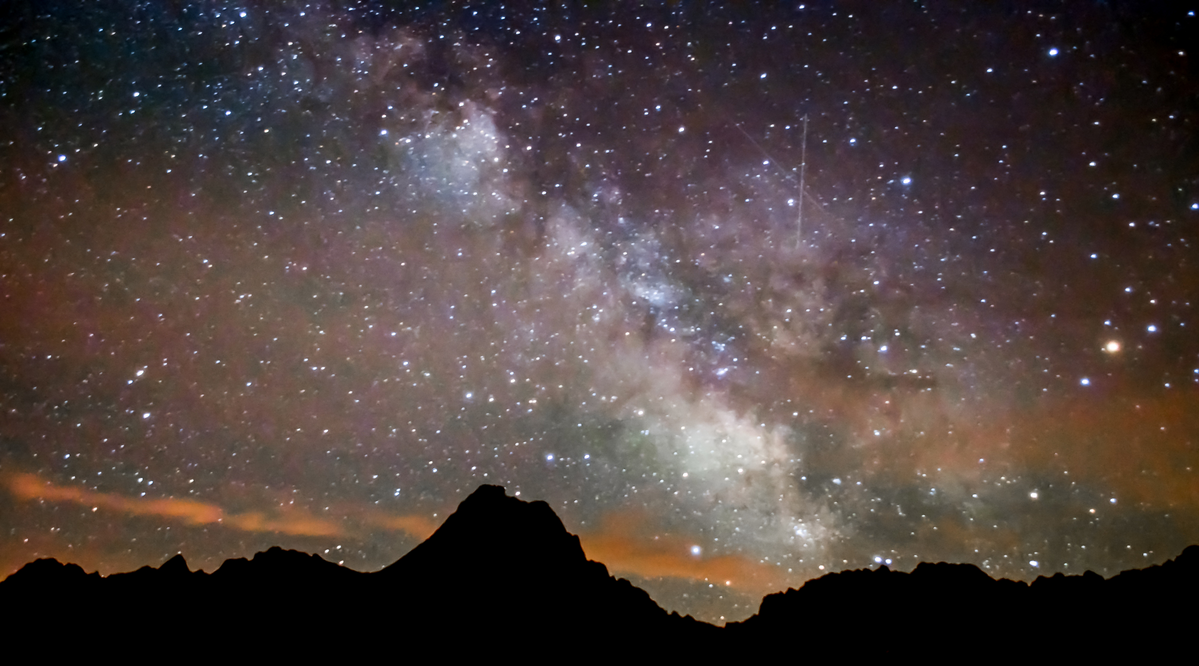
But it was not always so.  In the days of our earliest ancestors, the night sky was much clearer.  It is estimated that 1000 times more stars were visible then than in the most remote modern skies.  They Milky Way was not just a candy bar and rumor, but a dazzling, awe inspiring display.

The Milky Way can now best be seen from remote and shrinking wilderness.

Early humans, having not much else to do after the sun set, spent hours staring at those skies.  They noted first the cycles of the Moon and the seasonal procession of fixed stars across the roof of the world.  They also took note of a handful of bright stars which outshone all of the rest and meandered in mysterious ways in the heavens.  And they took note of transitory things—stars that seemed to fall out of the sky and disappear in a trice, sometimes swarms of them.  And once in a while a great light with a glowing tail would take days, weeks, or months to cross the sky.  They took all of these things as omens and pondered what these great events meant in their own lives.
Eventually they found they could regulate their lives—predict the comings and goings of game herds, times to plant and reap.  And perhaps divine propitious times to take a mate, wage war, elevate a chieftain, or make appropriate sacrifice to the mysterious powers that seemed to rule the world.
Almost as soon as civilizations arose around the world, as soon as temples were raised, and some way to record ideas in chiseled stone, or in clay tablets, humans were recording the doings of the sky and finding ways to predict, often with stunning accuracy how the sky would look and behave far into the future.  Stories were invented to explain the stars and heavens.  Often they became gods made visible on earth.

The ancients built monuments to align with the stars and saw their gods in the heavens.
Over the last two centuries or so, many peoples have lost that ancient connection.  Perhaps it doesn’t matter.  If we are curious at all, we can open books or tune in dazzling television programs that will explain in detail all about the stars, the Moon, the planets, the Solar System, and the Cosmos itself.  We are told it is all infinite yet had a beginning and in trillions upon trillions of years it will all come to an end.  Some of us may dream of traveling among the stars.  Others are so overwhelmed with loneliness in the vastness that they scurry back in terror to comforting fairy tales.
And many, so very many, just shrug their shoulders and go about the mundane business of putting one foot in front of another in a slog through brief existence.

The stars blazed fiercely for Van Gogh


Suddenly the Stars
Suddenly the stars
     unseen since god knows when—
     explode against the Arctic night.

No blank shelf of stratus bars them,
     no haze or mist obscures them,
     no scudding cirrus race the wind to hide them.

The fierce orange glow of pollution
     cannot obscure them.

Thus old Orion does his somersault
     across the heavens,
     ursine dippers pivot, reel
          upon bright Polaris’s steady blaze,
     forgotten constellations process
          with timeless dignity,
     long –lost Milky Way splatters half across the sky.

Once folk knew these stars,
     measured life blood by their glow,
     fixed on them for certainly against death and chaos,
     steered by their light where no marking showed he way,
     found their gods among them,
          and sacrificed to them in sacred duty.

But years have passed,
     these stars unseen, unrecognized,
     nor even missed
     amid a world of roofs, electric lights,
     other things to do, other lives to lead—
          until this night,
               when they come a calling
                    and change everything.

—Patrick Murfin

This poem appeared in a slightly different form in We Build Temples in the Heart published in 2004 by Skinner House Books of Boston.  Autographed copies are available upon request for $8 including postage. Post a request in the comments or E-mail pmurfin@sbcglobal.net with your request and a mail address.  I will send a volume winging toward you and let you know where you can send a check.