Showing posts with label blacklist. Show all posts

Tuesday, March 10, 2026

They are Making Lists Again--Like When J. Edgar Hoover Put Helen Keller on his Commie List


Note--There is no end of lists and the making of enemy lists by various tentacles of the Trump regime. Targets include main-stream media; individual editors, journalists, satirists; Judges, prosecutors, and investigators; leaders and rank and file members of dozens of critical organizations;  folk identified as simply being present and clashes with ICE or demonstrations and marches;  Social media users who share and circulate Anti-Trump material.  If the administration succeeds in obtaining detailed voter data from the States, it can even identify and target voters who are "the enemies of Americanism."


Despite her celebrity and status as a beloved icon Helen Keller ended up on J. Edgar Hoover's list of Communists.  She was never a party member or more than casually connected to groups suspected of being "fronts" but she was a proud member of the Industrial Workers of the World and of the Socialist Party as well as a long-time advocate for working people and for Civil Rights despite her privileged Southern roots.

On June 9, 1949 J. Edgar Hoover did his part to fuel the growing anti-Communist hysteria sweeping post-World War II America when he released a “confidential” Federal Bureau of Investigations (FBI) report that named scores of influential Americans, most of them in the movie and entertainment business as members of the Communist Party

Hoover developed his list after Attorney General Tom Clark in 1946 asked for the names of potentially “disloyal Americans” who might be detained in event of a “national emergency.”  The names on the list were included a year later in 1950 after the Korean War broke out in a report to President Harry Truman with the names of more than 12,000 who should be rounded up and detained after the formal suspension of the right of habeas corpus.  Truman had the good sense to thank his powerful FBI boss and promptly put the report and recommendation in the bottom drawer never to be acted upon.


FBI Director J. Edgar Hoover testifying before Congress about the "Communist Fifth Column."

But there were plenty, many of the in Congress and including some of the country’s most powerful media barons like the Chicago Tribune’s Col. Robert R. McCormack and Time’s Henry Luce were already clamoring for just such draconian measures.

Hollywood where the major studios were run by Jews and where many actors, writers, and creative people were politically active liberals and leftists and where there was a powerful labor union movement with sometimes radical leadership, were singled out as a virtual Commie fifth column


A protest rally to demand a pardon for the Hollywood Ten, film figures most of them screen writers, convicted for failing to "name names" before the House Un-American Activities Committee (HUAC.)

In 1946 and ’47 the powerful House Un-American Activities Committee (HUAC) launched high profile hearings on Communist infiltration of the film industry and subpoenaed hundreds to testify and name names.  Nineteen of those refused to do so and were named as unfriendly witnesses.  Eleven of those were called before the committee and 10 refused to answer questions.  Only German émigré Berthold Brecht relented and testified.  The others including screen writers Dalton TrumboHoward Koch, and Ring Larder, Jr. were indicted for contempt of Congress and eventually sent to prison and blacklisted from the industry.


Lauren Bacall and Humphrey Bogart lead a delegation at the Capitol of the Committee to Defend the Bill of Rights to protest the persecution of the Hollywood 10.  Easily identifiable are Danny Kaye behind Bogart, June Haver behind Bacall, William Holden and Richard Conti. Studio executive forced the committee to back down and some participants were themselves blacklisted.

Some of Hollywood royalty including John HustonHumphrey BogartLauren BacallJohn GarfieldDanny Kaye, and Billy Wilder attempted to rally support for the Hollywood Ten by organizing a Committee to Defend the Bill of Rights and traveling to Washington to protest.  They came under intense attack by the Committee, the press, and by the terrified studio owners.  Bogart, spearhead and principal spokesman for the group, was forced to back track and issue a statement that the trip had been ill advised.  The group broke up acrimoniously between those who thought they should have toughed it out and those like Wilder who advised it was time “to fold our tents.”

Two years later Garfield and Kaye were among those named in the new FBI report, which was based on unnamed confidential informants and the Bureau’s own “analysis” which concluded that the Communists claimed “to have been successful in using well-known Hollywood personalities to further Communist Party aims.”  Analysis was often based on no more than the recollection of an informant seeing an individual at a meeting years earlier, attendance at public functions, donations to certain charities, or signatures on some petitions.  It included pre-war support for anti-Fascist causes and war-time support of the Soviet Union—including activities undertaken at the request of the government.

Some people on the list were or had been Party Members.  Others were sympathetic.  Some were non-Communist leftists—members of the Socialist Party or the Industrial Workers of the World (IWW).  Many were unionists or sympathizers with the early Civil Rights Movement.  And many were simply liberals.  It made no difference.  To Hoover all were not just the “willing dupes” of the HUAAC hearings, but active, card-carrying Communists.

Among those listed was acknowledged Socialist and IWW member Helen Keller, even then widely regarded as a sort of secular saint.  The report centered on the activities of Fredric March, a well-known liberal and an active Democrat who recently won his second Academy Award for the brilliant film about the return of World War II GIsThe Best Years of Our Lives.  March was no Communist, but he organized a group concerned about atomic weapons and critical of America’s growing arsenal.  Any one even tangentially connected to that effort, or to people connected to the effort were caught up in rippling waves of innuendo.


John Garfield testifying before HUAC.  Unlike many others in Hollywood, Garfield was exceptionally defiant and flatly refused to sacrifice his friends to "Red baiters."  He became the most famous star blacklisted.  Like many others caught up in the hysteria he was also Jewish.

John Garfield, once the brightest new star at Warner Bros. came under especially severe scrutiny and his career immediately suffered.  Already plagued with heart problems, the stress of the accusations was widely believed to be a direct contributing factor to his death of a heart attack in May of 1952. 

Other prominent people named in the report, along with hundreds of non-celebrities included writer and wit Dorothy ParkerPaul Muni, and Edward G. Robinson.  Like Garfield and Kaye they were all Jewish.  In fact, the reek of Anti-Semitism hung over the whole report.


Fredric March, Paulette Goddard, Edward G. Robinson, and Audie Murphy, America's most decorated World War II soldier, stood up to Hoover and HUAC.

The effect on careers varied.  Many of the more obscure found themselves on blacklists.  Parker lost the radio panel show jobs that provided most of her income.  Muni’s film career was essentially finished.  March and Kaye were able to keep working and had some of their best work ahead of them.  Robinson’s career was hurt, but not over.  And he was the most outspokenly defiant befitting his tough guy image.

These rantings, ravings, accusations, smearing, and character assassinations can only emanate from sick, diseased minds of people who rush to the press with indictments of good American citizens. I have played many parts in my life, but no part have I played better or been more proud of than that of being an American citizen. 

Friday, August 22, 2025

Dorothy Parker—Fabulous Wag, Wit, Social Justice Warrior and Poet


                                                    Dorothy Parker--a stylish young post-World War I writer in a pensive pose.  

Dorothy Parker is one of those writers now more famous for who she was than what she wrote.  She will forever be etched in the public mind as the queen of the Algonquin Roundtable, that shifting group of Manhattan wits and sophisticates who daily gathered at an Algonquin Hotel table to exchange barbs and bon mots.  Through the Roaring Twenties and into the early years of the Depression the pithy sayings of these gin fueled repasts were breathlessly repeated in gossip columns read as avidly in Peoria as on Park Avenue. 

Despite her own very real accomplishments, Parker recognized this and even reveled in it.  “Every day,” she said, “I get up, brush my teeth, and sharpen my tongue.”

But Parker was a widely respected magazine journalist, critic, and above all a poet.  Her volumes of humorous verse were beloved best sellers.

Parker was born on August 22, 1893 on the Jersey Shore where her middle class Manhattan parents kept a summer cabin.  Her birth name was Rothschild—her father was of German Jewish descent (not related to the banking family) and her mother was of Scottish ancestry.  Her mother, Eliza died while staying at the same cabin just before her 5th birthday setting off a troubled and unhappy childhood.

Young Dot, as she was called, hated her father’s new wife and referred to her contemptuously as the “the housekeeper.”  She claimed her father physically abused her.  She was openly glad when her stepmother died in 1903.  Despite a Jewish father and a Protestant birth mother, she was sent to the Convent of the Blessed Sacrament School probably in hopes that the stern nuns would reign in her wild rebelliousness.  It didn’t work.  She was expelled when she was 14 for calling the Immaculate Conception “spontaneous combustion.”

After that she was shipped off for an indifferent education at a New Jersey finishing school mostly to keep her out of her father’s hair.  She graduated at age 18 in 1911.  Two years later her father died leaving most of his estate to a sister.  Dorothy went to work playing piano at a dancing school to earn a living.  In her spare time, she was writing verse.

She quickly established a career as a writer after selling her first poem to Vanity Fair in 1914.  Soon after she was hired as a staff writer at a sister publication, Vogue then moved back to a similar job at Vanity Fair two years later.

In 1917 she met and married stockbroker Edwin Pond Parker II.  They were soon separated by his service in World War I.  Not that she minded much.  Ambivalent about her Jewish identity, especially because she hated her father, she later joked that she got married to acquire a WASP name.  After Parker’s return from the war, the marriage was stormy and eventually ended in divorce in 1926.

Parker’s career really took off when she took over theater reviews at Vanity Fair from the vacationing P.G. Woodhouse.  Her criticism was arch, acerbic, witty, and penetrating.  Readers loved it.  Skewered playwrights, producers, directors, and actors felt differently.  


Some Round Table members: Art Samuals, Charles MacArthur, Groucho Marx, Dorothy Parker and Alexander Wollcott. 

Parker and fellow staff members Robert Benchley and Robert E. Sherwood began to take a daily largely liquid lunch at the Algonquin Hotel.  They were soon joined by others and by 1919 folks were talking about the Roundtable.  Other early participants included Alexander Wolcott, newspaperman/playwright Charles MacArthur, Harpo Marx, sportswriter Haywood Broun and playwrights George F. Kaufmann and Marc Connolly.  Franklin Pierce Adams not only began posting quips from the table in his popular column The Conning Tower but printed whole poems by Parker and other members helping to make their public reputations.

Sometimes all the publicity the wits received backfired.  Theater producers outraged over several quotes by Parker ridiculing their shows threatened to remove advertising from her employer.  Vanity Fair fired her. Benchley and Sherwood walked out in solidarity.  By then they were all hot commodities and could place poems, reviews and stories in all of the top magazines.

In 1925 Harold Ross founded the New Yorker and brought Parker and Benchley on board as part of his Editorial Board.  Parker really came into her own.  Her poems became a favorite feature and she contributed sharp, well drawn short stories as well.  Her caustic book reviews as the Constant Reader were very popular.

In 1926 her first volume of poems, drawn from her contributions to the New Yorker, other popular magazines and the Conning Tower sold an amazing 47,000 copies and had generally glowing reviews.  She followed with two more collections, Sunset Gun in 1928 and Death and Taxes in 1931.

Despite her success, which included collaborating on plays with Kaufmann and Elmer Rice, Parker’s personal life was a shambles.  Not only was she drinking heavily, but she was subject to bouts of black depression and suicidal thoughts, which she sometimes hinted at in her poems.  Her marriage was on the rocks and she was engaged in a series of sad, sometimes disastrous love affairs.  Affairs with MacArthur, who would go on to marry actress Helen Hayes, Benchley, and Wolcott resulted in pregnancies and abortions.  After the first she made the first of several suicide attempts.

Her love life and disappointments became the fodder of her most famous short story, Big Blonde, published in The Bookman magazine.  It won the prestigious O. Henry Award for Best Short Story of 1929.  She went on to publish several story collections over the next decade.

Parker’s life changed dramatically in 1927 as she became interested in the campaign to save anarchists Sacco and Vanzetti from execution on dubious murder/bank robbery charges in Massachusetts.  Previously largely apolitical, she traveled to Boston to protest and was arrested and fined $5 for picketing.  The experience set off a commitment to leftist causes, social justice, and civil rights that only grew and lasted the rest of her life.


Caricaturist Al Hirschfeld's take on a later Round Table gathering.  

By the early 1930’s the old gang at the Algonquin and newer members like Tallulah Bankhead and Edna Ferber were drifting apart.  The group dynamics of members sleeping with each other or occasional other’s spouses must have contributed.  But so did the increasing demands of successful careers and political tensions between the more conservative members and the increasingly radicalized Parker.

One day in 1932 Ferber showed up for lunch and found the regular table occupied by, “a party from Kansas.”  It was all over.

At about that time Parker began a relationship with a fellow New Yorker contributor and sometimes actor Allan Campbell.  Like her, he was of Jewish and Scottish heritage.  He was also ten years younger and an active bi-sexual.  The two were married in 1934 in Taos, New Mexico on the way to Hollywood and the lure of lucrative new careers as screenwriters.


Parker with her second husband Allan Campbell shortly after their 1934 marriage.  Their relationship was fraught  with ups and downs--he was bi-sexual, both committed infidelity, both drank heavily and suffered serious depression.  Despite a divorce, war-time separation, reconciliation, remarriage, and being victimized by the MaCarthy Era Black list  they remained connected personally and professionally. 

They first caught on at Paramount.  He was put under a contract for $350 which included acting in bit parts, and she got $1000 a week.  They soon, however, established themselves as a successful screen writing duo earning $2,000 to $5,000 a week free lancing a quality studios like MGM and Warner Bros.  Most of the 15 films on which they collaborated were competent, journeyman efforts.  But they earned an Academy Award nomination for the classic A Star is Born in 1937 with Janet Gaynor and Fredrick March.  When Parker’s friend and fellow left wing activist Lillian Hellman was called away from The Little Foxes to work on another project, they were called in to write additional dialogue for the Bette Davis.

The marriage broke up in divorce in 1938 but despite Parkers drinking and suicidal depressions, they continued to work together until Campbell entered the service as a military intelligence officer in World War II.  As her contribution to the war effort, she worked with Wolcott and Viking Press on a compact edition of her best stories and poems for soldiers serving overseas. After the War Viking released it for American readers as The Compact Dorothy Parker.  It has never since gone out of print. 


                                        Viking Press's The Portable Dorothy Parker has never gone out of print. 

After the war in 1947 Parker won another Oscar nomination for her contributions the Susan Hayward tearjerker Smash-Up, the Story of a Woman.  The tale of a woman whose life was disintegrating in alcoholism must have hit awfully close to the bone.

But Parker’s days in Hollywood were numbered as the Red Scare infected the industry.  For years she had been a leader of anti-Fascist crusades and organizations.  She had even reported on the Spanish Civil War for The Masses and had helped re-locate defeated veterans of the war to safety in Mexico.  She was active on or chaired several committees—most notably the Hollywood Anti-Nazi League which grew to 4,000 members and was accused funneling large sums of money to the Communist Party.

Parker’s last Hollywood job was The Fan, an adaptation of Oscar Wildes Lady Windermeres Fan for Otto Preminger in 1949.  After that she was hauled before a Congressional Committee, pled the Fifth Amendment, and blacklisted.

In the midst of all of that, Parker re-married Campbell in 1950.  They separated, but did not divorce, in 1952 and Parker returned to New York to take up residency in the Volney Hotel.  Advanced alcoholism prevented her from returning to regular magazine work, although she submitted occasional reviews.  Mostly she made a small living as celebrity guest or panelist on such radio programs as Information Please and Author, Author.  She wrote monologues for old friends Tallulah Bankhead and Ilka Chase.


                                    The ravages of alcoholism were evident in this mid-1960's portrait by Richard Avadon. 

Despite her drinking, she remained as active as possible politically.  She was especially moved by the Civil Rights Movement as it unfolded on the streets of the South.

In 1960 she reconciled with Campbell and moved back to Los Angeles where the couple worked fitfully on un-realized projects.  In 1962 Campbell committed suicide.  In worse emotional shape than ever, Parker returned to the lonely life of a Volney Hotel drunk.

When she died of a heart attack on June 7, 1967 Parker left her estate, including valuable literary properties, to Martin Luther King, Jr. to support him in his work.  When he was killed days later the estate ended up in the hands of the NAACP.


The commemorative marker over Parker's ashes at NAACP headquarters in Baltimore.  A fan has left flowers and an airplane bottle of gin. 

With no living relative or willing friend to claim them Parker’s ashes stayed in a file cabinet in her lawyer’s office for 17 years until the NAACP claimed them.  They buried them under a marker on the grounds of their Baltimore headquarters.  The plaque reads:

Here lie the ashes of Dorothy Parker (1893–1967) humorist, writer, critic. Defender of human and civil rights. For her epitaph she suggested, “Excuse my dust”. This memorial garden is dedicated to her noble spirit which celebrated the oneness of humankind and to the bonds of everlasting friendship between black and Jewish people. Dedicated by the National Association for the Advancement of Colored People. October 28, 1988.

Here is just a sample of Dorothy Parker’s poetry—snide, sarcastic, and finally movingly personal.

A Pig’s Eye View of Literature

The Lives and Times of John Keats,
Percy Bysshe Shelley, and
George Gordon Noel, Lord Byron

Byron and Shelley and Keats
Were a trio of Lyrical treats.
The forehead of Shelley was cluttered with curls,
And Keats never was a descendant of earls,
And Byron walked out with a number of girls,
But it didn’t impair the poetical feats
Of Byron and Shelley,
Of Byron and Shelley and Keats.

–Dorothy Parker


Autobiography

Oh, both my shoes are shiny new,
And pristine is my hat;
My dress is 1922....
My life is all like that.


–Dorothy Parker


Of a Woman Dead, Young

If she had been beautiful, even,
Or wiser than women about her,
Or had moved with a certain defiance;
If she had had sons at her sides,
And she with her hands on their shoulders,
Sons, to make troubled the Gods-
But where was there wonder in her?
What had she, better or eviler,
Whose days were a pattering of peas
From the pod to the bowl in her lap?

That the pine tree is blasted by lightning,
And the bowlder split raw from the mountain,
And the river dried short in its rushing-
That I can know, and be humble.
But that They who have trodden the stars
Should turn from Their echoing highway
To trample a daisy, unnoticed
In a meadow of small, open flowers-
Where is Their triumph in that?
Where is Their pride, and Their vengeance?


–Dorothy Parker


Monday, October 17, 2022

The True Story Behind the Classic Labor Film Salt of the Earth

In reel life and in real life--women were the heroes of the mid-20th Century Southwestern mine strike made famous in the film Salt of the Earth.

When workers went on strike against the Empire Zinc Corporation in Grant County, New Mexico on October 17, 1950 it may have seemed like just another action in almost 60 years of struggle by hard rock miners and allied workers in the West.  But the bitter strike, which dragged on for 14 more months took place against a backdrop of anti-communist hysteria, government suppression, racism, and gender discrimination would likely be forgotten today except that it was documented in a classic film that had its own epic battle to see the light of day.

Almost everyone called the strikers Mexicans and continue to do so to this day, even in histories sympathetic to the workers.  In fact, although most were Spanish speaking, few had immigrated.  By in large they belonged to communities that had lived in New Mexico from colonial days.  In the film Salt of the Earth based on the strike the narrator, based on a striker’s wife, put it this way: 

...I am a miner’s wife. This is our home. The house is not ours. But the flowers... the flowers are ours. This is my village. When I was a child, it was called San Marcos. The Anglos changed the name to Zinc Town. Zinc Town, New Mexico, U.S.A. Our roots go deep in this place, deeper than the pines, deeper than the mine shaft…

The name of the real town was Silver City, named after an early mining boom.  The workers were members of the United Mine, Mill, and Smelt Workers, commonly called simply Mine and Mill.  The union was founded in 1893 as the Western Federation of Miners and had been on the front lines of often bloody battles against copper, silver, gold and other metal mine operators from Montana, Idaho, Colorado, Utah, Nevada, Arizona and other Western states.


The organization was a pioneer of industrial union organization and early on was deeply radicalized by the common cause made by the Eastern trusts and cartels with local, state, and even Federal authorities in trying to smash organizing and strikes by violence and repression.  In 1905 William D. “Big Bill Haywood other leaders helped found the Industrial Workers of the World (IWW) and the Western Federation formed the bulk of the new union’s original membership.

Internal disputes caused the Western Federation to drop out and return to independent status by 1907, although Haywood and many others stayed with the IWW.  Over the next decades both unions would continue to organize metal miners and fight strikes that often resembled open war.

But the union had largely been eclipsed by the IWW and was in decline just before American entry into World War I.  It changed its name Mine and Mill in 1916.  Although it escaped some of the repression that fell onto the IWW in the post war Red Scare, it limped along until the Depression.  In 1934, after re-claiming its old base in Butte, Montana the union began to aggressively expand across the West and into new territories in Ontario and even in the South.  It also organized smelters in New Jersey.  This burst of energy was largely due to the leadership of radicals, some of them former Wobblies but most openly members of the Communist Party.  The union became one of the founders of the Congress of Industrial Organizations (CIO).

However, another war ushered in another Red Scare.  Despite pressures from John L. Lewis, the conservative leader of the CIO, the union refused to dump its Communist leadership.  It also refused to stop organizing minority workersBlacks in the South and Hispanics across the Southwest.  The CIO then encouraged the United Steel Workers and the United Auto Workers to raid Mill and Mine shops and encouraged use of racial resentment against minority workers to do so.

Pressure increased after the Taft-Hartley Act was passed in 1947 which required unions to sign an anti-communist pledge and purge their leadership of Reds.  In 1950, not long before the strike began, the CIO formally expelled the Mine and Mill Workers.

That meant that the New Mexico strike would not have the customary support of other unions.  In fact, other unions were encouraged to cross picket lines.

The issues in the strike were equal pay for the majority Spanish speaking miners with the minority of whites, mostly those in the skilled trades, and safety in a mine notorious for repeated injuries and deaths.  Some of the white miners crossed the picket line, though others remained loyal to their union and fellow workers.

Most of the miners in the Empire Zinc strike were of Mexican decent but whose families had been in New Mexico since it was annexed into the United States following the Mexican War.

Predictably the strike was marked by mass picketing and regular arrests by local authorities operating openly on behalf of the owners.  In addition, owners sought to have strikers’ families evicted from the shoddy company owned housing in town.

As the strike dragged on, the mine owners sought relief under the Taft-Hartley Act.  On June 12, 1951 an injunction was granted forbidding strikers from picketing.  Facing the collapse of the strike, which would have meant the blacklisting of their husbands and their families’ eviction from their homes, the strikers’ wives at a dramatic meeting, demanded that their husbands let them replace them on the picket line.  Resistance was fierce.  Cultural norms were macho and women were expected to be both subservient and stay at home.  Marriages were strained.

But with few alternatives, the women took their place on the line.  The strike held.  Intimidation did not stop.  Many of the women were arrested.  Famously, they were crammed into tiny cells in the county jail with their children.  But they would not relent.  The longer the strike lasted, the more militant they grew.  And so did the admiration of them by their once reluctant husbands.

The women’s participation also shifted some of the demands of the strike to include improvement to the appalling living conditions in company housing.  White workers had indoor plumbing.  Spanish speaking workers had none.  Many did not even have electricity.  Sanitation and safety improvement in housing became key issues.

Against all odds, the company finally capitulated on January 24, 1952.  The strikers won most of their demands. 

The dramatic story would have faded to obscurity if a blacklisted Hollywood writer had not stumbled upon the women’s picket line while vacationing at a near-by dude ranch.  Returning to California he rounded up other blacklisted artists to undertake a fictionalized film about the strike. 

Black Listed Hollywood screen writer Paul Jarrico stumbled on the strike and made a crusade of bringing the story to the screen with other black listed talent.  Seen here, left, refusing to name names before the House Un-American Activities Committee (HUAAC) in 1951.

Paul Jarrico was the writer who recruited others for his vision and became producer of Salt of the Earth.

Writer Michael Wilson, who had won an Oscar for A Place in the Sun, would have to work anonymously if at all for the next ten years working on films like The Court Martial of Billy Mitchell, Friendly Persuasion, The Bridge Over the River Kwai, and Lawrence of Arabia unaccredited. 

Director Herbert J. Biberman was one of the famous Hollywood Ten and had served time in prison for refusing to “name names.”

Wilson produced a draft of the script after extensive interviews with the participants.  It was then given to the strikers for comments and the final drafts reflected their concerns and sensitivities.  Interestingly, the strikers themselves wanted greater attention paid to the family struggles to come to grips with assertive women. 

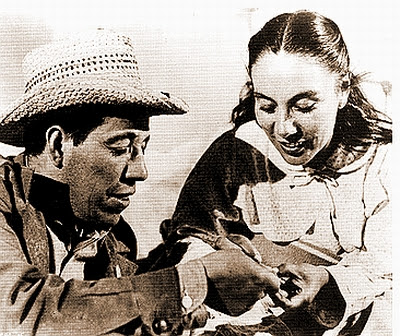
Juan Chacón , the Mill and Mine local President during the strike, played the chief union steward Ramon Quintero and Mexican actress Rosaura Revueltas played the key role of his indomitable  wife Esperanza (Hope.)

It was decided to cast actual participants as far as possible.  In the end only five professional actors were used, the best known was blacklisted Will Geer, who played the Sheriff.  Mexican actress Rosaura Revueltas was cast in the central role of Esperanza, the pregnant wife of a striker who also narrated the film.  Real life local union president Juan Chacón was cast as her chief union steward husband.  Lead union organizer Clinton Jencks and his wife Virginia played versions of themselves. 

From the beginning filming in New Mexico attracted as much opposition as had the strikers themselves.  The crew was run out of the originally selected location by death threats.  Harassment of the cast and crew—and of the union miners themselves was constant.  At least one union family had their house burned down. The local American Legion organized vigilante attacks, including firing live ammunition at the company on location.

On February 24, 1953 Representative Donald L. Jackson (R-Ca.), a member of the House Committee on Un-American Activities (HUAC), bitterly denounced the film as the bidding of Communist Russia in a widely publicized speech on the House floor.

The next day Revueltas was arrested and deported on the flimsy grounds that her visa had not been properly stamped.  Although most of her scenes were in the can, some scenes had to be shot with a double at a distance and her narration had to be recorded in Mexico and smuggled into the states.

After on-site cinematography was ended, postproduction was a problem with all of Hollywood’s facilities denied them.  Black listed editors, sound dubbers, and other crafts people had to work in secret in their homes or, at great pers. l peril, in un-used studio facilities late at night.  The raw footage and prints were actively being hunted by both Federal authorities and the Studios themselves hoping to prove their loyalty.  The reels were hidden in a shack.

                                A DVD release of Salt of the Earth.

And the trouble did not end when the final cut was made.  Producers found it almost impossible to distribute and show the film.  Only a handful of theaters agreed to show it and most of those withdrew under pressure.  The AFL Projectionists Union ordered its members not to show the movie.  In the end Salt of the Earth was only shown on 13 of America’s more than 13,000 screens.

It fared better in both Eastern and Western Europe where it played to appreciative audiences, rave reviews, and garnered film festival awards.

Mine and Mill union organizer Clinton Jencks, second from left, in Jail with union members during the strike.  Under anti-Communist pressure his union abandoned him and he was imprisoned for falsifying his Taft-Hartley loyalty oath.

Shortly after the film was released Clinton Jencks was charged by a Federal Grand Jury for lying when he signed a Taft-Hartley oath in 1950.  He was convicted in 1954 and sentenced to prison.  Even his union abandoned him.  In 1957 his conviction was overturned in a landmark case on the grounds that the prosecution had not shared exculpatory evidence with the defense.  Jenck’s was never able to return to union organizing but became a college teacher.

By the 1960’s writer Wilson and other victims of the blacklist were able to work once again under their own names.  The blacklist was looked on increasingly as black mark on both Hollywood and the nation.

In the ‘60’s 16 mm prints of Salt of the Earth began to be circulated in union halls, on college campuses, and especially among Chicano and womens organizations for which it was both an inspiration and a revelation.  Soon revival houses were putting it up, finally, on the big screen. 

In the 1980’s the film was intentionally allowed to go into the public domain.  Copies circulated freely on VHS and latter on DVD.  It can be viewed in its entirety here on YouTube.

Salt of the Earth is now hailed as a classic.  It is one of the very few films with a 100% positive rating on Rotten Tomatoes.  In 1992 the Library of Congress selected it for preservation in the National Film Registry for being “culturally, historically, or aesthetically significant.”

As for the Mine and Mill union, it was finally coerced into a mergerswallowed up really—with the United Steel Workers of America (USWA) in the U.S. in the early 1960s after the union’s once proud flagship local in Butte, Montana voted to switch in 1962.  The merger was completed in 1967.  The  Sudbury, Ontario local which had a long, contentious, and sometimes violent history with the city’s Steelworkers locals, voted against the merger. It remained the last autonomous remnant of Mine Mill until 1993, when it merged with the Canadian Auto Workers.

The once proud union evaporated from memory. 

Today many of its former Western mines and mills have closed.  After decades of unrelenting company opposition, some locals were de-certified.  The USWA, fighting for survival in the basic Steel industry, has little time or resources to support organizing efforts in the West.