Showing posts with label circus. Show all posts

Monday, June 22, 2026

A Real Circus Train Wreck Inspired DeMille's Screen Extravaganza

Cecil B. DeMille's 1953 The Greatest Show on Earth was a huge hit and helped save Hollywood as television was keeping people home.  In gratitude the film won the Oscar for Best picture over such certified classics as High Noon, Moulon Rouge, and The Quiet Man.

Old time movie buffs like me are sure to remember the glitzy, gaudy, gauche 1952 Cecil B. DeMille flick The Greatest Show on Earth.  The veteran director put aside his sandal and sand Biblical epics to use the Ringling Bros, Barnum & Bailey Circus as the backdrop for a somewhat turgid melodrama.  The film was a box office sensation at the time the movies were losing a battle for viewers to the infant medium of television.  Impressed, Motion Picture Academy voters picked it as Best Picture over far better films including High Noon, Moulon Rouge, and The Quiet Man, each of which is a certified classic.

The climatic scenes from the movie are a spectacular and gut-wrenching circus train wreck and its grizzly aftermath.  In the film a jealous animal trainer and a sideshow operator fired for running crooked games with ties to a shady character with a financial interest in seeing the circus fail, throw a switch leading the circus train to ram a stopped freight.  
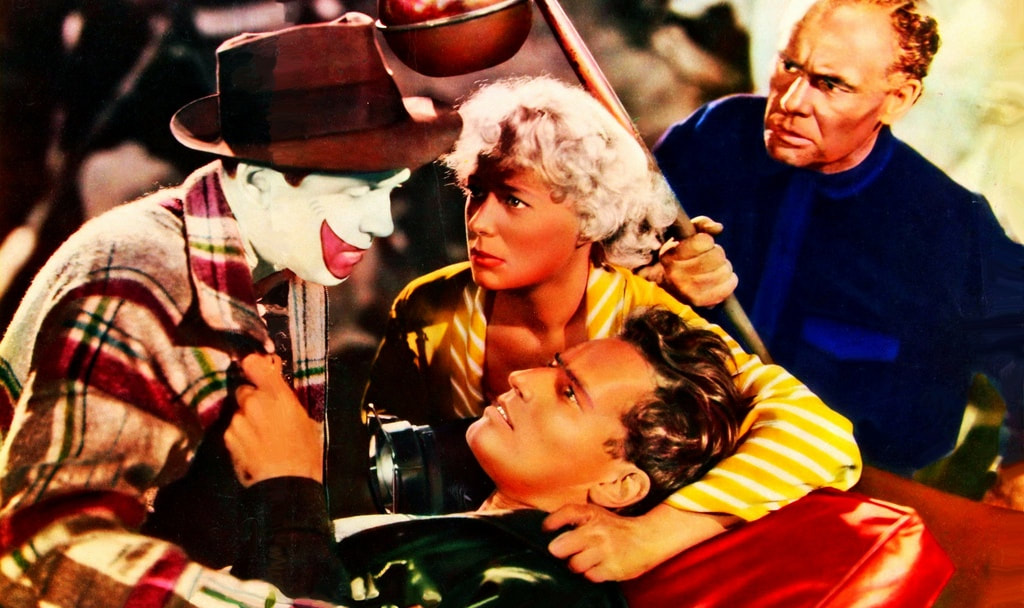
In the melodramatic climax of the film beloved clown Buttons--James Stewart--exposes his true identity as a doctor on the lam for the mercy killing of his wife to save circus boss Brad--Charlton Heston--who is being cradled by trapeze artist Holly--Betty Hutton--after a gut-wrenching train wreck.

The film’s plot threads are all neatly tied up in the wreckage as the beloved never-seen-without-his-make-up Buttons the Clown (James Stewart) reveals his true identity as doctor on the lam wanted for the mercy killing of his wife when he saves the life of the rugged and driven circus boss Brad (DeMille favorite Charlton Heston).  Brad’s rival for trapeze artist Holly (Betty Hutton) The Great Sebastian (Cornell Wilde) bitterly nursing an injury that threatens to end his career in the center ring, nobly contributes his blood to help save Brad.  Holly realizes that it was always Brad she loved, not her erstwhile rival Sebastian, and steps into his role as hardnosed boss to save the circus.  She leads the battered and bloodied troupe into the nearest town at the head of the circus parade while singing the title song and sets up the show for an outside performance.

The movie was the first film that Steven Spielberg saw in a theater and triggered his lifelong passion for the movies.  The train wreck scene in particular inspired his first teen age film efforts and helped inspire his 2011 film Super 8.

What people don’t necessarily know is that DeMille’s circus train wreck was inspired by a true incident, one of the deadliest rail disasters in American history.

The Hagenbeck-Wallace Circus promoted its shows with posters celebrating its show train.  Unloading the train and a parade to the grounds where the Big Top would be erected were big opportunities to promote the show.

Shortly before dawn on June 22, 1918 a Michigan Central Railroad troop train pulling 20 empty Pullman cars was closely following a slower moving train carrying the cast, crew, animals, and equipment of the Hagenbeck-Wallace Circus, then the second largest traveling show in the country.  Alonzo Sargent, a veteran engineer with sixteen years at the throttle and a spotless record, was at the controls of the deadheading train.

Sargent had been called in for this run at the last minute and had hardly slept in 21 hours.  He knew he was following the slow circus train and had taken care to note signals at several crossings and switch points.  He figured he was two miles or more behind the other train.  But up ahead at the Ivanhoe Interlocking crossing 5½ miles east of Hammond, Indiana the circus train had come to a stop to attend a hot box on a flat car.  The exhausted Sargent momentarily nodded out at the controls of his locomotive.  When he jerked himself awake, he could see the red lights of the circus train’s caboose just ahead.  While snoozing he had blown through three signals and the warning flares put out by the proceeding train.

According to his own testimony before an investigating commission:

I awoke suddenly and saw the tail or marker lights showing red on a train directly ahead of me. Not realizing that the rear end of this train was so close. I started to make a service application, but before completing it placed brake-valve handle into emergency position. We struck almost instantly after making the brake application. Don't know whether I closed the throttle or not, but think I did.

Rescuers and survivors pick through the smoldering rubble of the circus train accident.

Still moving at an estimated 35 miles an hour the engine plowed through the caboose and the four ancient wooden passenger cars at the rear.  The cars were jammed with sleeping roustabouts and performers.  Most of the 86 dead were killed instantly, but some were trapped in the wreckage which immediately caught fire from the smashed oil lamps used to illuminate the old cars.  The were 126 severely injured, many of them badly burned, among the estimated 400 circus people and train crew in the four cars and caboose.  To his credit, Sargent, who survived the wreck with minor injuries, leapt from his cab and immediately began trying to pull survivors from the wreckage, working frantically for the next two hours.

Arthur, Joe and Max Dierickx during their heyday with the Hagenbeck-Wallace Circus before the train wreck that killed Arthur and Max.

Although most of the circus stars were resting in Pullman cars forward, the dead were known to include  Arthur Dierckx and Max Nietzborn of the Great Dierckx Brothers strongman act and Jennie Ward Todd of The Flying Wards.  Most of the victims were burned beyond recognition.

Just months before the wreck the wreck the Showmen’s League of America, a fraternal benefits society formed by William F. “Buffalo Bill” Cody in 1913, purchased a large plot in Woodlawn Cemetery at the intersection of Cermak Road and Des Plaines Avenue in Forest Park, Illinois for its members.  Five days after the accident the remains of 59 to 61 of the victims were buried in a mass grave.  Markers note unidentified male or female. As was typical of circus folks even when the dead were identified by survivors their real names were often unknown.  So, there are markers for Smiley, Baldy, 4 Horse Driver, and others.  

Most of the victims of the train wreck were buried in mass grave at Showmen's Rest at Woodlawn Cemetery near Chicago.  Individual markers were erected--most noting unknown male or female since bodies were burned beyond recognition.

Today the area known as Showmens Rest is guarded by five large elephant statues.  There is a gathering every Memorial Day to remember the dead of the train wreck and the many circus and carnival people who continue to be buried there.  

                                            The Showmen's Rest memorial elephant statue surrounded by markers of the train wreck victims.

Meanwhile the shattered Hagenbeck-Wallace show struggled in the spirit of the show must go on later celebrated in DeMille’s film, to resume operations.  In a show of solidarity rivals, including the biggest of them all, the Ringling show, lent equipment, animals and performers to the company.  The circus only missed two dates in Hammond and Monroe, Wisconsin and was able to finish out the season’s tour.

The circus was bought and sold several time after that consolidating with other shows.  It finally succumbed to the Great Depression, folding its tents for the last time in 1938 as the Hagenbeck-Wallace & Forepaugh-Sells Bros. Circus. 

The former home base of the show in Peru, Indiana is now the International Circus Hall of Fame.

The Federal investigation of the accident put the blame a squarely on the shoulders of engineer Sargent.  But the report noted that the flimsy, obsolete wooden passenger cars and their oil lamps contributed significantly to the death toll.  After that the old cars were rapidly taken out of service across the country and replaced by modern steel safety cars illuminated and heated by electricity.

Monday, June 15, 2026

The Dark Side--When Was Minnesota Not So Nice


Jubilant Whites celebrate the beating, torture, and lynching of three Black circus roustabouts in Duluth, Minnesota in 1920.  This image was printed on postcards and sold briskly for years after the lynching, as described by Minnesotan Bob Dylan in the openings verse of Desolation Row.

Note--This blog has sung the praises of heroic action and determined Resistance of Minnesotans this year.  But despite the popular progressive traditions, there has been a dark history as well.

Ida B. Wells and the Black press including W.E.B. Du Bois The Crisis and the Chicago Daily Defender  long exposed lynching as a brutal tool of oppression in the Jim Crow South.  Later Billie Holiday sang about the Strange Fruit she witnessed dangling from lamp posts and bridges on her tours of the South.  Lynchings were a terrible thing, civilized people agreed, but they were a Southern thing.

That’s why much of the nation was shocked to learn that on June 15, 1920 that three Black circus workers were dragged from a Duluth, Minnesota jail, beaten, and hung by a howling mob of as many as 1,500 citizens. 

The busy Lake Superior port and principal city of the Iron Range, with a tiny Black population of its own, seemed like the last place in the country to expect such an outrage.  It was a city of hard-working immigrants, most of them Finnish, Norwegian, Swedish, and German Many of them, especially the Finns, were Socialists, Wobblies, and now Communists with roots in the labor and union movements.  It was not that violence itself was unexpected, it was just that it was associated with the epic labor battles that had long raged across the Iron Range.

During the World War “decent citizens” were worked up into a frenzy of patriotism and came to view the immigrant radicals, most of them opposed to the war, as threats.  The refusal of workers to abide by patriotic calls for labor peace and keep up the flow of vital taconite ore to the freighters and down to the steel mills of Gary and Chicago stoked more outrage.

In September of 1919 a young Finish immigrant, Olli Kinkkonen, thought by a mob to be a Draft dodger, was beaten, tarred, and feathered, and lynched in a downtown park.  No one was ever charged or tried for that murder.  So violence and lynching were not unknown in Duluth.

1919 was also a year when race riots erupted in Chicago and in other Midwestern cities where waves of Blacks from the South poured into to take war time jobs.  Although Duluth, with only a handful of Blacks residents, escaped the rioting, it did not escape the national hysteria that followed.

So, the stage was set for the unexpected.


Lured by advertising like this for the John Robinson Circus, two young people were drawn to the grounds to watch the set up--and maybe for a romantic rendezvous.

The circus was in town.  On June 14 the John Robinson Circus, a mid-sized traveling show, rolled into town.  As always, the arrival of the circus stirred local excitement.  Two young people, Irene Tusken, 19, and James Sullivan, 18 were among the many who came down to the grounds where the show was being set up to watch the excitement.  The Circus encouraged that—it was good for ticket sales.  By design or otherwise Tusken and Sullivan, who arrived separately, got together on the grounds.  They drifted around to the relative isolation of an area behind the big top.  A gang of Black roustabouts was unloading the menagerie tent nearby.

What happened next is a matter of confusion and controversy.  There may—or may not—have been some kind of confrontation between Sullivan and some of the roustabouts.  Later that evening police received a call from Sullivan’s father claiming that his son had been attacked and robbed.  The boy was questioned and told police that five or six of the workers attacked and robbed him and then raped Tusken as he was held at gun point.  Tusken seemed frightened and confused, but generally went along with Sullivan’s story.

All 150 Black workers from the circus were rounded up and lined up against the railroad tracks.  Sullivan was brought there to identify the alleged assailants.  He identified six and said a few others might have been involved.  The six were taken to jail.

Overnight rumors flew around town, including reports that Tusken had been murdered.  In fact, the story of the rape fell apart almost immediately.  A doctor examining her the next morning found no physical evidence of assault—bruising, scratches, abrasions—or of semen.


The respectable press of Duluth reported the mob action but also fanned the flames by publishing exaggerated claims and rumors.

Local newspaper reports sensationalized the charges, rumors ran rampant.  Through the day of the 15th a crowd grew around the jail until it became a mob of more than 1,000.  An attack on the jail was expected.  Authorities ordered deputies, guards, and police on the scene not to resist an attack with firearms.

When the mob moved on to the jail, police fought back as best they could with fire hoses and truncheons.  But they were vastly outnumbered and after a vicious melee in which men on both sides were injured, they were overwhelmed.  In fact, the resistance had only inflamed the mob who managed to seize three men—Elias Clayton, Elmer Jackson, and Isaac McGhie.  They were beaten inside the jail and then hauled to the street where they were put on sham trial.

They were taken to the center of town, the corner of 1st Street and 2nd Avenue East where they were beaten again and hung from a lamp pole.  The mob posed for pictures with the bodies which were published in the press and later sold as souvenir post cards.

The three other men suspected in the rape were still in the jail.  A shifting mob kept up a presence outside, threatening a new attack.  But it was not until the next morning that National Guard troops arrived to secure the jail and its prisoners who were moved to the St. Louis County Jail under heavy guard.

As the rape case against the victims evaporated over the next few days, the mob action drew national headlines.  Most were condemning.  Some Southern papers, however, openly gloated that Yankees were now awakening to the threat to White womanhood and were taking vigorous “corrective action.”

But next door in Superior, Wisconsin the local police chief pledged that, “We are going to run all idle Negroes out of Superior and they’re going to stay out.”  How many were actually rousted and deported is not certain, but all of the Blacks employed by a carnival visiting the city were fired and told to leave the city.

A Grand Jury was empaneled on June 17, but despite loads of evidence including photographs and the open boasts of ringleaders, the jury had a hard time bringing indictments.  After a struggle, 37 were indicted for participating in the lynching, 25 for rioting, and 12 for first degree murder.  Several were indicted on multiple charges.  In the end only three were convicted of rioting.

Of the Blacks suspected in the alleged rape and assault, the three survivors from the jail and four others were indicted for rape, but the charges against all but two were dropped.   William Miller was acquitted, and Max Mason was convicted and sentenced to serve seven to thirty years in prison.  Amid growing public outrage, Mason was released from prison after only four years on the proviso that he leave Minnesota and never return.  Somehow, I suspect he was never tempted to violate that provision.

Like many places after such a shameful atrocity, Duluth tried hard to forget it ever happened.  Willful amnesia it’s called.  But nagging reminders kept popping up.


Young Minnesotan Bob Dylan wrote of the lynchings in his classic 1965 song Desolation Row..

In 1965 Duluth born Bob Dylan, whose father was five years old and living two blocks from the lynching in 1920 opened his song Desolation Row with a reference to that awful night:

They’re selling postcards of the hanging

They’re painting the passports brown

The beauty parlor is filled with sailors

The circus is in town.  

In 2003, after a long public campaign, a stunning monument to the three lynching victims was unveiled—a plaza including three seven-foot-tall bronze statues across the street from the site of the lynching. The Clayton Jackson McGhie Memorial was designed and sculpted by Carla J. Stetson, in collaboration with Anthony Peyton-Porter, a California-based Black writer who had taken an interest in the case.


Bas relief images of the three lynching victims over look a downtown Duluth plaza near the scene of their murders.

At the dedication Warren Read, the great-grandson of one of the most prominent leaders of the lynch mob told the crowd:

It was a long held family secret, and its deeply buried shame was brought to the surface and unraveled. We will never know the destinies and legacies these men would have chosen for themselves if they had been allowed to make that choice. But I know this: their existence, however brief and cruelly interrupted, is forever woven into the fabric of my own life. My son will continue to be raised in an environment of tolerance, understanding and humility, now with even more pertinence than before.

Read has since written The Lyncher in Me, a memoir of his family and of his own search for reconciliation with the decedents of Elmer Jackson.

Saturday, June 15, 2024

When Was Minnesota Not So Nice—Strange Fruit Hung from Northern Trees

Jubilant Whites celebrate the beating, torture, and lynching of three Black circus roustabouts in Duluth, Minnesota in 1920.  This image was printed on postcards and sold briskly for years after the lynching, as described by Minnesotan Bob Dylan in the openings verse of Desolation Row.

Ida B. Wells and the Black press including W.E.B. Du Bois The Crisis and the Chicago Daily Defender had long exposed lynching as a brutal tool of oppression in the Jim Crow South.  Later Billie Holiday would sing about the Strange Fruit she witnessed dangling from lamp posts and bridges on her tours of the South.  Lynchings were a terrible thing, civilized people agreed, but they were a Southern thing.

That’s why much of the nation was shocked to learn that on June 15, 1920 that three Black circus workers were dragged from a Duluth, Minnesota jail, beaten, and hung by a howling mob of as many as 1,500 citizens. 

The busy Lake Superior port and principal city of the Iron Range, with a tiny Black population of its own, seemed like the last place in the country to expect such an outrage.  It was a city of hard working immigrants, most of them Finnish, Norwegian Swedish, and German.  Many of them, especially the Finns, were Socialists, Wobblies, and now Communists with roots in the labor and union movements.  It was not that violence itself was unexpected there, it was just that it was associated with the epic labor battles that had long raged across the Iron range.

During the World Wardecent citizens” had been worked up into a frenzy of patriotism and had come to view the immigrant radicals, most of them opposed to the war, as threats.  The refusal of workers to abide by patriotic calls for labor peace and keep up the flow of vital taconite ore to the freighters and down to the steel mills of Gary and Chicago stoked more outrage.

In September of 1919 a young Finish immigrant, Olli Kinkkonen, thought by a mob to be a Draft dodger, was beaten, tarred, and feathered, and lynched in a downtown park.  No one was ever charged or tried for that murder.  So violence and lynching were not unknown in Duluth.

1919 had also been a year when race riots erupted in Chicago and in other Midwestern cities where waves of Blacks from the South had poured into the cities to take war time jobs.  Although Duluth, with only a handful of Blacks residents, had escaped the rioting, they had not escaped the national hysteria that followed.

So the stage was set for the unexpected.

Lured by advertising like this for the John Robinson Circus, two young people were drawn to the grounds to watch the set up--and maybe for a romantic rendezvous.

The circus was in town.  On June 14 the John Robinson Circus, a mid-sized traveling show, rolled into town.  As always, the arrival of the circus stirred local excitement.  Two young people, Irene Tusken, 19, and James Sullivan, 18 were among the many who came down to the grounds where the show was being set up to watch the excitement.  The Circus encouraged that—it was good for ticket sales.  By design or otherwise Tusken and Sullivan, who had arrived separately, got together on the grounds.  They drifted around to the relative isolation of an area behind the big top.  A gang of Black roustabouts was unloading the menagerie tent nearby.

What happened next is a matter of confusion and controversy.  There may—or may not—have been some kind of confrontation between Sullivan and some of the roustabouts.  Later that evening police received a call from Sullivan’s father claiming that his son had been attacked and robbed.  The boy was questioned and told police that five or six of the workers attacked and robbed him and then raped Tusken as he was held at gun point.  Tusken seemed frightened and confused, but generally went along with Sullivan’s story.

All 150 Black workers from the circus were rounded up and lined up against the railroad tracks.  Sullivan was brought there to identify the alleged assailants.  He identified six and said a few others might have been involved.  The six were taken to jail.

Overnight rumors flew around town, including reports that Tusken had been murdered.  In fact the story of the rape fell apart almost immediately.  A doctor examining her the next morning found no physical evidence of assault—bruising, scratches, abrasions—or of semen.

The respectable press of Duluth reported the mob action but also fanned the flames by publishing exaggerated claims and rumors.

Local newspaper reports sensationalized the charges, rumors ran rampant.  Through the day of the 15th a crowd grew around the jail until it became a mob of more than 1,000.  An attack on the jail was expected.  Authorities ordered deputies, guards, and police on the scene not to resist an attack with firearms.

When the mob moved on to the jail, police fought back as best they could with fire hoses and truncheons.  But they were vastly outnumbered and after a vicious melee in which men on both sides were injured they were overwhelmed.  In fact the resistance had only inflamed the mob who managed to seize three men—Elias Clayton, Elmer Jackson, and Isaac McGhie.  They were beaten inside the jail and then hauled to the street where they were put on sham trial.

They were taken to the center of town, the corner of 1st Street and 2nd Avenue East where they were beaten again and hung from a lamp pole.  The mob posed for pictures with the bodies which were published in the press and later sold as souvenir post cards.

The three other men suspected in the rape were still in the jail.  A shifting mob kept up a presence outside, threatening a new attack.  But it was not until the next morning that National Guard troops arrived to secure the jail and its prisoners who were moved to the St. Louis County Jail under heavy guard.

As the rape case against the victims evaporated over the next few days, the mob action drew national headlines.  Most were condemning.  Some Southern papers, however, openly gloated that Yankees were now awakening to the threat to white womanhood and were taking vigorous corrective action.”

But next door in Superior, Wisconsin the local police chief pledged that, “We are going to run all idle Negroes out of Superior and they’re going to stay out.”  How many were actually rousted and deported is not certain, but all of the Blacks employed by a carnival visiting the city were fired and told to leave the city.

A Grand Jury was empaneled on June 17, but despite loads of evidence including photographs and the open boasts of ringleaders, the jury had a hard time bringing indictments.  After a struggle, 37 were indicted for participating in the lynching, 25 for rioting, and 12 for first degree murder.  Several were indicted on multiple charges.  In the end only three were convicted of rioting.

Of the Blacks suspected in the alleged rape and assault, the three survivors from the jail and four others were indicted for rape, but the charges against all but two were dropped.   William Miller was acquitted, and Max Mason was convicted and sentenced to serve seven to thirty years in prison.  Amid growing public outrage, Mason was released from prison after only four years on the proviso that he leave Minnesota and never return.  Somehow I suspect he was never tempted to violate that provision.

Like many places after such a shameful atrocity, Duluth tried hard to forget it ever happened.  Willful amnesia it’s called.  But nagging reminders kept popping up.

Young Minnesotan Bob Dylan wrote of the lynchings in his classic 1965 song Desolation Row..

In 1965 Duluth born Bob Dylan, whose father was five years old and living two blocks from the lynching in 1920 opened his song Desolation Row with a reference to that awful night:

They’re selling postcards of the hanging

They’re painting the passports brown

The beauty parlor is filled with sailors

The circus is in town.  

In 2003, after a long public campaign, a stunning monument to the three lynching victims was unveiled—a plaza including three seven-foot-tall bronze statues across the street from the site of the lynching. The Clayton Jackson McGhie Memorial was designed and sculpted by Carla J. Stetson, in collaboration with Anthony Peyton-Porter, a California-based Black writer who had taken an interest in the case.

Bas relief images of the three lynching victims over look a downtown Duluth plaza near the scene of their murders.

At the dedication Warren Read, the great-grandson of one of the most prominent leaders of the lynch mob told the crowd:

It was a long held family secret, and its deeply buried shame was brought to the surface and unraveled. We will never know the destinies and legacies these men would have chosen for themselves if they had been allowed to make that choice. But I know this: their existence, however brief and cruelly interrupted, is forever woven into the fabric of my own life. My son will continue to be raised in an environment of tolerance, understanding and humility, now with even more pertinence than before.

Read has since written The Lyncher in Me, a memoir of his family and of his own search for reconciliation with the decedents of Elmer Jackson.