Showing posts with label environmental disaster. Show all posts

Sunday, July 9, 2023

Alas Murfin Verse The Fire Next Time is Now—More Pointed than Ever


The record breaking string hottest days ever was not even over when ABC TV showed this frightening graphic this week.

Scientists tell us that the Earth reached the highest temperatures ever recorded on four consecutive days this week—an unprecedented occurrence.  Worse, even higher temperatures are expected in this month and August as El NiƱo strengthens.  Canadian wildfires—this time mostly in northern Quebec and eastern provinces continue to burn out of control repeatedly blanketing much of the American Midwest and Northeast with foul and dangerous smoke.  Melting of the Antarctic and Artic ice caps is accelerating.  Climate change, the egg heads tell us, is accelerating even faster than predicted despite half-hearted attempts by global economic powers to reduce  greenhouse gas emissions.

Smoke from massive Canadian wildfires respect no puny human boundary lines.

Conditions were much the same back in the Summer of 2019 when I was moved to write this poem.

The Fire Next Time is Now

August 27, 2019


For this they willfully forget: that by the word of God the heavens were of old, and the earth standing out of water and in the water, by which the world that then existed perished, being flooded with water. But the heavens and the earth which are now preserved by the same word, are reserved for fire until the day of judgment and perdition of ungodly men.

           —2 Peter 3: 5-7  The Bible New King James Version


Okay, so Biblical Prophecy is not my thing.

Mumbo-jumbo, mystic-tristick bullshit.

It gives me a rash and a headache.


But this creeps me out, you know?

            Cripes look at the headlines!

                        Record Heat Wave Feeds Massive Australian Bush Fires

                        Wildfires Permanently Alter Alaska’s Forest Composition

                        Huge Wildfires in the Arctic and Far North Send a Planetary Warning

                        Siberia is Burning!

                        Lungs of the World Ablaze in the Amazon

                        More Fires Now Burning in Angola, Congo Than Amazon.


Maybe Peter, or whoever wrote in his name,

            was onto something after all.

            I don’t know exactly who is un-godly

—me probably, you maybe,

those guys over there,

but maybe the day of judgement and perdition

is on us all after all.


We failed somehow despite the warnings

            of a thousand prophets, Jeremiahs, and Cassandras

            who warned us over and over

            to do something before it’s too late.


Is it too late really?  We beg for answers from the Holy seers.

            Hear our plea

                        Al Gore

                        Neil deGrasse Tyson

                        Gagged scientists of NOAA and NASA

Greta Thunberg  and your children’s crusade.

                        Elders of the Alaskan Nunakauyarmiut Tribe


Can we wake up, you know, like Scrooge on Christmas morning

            fresh and new, our eyes wide open

            and throw open the shutters to buy the world

            a turkey and a second chance?


Probably not that easy.


But you know what’s worse?

            That Bible guy said no flood this time,

            but he was wrong—

            the oceans rise, the world sinks

            Fire and Flood

                        Fire and Flood.

                                    Fire and Flood


—Patrick Murfin

Thursday, March 24, 2016

A Mess After All These Years—The Exxon Valdez Spill

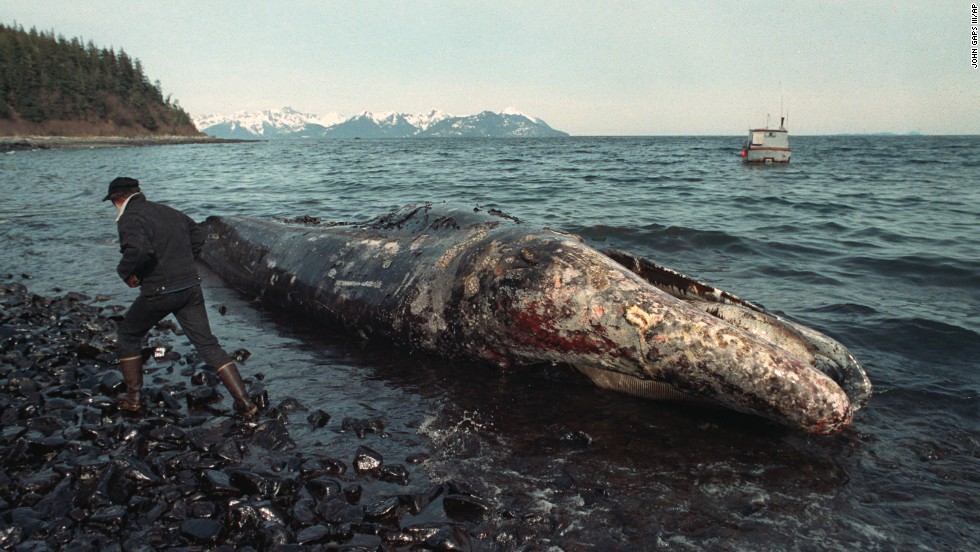
A whale killed by the Exxon Valdea oil spill in Alaska.


On March 23, 1989 the Exxon Valdez, a so-called super tanker outward bound from the Valdez, Alaska oil depot and filled with Prudhoe Bay crude oil, ran aground on a reef spilling about 10.8 million gallons. 
The ship was outside normal shipping lanes due to icebergs in the usual out-bound route.  With Coast Guard permission, it was sailing in the inbound lanes under auto-pilot.  The ship’s radar had been inoperable since leaving port. Captain Joseph Hazelwood, who had been drinking, left the bridge shortly before the accident leaving a junior officer in charge and a seaman at the helm.  Both men were working without required rest when the ship struck the reef just after midnight.  

Capt. Haelwood was drunk and had left the bridge.

While there have been several worse oil releases around the world, until the catastrophe in the Gulf of Mexico in 2010 few, if any, had the devastating environmental impact of this wreck.
The prevailing winds and tides drove the thick oil slick into the rocky coves and shores of Prince William Sound contaminating one of the world’s richest natural fisheries teaming with marine mammals, abundant water fowl, and avian raptors.  The remoteness of the location made bringing in the booms, skimmers, and other customary equipment to isolate and contain a spill difficult.  When equipment finally did arrive it was too little too late.  A coat of tar-like crude inches thick was born ashore contaminating mile after mile of shore line. 
Despite on-shore rescue and clean-up efforts that ultimately involved 11,000 workers and volunteers, wild life was devastated.  Up to a quarter million sea birds, 2000 sea otters, 300 harbor seals, 247 bald eagles, and 22 orca whales were killed.  The red salmon fishery lost most of that season’s eggs, and the population has remained stunted almost 30 years later.  

Clean up effort were slow to start but involved massive manpower, but the damage had been done/

Litigation against Exxon and the crew has dragged on for years with Exxon stubbornly fighting for ever greater reductions in an original $5 billion punitive damage award—the equivalent of one year of profit for the giant oil company at the time.  An account of the case and its many appeals is too tedious—and disheartening—to report here.  Suffice it to say that the Supreme Court ultimately decided that punitive awards could not exceed the compensatory damages in the suit, calculated at $507.5 million.  Even figuring in perhaps hundreds of millions of dollars in legal fees fighting the case, Exxon walked away with a slap on the wrist.  

Twenty-five years latter oil was still trapped under a thin layer of sand on Prince William Sound, among the rocks, and on the sea bed.

Of course there were separate civil and criminal findings amounting to a billion or so more and Exxon claims it spent $2 billion on the still incomplete clean-up. 
Congress mandated in the Oil Pollution Act of 1990 which was a direct result of the disaster much safer double-hulled tankers replace the single-hull fleet.  But shippers were given until 2015 to complete the transition.  At the end of December last year the old tankers were officially banned for use as petroleum transports, although those still afloat could be cleaned and used to transport other liquids.   But other transports and large ships which can carry significant amounts of oil either as cargo or as fuel are still single hulled.  Several accidents to such ships have resulted in spill, but nothing on the epic scale of the Exxon Valdez.
Modern double-hulled super tankers are not immune from accidents or from spills.  But experience has show that they are effective in preventing leaks, or when the inner-hull has been damaged as well, in limiting the spill outside of the ship.  But experts warn that a complete break up of a ship in a severe storm, catastrophic collision, an act of war or sabotage could still cause another ecological disaster.