Showing posts with label game show. Show all posts

Saturday, September 3, 2022

Will the Mystery Guest Sign In Please

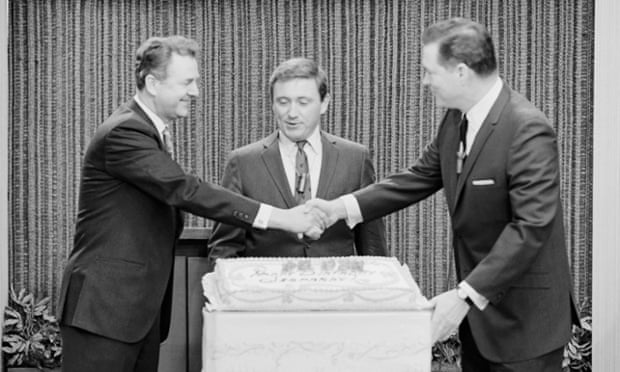
John Charles Daly with the What's My Line? panel in 1950 after poet Louis Uttermeyer was ousted by the sponsor and replaced with publisher Bennett Cerf.  Gossip columnist Dorothy Kilgallen had been with the show from the start.  Broadway actress Arlene Frances--soon to become a blonde--stayed with the show through the entire run and on the 1970s syndication run.  Comedy writer Hal Block would depart in 1953 and the "comics seat" would be occupied by Steve Allen and then radio star Fred Allen.

On September 3, 1967 What’s My Line, the longest running game show in the history of prime time television, ended a 17 year run on CBS, all but the first few months in the same familiar Sunday nighttime slot.  And for all 17 years the program was hosted by the suave, but sometimes superciliousJohn Charles Daly, who in that entire run missed only four shows.

The Irish American Daly was born in 1914 in South Africa where his father was working as an engineer.  After the senior John Charles died of a tropical illness the family returned to its roots in Boston.  He was educated at the Tilton School, a progressive boarding school in Tilton, New Hampshire and at Boston College, one of the most prestigious American Catholic institutions.  He was particularly devoted to Tilton, on whose board of trustees he served and to which he donated substantial sums for the restoration and preservation of its historic building.  Daly credited his suburb diction and vaguely Mid-Atlantic accent to his training there. 

After a brief stint as a reporter on an NBC station, Daly’s radio career began to take off when he signed on the local Washington, D.C. affiliate where he was soon doing double duty as the network correspondent at Franklin D. Roosevelts White House.  Soon he was regularly introducing Roosevelt’s speeches to the nation.  Late in 1941 he transferred to the network in New York where he became anchor of The World Today broadcast. 

                        John Daly with a hair piece in a publicity photo for CBS radio news in the late 1940s.

He arrived in New York in time to be the first voice that broke the news of the Japanese attack on Pearl Harbor.  Later, he broke the news of F.D.R.’s death.  In between, he broadcast the news from London and was a war correspondent in North Africa and Italy.  After the war in addition to his reporting duties he hosted CBS is There which recreated historical events that were “covered by actual radio reporters.”  That program later became You Were There on television with Walter Cronkite.

After a brief stint as a panelist on a short lived game program producers Mark Goodson and Bill Todman tapped him to host What’s My Line which premiered on February 2, 1950.

In 1953, Daly abandoned CBS news and became Vice President of ABC and the face of its fledgling TV news department anchoring its evening news program.  He became one of the few people to be featured proximately at two networks over a long period.  Daly abruptly resigned in November 1960 when the network chose to run cartoons instead of the first half hour of coverage of the Kennedy-Nixon election

Daly and Quincy Howe anchored ABC News gavel-to-gavel coverage of the 1956 Presidential nominating conventions.  Struggling ABC was was trounced in the ratings by David Brinkley at NBC and Walter Cronkite and Eric Sevareid on CBS.

It would not be the last time Daly resigned on principle.  After the end of the What’s My Line’s run, he was appointed Director of the Voice of America but quit after a few months on the job because the head of the U.S. Information Agency made personnel changes without consulting him. 

After that Daly retired.  He died at the age of 77 in Chevy Chase, Maryland on February 24, 1991 leaving behind his second wife, the former Virginia Warren, daughter of Chief Justice of the Supreme Court Earl Warren, and six adult children from his two marriages.

What’s My Line, under Daly’s stewardship, was a quintessential New York show.  Its celebrity panelists were for the most part not Hollywood or music industry types.   The members of the panel on the first show were poet Louis Untermeyer, former New Jersey Governor Harold Hoffman, psychiatrist Richard Hoffman, and Dorothy Kilgallen, a gossip columnist for the New York Journal-American.  Kilgallen remained a regular on the panel until her death in 1965 at the age of 52.

Soon a regular panel included Untermeyer, Kilgallen, Broadway actress Arlene Frances, and comedy writer Hal Block.  Frances remained on the show the rest of the run and into a later syndicated version, wearing the same heart shaped diamond pendent for every show. 
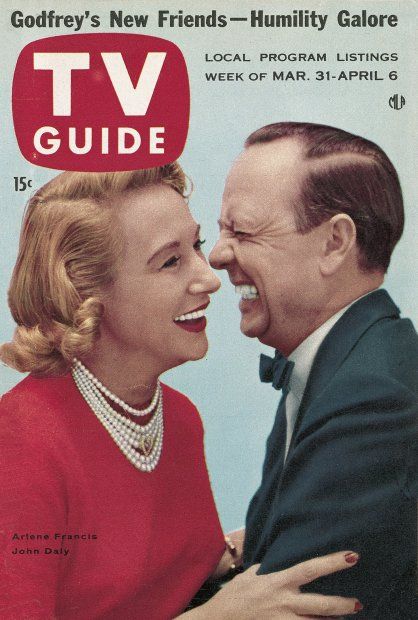
Daly and Arlene Frances on the cover of TV Guide, by far the best selling magazine of the 1950's.  Frances was almost as much the face of  What's My Line? as Daly.

Untermeyer was swept up in the anti-Communist hysteria of the period and was forced off the show over the objections of Daly and the producers at the instance of the sponsorStopette deodorant.  The poet’s place on the panel was taken by publisher Bennett Cerf of Random House.  Cerf also stayed on the program the rest of its time on the air and appeared on the syndicated version until his death in 1971 at age 73. 

Block left the show in 1953 and the comics spot on the panel was filled for a year by Steve Allen and then by the acerbic Fred Allen until his death in 1956.  After that the fourth spot was not regularly filled but frequent panelists include Frances’s husband Martin GableOrson Bean, and sometimes by regular panelists on other Goodson-Todman programs like Betsy PalmerBess Myerson, and Robert Q. Lewis.

Daly ran the show with a certain dignity and formality.  He always referred to the panelists as Mr. or Miss.  After 1953 he insisted the dress code be more formal.  Gentlemen wore black dinner jackets and bow ties.  The ladies were in formal gowns, and frequently white gloves.

About the only thing that changed on the show was the set.  New sponsors would have their names emblazoned on the panel’s desk.  The moderator’s background changed from paneling to drapes and back again.  But the game remained the same.

The show's 15 anniversary on CBS was celebrated by this cartoon featuring Daly and regular panelists Killgalen, Francis, and Cerf. 

Daly would invite contestants to “sign in please” on an ordinary blackboard.  In the earliest shows they would parade in front of the panel who were invited to make wild guesses as to their occupation, but later they came directly to Daly, who rose to greet them.  Contestants who could stump the panel for 10 questions could win a whopping $50 and a slice of immortality.  A panelist could ask a question until he or she got a “no” for an answer, causing Daly to flip over a low tech card on his desk and move to the next panelist.  Essentially it was just a version of the old parlor game 20 questions.  The entertainment came from repartee between the panel and Daly, Daly’s sometimes convoluted attempts to clarify a contestant’s answer, and the occasional accidental double entendres of the panelists guesses.

The most popular feature was the Celebrity Guest.  With the panel blindfolded—the women’s masks often adorned in rhinestones—the famous personage would sign in to inevitable cheers from the studio audience.  The panel followed the same procedures to guess his or her identity.  Well known stars often tried to disguise their famous voices. Almost all major Hollywood and Broadway stars, as well as recording artists appeared at one time or another.  But Celebrity Guests also included the likes of Eleanor RooseveltFrank Lloyd Wright, and Salvador Dali.

Fred Astaire was just one of the top celebrity mystery guests,  A panelist's question has just broken up Daly.

In 1967 CBS announced it was cancelling all of their long running nighttime game shows in an attempt to appeal to a younger audience.  On the final show old clips were shown and former panelists brought back for a visit.  The last mystery guest was…. John Charles Daly.

Goodson and Todman revived the show for daily syndication in 1968 and it ran successfully until 1975 hosted first by Wally Bruner and then by Larry Blyden.  It frequently ran in the half hour between the network news casts and prime time programming.  Despite its success, the syndicated version is barely remembered today.

Actor Larry Blyden was the final host of the daily syndicated revival of the show until his death in an auto accident in 1975,  In quintessential '70s attire with Lenard Nimo in a leisure suit and Blyden in a wide lapel peach suit and matching tie--a long way from the dignified formality under Daly. 

But the original show continued to attract audiences on the Game Show Network (GMS). For a while I frequently find myself chuckling along with John Daly and Bennett Cerf in the wee small hours of the morning when I surely should be asleep.  Many clips are also available on YouTube. 

Tuesday, November 10, 2020

Final Jeopardy—The Answer is the Most Beloved Game Show Host

A few years ago Alex Trebek showed of the Day Time Emmy Awards that he and the show  had won.  Many more since then.  Among many other honors Trebek especially cherished his Peabody Award.
 

Amid the celebration of the deliverance of democracy and decency 2020 slapped us once again alongside the head.  On Monday came word that the long-time host of Jeopardy! Alex Trebek died peacefully at his home after a valiant and public two year battle with stage 4 pancreatic cancer. He was 80 years old.

Trebek was not just a departed celebrity to be remembered in the In Memorium reels at the end of the year and on next year’s Emmy Awards—he was a cultural icon who was an important part of the lives of so many of us.  It was almost a personal relationship that transcended the separation of the TV screen.  I was one of those people, as anyone familiar with my love of trivia would suspect.

I was a fan of the original run of the show hosted by Art Flemming from the beginning of its run in 1964 watching it and playing along whenever I was home from school.  When Trebek took over a high-tech remount of the program in syndication twenty years later I likewise made sure to catch it whenever my work schedule permitted it.  When we finally got a TV with a DVR, I recorded the shows to watch when I got off the bus from Woodstock every afternoon.  In the two years of my retirement my daily schedule revolves around the program’s 3:30 air time on Chicago’s Channel 7.  I would get mightily annoyed if the show was preempted by some breaking news lie a mass shooting or chasing the Black Cowboy on his Pinto down Lakeshore Drive.  Worse was when Illinois Governor J.B. Pritzker’s daily Coronavirus news conferences ran long.  Catastrophically worse was anytime the Cheeto-in-Charge’s antics were the cause.

I was still weak and recovering from gall bladder surgery when Trebek straight forwardly announce that he had stage 4 pancreatic cancer.  He was taking the essentially painful death sentence with much more equanimity than I had with my relatively routine recovery.

Trebek was born in the working class iron mining city of Sudbury, Ontario, Canada on July 22, 1940.  He was the son of George Edward Trebek, a chef who had emigrated from Ukraine as a child, and Lucille LagacĂ©, a Franco-Canadian. He grew up in a bilingual French-English household. He attended Sudbury High School (now Sudbury Secondary School) and then attended the University of Ottawa from which he graduated with a degree in philosophy in 1961.  Later when asked what he studied in college he joked, “Philosophy—I know why I’m here.”  That background also made him the poster boy for a Liberal Arts education at a time when that was under assault. 

Trebek was first interested in a career in TV news but before even completing his degree, he began working part time for the Canadian Broadcasting Corporation (CBC) in 1961.   According to Trebek, “I did everything, at one time replacing every announcer in every possible job.”  He would go on to read the CBC national radio news and cover a wide range of special events for CBC Radio and CBC Television, including curling and horse racing. As Jeopardy! host he always to special delight when curling came up as an answer or a question.


Twenty-three year old Alex Trebec hosted Music Hop on the CBC.

Trebek’s first hosting job was on the teen dance party a la Dick Clark Music Hop in 1963.His career really took off in In 1966 he hosted a high school quiz show called Reach for the Top, a foray into the game show format at which he was especially adept.  Other CBC assignments were classical music programs including performances by Glenn Gould, a weekly skating program and Strategy, a weekday afternoon game show.  Juggling multiple assignments at once from 1971 until the end of 1972, he hosted I’m Here Til 9, the local morning drive radio show on CBC Toronto.

Based on his success and popularity fellow Canadian Alan Thicke invited him to come to the States in 1973 to host a new NBC TV game show he produced, The Wizard of Odds.  In those days many game shows came and went ephemerally.  His first show lasted only one season by he quickly followed up with   High Rollers (which replaced Wizard), from 1974–1976 and again from 1978–1980, and Classic Concentration from 1987–1991. He was so popular that he was the only host with three programs on the air at one time.  In addition there were a dizzying array of other shows and two periods when he hosted game shows in both Canada and the USA.

Trebek took particular pride in his work ethic and boasted in one of his final interviews that he was proud to “have been employed  except for less than six months” since he came to America.  He might have noted that his string of jobs in Canada was uninterrupted since college, too.

In 1984 came the call that would change his life.

Jeopardy! went a long way to making creator, erstwhile big band boy singer and TV impresario Merv Griffin one of the richest men in show business.

The original men of Jeopardy!--Announcer Don Pardo, creator/producer Merv Griffith, and host Art Flemming.

According to Griffin, he was bemoaning the lack of smart question and answer game shows in the aftermath of the quiz show scandals of the ‘50’s.  His wife suggested instead of asking questions, why not give the answers and have the contestants figure out the questions?  It was such a good idea that he sold it to NBC without even producing the customary pilot.

Griffin picked Art Fleming, a strapping 6’4” former college football player and World War II Navy dive bomber pilot to host the show.  Fleming had experience as a radio announcer, TV pitchman—he intoned the famous “Winston tastes good like a cigarette should” catch phrase—and middling actor, but had never hosted a game show.  But he was a natural, both warm and authoritative.

Fleming he never missed a show taping on his watch, which included the NBC daily run from 1964 to 1975, a weekly syndicated version in ’74 and ’75, and a brief revival in ’78-’79. 

While the show went off the air for a while, Griffin was constantly asked when it would come back.  In on March 30, 1984 he launched a new daily syndicated version hosted Trebek,

The new version of Jeopardy! became one of the most successful syndicated programs of all time and is still in production.  Trebek matched and surpassed Fleming’s iron man record hosting every scheduled show for 36 years except for one when he and Pat Sajak of Griffith’s other game show hit Wheel of Fortune swapped places as an April Fool’s joke.

Always the sharp dressed,                                                                                                                             

Over the years the famous answer board became more high tech and the set glitzier.  But the answers are still challenging lots of geniuses-on-the-couch, each of whom believes he could become another Ken Jennings—the boyish Utah geek who racked up 74 consecutive games on the show in 2004—if only he or she could somehow get on the show and master the thumb buzzer.

Trebek’s wide experiences; eclectic and compulsive reading; extensive travel; bilingualism; equal savviness in academic topics, pop culture, and sports; and innate curiosity made him the perfect fit for the most erudite of TV quizzes.  He carefully prepared before each show, reviewing—and sometimes rejecting or re-writing the answers and questions prepared by the show staff.  If he had any doubt or question, he personally researched the issue mostly using his old-school collection of reference books.  On the set he was suave and sophisticated without ever seeming supercilious or condescending.  He was friendly with his guest contestants and seemed genuinely interested in their lives in conversations behand the scenes and as tape rolled.  He had a genuine, ready wit but tried to keep the focus on the game and contestants.

Trebek typically recorded a week’s worth of programs—five games—twice a week including regular games, College and teacher tournaments, celebrity competitions, and Season Tournament of Champions.

He kept up that schedule despite several health problemsheart attacks in 2007and ’12, an injured Achilles tendon from chasing a burglar who had entered his San Francisco hotel room requiring six weeks in a cast, and a subdural hematoma from a fall at his home in 2017. Then in March 2019 Trebek announced his cancer diagnosis and acknowledged it was usually fatal within six months but pledged to try and beat the odds and continue working as long as he could.  He taped periodic health updates afterwards mater-of-factly discussing he health.

Despite having to wear a silver white wig on camera to cover for his chemo-therapy hair loss, views saw little difference in Trebek’s daily work.  But he confided to interviews that he was often in intense pain suffering from the effects of the disease itself, chemo-therapy, and immune system therapy. He sometimes despaired.  But when he put on one of his sharp suites,  knotted his natty tie, and strode confidently onto the set, “it was like a switch turned on,” even if he barely made it back to his dressing room and writhed on the floor in agony.


When the California Coronavirus lock-down forced the show to go into hiatus, Trebek took the time to write the memoirs he once said he would never do.  Alex Trebek The Answer Is...Reflections on My Life was his gift to his fans who he suspected might be in need of something to read in sequestration.

Trebek spent the time at his long-time California home with his second wife of 30 years Jean Currivan, a real estate project manager. They had two children, Matthew and Emily, and Trebek adopted his first wife’s daughter Nicky.  They were a close family and often traveled the world together for enjoyment and in support of his many world-wide charity causes.  At home Trebek was more comfortable in jeans, chambray work shirts, boots, and battered baseball style caps.  He was a master do-it-yourselfer who completed many projects and renovations on his home.  He built and his final moths restored a bench swing on his patio where he would sit for hours with his wife.

Trebek and his wife Jean Currivan.

When the Covid restrictions relaxed, Trebek returned to social distancing redesigned set in August to tape his 36 season of shows.  He and his producers and staff all new it would probably be his last although he just signed a contract renewal through 2022.  In one of the question and answer sessions he regularly held with his audiences one of them asked him who he wanted to replace him, “Betty White,” he said without missing a beat.  Earlier before his diagnosis but when his age was coming into question, he had floated Meredith Vieira who had hosted Who Wants to be a Millionaire as a gender smashing possibility.  The producers may have tipped their hand when at the beginning of the season they announced that all-time Jeopardy! Champ Ken Jennings had been signed in a new role as consulting producer and brand ambassador, a hint that he might be warming up in the bullpen.

Jeopary! champ Ken Jennings may be in line to host the show.

Despite pain and weakness, Trebek continued to tape shows until just two weeks before his death.  His last episode will be shown on December 25Christmas Day. A week or two of shows highlighting best work, it is likely that the program will return with a new host after the first of the year.

Trebek returned to his beloved home and died just as he had hoped, sitting on the swing, holding his wife’s hand, and “watching the horizon.”


Monday, March 30, 2015

I’ll Take Geek Favorites for $50, Art

The original men of Jeopardy!--Anouncer Don Pardo, creator/producer Merv Griffith, and host Art Flemming.


This week you will not be able to turn around without bumping into somebody’s Holy Day.  And speaking of Holy Days, geeks everywhere are celebrating the first presentation of Jeapardy! on March 30, 1964. 
The game show went a long way to making creator, erstwhile big band boy singer and TV impresario Merv Griffin one of the richest men in show business. 
According to Griffin, he was bemoaning the lack of smart question and answer game shows in the aftermath of the quiz show scandals of the ‘50’s.  His wife suggested instead of asking questions, why not give the answers and have the contestants figure out the questions?  It was such a good idea that he sold it to NBC without even producing the customary pilot. 
Griffin picked Art Fleming, a strapping 6’4” former college football player and World War II Navy dive bomber pilot to host the show.  Fleming had experience as a radio announcer, TV pitchman—he intoned the famous “Winston tastes good like a cigarette should” catch phrase—and middling actor, but had never hosted a game show.  He was a natural, both warm and authoritative. 
Fleming he never missed a show taping on his watch, which included the NBC daily run from 1964 to 1975, a weekly syndicated version in ’74 and ’75, and a brief revival in ’78-’79.  

A few years ago Alex Trebek showed of the Day Time Emmy Awards that he and the show  had won.  Many more since then.


While the show went off the air for a while, Griffin was constantly asked when it would come back.  In 1984 he launched a new daily syndicated version hosted by Canadian Alex Trebek, a handsome host with long experience as a game show emcee on both sides of the border.
Jeapardy! became one of the most successful syndicated programs of all time and is still in production with Trebek as host. 
Over the years the famous answer board has become more high tech and the set glitzier.  But the answers are still challenging lots of geniuses-on-the-couch, each of whom believes he could become another Ken Jennings—the boyish Utah geek who racked up 74 consecutive games on the show in 2004—if only he could somehow get on the show and master the thumb buzzer. 

While the show went off the air for a while, Griffin was constantly asked when it would come back.  In 1984 he launched a new daily syndicated version hosted by Canadian Alex Trebek, a handsome host with long experience as a game show emcee on both sides of the border.
Jeapardy! became one of the most successful syndicated programs of all time and is still in production with Trebek as host. 
Over the years the famous answer board has become more high tech and the set glitzier.  But the answers are still challenging lots of geniuses-on-the-couch, each of whom believes he could become another Ken Jennings—the boyish Utah geek who racked up 74 consecutive games on the show in 2004—if only he could somehow get on the show and master the thumb buzzer.  

Game show grand master Kee Jennings, quick on the plunger....

And now your Final Jeopardy Answer is:  Brad Rutter.  You have thirty seconds.   Make sure your response is in the form of a question.