Showing posts with label internal combustion engine. Show all posts

Wednesday, July 3, 2024

The Real Beginning of the Automobile Age and a Woman Driver


Karl Benz, creator of the first modern internal combustion engine automobile, demonstrates a prototype Motorwagen.

On July 3, 1886 inventor Karl Benz rolled his latest creation, the Benz Patent-Motorwagen, a light weight three wheeled carriage powered by an internal combustion engine of his own design onto the streets of Manheim for its first public demonstration.

There had been self-propelled road vehicles since Nicolas-Joseph Cugnots lumbering Fardier à vapeur, a heavy cart built to haul artillery for the French Army in 1769.  Since then dozens of steam powered vehicles had been built and/or proposed.  By the 1880’s Amédée Bollée of Le Mans was producing large, multi-passenger coaches and de Dion & Bouton were turning out light weight tri and quadricycles.  But Benz’s gasoline powered Motorwagan is considered the first modern automobile and the direct ancestor of all that came that came after.  

Benz's heiress wife Bertha financed her husband's inventions and we a shrewd businesswoman in her own right.

Benz, a successful engineer and developer of stationary engines for industrial applications, was financed by his heiress wife Bertha, a woman of strong mind and keen intellect in her own right who would be deeply involved in advising her husband on business matters.  Benz’s German patent dated from his application on January 29 of that year.

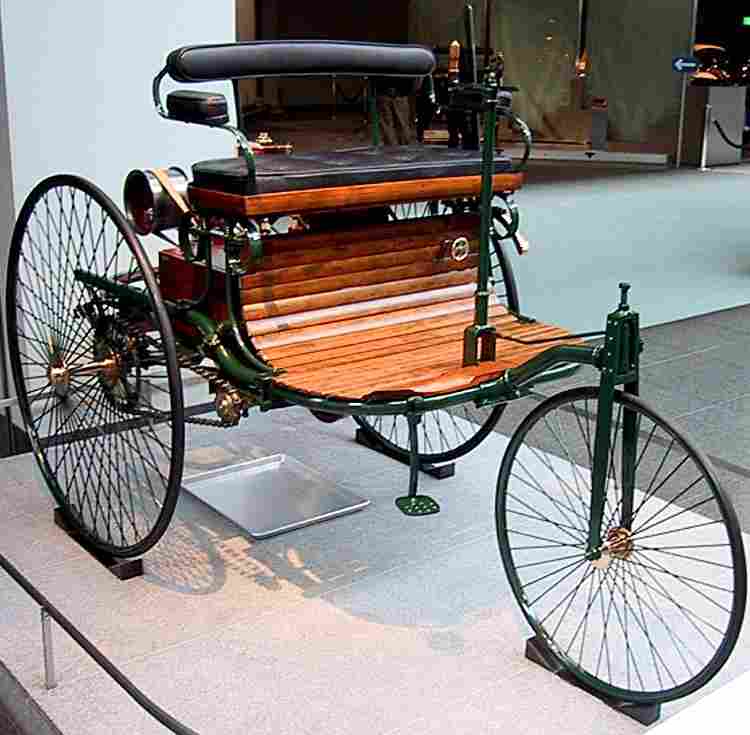
Key to the tricycle was the light weight gasoline powered two-stroke piston engine that he had patented back in 1873.  The version he mounted on his Motorwagen was a  954 cc single-cylinder four-stroke engine with trembler coil ignition which produced 2⁄3 horsepower (hp) 250 rpm—about the same power as a modern walk-behind self-propelled lawnmower engine.  But it was powerful enough to propel the very light vehicle built on a tubular steel frame with thin wood panels.  Each of the three wheels, specially designed by Benz, had wire steel spokes and hard rubber tires.  The freely rotating single front wheel was steered by a tiller by a driver seated in front of the engine.

A museum replica of the Patent Moterwagan.

The engine drove the two rear wheels with a chain drive on both sides. A simple belt system served as a single-speed transmission, varying torque between an open disc and drive disc. A large horizontal flywheel stabilized the engine power output.

That first put-putting prototype strikes us as not quite finished.  There was an open crankcase  into which oil dripped from an open pan on critical moving parts.  Similarly there was neither a sealed gas tank as we know it nor a carburetor.  Gasoline (or another suitably combustible fluid) dripped from a small reservoir into a basin of soaked fibers that supplied a vapor to the cylinder by evaporation.  There were also no brakes.

But Benz was not finished tinkering.  Over the next year he built two more improved models.  By the time of his Model 3 Motorwagen, it was powered by a new 2 hp engine capable of getting the vehicle up to a dizzying 10 miles per hour.  It also had a real carburetor, gas tank, and manually operated brakes on the rear wheels.

All of these prototypes were all well and good, but perhaps Mrs. Benz was a trifle anxious for her investment to start paying off with sales.  She recognized that the public interest had been piqued but was far from convinced that the Motorwagen was a practical means of transportation.  The shrewd and intrepid Bertha realized something more dramatic needed to be done.

Bertha Benz and her teenage sons posed for a photo, seen here tinted, recreating the beginning of her historic drive.

In early August 1888 supposedly without her husband’s permission—some historians doubt this claim—she gathered up her two sons, ages 15 and 14 and took the Model 3 out for a spin.  A trip actually, all the way from Mannheim to her mother’s home in Pforzheim a about 60 miles away.  The drive took her through the streets of Heidelberg and Wiesloch.  The sight of a woman and two children zipping through the streets in a noisy, smoky contraption with no horse naturally attracted considerable attention.

Bertha was not only the driver and navigator, but the mechanic as well.  When the carburetor clogged, she had no problem clearing it with her hat pin and she used her garter to insulate an exposed wire.  When fuel ran low and no gasoline was available she purchased ligroin, a petroleum ether related to benzene, at the Wiesloch municipal pharmacy.  Later when the wooden block of her brakes wore down, she found a cobbler to nail strips of leather on them, thus inventing brake pads on the fly.

Bertha made it safely to her mother’s by evening and sent husband a famous telegram explaining her whereabouts and how she got there.  The next morning she drove home.  She had proved the automobile was a reliable transportation option and that it could even be operated by an unsupervised woman.  And as she hoped, the trip generated sales.

Afterwards her husband, at Bertha’s suggestion, made brake pads standard equipment and added a second gear for aid in climbing hills.

An early ad for the Patent-Motorwagen featured an illustration of Benz at the tiller.

Over the next few years until 1893 about 25 Motorwagens were built and sold before Benz moved on to more sophisticated models.

Three years before Karl Benz died in 1929 he merged his Benz & Cie company with Gottlieb Daimlers Daimler-Motoren-Gesellschaft to form what would become Mercedes-Benz.

Bertha Benz’ investment paid off.  When she died at age 95 in 1944 she was a very wealthy woman indeed.

The route she took on her memorable 1888 drive has been named the Bertha Benz Memorial Route.


Friday, July 3, 2020

The Real Birth of the Automobile Age and a Woman Driver

Karl Benz, creator of the first modern internal combustion engine automobile.
On July 3, 1886 inventor Karl Benz rolled his latest creation, the Benz Patent-Motorwagen, a light weight three wheeled carriage powered by an internal combustion engine of his own design onto the streets of Manheim for its first public demonstration.
There had been self-propelled road vehicles since Nicolas-Joseph Cugnot’s lumbering Fardier à vapeur, a heavy cart built to haul artillery for the French Army in 1769.  Since then dozens of steam powered vehicles had been built and/or proposed.  By the 1880’s Amédée Bollée of Le Mans was producing large, multi-passenger coaches and de Dion & Bouton were turning out light weight tri and quadricycles.  But Benz’s gasoline powered Motorwagan is considered the first modern automobile and the direct ancestor of all that came that came after. 

Benz's heiress wife Bertha financed her husband's inventions and we a shrewd businesswoman in her own right.
Benz, a successful engineer and developer of stationary engines for industrial applications, was financed by his heiress wife Bertha, a woman of strong mind and keen intellect in her own right who would be deeply involved in advising her husband on business matters.  Benz’s German patent dated from his application on January 29 of that year.
Key to the tricycle was the light weight gasoline powered two-stroke piston engine that he had patented back in 1873.  The version he mounted on his Moterwagen was a  954 cc single-cylinder four-stroke engine with trembler coil ignition which produced 2⁄3 horsepower (hp) 250 rpm, producing about the same power as a modern walk-behind self-propelled lawnmower engine.  But it was powerful enough to propel the very light vehicle built on a tubular steel frame with thin wood panels.  Each of the three wheels, specially designed by Benz, had wire steel spokes and hard rubber tires.  The freely rotating single front wheel was steered by a tiller by a driver seated in front of the engine.

A museum replica of the Patent Moterwagan 
The engine drove the two rear wheels with a chain drive on both sides. A simple belt system served as a single-speed transmission, varying torque between an open disc and drive disc. A large horizontal flywheel stabilized the engine power output.
That first put-putting prototype strikes us as not quite finished.  There was an open crankcase.  Into which oil dripped from an open pan on critical moving parts.  Similarly there was neither a sealed gas tank as we know it or a carburetor.  Gasoline (or another suitably combustible fluid) dripped from a small reservoir into a basin of soaked fibers that supplied a vapor to the cylinder by evaporation.  There were also no brakes.
But Benz was not finished tinkering.  Over the next year he built two more improved models.  By the time of his Model 3 Moterwagen, it was powered by a new 2 hp engine capable of getting the vehicle up to a dizzying 10 miles per hour.  It also had a real carburetor, gas tank, and manually operated brakes on the rear wheels.
All of these prototypes were all well and good, but perhaps Mrs. Benz was a trifle anxious for her investment to start paying off with sales.  She recognized that the public interest had been piqued, but was far from convinced that the Moterwagen was a practical means of transportation.  The shrewd and intrepid Bertha realized something more dramatic need be done.

Bertha Benz and her teenage sons posed for a photo, seen here tinted, recreating the beginning of her historic drive.
In early August 1888 supposedly without her husband’s permission—some historians doubt this claim—she gathered up her two sons, ages 15 and 14 and took the Model 3 out for a spin.  A trip actually, all the way from Mannheim to her mother’s home in Pforzheim, a trip of about 60 miles which took her through the streets of Heidelberg and Wiesloch.  The sight of a woman and two children zipping through the streets in a noisy, smoky contraption with no horse naturally attracted considerable attention.
Bertha was not only the driver and navigator, but the mechanic as well.  When the carburetor clogged, she had no problem clearing it with her hat pin and she used her garter to insulate an exposed wire.  When fuel ran low and no gasoline was available she purchased ligroin, a petroleum ether related to benzene, at the Wiesloch municipal pharmacy.  Later when the wooden block of her brakes wore down, she found a cobbler to nail strips of leather on them, thus inventing brake pads on the fly.
Bertha made it safely to her mother’s by evening and sent husband a famous telegram explaining her whereabouts and how she got there.  The next morning she drove home.  She had proved the automobile was a reliable transportation option and that it could even be operated by an unsupervised woman.  And as she hoped, the trip generated sales.
Afterwards her husband, at Bertha’s suggestion made brake pads standard equipment and added a second gear for aid in climbing hills.

An early ad for the Patent-Motorwagen featured an illustration of Benz at the tiller.
Over the next few years until 1893 about 25 Moterwagens were built and sold before Benz moved on to more sophisticated models.
Three years before Karl Benz died in 1929 he merged his Benz & Cie company with Gottlieb Daimler’s Daimler-Motoren-Gesellschaft to form what would become Mercedes-Benz.
Bertha Benz’ investment paid off.  When she died at age 95 in 1944 she was a very wealthy woman indeed.
The route she took on her memorable 1888 drive has been named the Bertha Benz Memorial Route.

Wednesday, January 10, 2018

The Gusher that Changed the World —Spindletop

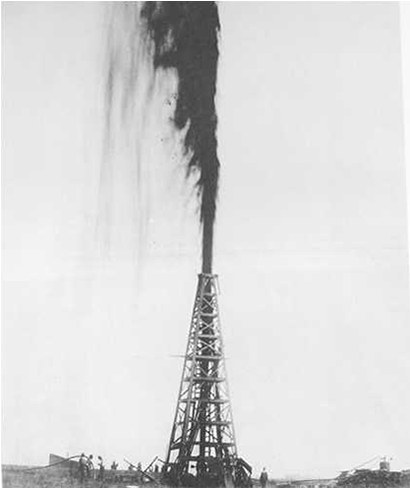
The Lucas Gusher at /spindletop Hill south of /Beaumont, Texas in 1901.  Photo by John Trost.
On January 10, 1901 after almost nine years of poking useless holes into a salt dome formation near Beaumont, Texas in the southeast corner of the state near the Louisiana line and Gulf Coast some nearly busted and discouraged wildcatters watched in amazement as oil geysered 150 feet in the air from a well head at a rate of 100,000 barrels per day. It took nine days before the well was brought under control.  When the well began pumping instead of spewing an oil boom was set off around the Gulf Coast, an industry was disrupted and transformed, and the door was opened to the age of the automobile for better or for worse.
The petroleum industry got its start in 1859 when Colonel Edwin L. Drake struck rock oil at Titusville, Pennsylvania.  It grew rapidly after the Civil War based on demand for a replacement of whale oil as a lamp fuel—coal oil or kerosene—lubricants for the railroads and other rapidly expanding industries, and eventually as a heating fuel.  Oil quickly became one of the most valuable commodities in the U.S.

A ruthless genius, John D. Rockefeller worked his way up from an assistant clerk to the world's first billionaire by creating  the first all-compassing Trust, Standard Oil.  He gleefully ruined competitors and ran roughshod over the law eventually raising public outrage to a fever pitch.  Late in life he sought to transform his personal image through ostentatious philanthropy.

By the late 1870 John D. Rockefeller and his partners dominated the oil industry via a spider web of companies centered on his Standard Oil of Ohio.  In 1882 those companies were consolidated into the nation’s first all-powerful Trust under the holding company, Standard Oil of New Jersey.  It controlled virtually all production, distribution, and sales of oil products and quickly used its power to ruthlessly destroy upstart competitors, drive prices high, and evade state laws intended to regulate it. 
Public outrage, spurred by the work of muckraking journalists, led to the passage of the Sherman Anti-Trust Act which regulated or outlawed many of Standard Oil’s business practices illegal under Federal Law.  Under siege, legions of lawyers fought enforcement for years.  It was not until 1911 that the courts finally ordered the break-up of Standard Oil into regional companies.
Meanwhile production in Pennsylvania peaked around 1890.  Exploration led to new fields, but satisfied with the high prices of restricted supply Standard officials were slow to expand exploration to the West and South.  Even if they had wanted to, its business practices had so stirred up Populist resentment in the Midwest and West.  Sentiment was riding so high against the company that Texas barred Standard Oil from operating in the state in 1900.  The door was ajar.
Everyone knew there was oil around the Gulf where it bubbled to the surface in several areas on land, in swampy bayous, and even in Gulf watersNative Americans had long used it as a salve and medicineHuckster showmen were mixing it with alcohol and sometime cocaine to peddle by the bottle as patent medicine.  The trick was finding ways to extract the oil in quantity economically enough to compete with Standard Oil.
Enter the wildcatters who took their name from the Wildcat banks of the Jacksonian Era which fraudulently issued banknotes with little or no capital to back them up.  Similarly independent oil speculators formed companies, sold stock, and borrowed money to finance their operations.  The vast majority of the wildcatters went bankrupt, often multiple times taking down their investors and creditors with them.
One armed wildcatter Pattillo Higgins was a colorful scoundrel of a different sort--founder of fly-by-night-companies and a former cop killer.

In August 1892, George W. O’Brien, George W. Carroll, Pattillo Higgins and others formed the Gladys City Oil, Gas, and Manufacturing Company to drill on Spindletop Hill. They sunk nothing but dry holes and were soon being hounded by irate investors.  Money dried up.  Higgins, a one armed rascal—he had lost the arm in a shootout with a deputy sheriff which left the lawman dead after trying to torch a Black Baptist church—left the group and sought new backers and partners.  A he found Croatian born Capt. Anthony F. Lucas, an expert in salt domes who agreed with his assessment that there was oil under the hill.  In 1899 the new partners began to drill again, but the light equipment Lucas used collapsed when they reached a depth of 575.  So did their their credit.
Instead Lucas cut a new deal for backing with Pittsburgh investors James M. Guffey, who held and controlled funds, and John H. Galey that left him with a minority stake and cut out Higgins entirely.  Lucas resumed drilling in October 1900 with an experienced crew. 

Higgins's erstwhile partner, Serbian born engineer Antthony F. Lucas a/k/a Antun Lucic brought in the gusher at Spindletop named for him but was soon forced out by his Eastern banker partners.

It was a difficult drill through unsteady sand but on January 10 the crew of roughnecks was sent scurrying for their lives as a six ton, four-inch drilling pipe shot out of the hole.  Officially named Lucas #1 but usually called the Lucas gusher, the success of the well set off a stampede of exploration on Spindletop which rapidly spread to other Gulf sites in Texas and Louisiana.  The Oil Boom was on.
The single well produced around 100,000 barrels a day. The population of Beaumont mushroomed from 8,000 to 60,000 within a year. By 1902 285 wells were operating on Spindletop Hill and over 600 oil companies had been chartered. Lucas, a minority partner, did not share in the bonanza of wealth produced by the well.  He was forced out of the company leaving it in the hands of the Eastern investors by the end of the year.
Higgins for his part sued Lucas and his former partners claiming that he still held the valid lease on the mineral rights of the well.  The complicated case dragged out in the courts but in 1903 Higgins was essentially paid off with $3 million to go away.  He went on to found other oil companies, usually quarreling with his partners and leaving before the wells could produce much revenue. 
The Oil Boom came at an auspicious moment.  It assured what seemed like unlimited supplies of cheap oil just as the infant automobile industry was about to take off.  Heretofore scores of small companies had been founded the most successful of which hand built a dozen or so cars a year for sale to the rich in search of new toys and ways to display their wealth.  But the matter of how automobiles would be powered was far from settled.  Several companies were producing battery powered electric cars and steam still looked like a viable option.  The prospect of cheap gasoline tipped the scales to internal combustion engines.
In 1903 the Curved Dash Olds became the first successfully mass marketed car.  Soon several companies with familiar names were turning out luxury cars—Cadillac, Packard, and Buick among them.  Henry Ford entered the market with his inexpensive assembly line produced Model T in 1908 which put motoring within the reach of the middle class and within a few years even blue collar workers.  By 1920 millions of vehicles were on the road, city streets were being paved, and a haphazard web of interconnecting highways was being developed.  America was on wheels and powered by gasoline.

Just 18 months after the Lucas strike, Spindletop Hill was a forest of derricks operated by dozens of wildcatters and speculative companies.  Within five years almost all would be absorbed into powerful new petroleum companies competing with Standard Oil

All of the wealth produced by this boom was not destined to stay in the hands of small time operators like Higgins and Lucas and the others that followed them to Spindletop and to a succession of oil boom towns from Tampico in Mexico to the Texas interior and Oklahoma up to Wyoming and out in California.  Sometimes led by an astute oil man but more frequently by bankers and Wall Street investors the small firms were gobbled up and linked to refineries and distribution systems.  Out of Spindletop and surrounding oil fields Gulf Oil and Texaco were formed and were soon competing with Standard Oil and after the Federal break-up its still powerful regional descendents.  In post World War I America branded gas stations became a national fixture.
The story of Spindletop also influenced pop culture.  The 1940 MGM classic Boom Town starring Clark Gable, Spencer Tracy, Claudette Colbert, Heddy Lamarr, and Frank Morgan was largely inspired by Higgins and Lucas.  Edna Ferber’s novel Giant and the 1956 Warner Bros. epic movie starring Rock Hudson, Elizabeth Taylor, and James Dean partially modeled the bitter and jealous character Jeff Rinks on Higgins.  More recently the Academy Award winning 2008 film There Will Be Blood based on Upton Sinclair’s muckraking novel Oil! Starring Daniel Day Lewis also drew inspiration from Spindletop.

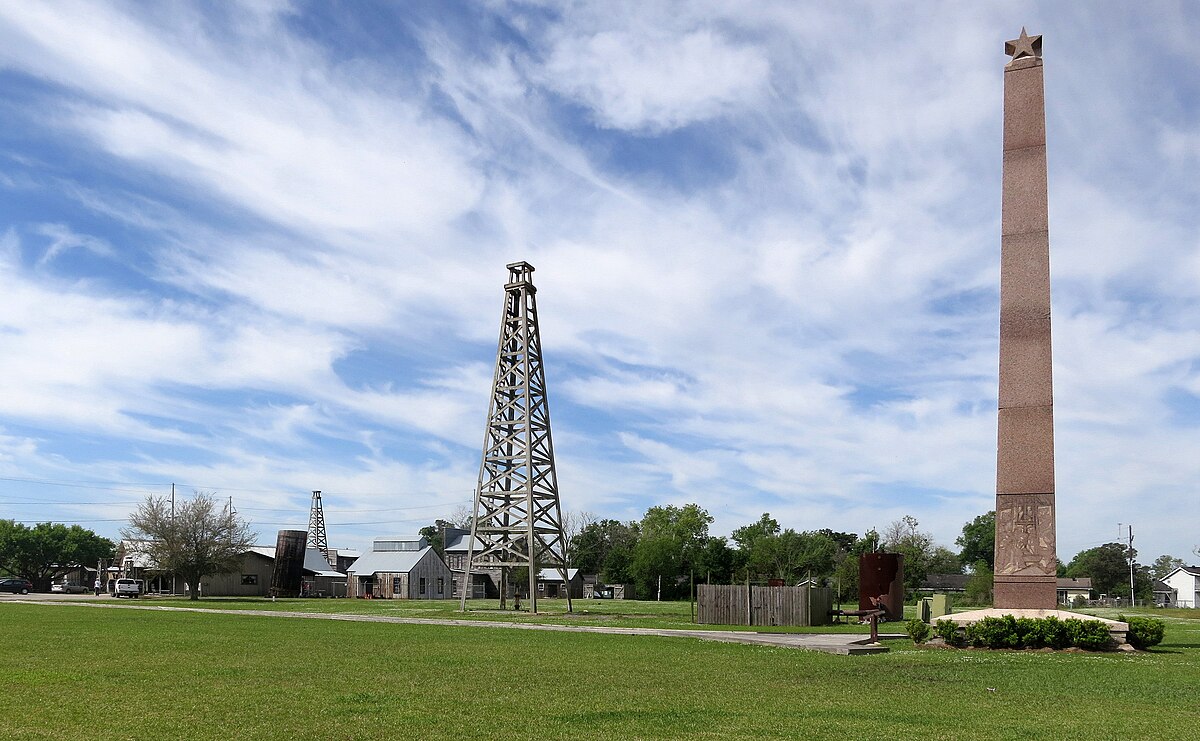
A model of the oriinal derrick and a Lone Star topped obelisk monument to Lucas are te central attractions of the Spindletop Gladys City Boomtown Museum in Beaumont.

The
Lucas Gusher Monument is a nearly 60 foot tall obelisk topped by a Texas Lone Star  was erected at the site of the original well head in 1941.  In 1977 it was moved to the Spindletop Gladys City Boomtown Museum in Beaumont near a reproduction of the original oil derrick.  Today a flag pole marks the original well.

Friday, July 3, 2015

The Dawn of the Age of the Automobile Age

Karl Benz, creator of the first modern internal combustion engine automobile.


On June 3, 1886 inventor Karl Benz rolled his latest creation, the Benz Patent-Motorwagen, a light weight three wheeled carriage powered by an internal combustion engine of his own design onto the streets of Manheim for its first public demonstration.
There had been self-propelled road vehicles since Nicolas-Joseph Cugnot’s lumbering Fardier à vapeur, a heavy cart built to haul artillery for the French Army was built in 1769.  Since then dozens of steam powered vehicles had been built and/or proposed.  By the 1880’s Amédée Bollée of Le Mans was producing large, multi-passenger coaches and de Dion & Bouton were turning out light weight tri and quadricycles.  But Benz’s gasoline powered Motorwagan is considered the first modern automobile and the direct ancestor of all that came that came after. 
Benz, a successful engineer and developer of stationary engines for industrial applications, was financed by his heiress wife Bertha, a woman of strong mind and keen intellect in her own right who would be deeply involved in advising her husband on business matters.  Benz’s German patent dated from his application on January 29 of that year.

A museum replica of the Patent Moterwagan


Key to the tricycle was the light weight gasoline powered two-stroke piston engine that he had patented back in 1873.  The version he mounted on his Moterwagen was a  954 cc single-cylinder four-stroke engine with trembler coil ignition which produced 2⁄3 horsepower (hp) 250 rpm, producing about the same power as a modern walk-behind self-propelled lawnmower engine.  But it was powerful enough to propel the very light vehicle built on a tubular steel frame with thin wood panels.  Each of the three wheels, specially designed by Benz, had wire steel spokes and hard rubber tires.  The freely rotating single front wheel was steered by a tiller by a driver seated in front of the engine.
The engine drove the two rear wheels with a chain drive on both sides. A simple belt system served as a single-speed transmission, varying torque between an open disc and drive disc. A large horizontal flywheel stabilized the engine power output.
That first put-putting prototype strikes us as not quite finished.  There was an open crankcase.  Into which oil dripped from an open pan on critical moving parts.  Similarly there was neither a sealed gas tank as we know it or a carburetor.  Gasoline (or another suitably combustible fluid) dripped from a small reservoir into a basin of soaked fibers that supplied a vapor to the cylinder by evaporation.  There were also no brakes.
But Benz was not finished tinkering.  Over the next year he built two more improved models.  By the time of his Model 3 Moterwagen, it was powered by a new 2 hp engine capable of getting the vehicle up to a dizzying 10 miles per hour.  It also had a real carburetor, gas tank, and manually operated brakes on the rear wheels.
All of these prototypes were all well and good, but perhaps Mrs. Benz was a trifle anxious for her investment to start paying off with sales.  She recognized that the public interest had been piqued, but was far from convinced that the Moterwagen was a practical means of transportation.  The shrewd and intrepid Bertha realized something more dramatic need be done.

Bertha Benz and her sons recreate the beginning of her famous road trip.

In early August 1888 supposedly without her husband’s permission—some historians doubt this claim—she gathered up her two sons, ages 15 and 14 and took the Model 3 out for a spin.  A trip actually, all the way from Mannheim to her mother’s home in Pforzheim, a trip of about 60 miles which took her through the streets of Heidelberg and Wiesloch.  The sight of a woman and two children zipping through the streets in a noisy, smoky contraption with no horse naturally attracted considerable attention.
Bertha was not only the driver and navigator, but the mechanic as well.  When the carburetor clogged, she had no problem clearing it with her hat pin and she used her garter to insulate an exposed wire.  When fuel ran low and no gasoline was available she purchased ligroin, petroleum ether related to benzene, at the Wiesloch municipal pharmacy.  Later when the wooden block of her brakes wore down, she found a cobbler to nail strips of leather on them, thus inventing brake pads on the fly.
Bertha made it safely to her mother’s by evening and sent husband a famous telegram explaining her whereabouts and how she got there.  The next morning she drove home.  She had proved the automobile was a reliable transportation option and that it could even be operated by an unsupervised woman.  And as she hoped, the trip generated sales.
Afterwards her husband, at Bertha’s suggestion made brake pads standard equipment and added a second gear for aid in climbing hills.

An early ad for the Moterwagen.

Over the next few years until 1893 about 25 Moterwagens were built and sold before Benz moved on to more sophisticated models. 
Three years before Karl Benz died in 1929 he merged his Benz & Cie company with Gottlieb Daimler’s Daimler-Motoren-Gesellschaft to form what would become Mercedes-Benz.
Bertha Benz’ investment paid off.  When she died at age 95 in 1944 she was a very wealthy woman indeed.
The route she took on her memorable 1888 drive has been named the Bertha Benz Memorial Route.