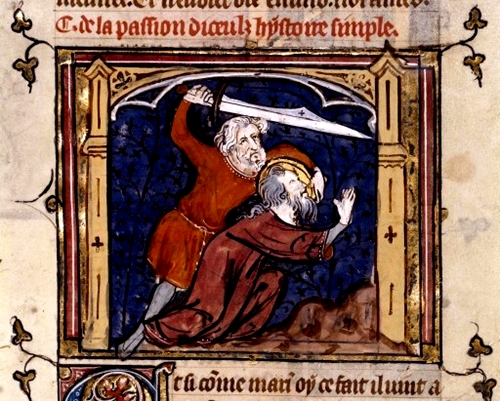
So just what do we know about this St. Valentine whose feast day is the occasion of all of today’s romantic hoopla? Absolutely nothing, nada, zilch. A Valentine was evidently venerated in the very early Latin Church and likely a martyr. The name appears in the rolls of the Martyrologium Hieronymianum which was compiled from older and mostly lost local documents between 460 and 544. In 496 when Pope Gelasius I was regularizing the calendar of saint feast days he assigned Valentine February 14 and listed him among the saints, “whose names are justly reverenced among men, but whose acts are known only to God.” In other words at that early date, the Church knew nothing about his life.
Legends grew up about possibly two Saints Valentine who were celebrated on the February date, martyred, and buried somewhere along the Via Flaminia outside of Rome or perhaps they were the same man. Later hagiographers elaborated on those sketchy oral traditions. He has been identified as a 3rd Century bishop of Interamna—modern Terni. He has also been identified as Roman priest of about the same period.

A church window celebrating the Bishop of Terni adopts the theme of secret forbidden weddings usually associated with the Roman priest known as Valentine.
An elaborate story about the Bishop has him held under house arrest by a certain Judge Asterius with whom he discussed his faith. Asterius challenged Valentine to show the power of God by healing his blind daughter, a miracle the Bishop promptly performed. In gratitude Asterius, his entire family, and his large household including slaves were all baptized. He also smashed all of the idols in his villa and released all of his Christian prisoners. Although the Bishop was off the hook with Asterius, he later fell afoul of other Roman officials, perhaps while visiting Rome itself, was tortured, refused to denounce the Faith, and was then executed in some suitably grizzly manner.
Other tales spoke of the Roman priest among whose crimes may have been marrying either/or Christians or soldiers who were forbidden to wed during their lengthy period of enlistment. He also may have personally tried to convert the Emperor Claudius Gothicus (Claudius II) who ordered his execution. Or so the stories went. And perhaps the priest executed by Claudius was also the Bishop of Interamna…or not.

Even if they were not sure who they were venerating, Valentine was one of the more popular saints in the early Middle Ages and his feast was widely celebrated. He was associated with love as the Patron of Affianced Couples. That romantic connection may have been as much due to his feast being fixed the day before the pagan Roman festival of Lupercalia which was noteworthy for its sexual excesses. As we saw in an earlier post this year on Groundhog Day/Candlemas Pope Gelasius also fixed the date of the Feast of the Candles near Lupercalia. Both Christian feasts were supposedly helpful in luring stubborn pagans to the Church.
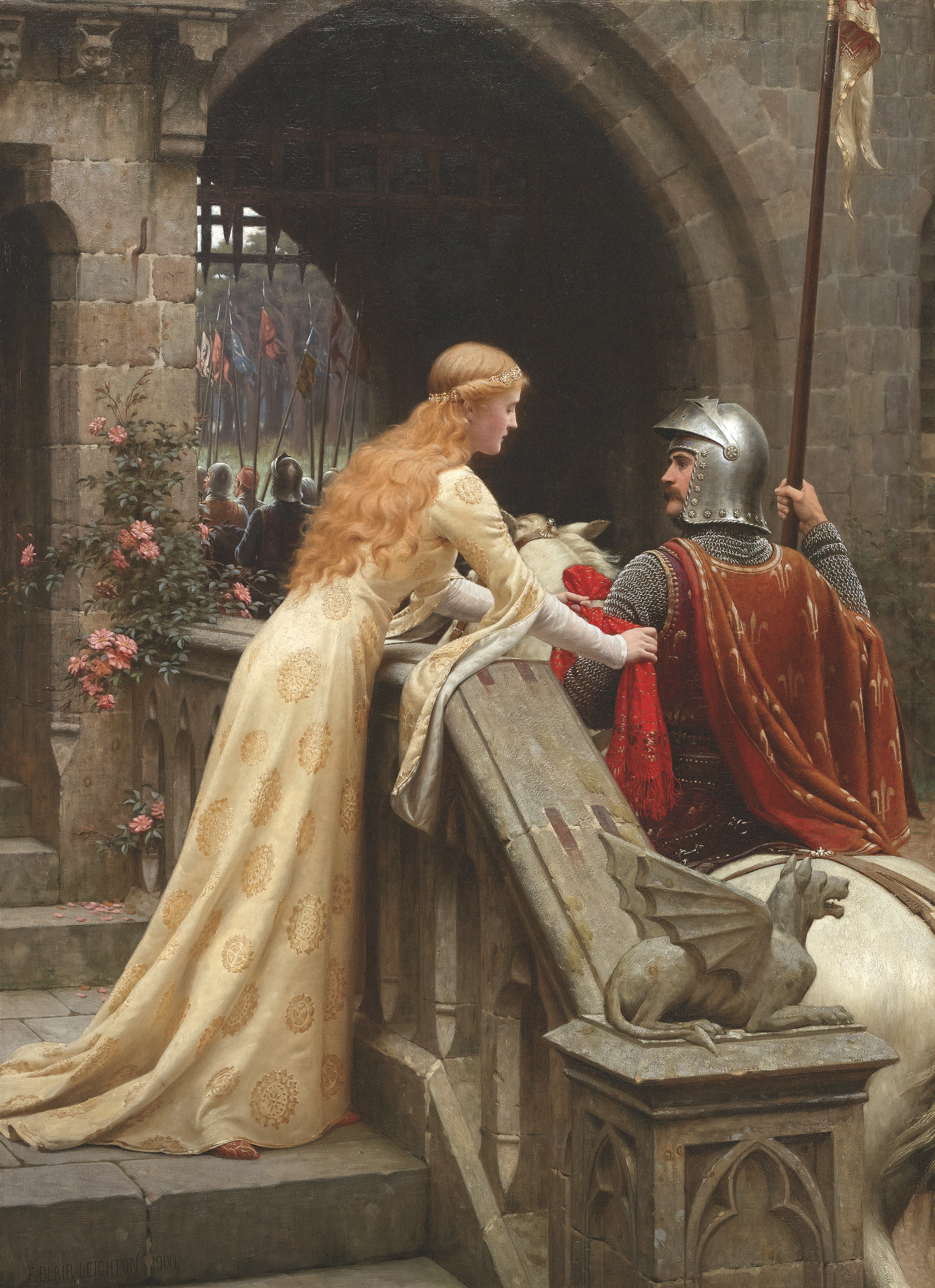
In the Age of Chivalry he became identified with courtly love. Marriage between the feudal nobility and their knights was expected to be a dynastic and business relationship meant to cement alliance, preserve or enhance wealth (estates and land) and produce children and heirs with prestigious blood lines. Romance or love between the parties of the arranged marriages was neither expected nor encouraged. For the excitement of love the noble young man or dashing knight was permitted to turn his attention to some lady of his court or some other lord and she was allowed to return his admiration. The lady might be a maiden but more frequently was the dutiful wife of another. The gentleman could woo her with poetry, dedicate his victories in battle or tournament often by carrying some token given to him by her, to perform routine acts of gallantry, defend her honor against all who would sully it, and slay any dragons that might annoy her. In return she was supposed to inspire him to greatness and demurely adore him.

Theoretically this love was pure and chaste with the lady reserving her body for the production of her husband’s heirs. In reality, of course, things were messier. Husbands often had their own courtly love interests. Sometimes everyone whistled and hummed ignoring what was plainly going on and tacitly accepting it. Other times jealousy or mere possessiveness reared its ugly head—think the nasty Arthur/Guinevere/Lancelot triangle. More than one blood feud, war, or spousal murder was the result.
Either way, bards composed ballads some of which became folk songs and others which became literary epics.
All of this happened under the apparent approving eye and protection of good ol’ St. Valentine, whoever he was. None of it, however, applied serfs, peasants, and other commoners who were supposed to be slaves of carnal desire and indiscriminate rutting barely restrained by church marriages and expected to be fertile and breed in sufficient numbers as to ensure a steady supply of field drudges and expendable levies of ground troops. Also their wives and daughters were expected to be available for the less noble urges of their overlords.
Courtly love and St. Valentine took a hit with Renaissance, Reformation, and the rise of the absolute monarchs and the nation state. Those reliable killjoys the English Puritans did their best to stamp out such nonsense as did Protestant Reformers in Germany, the Low Countries, and elsewhere in Europe. Even in the Catholic Italian states, the, you should pardon the expression, throbbing heart of Valentine veneration things got dialed down for a while.
That changed with the rise of the Romantics and Victorians. They ate up tales of courtly love and expanding on them in French poetry, Wagnerian opera, and in the insatiable appetite for Arthurian tales and Sir Walter Scott novels in England. Young girls swooned over knights in shining armor and boys dreamed of winning fair damsels by daring do.

St. Valentine’s fortunes also rose. The custom among the better classes of exchanging elaborate handmade Valentines took hold and spread to the rising middle classes who followed the lead of their betters. By the late 19th Century the development of inexpensive color lithography made commercial valentines available to the masses. It turned out shop girls and ordinary clerks could dream of romance, too.

The discovery of the commercial potential of St. Valentine’s Day and its promotion by the greeting card industry, florists, candy makers, jewelers, restaurants, and entertainment venues is a story in itself. Suffice it to say that Valentine’s Day has become a very big deal and the second biggest gift giving occasion in the United States. It has also become an emotional test both embraced and dreaded by couples and lonely singles.
What of the Saint himself? Well, he seems to have become crowded out of his feast day. In the U.S. at least hardly anyone even calls it St. Valentine’s Day anymore.
Although the Anglican Communion and Lutherans as well as some Orthodox Churches include St. Valentine’s Day in their calendars, he was dropped by the Catholic Church from the General Roman Calendar in 1969 because so little was known about him that his very existence might be called into questions. He was not, however, completely erased from the roster of Saints like other popular but probably apocryphal figures like St. Christopher and St. George the Dragon Slayer. Local Bishops have the option of keeping his Feast Day on February 14. That was a tribute to his mythic power.

It should not have been a surprise. In 1960 a St. Valentine’s Church was built to serve the athletes in the Rome Olympic Village. When the Games were over the Church became the home of a new parish in the Eternal City. It is one of the most visited churches in the city with a vibrant membership including many young adults and is frequently sought out by tourists.
Proving that you just can’t keep an old Saint down or the romance he invokes.