Showing posts with label memoir. Show all posts

Friday, November 15, 2024

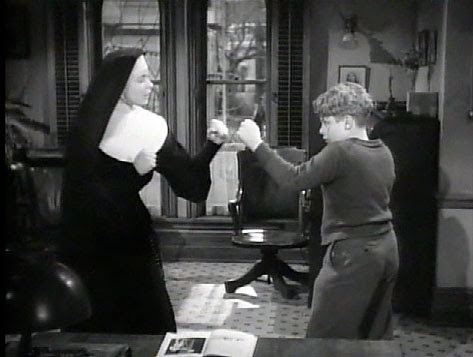
The Fight—A Murfin Cheyenne Boyhood Memoir

Back then the culture took a sometimes amused, sometimes encouraging view of children fighting.  Boys will be boys, that sort of thing, and a feeling that it would "toughen 'em up"   and that the victims of bullies could only be redeemed by standing up to their tormentors.

Note—This Cheyenne memoir originated and was adapted from a presentation at a Panel on Peace at what was then still the Congregational Unitarian Church of Woodstock on November 30, 2008 and which was first posted on the blog in this form in 2012. 

I pretty much defined the word dork. That was the preferred term, way back when, for guys who would now be called nerds.  Back in the sixth grade at Eastridge Elementary School in Cheyenne, Wyoming, I was the pasty, pudgy kid with the cowlick and thick horn-rim glasses.  A bookish kid with an irritating know-it-all attitude, I favored plaid shirts with—no kidding—pocket protectors and an assortment of leaking pens.  And I stuffed that cowlick under a grey, broad-brimmed hat pinned up on one side with an Army insignia stolen from my Dad’s World War II uniform, an homage to my personal hero, Theodore Roosevelt.  I told you I was a dork.

Then, as now, dorks have few friends.  In fact, in school, I had exactly zero friends.  I irritated just about everyone, including my teachers, mostly because I just would not shut up.  Despite being kind of a large oaf, I naturally got picked on—a lot—on the playground. Teachers, who thought I was pretty much getting what I deserved anyway, made a point of being occupied elsewhere when I was getting my face washed with gravely snow, being tied up with the girls’ jump ropes, or having my pants pulled down.

I dealt with it by reading a lot, watching old movies on TV, and indulging in a rich, rich fantasy life.  Mostly I read histories and biographies with a dose of hairy-chested fiction with historical themes, by which I mean I mostly read about war.  I watched the old John Wayne war movies on TV re-enacting my father’s war, the war of all of the neighborhood fathers.  And I, this lump of child who never could stand up the most pathetic playground bully, dreamed of being a hero, dreamed of glory.

One fine spring day it happened.  Instead of just being teased and roughed up at recess, I was called out. In the time honored way schoolboys, I was formally challenged to a fight.  The challenger was a grade up from me.  I barely knew him.  I am sure that he barely knew me.  I have no memory of what perceived offense I committed against him.  Indeed, there may have been none at all.  He may have just needed to notch up a cheap and easy victory to establish himself in the school pecking order.  I was a big kid, but he was bigger—a full head taller and maybe twenty pounds heavier.

The usual procedure was to meet out by the dumpsters behind the school for the fight.  I told the kid I wouldn’t meet him.  I didn’t have any reason to fight him.  He taunted me and we were soon surrounded by a knot of others, all jeering.  “Fine,” I said at last, “I’m not looking for a fight.  But I cut across the football field every night on my way home.  You can find me if you want.”

It was a fine, bright, sunny afternoon cold enough for heavy coats and breath that hung in visible clouds.  Time moved like molasses as I crossed the wide school yard, the gravel parking lot, the cinder track.  I carried my books in my dad’s old briefcase in one gloved hand, and my lunch box in the other.  Ahead a dozen or so eager spectators gathered on the gridiron in anticipation of a fine beating.  The kid stood apart, arms folded waiting my slow approach.

My heart boomed in my hollow chest, my stomach knotted, my breathing labored.  I had never in my entire life known such abject terror.  I walked directly up to my doom.  “Ya gonna fight?” he asked.

“No,” I said and tried to move around him.  His fist caught me by the side of the head before I ever saw it.  My glasses and hat etched different arcs in the air as I stumbled and crumpled ripping a hole in the knee of my jeans.  I was stunned, but oddly felt no pain.  I could hear the cheering and yelling as if it came from far, far away.  I groped for my glasses, hat, brief case and lunch box and rose unsteadily. 

“Now,” the kid demanded.  “No,” I said and tried to move forward.  This time I saw the fist coming, square at my face.  I could feel my lip split and the metallic taste of blood seep between my teeth and bathe my tongue.  I stumbled backwards but kept my feet somehow.  “Fight! Fight! Fight!” little mob chanted.

I clutched my bag and box tighter and pushed forward one more time.  This time he hit me in the stomach, the weak spot of any fat kid.  He hit me so hard that I turned a forward somersault in the air landing with a crashing thud on my back, all the wind knocked out of me.  I lay stunned and gasping for a moment.  The crowd grew quiet.  The kid pushed at me with the toe of his boot, not kicking but just kind of nudging my body.  I rose very slowly and gathered my things.  I began walking again.  Nobody stopped me.   Nobody said a word.

By the time I walked the half mile or so home, I was strangely exhilarated, almost euphoric.  I had not fought.  They could not make me fight.  But I had not given in.  I kept getting back up.  I imagined—foolishly as it turned out—that my bravery and determination had somehow won the grudging respect of the kid and crowd.  It turned out, they all just thought I was crazy and the legend of my dorkiness only grew.  But for that one afternoon, I imagined something like glory.

My mother, of course, was horrified and was ready to march back to school to demand punishment of my tormentors until I literally threw myself in the door to prevent it.  I didn’t try to tell her what happened.  She would not have understood it.  When my Dad came home from work, I did tell him, blurting it all out with excitement and even pride.  He tried to understand and to be supportive, but I could tell that he would much rather that I just “stood up and fought back.”  For him, there was greater honor in taking a licking in a fair fight than refraining from being goaded into one.

And I knew, when I thought about it lying in bed alone that night, that my hero Teddy Roosevelt, a fat, four-eyed, asthmatic outcast, would not have approved either.  He would have—as he did—studied boxing for months and come back and given the miscreant the thrashing he so richly deserved.  I knew I was supposed to be a failure.  But still didn’t feel like one.

Where had this strange thing come from, this oddly prideful, totally unexpected pacifism?

Maybe I needed a nun to teach me to stand up to bullies and fight like a Christian.

Maybe I had just taken too literally to heart the Sunday School lessons about the Gentle Jesus in all of his brightly colored, lithographed glory in my weekly study tracts.  Had I actually taken to heart the Master’s words—I tell you, do not resist him who is evil; but whoever strikes you on your right cheek, turn to him the other also—spelled out in bright red letters in my very own King James Version of the Bible?

Of course, as a good Christian boy, I knew that whatever good I might have done following the great preaching, I had washed away in my sinful pride.  There were, after all, so many ways to be unworthy.

And could this one commandment overturn a lifetime of playing Davey Crockett, Hopalong Cassidy, Teddy Roosevelt himself, and gallant GIs storming bloody beaches and imagining over and over the accolades and honors due a fighting hero?  It seemed doubtful.

Time went by.  I never stopped being the star of the violent movies that played in my head.  But I never fought.  And I never ceased to be a dork. 

By the mid-Sixties, I was becoming aware of a new kind of hero, brought to me in grainy black and white by Chet Huntley, David Brinkley, and Walter Cronkite—Martin Luther King and the marchers and protestors who stood up to dogs, batons, and fire hoses, singing hymns, turning cheeks, and changing the world by just getting back up and walking again.

Later, when the time came, I chose peace over war.  I resisted the Vietnam draft.  I did my stint in prison.  And I was as unfoundedly prideful over that as I had been on a cold and sunny football field more than a decade earlier.


Wednesday, November 16, 2022

The Fight—A Murfin Memoir of a Cheyenne Boyhood

Back then the culture took a sometimes amused, sometimes encouraging view of children fighting.  Boys will be boys, that sort of thing, and a feeling that it would "toughen 'em up"   and that the victims of bullies could only be redeemed by standing up to their tormentors.

Note—This Cheyenne memoir peace originated and was adapted from a presentation at a Panel on Peace at what was then still the Congregational Unitarian Church of Woodstock on November 30, 2008 and which was first posted on the blog in this form in 2012. 

I pretty much defined the word dork. That was the preferred term, way back when, for guys who would now be called nerds.  Back in the sixth grade at Eastridge Elementary School in Cheyenne, Wyoming, I was the pasty, pudgy kid with the cowlick and thick horn-rim glasses.  A bookish kid with an irritating know-it-all attitude, I favored plaid shirts with—no kidding—pocket protectors and an assortment of leaking pens.  And I stuffed that cowlick under a grey, broad-brimmed hat pinned up on one side with an Army insignia stolen from my Dad’s World War II uniform, an homage to my personal hero, Theodore Roosevelt.  I told you I was a dork.

Then, as now, dorks have few friends.  In fact, in school, I had exactly zero friends.  I irritated just about everyone, including my teachers, mostly because I just would not shut up.  Despite being kind of a large oaf, I naturally got picked on—a lot—on the playground. Teachers, who thought I was pretty much getting what I deserved anyway, made a point of being occupied elsewhere when I was getting my face washed with gravely snow, being tied up with the girls’ jump ropes, or having my pants pulled down.

I dealt with it by reading a lot, watching old movies on TV, and indulging in a rich, rich fantasy life.  Mostly I read histories and biographies with a dose of hairy-chested fiction with historical themes, by which I mean I mostly read about war.  I watched the old John Wayne war movies on TV re-enacting my father’s war, the war of all of the neighborhood fathers.  And I, this lump of child who never could stand up the most pathetic playground bully, dreamed of being a hero, dreamed of glory.

One fine spring day it happened.  Instead of just being teased and roughed up at recess, I was called out. In the time honored way schoolboys, I was formally challenged to a fight.  The challenger was a grade up from me.  I barely knew him.  I am sure that he barely knew me.  I have no memory of what perceived offense I committed against him.  Indeed, there may have been none at all.  He may have just needed to notch up a cheap and easy victory to establish himself in the school pecking order.  I was a big kid, but he was bigger—a full head taller and maybe twenty pounds heavier.

The usual procedure was to meet out by the dumpsters behind the school for the fight.  I told the kid I wouldn’t meet him.  I didn’t have any reason to fight him.  He taunted me and we were soon surrounded by a knot of others, all jeering.  “Fine,” I said at last, “I’m not looking for a fight.  But I cut across the football field every night on my way home.  You can find me if you want.”

It was a fine, bright, sunny afternoon cold enough for heavy coats and breath that hung in visible clouds.  Time moved like molasses as I crossed the wide school yard, the gravel parking lot, the cinder track.  I carried my books in my dad’s old briefcase in one gloved hand, and my lunch box in the other.  Ahead a dozen or so eager spectators gathered on the gridiron in anticipation of a fine beating.  The kid stood apart, arms folded waiting my slow approach.

My heart boomed in my hollow chest, my stomach knotted, my breathing labored.  I had never in my entire life known such abject terror.  I walked directly up to my doom.  “Ya gonna fight?” he asked.

“No,” I said and tried to move around him.  His fist caught me by the side of the head before I ever saw it.  My glasses and hat etched different arcs in the air as I stumbled and crumpled ripping a hole in the knee of my jeans.  I was stunned, but oddly felt no pain.  I could hear the cheering and yelling as if it came from far, far away.  I groped for my glasses, hat, brief case and lunch box and rose unsteadily. 

“Now,” the kid demanded.  “No,” I said and tried to move forward.  This time I saw the fist coming, square at my face.  I could feel my lip split and the metallic taste of blood seep between my teeth and bathe my tongue.  I stumbled backwards but kept my feet somehow.  “Fight! Fight! Fight!” little mob chanted.

I clutched my bag and box tighter and pushed forward one more time.  This time he hit me in the stomach, the weak spot of any fat kid.  He hit me so hard that I turned a forward somersault in the air landing with a crashing thud on my back, all the wind knocked out of me.  I lay stunned and gasping for a moment.  The crowd grew quiet.  The kid pushed at me with the toe of his boot, not kicking but just kind of nudging my body.  I rose very slowly and gathered my things.  I began walking again.  Nobody stopped me.   Nobody said a word.

By the time I walked the half mile or so home, I was strangely exhilarated, almost euphoric.  I had not fought.  They could not make me fight.  But I had not given in.  I kept getting back up.  I imagined—foolishly as it turned out—that my bravery and determination had somehow won the grudging respect of the kid and crowd.  It turned out, they all just thought I was crazy and the legend of my dorkiness only grew.  But for that one afternoon, I imagined something like glory.

My mother, of course, was horrified and was ready to march back to school to demand punishment of my tormentors until I literally threw myself in the door to prevent it.  I didn’t try to tell her what happened.  She would not have understood it.  When my Dad came home from work, I did tell him, blurting it all out with excitement and even pride.  He tried to understand and to be supportive, but I could tell that he would much rather that I just “stood up and fought back.”  For him, there was greater honor in taking a licking in a fair fight than refraining from being goaded into one.

And I knew, when I thought about it lying in bed alone that night, that my hero Teddy Roosevelt, a fat, four-eyed, asthmatic outcast, would not have approved either.  He would have—as he did—studied boxing for months and come back and given the miscreant the thrashing he so richly deserved.  I knew I was supposed to be a failure.  But still didn’t feel like one.

Where had this strange thing come from, this oddly prideful, totally unexpected pacifism?

Maybe I needed a nun to teach me to stand up to bullies and fight like a Christian.

Maybe I had just taken too literally to heart the Sunday School lessons about the Gentle Jesus in all of his brightly colored, lithographed glory in my weekly study tracts.  Had I actually taken to heart the Master’s words—I tell you, do not resist him who is evil; but whoever strikes you on your right cheek, turn to him the other also—spelled out in bright red letters in my very own King James Version of the Bible?

Of course, as a good Christian boy, I knew that whatever good I might have done following the great preaching, I had washed away in my sinful pride.  There were, after all, so many ways to be unworthy.

And could this one commandment overturn a lifetime of playing Davey Crockett, Hopalong Cassidy, Teddy Roosevelt himself, and gallant GIs storming bloody beaches and imagining over and over the accolades and honors due a fighting hero?  It seemed doubtful.

Time went by.  I never stopped being the star of the violent movies that played in my head.  But I never fought.  And I never ceased to be a dork. 

By the mid-Sixties, I was becoming aware of a new kind of hero, brought to me in grainy black and white by Chet Huntley, David Brinkley, and Walter Cronkite—Martin Luther King and the marchers and protestors who stood up to dogs, batons, and fire hoses, singing hymns, turning cheeks, and changing the world by just getting back up and walking again.

Later, when the time came, I chose peace over war.  I resisted the Vietnam draft.  I did my stint in prison.  And I was as unfoundedly prideful over that as I had been on a cold and sunny football field more than a decade earlier. 

Sunday, June 27, 2021

Cringe Worthy Murfin Verse Juvenalia Unearthed

The pseudo-hippie cover of  the 1967 Apotheosis, the student literary magazine of Niles Township West Highschool in Skokie, Illinois.

A few years ago, I unearthed the 1967 issue of Apotheosis, the grandiosely named student literary magazine of Niles West High School in Skokie, Illinois.  I was significantly over-represented with prose short-short stories which were ever-so-earnestly written.  But the little magazine was also littered with my juvenile poetry. 

Ouch!  The poems were generally as excruciating as you would image.  There were three short pieces inspired by my exposure that year to e. e. cummings and Lawrence Ferlinghetti—my stab at off-beat bohemianism

With my late twin brother Tim (on top) a decked out for Cheyenne Frontier Days the summer before 1st Grade.

Today I am inflicting on you the longest piece of all, which occupied a whole page in two columns all by itself.  It was a memoir piece which evoked the playground of Churchill Elementary School in Cheyenne, Wyoming circa 1955 when I was six years old and in first grade.  The memories were like random snapshots found years later in a shoe box buried in a corner of the basementfragmented and without context, the subjects at best hazily recalled. 

Those memories may have been sharper to the 17 year old who wrote them than to the 72-year-old rereading them today.


The piece would have been better off as a prose memoir, but I was determined, for some reason to hammer it into a poem.  That reason might have been Dylan Thomass memory poems, although my work lacked all his lyricism.  I used a clunky devise of variations on the opening lines of each stanza.

A couple of notes of explanation are required.  First, the long blue busses described were Air Force vehicles delivering the children of personnel from Frances E. Warren Air Force Base to the school.  There were no yellow school busses because the rest of us lived close enough to the old school building to walk.

The Black girl was, I believe looking back on it, Haitian.  Just how she ever got to Cheyenne is anyone’s guess.  It must have been a terribly hard experience for her.  I am sure gaping dolts like me didn’t make it any easier.  She was the first Black person I ever saw.  One day I pretended to lose something in the gravel by the high slide so I could get down on my hands and knees and crawl over to where she was standing to stare close-up to the black skin of her thin legs above her white socks.

It must have been a horrible and humiliating experience for her.  Made worse by the fact that I never once, for all my curiosity spoke to her the entire year. 

Innocence, in retrospect, was not all that innocent at all.


What I Remember of Play


I remember-

Straw yellow sunlight

Filtered through trees

That seemed so big

God must have been at their tops, 

Looking down on

Me as I played on the gravel  

And sat in their roots to rest.


And I remember­

The suntan brick

Of the school building

Always looking dusty,

Even after rain washed it.

The high, wide windows

Looked down on the

Playground below. 


This I remember­

Only her hair, 

Only her plain brown hair

Pulled back in a bun

With a smell that

Excited my nose.

She was but six

And I was but five

As we sat in the Roots together.


And this to remember­

Boys abreast up in a line

Then charging, shouting

At the top of our lungs, 

“Kill the Japs,  

Kill the Nazis,

We’ll win!”

And the little toy flag

That fell in the dirt

            and was solemnly burned.


           This is remembered-

Rosa had dark brown skin

And fine, windblown hair,

But her dress was thin

And its colors faded.

She never spoke but

Always looked through

Frightened, dark eyes.


I remember this-

Long blue busses

Coming every morning,

Leaving every night.

Friends getting on with the

Driver In green uniform

And stiff cap, And me always

Staying behind


This to remember­

Billy was smaller by far

Than the rest of the boys who

Played in the yard.

But it was Billy

Who led us in games 

and shouted the loudest at play.


And I remember this­

The bean tree stood

In the corner of the yard.

And in the fall the boys

Would fight to see

Who could get the most

Of the long black, stiff beans.


And this is remembered­

From the top of the slide

I could look down at the sun

Shining off its slick face 

And how tall I felt

Looming down

On my friends in

 the school yard far below.


I can remember­

The little girl in

The frilly pink dress

Whose language I did not know, 

And did not care to know,

for she was Black 

And I did not

Know why she was Black.


But most I remember-

A dream that never was,

Shaded by trees from

The straw yellow sunlight,

I got on the blue bus

And the girl with her hair tied up in a bun

Said, “Goodbye,

Take good care of him.”

As the bus pulled away

I knew that I

Would never return

To the play yard,

And that was the 

End of my youth.


—Pat Murfin ‘67